By: Barbara Sherwood and Julianne Mason, Forest Preserve District of Will County, IL
Key Takeaways
- A late-August prescribed fire killed all mature sericea lespedeza (Lespedeza cuneata) plants where the fire burned with at least moderate intensity.
- Herbiciding the base of sericea plants with a mixture of Triclopyr 4 herbicide in bark oil during early September killed 100% of treated mature plants while causing minimal collateral damage to neighboring native forbs.
- One year after treatment, seedlings were present near previously occupied sericea locations, indicating that follow-up monitoring and treatment will be necessary to exhaust the soil seed bank.
Background
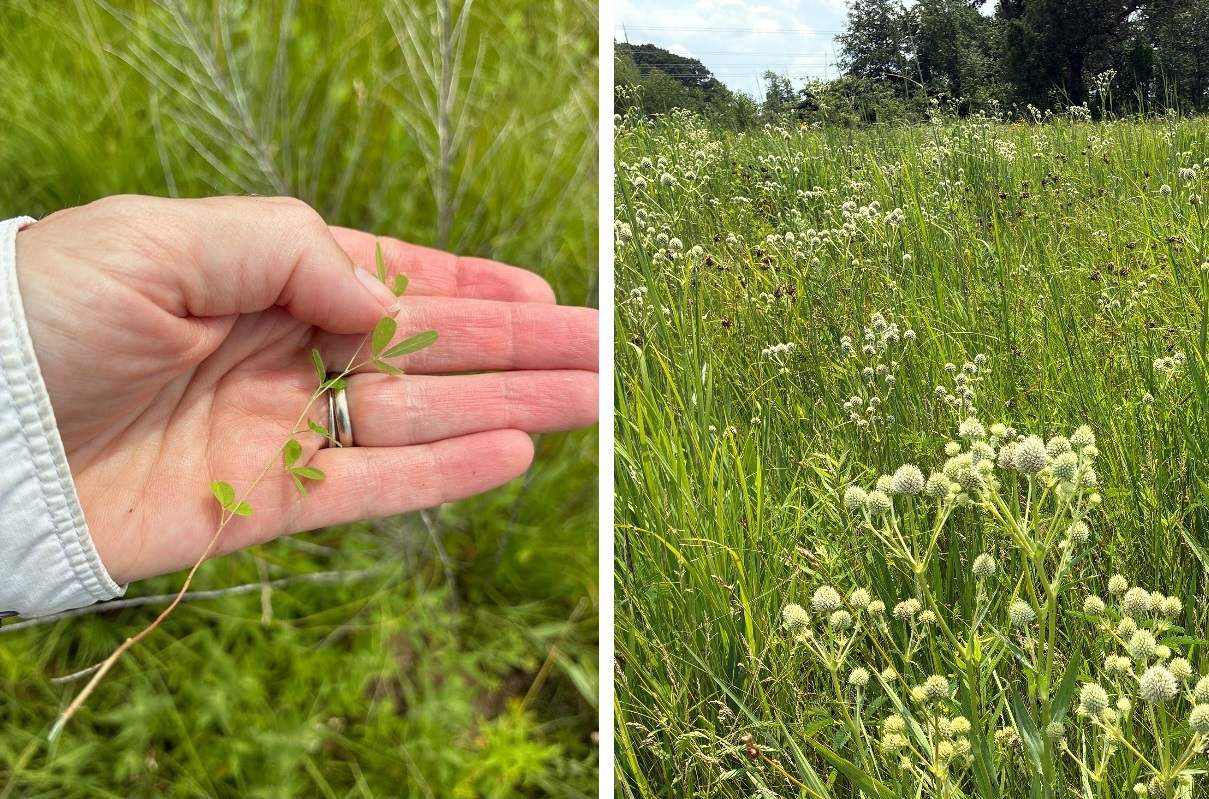
At one of our prairie preserves near Braidwood, Illinois, we have incorporated late-August prescribed burns into a rotating program of primarily dormant season burns. The summer burn timing is intended to benefit the Rattlesnake Master Borer Moth (Papaipema eryngii), an endangered insect in Illinois. By late August, the larvae have tunneled belowground into the roots of rattlesnake master (Eryngium yuccifolium), where they are protected from fire. In contrast, dormant-season burns may consume eggs that have been deposited in the duff layer. This vulnerability is shared by many prairie insects, both common and rare, reinforcing the importance of burning only portions of a site in any given year and rotating burn units over time.
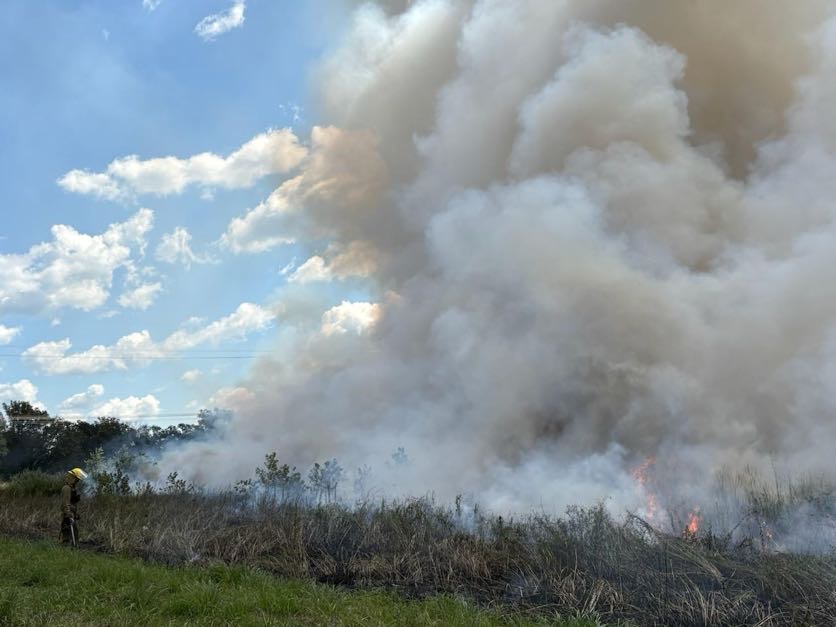
Growing-season burns also have potential ecological drawbacks. Consequently, we limit these burns to areas where rare reptiles and amphibians are absent and burn relatively small units, minimizing the risk of direct mortality to species that may be active aboveground during the growing season.
Although an interesting topic, the potential benefits and drawbacks of growing season burns isn’t the point of this article. After the growing season burn last year on August 26, 2025, our crew did a post-burn basal bark treatment to unwanted woodies in the burn unit. This is a highly effective management technique which we strongly endorse – see here – but it’s also not the point of this article.
Treatment Methods
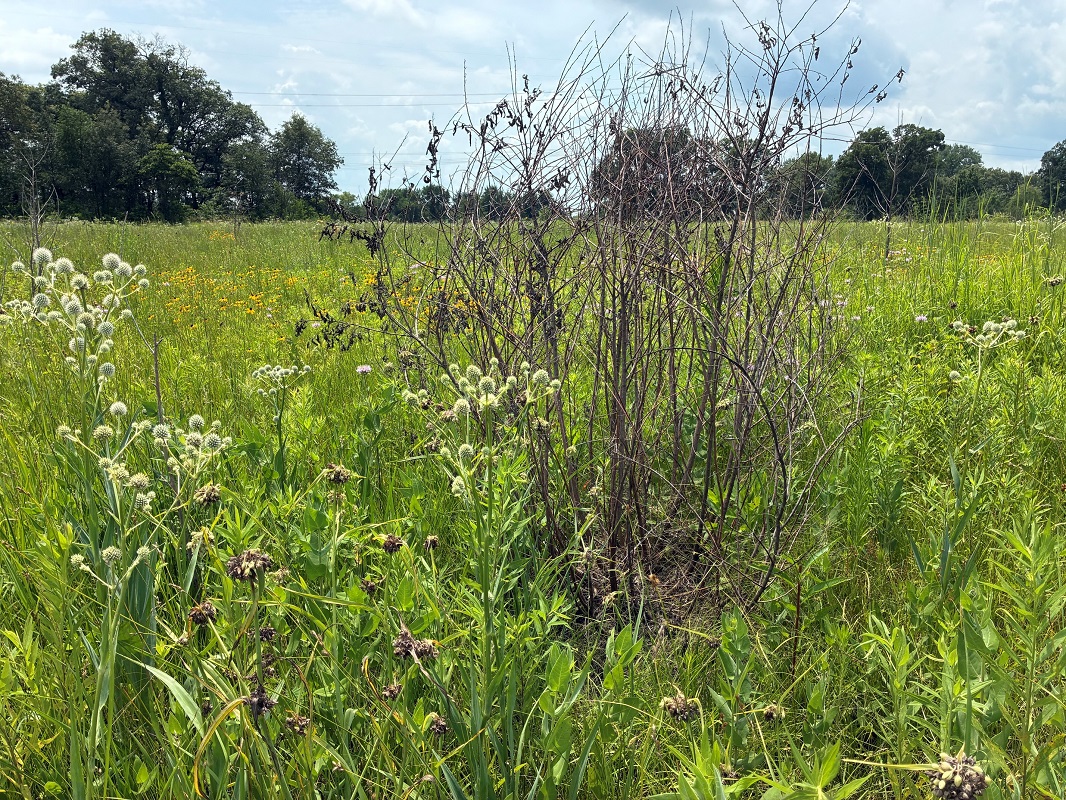
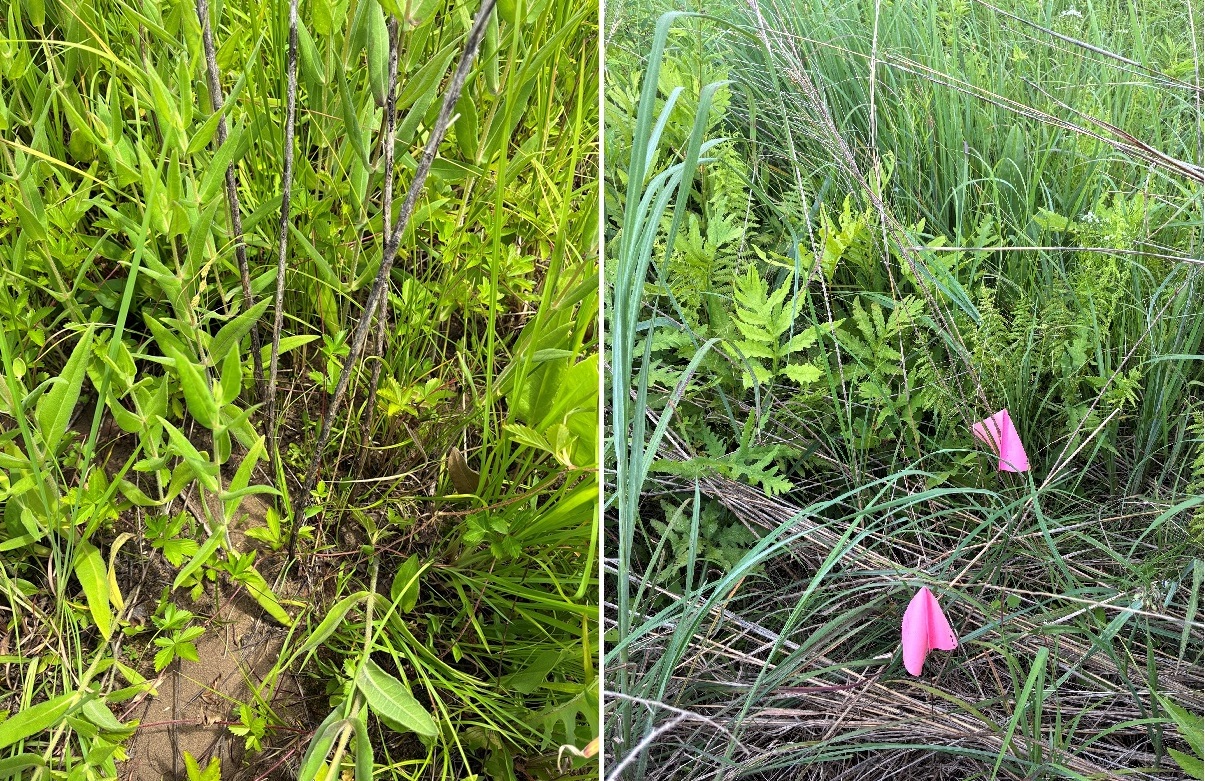
Now we’re coming to the point of this article. The unit burned in August 2025 is a 10-year old prairie restoration that has scattered sericea lespedeza (Lespedeza cuneata), a highly invasive perennial legume. While the crew was doing the post-burn herbicide treatment to woodies on September 2, 2025, they also “basal barked” or base sprayed several dozen mature sericea plants. This involved using a backpack sprayer to treat the base of the sericea plants with 15% Triclopyr 4 herbicide mixed in bark oil. The lower two inches or so of the sericea were sprayed, both front side and back side, with the herbicide mixture. At the time of treatment, the sericea plants were just starting to flower.
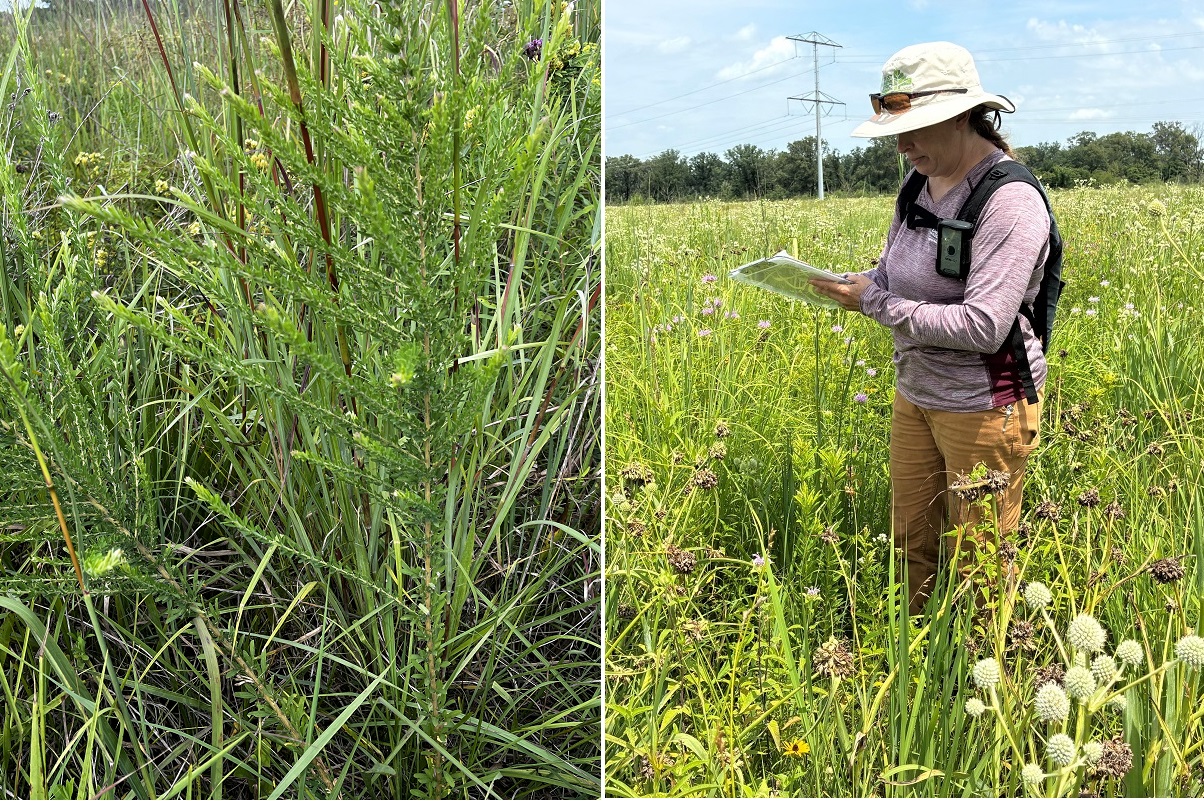
To evaluate treatment effectiveness, pin flags and GPS coordinates were used to mark about a dozen individuals in three treatment groups:
1) Sericea plants that received the prescribed burn only.
2) Sericea plants that received the prescribed burn followed by base spray herbicide treatment.
3) Sericea plants in an adjacent unburned area that received base spray herbicide treatment only.
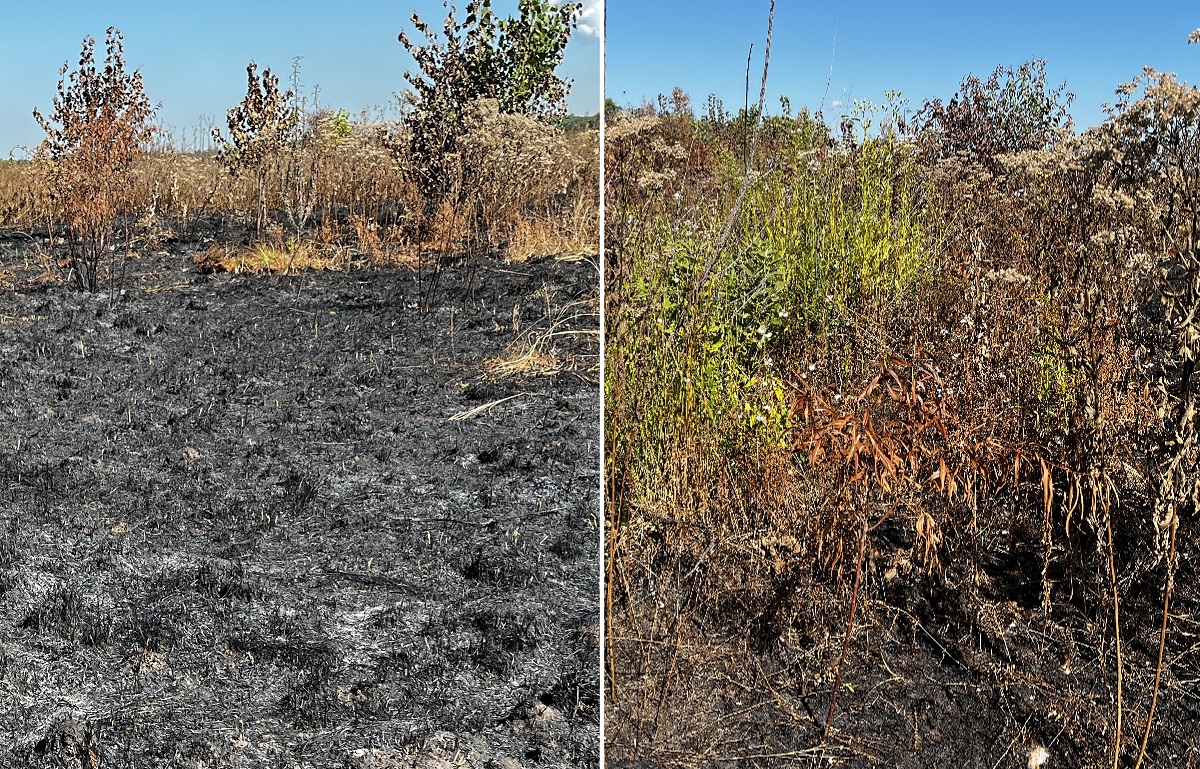
Fire intensity varied across the burn unit. Many sericea stems remained standing following the burn, exhibiting varying degrees of scorching from light to moderate. For each marked plant, the degree of scorching and whether green tissue remained one week after the fire were recorded.
Results
One year after treatment, all plants that had received the base spray herbicide application were dead, regardless of whether they occurred in burned or unburned portions of the site. This represents 100% mortality among the treated plants. An additional benefit of the base spray technique was the confined amount of overspray. Damage to adjacent native forbs was minimal and substantially less than would typically be expected from a foliar application of either triclopyr ester (T4) or triclopyr amine (3A).

Prescribed fire alone also proved highly effective. Every mature sericea lespedeza plant exposed to at least moderate scorching was dead one year after the burn. The single surviving plant experienced only very light scorching and retained green foliage one week after the burn.
In a previous Grassland Restoration Network post, Jeff Horn (Illinois Department of Natural Resources) documented sericea lespedeza treatments that included summer prescribed burning. At his site, some sericea plants resprouted following fire. However, because summer burns can be patchy and vary considerably in intensity, tracking individual plants can help establish the relationship between burn coverage, fire intensity, and plant mortality.
At our site, all tracked sericea plants that experienced at least moderate scorching were dead at the one-year evaluation. These results suggest that where summer fire achieves moderate or greater intensity at the plant level, it can provide substantial control of mature sericea lespedeza. However, these observations are based on a single burn at one site and should be interpreted accordingly, as noted in the disclaimer at the end of this article. It will be valuable to determine whether these results are consistent across multiple sites and years, particularly under varying weather and fire conditions.
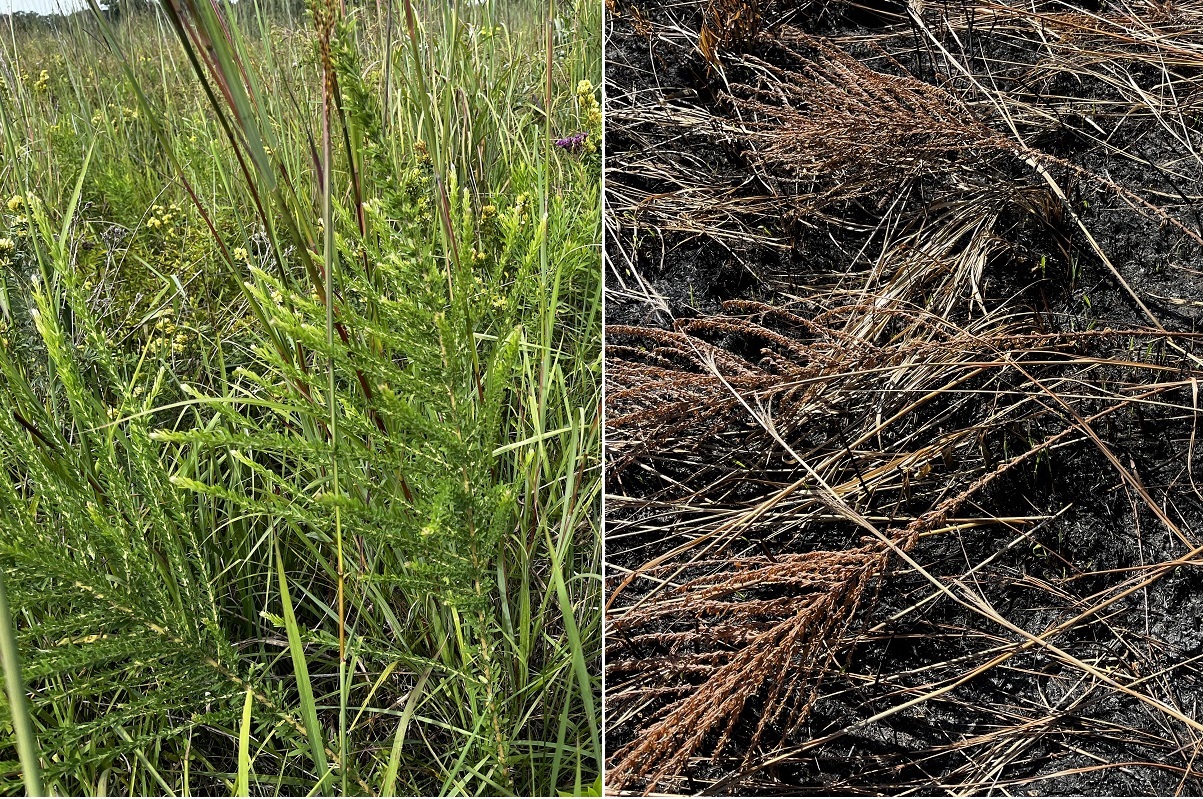
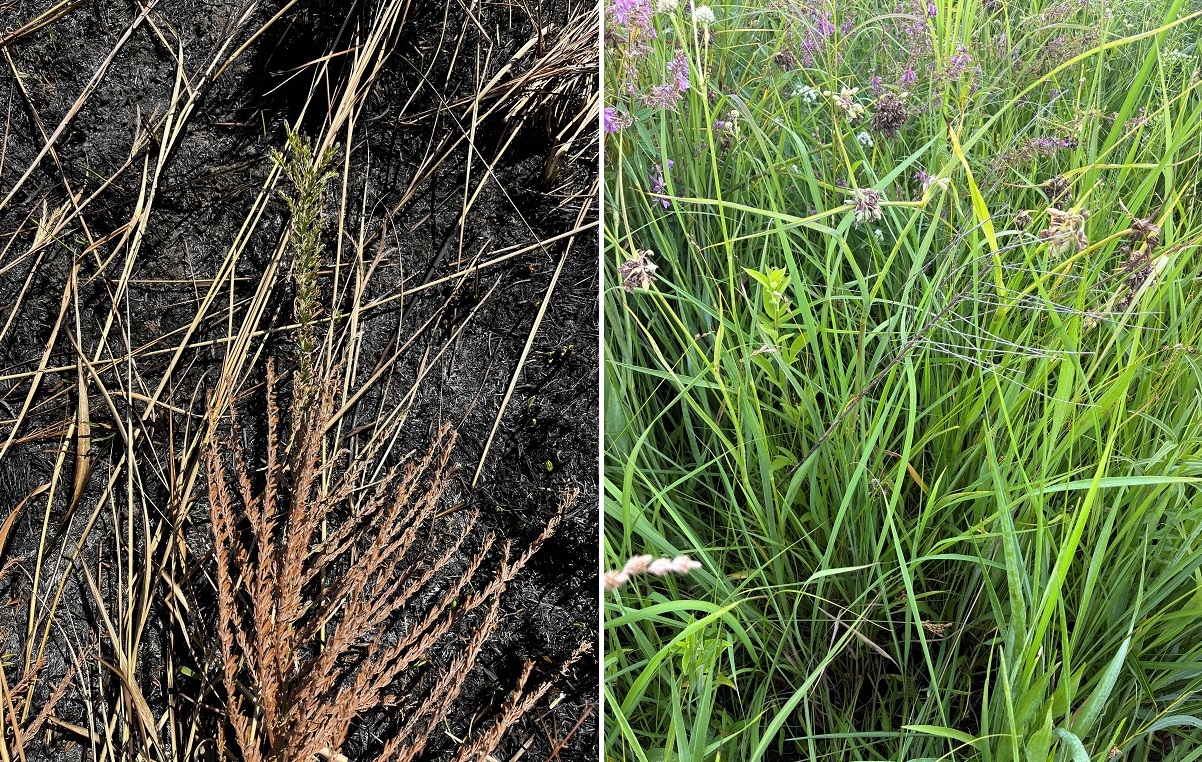
One year after the treatments, numerous small legume seedlings were present around many of the locations formerly occupied by mature sericea plants. Although these seedlings may be sericea, some may be sweet clover or native legumes and follow-up monitoring will be needed to verify species identifications.
Management Implications
It will take continued monitoring and treatments to the next generation sericea plants to deplete the seedbank and reduce the invasive sericea population. In the ongoing effort to control this invasive perennial, it’s helpful to know that both late-summer burning and base spraying with triclopyr 4 herbicide in bark oil are effective treatments. We intend to alternate these treatment methods on an annual basis as we continue to address the sericea at this preserve.
Disclaimer: This was an impromptu field study, not a formal experiment. Sample sizes were small and not replicated across multiple sites. However, by marking treated individuals and tracking their fate, we can get useful information on treatment effectiveness. Our collective understanding is strengthened when we monitor diligently and share observations and results from across our various sites. Even informal field observations can contribute valuable information when considered alongside results from other practitioners and locations.


Great work as always. I basal barked sericea last month using 10% triclopyr. The plants appear dead. I’ll check next year. I suspect we could go lower. This study on thin-barked trees found high mortality even at 2.5%. https://extension.psu.edu/using-basal-bark-herbicide-applications-to-control-understory-tree-species. Basal bark oil-water emulsion?
Another experiment is MSM during mid-late flowering. There is evidence of selectivity late in the year when many grassland forbs are no longer actively growing. But how late can we spray and still prevent seed production? I have found that the only evidence of the MSM even working the year of application is the flowers abort. When the flowers first start to senesce is this too late?
Hi Booker, I agree that a much lower concentration of triclopyr ester would probably work for the “basal bark” treatment of sericea. We used 15% triclopyr because we did the treatment at the same time as we were basal barking woodies and that’s what was in our packs. We quite possibly used an oil-water emulsion for the treatment in this study (15% triclopyr/ 15% bark oil/ 70% water), which we often do when basal barking woodies, but we didn’t make note of it so I don’t know for sure if we used an emulsion or straight bark oil for the carrier. Based on a previous study, oil-water emulsion applications for basal bark treatments work well, and I would assume that it would work just fine for sericea too.
We haven’t used MSM on sericea. If you test it out, please write it up and share your results!
Hi Julie – Great Post. This is anecdotal, but I did a late growing season burn on my property in east-central Missouri on September 4th 2016 in a 20+ year old prairie planting with known patches of Sericea. The fire burned hot and thoroughly (for a growing season burn). I did not mark plants to have any estimate of resprout percentage, but I had many resprouts of mature plants. My main memories are that the late-growing season burn made it easy to find and treat the resprouts of mature Sericea, which bolted and resprouted faster than most other species, making the lush clumps of Sericea resprouts very easy to spot. They were like big fluffy chia pets sticking above the surrounding slower regrowth of other species. I also recall that there was a flush of seedling germination, and that it was easy to find and treat the seedlings against the backdrop of blackened earth. That I had such a flush of germination suggests that there was ample soil moisture at the time. So, it’s plausible that the mortality induced by late-growing season fire is dependent upon soil moisture (andor other factors) at the time of the burn. My apologies for posting so late after the initial post! – Quinn
Interesting work, thanks for sharing! There is research out of Kansas on rangelands that demonstrate some positive results similar to your findings: This first one showed significant control of sericea with 4 years of consecutive summer burns with fire alone: https://journals.newprairiepress.org/kaesrr/article/11379/galley/11269/download/
These others generally show other similar positive results related to control and greater diversity:
Effects of Growing-Season Prescribed Burning on Vigor of Sericea Lespedeza in the Kansas Flint Hills: I. Suppression of Seed Lespedeza in the Kansas Flint Hills: I. Suppression of Seed Production and Canopy Dominance Production and Canopy Dominance https://journals.newprairiepress.org/kaesrr/article/6403/galley/6346/download/
Effects of Growing-Season Prescribed Burning on Vigor of Sericea Lespedeza in the Kansas Flint Hills: II. Plant-Species Composition https://journals.newprairiepress.org/kaesrr/article/6382/galley/6326/download/
Effects of prescribed fire timing on vigor of the invasive forb sericea lespedeza (Lespedeza cuneata), total forage biomass accumulation, plant-community composition, and native fauna on tallgrass prairie in the Kansas Flint Hills https://pmc.ncbi.nlm.nih.gov/articles/PMC8223592/pdf/txab079.pdf
Powerpoints of some of the same research:
https://ksfgc.org/wp-content/uploads/2018/12/2018-Tachman-Olson-Presentation.pdf
https://www.frontierdistrict.k-state.edu/docs/J.%20Lemmon%20Prescribed%20Burning%20Effects%20on%20SL%20and%20OWB.%203.18.2025%201.pdf
Thanks for sharing links to these excellent studies!