By:
Every summer, Nachusa’s field crew spends long days walking through prairie vegetation searching for birdsfoot trefoil.

At first glance, it sounds simple enough. Find the plant. Spray the plant. Move on.
But birdsfoot trefoil rarely cooperates.
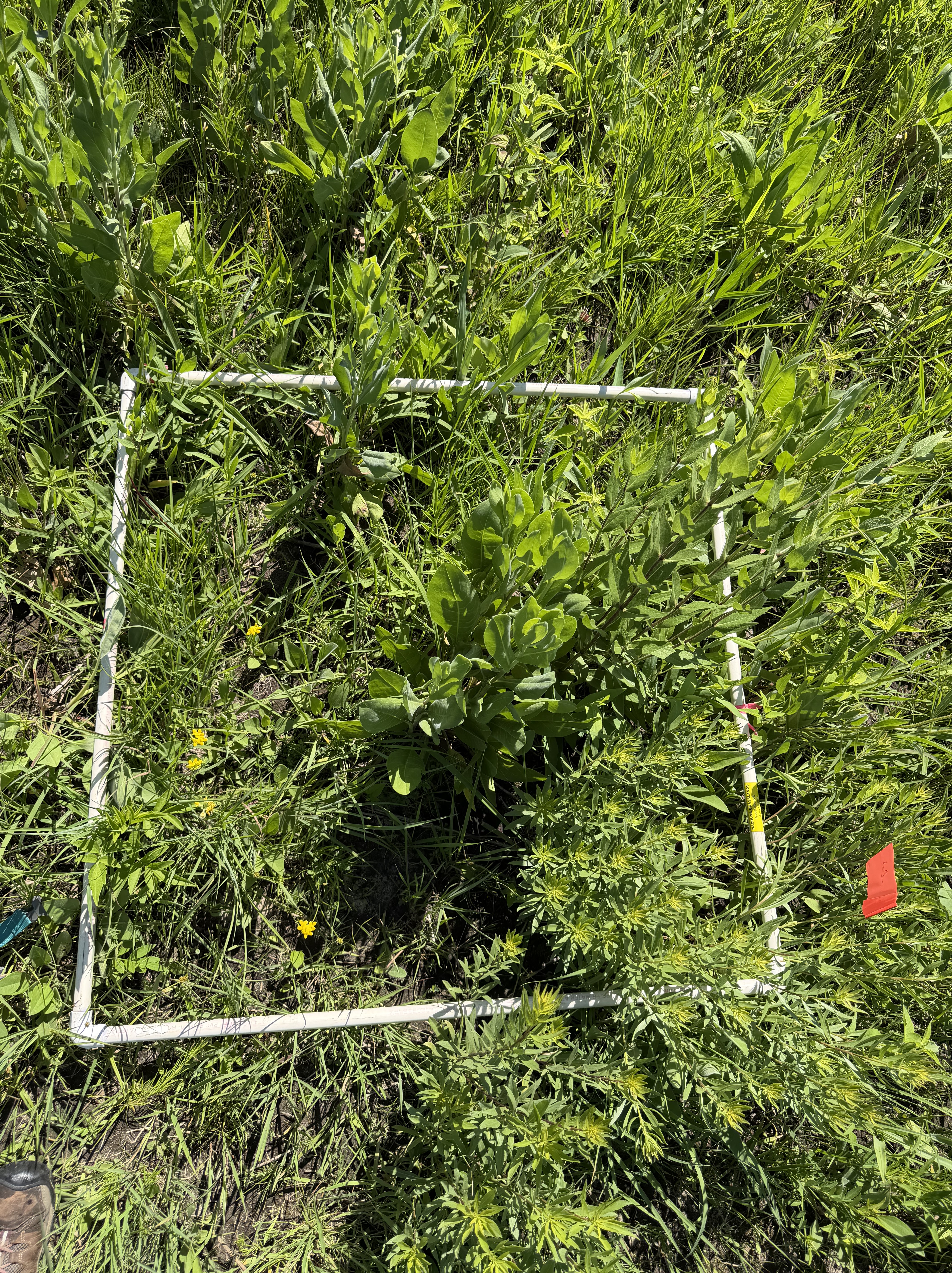
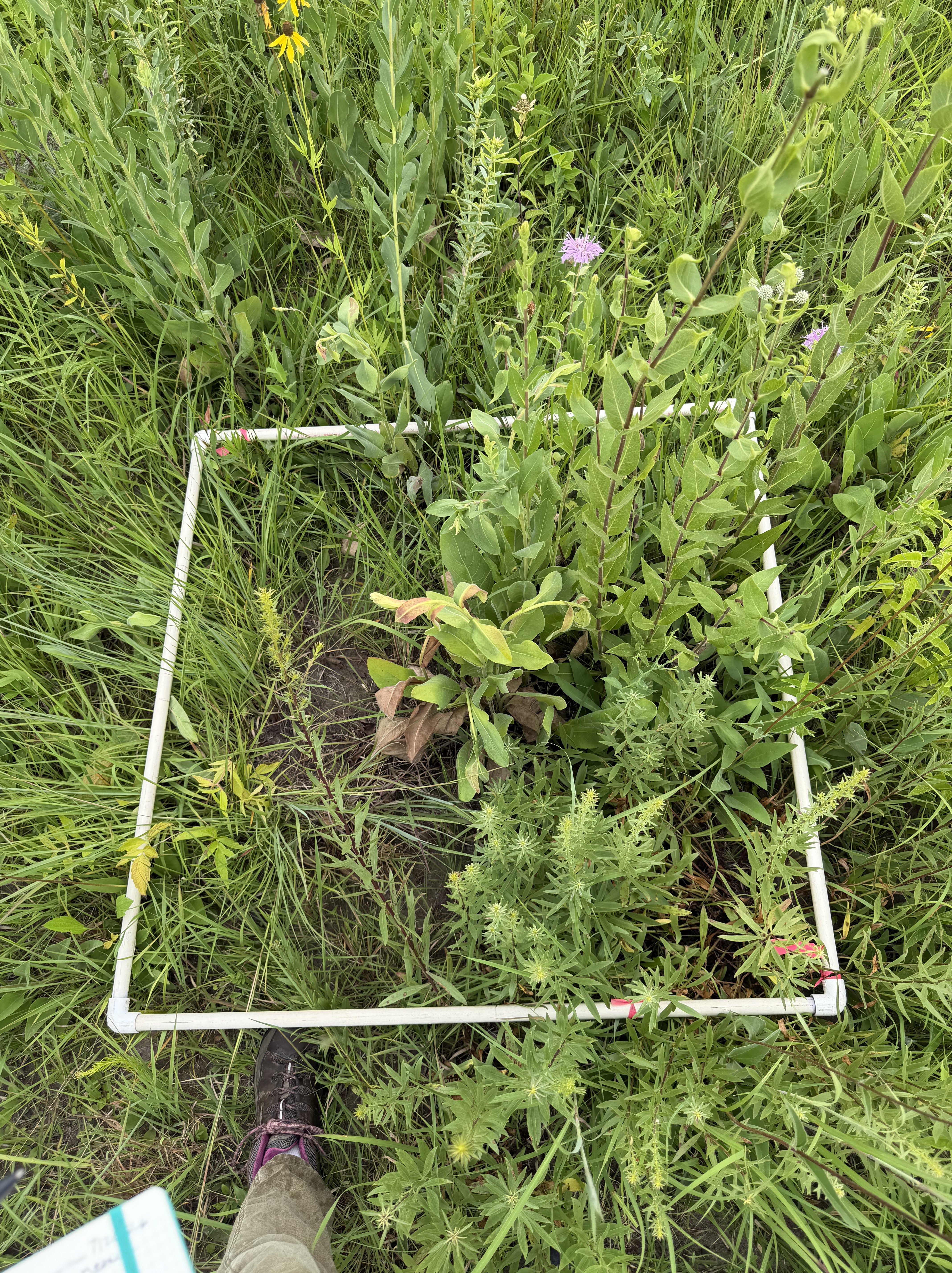
Some plants flower early. Others wait until weeks later. Bright yellow blooms that seem impossible to miss during one visit may not have emerged yet during the first sweep. Meanwhile, vegetative plants hide among grasses and native wildflowers, blending into the surrounding prairie.
As Crew Lead Katie Jo explained:

“[Birdsfoot trefoil] starts [as a] non-flowering, very small indescript plant. When you know it, you know it, but it can be short, it can be tall, it can be as big as the vegetation around it, it can be hardly anything. A lot of the times it’s not flowering and then it is flowering [at seemingly] random times in the summer.”
Because birdsfoot trefoil does not all bloom at once, some of Nachusa’s worst infestations receive a second sweep later in the season. The return visit gives the crew another opportunity to catch plants that were missed most likely because they had not yet flowered during the first treatment.
We wanted to know whether our current treatment strategy was working as well as we thought it was. Are two sweeps enough to catch most birdsfoot trefoil plants, or are some sites needing more?
To find out, I established monitoring plots in three areas with known birdsfoot trefoil infestations: Wades Bottoms, Big Woods, and Leopolds Knob. Before treatment began, I counted every birdsfoot trefoil plant inside a series of one-square-meter plots. I then revisited those same plots after the first sweep and again after any follow-up treatments. The goal was not to measure the overall infestation at each site, but to evaluate how effective Nachusa’s current treatment strategy is at finding and treating birdsfoot trefoil over multiple visits. My question was simple: are two sweeps enough to catch most plants?
Wade’s Bottoms
Wades Bottoms generally received strong coverage during the first sweep. Most monitored plants were treated successfully, and overall infestation levels were lower than expected. In fact, Crew Lead Katie Jo noted that this season was noticeably different from previous years, saying, “It was the least amount of [birdsfoot trefoil she’s] ever found in it.”
Because crews were finding fewer plants than expected, the area was not selected for a second sweep. Decisions like this often involve balancing time and resources across the preserve. As Katie Jo explained, “I try and make the decision [based] on what our time [is] best worth spent doing when we’re fighting other weeds.”
While Wades Bottoms did not achieve complete control within the monitored plots, having a few remaining vegetative plants, the results were encouraging. Compared to previous years, infestation levels appeared substantially lower, suggesting that years of continued management and the use of preemergent treatments may be reducing the overall abundance of birdsfoot trefoil in the area. Katie Jo also noted that, from her perspective, Wades Bottoms “felt significantly better to me [with] less BFT than two prior summers that I’ve been spraying there.”
Big Woods
Big Woods presented a very different challenge.
Unlike the other monitoring areas, much of Big Woods received an initial tractor treatment rather than being treated entirely on foot. The decision was driven by the sheer volume of birdsfoot trefoil present. As Crew Lead Katie Jo recalled, the crew was encountering “mats and mats and mats of BFT” across portions of the unit.
Large tractor treatments allowed a great deal of ground to be covered quickly, but the site’s size and infestation density also made it one of the most difficult areas included in the study. Following the first treatment, many plants remained within the monitoring plots. A follow-up sweep improved results considerably, although a few plants still persisted.
The challenges at Big Woods were not unexpected. Crew members have long regarded it as one of Nachusa’s most persistent birdsfoot trefoil problem areas. As assistant crew leader Ocean explained, “Our unit Big Woods we know has had a large problem with BFT throughout its years, so we know that it’s one that we have to watch carefully.”
The site’s dense vegetation and heavy infestation likely contributed to some plants being overlooked. While tractor treatments remain a valuable tool for rapidly treating large concentrations of birdsfoot trefoil, the monitoring results suggest that they are most effective when paired with follow-up sweeps on foot. Big Woods also provided the strongest evidence that particularly severe infestations may occasionally benefit from a third visit, especially when the crew is finding quite a few plants during the second sweep.
Leopold’s Knob
Leopolds Knob showed the best overall treatment effectiveness.
By the end of the treatment process, every monitored plant had been captured, and follow-up visits revealed very few issues.
One reason may have been visibility. Compared to the other sites, vegetation at Leopolds Knob was generally shorter, making birdsfoot trefoil easier to detect.
Crew member Ryn noted similar differences between the sites:
“Leopold’s is much more open… [birdsfoot trefoil] is much more visual, especially when you have those yellow flowers. With Big Woods you have a much denser stand of grasses and different mixes of plants that could be more challenging”

Whatever the reason, Leopolds Knob provided the strongest evidence that two sweeps can be highly effective when plants are easy to detect and crews are able to thoroughly cover an area.
Blog post on what the crew sprays birdsfoot trefoil with: Comparison of Transline and Milestone-Based Treatment for Birdsfoot Trefoil Control | grassland restoration network
Why do Second Sweeps Work?
One pattern emerged across all three monitored sites.
The plants most likely to survive the first sweep often weren’t flowering plants at all. Instead, they were vegetative individuals tucked among surrounding vegetation. Without bright yellow flowers announcing their presence, these plants can be surprisingly difficult to find.
Crew member Matt wasn’t surprised by this result:

“Bird’s-foot trefoil … flowers continuously over the summer. [The flowers] [are] useful for helping us find the plant. The yellow flower is very easy to see. But it’s not really a guarantee when you first go through an area if the plant is going to be flowering or not. You can still find the vegetative plant, and that’s not too hard to do, but this is something also that I think helps with second sweeps. If it wasn’t flowering the first time, it should be [by] the second.”
This observation helps explain why return visits are so valuable. A plant that blended into surrounding vegetation during the first sweep may be flowering by the time a crew revisits the area.
Vegetation itself also becomes a challenge as summer progresses. As crew member Sam explained:
“The surrounding cover characteristics change too. As you get kind of into the warm season, those warm season grasses really sprout up, really dense up, which just makes it tricky to see something like bird’s-foot trefoil, which is primarily lower to the ground.”

Together, these factors help explain why a single treatment often isn’t enough and why repeat visits remain an important part of Nachusa’s management strategy.
Blog Post about repeat visits: Make repeat visits to reduce weed occurrences | grassland restoration network
More Than Just Finding a Weed
The results were encouraging. Across the sites I monitored, Nachusa’s two-sweep strategy captured the vast majority of birdsfoot trefoil plants. The approach appears to be working, particularly in areas treated on foot by the field crew. At the same time, the study reinforced a broader lesson about prairie conservation. Removing invasive species is not simply a matter of finding plants and spraying them. Effective management requires planning, observation, monitoring, and often multiple visits to the same site.
As Sam put it:

“People think that it’s just letting nature go and it’s not killing anything, not messing with anything, kind of just leaving it untouched. And in a sense that’s true, but there is a lot of discipline and directed management involved.”
That management is part of something much larger than birdsfoot trefoil control alone.
As Katie Jo explained:
“When we’re doing our weed sweeps, what we’re doing in the grand scheme of things is protecting the prairie.”

The findings from this project suggest that two sweeps are often enough to catch the majority of birdsfoot trefoil plants, though exceptionally heavy infestations may occasionally warrant a third visit. More importantly, the project highlights the value of persistence.
Assistant Crew Lead Ocean reflected on that long-term perspective:

“The work here is not any one person’s responsibility and it’s not any one season’s responsibility. Each season builds upon the last and I think that’s really important to remember in any kind of conservation work that you do because sometimes you look at a space and you think, ‘How on earth is this gonna get done? How on earth are we gonna fix this?’ But you have to remember that it’s not just you, it’s everyone you’re working with, everyone’s knowledge that you’re using, and the people who are gonna come after you and do the same kind of work that you’re doing. So even though if you’re walking a line and you’re thinking, ‘Man, I don’t know that I’m gonna ever see the results of this,’ you know that one day someone will. And to me, that’s really important.”
Like many aspects of prairie restoration, birdsfoot trefoil management is not about achieving perfection in a single season. It is about making steady progress year after year, building on the work of those who came before and leaving the prairie a little better than when you found it.

Special Thanks to the crew!


For minimizing missed plants, is a crew different than a single person? If the crew spreads out enough, a given spot will only have one pair of eyes (equivalent to a single person) but if their paths overlap, multiple pairs of eyes should be more effective. How the crew is arranged spatially would also affect the results of the experiment.
On average, how much time elapses between the 1st & 2nd passes?
I believe the organization of the crew allows them to operate differently than a single individual would. During sweeps, crew members walk side by side in a line, maintaining enough spacing that each person can effectively search their portion of the prairie while still having some overlap in peripheral vision with adjacent crew members. In dense infestations, the crew tightens their spacing considerably, sometimes close enough to reach out and touch hands, to ensure thorough coverage. In lighter infestations, they spread out more to cover ground efficiently.
Crew members also use flagging and visual spacing with one another to maintain a consistent formation and avoid gaps and overlap. One advantage of working as a crew is that it is easier to maintain a straight, uniform search pattern across a large area. I think having multiple people help to keep everyone on track. An individual working alone is more likely to drift off line, overlap previously treated areas, or leave uneven coverage.
I would hypothesize that this organization helps reduce missed plants compared to a single person searching the same area, although that was not something I specifically measured in this project. It would be an interesting thing to look into in the future, also might be fascinating to compare it to the tractor sweeps as well.
The time between the first and second passes varied by site. The exact timing depends on treatment priorities and how many plants crews were still finding elsewhere on the preserve. In general, resweeps occur several weeks after the initial treatment, for the sites I studied the average time between treatments was about 22 days (~3 weeks)
When working alone, I’ve experienced all the drawbacks you mention.
For efficiency, I use binder clips with flagging pre-attached. I clip them on a loop of string around my neck. The person on the outer transect has the same. Clip on plants as we walk and collect on the return transect.
If in an area of tall, dense foliage the bird’s-foot trefoil (BFT) is obscured, then consideration should be given to mowing/weed whacking the foliage to expose the BFT for herbiciding. The mowing height should be set high enough to have little effect on the BFT without significantly damaging the desirable species that are present. Restoration is a long-term (decades) effort, and the loss of self-reseedings by desirable species for one or two seasons will eventually be overcome naturally.
For small patches of weeds, in general, it has been suggested that clearing to virtually bare earth around them in order to completely expose the target weeds (both the flowering and the still vegetative) allows for complete herbicide (preferably a selective one) coverage of the targets. Find an edge and push it back.
Thanks for writing this article. It was good to get a number of perspectives. Question: Is there ever a point in time where a site be considered “controlled” enough to reduce monitoring intensity or remove it from the sweep rotation?
If a site consistently yielded few or no birdsfoot trefoil plants over multiple years, it would likely move lower on the priority list. However, because birdsfoot trefoil can persist in the seed bank for years, periodic monitoring would be important to check that plants have not reappeared.
You mention that BFT blooming throughout a long portion of the season is part of what requires multiple treatments. This would be a hard thing to notice, but do you know if BFT plants are also germinating throughout the growing season? At some lower quality sites, my team has been thinking through comprehensive broadcast applications targeting BFT and crownvetch. I’m not sure yet about ideal timing for those treatments but continuous germination would affect that. Do you know if this plant will do that?
Both the crew and I have noticed seeds developing at different times throughout the summer. Katie Jo (our crew leader) observed plants with seed pods as early as June, while I found seed pods in July and August alongside plants that were just beginning to flower. These observations do suggest that plants are reaching reproductive stages at different times, although that could be related to differences in site conditions rather than differences in germination timing. The plants Katie Jo and the crew observed in June were in wetter, low-lying areas, while the plants I observed later in the season were generally in drier upland areas, so the difference in timing may be driven by environmental conditions.
I have not monitored germination timing in birdsfoot trefoil specifically, so I cannot say for sure whether germination occurs continuously throughout the growing season. If I were considering a broadcast treatment, I would probably monitor the site first and base the timing on what the majority of the birdsfoot trefoil population is doing at that location. If plant emergence is spread out through the season, an herbicide with longer residual activity could help catch more plants given the longer window, but I cannot say for sure on the timing.
In order to reduce birdsfoot trefoil in the past we have gone through with a springtime pre-emergent treatment in our sites with the heaviest infestations, then followed up with backpack spraying done by the crew in the summer.
This would be an interesting study to conduct in the future, I have made note of this. Hope this helps!
Two local botanical reference books, Plants of the Chicago Region (Swink and Wilhelm, 1994) and Flora of the Chicago Region (Wilhelm and Rericha, 2017), have blooming dates for plants that are found in northeastern Illinois and parts of southern Wisconsin and western Indiana. Bird’s-foot trefoil blooms from 26 May to 29 September, giving this plant many months in which to appear.
These books are usually available at a local library or through a library’s Interlibrary Loan Department.