By: Julianne Mason, Forest Preserve District of Will County
Over the past decade, we’ve consistently found basal bark herbicide treatment to be the most efficient and effective way to control invasive shrubs. In fact, we now use basal bark treatments almost exclusively across thousands of acres of prairies, wetlands, and woodlands in northeastern Illinois, in place of traditional cut stump methods.
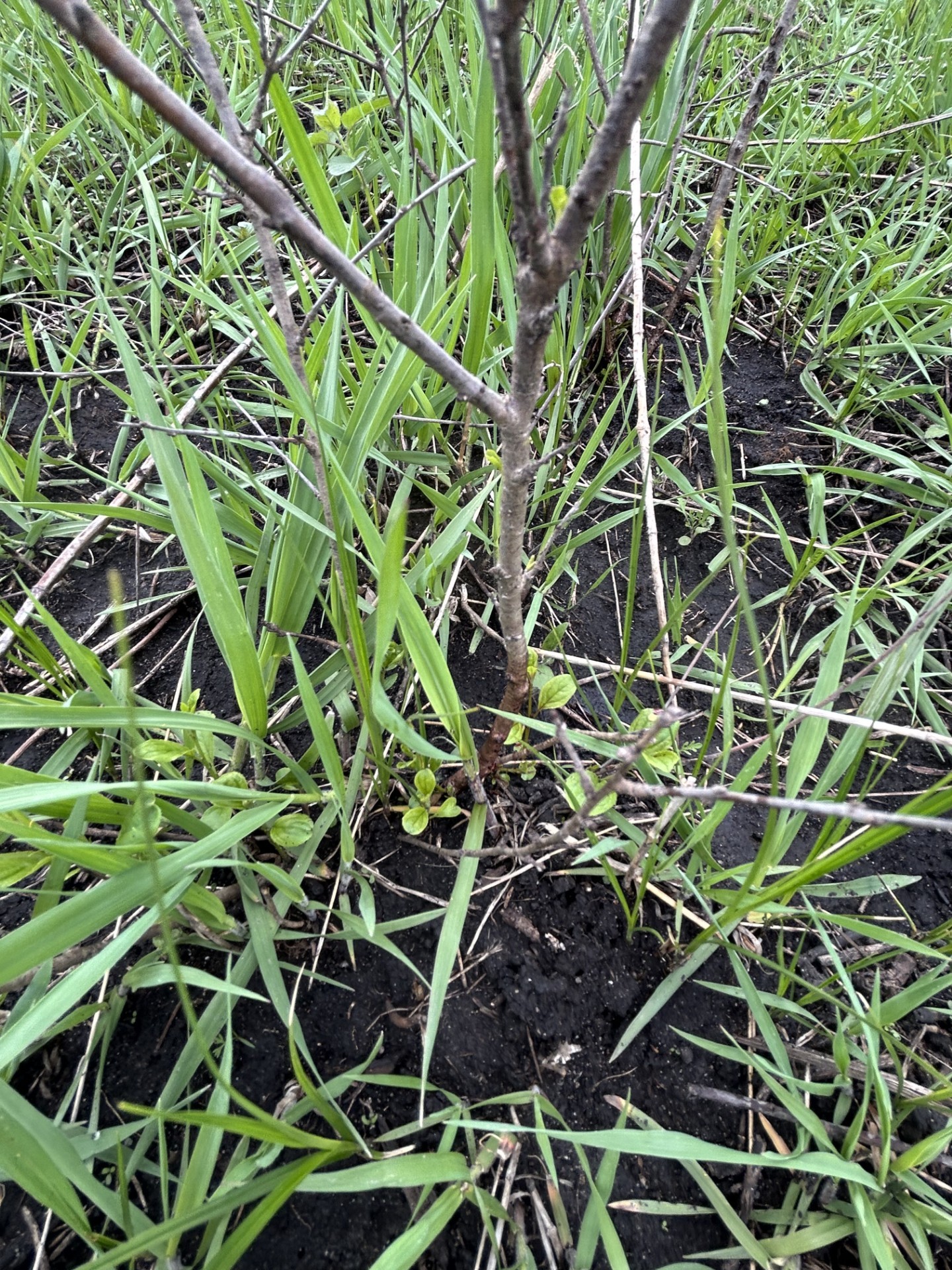
For anyone unfamiliar with the technique, basal bark treatment is an herbicide-only application. We typically use a 15% solution of Garlon 4 (or a comparable triclopyr ester product) mixed in a commercially formulated bark oil. The herbicide is sprayed onto the lower 3–12 inches of the stem, depending on shrub size. Smaller stems only need a narrow 3-inch band, while larger shrubs require a wider treated area. We apply the mixture with backpack sprayers set to low pressure and large droplet sizes to minimize overspray. It’s important to make a 360 degree application around the entire circumference of the stem. It’s important to use an official bark oil (not diesel or other weird oils).
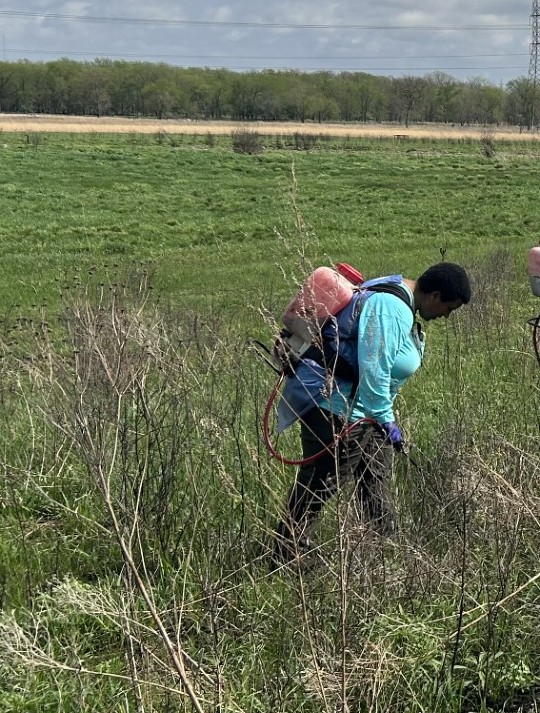
When done properly, basal bark treatment has proven effective for us year-round, as long as there is no snow cover (winter consideration) and as long as temperatures are below about 85°F to reduce the risk of herbicide volatilization and vapor drift (summer consideration).
Over the years, we’ve had many discussions comparing basal bark and cut stump treatments. Cut stump methods certainly satisfy our human desire for instant gratification — there’s something emotionally satisfying about cutting down a shrub and seeing it gone immediately. But once we get past that emotional reaction, I think the evidence strongly favors basal bark treatments for many situations. They are often faster, less disruptive, and, in our experience, more consistently effective.
Last spring, we stumbled into an unexpected discovery because of a scheduling mistake. An ecological contractor was scheduled to conduct basal bark treatments in a prairie and wetland near Braidwood, IL. However, we forgot to tell them that we had just conducted a prescribed burn there the previous day.
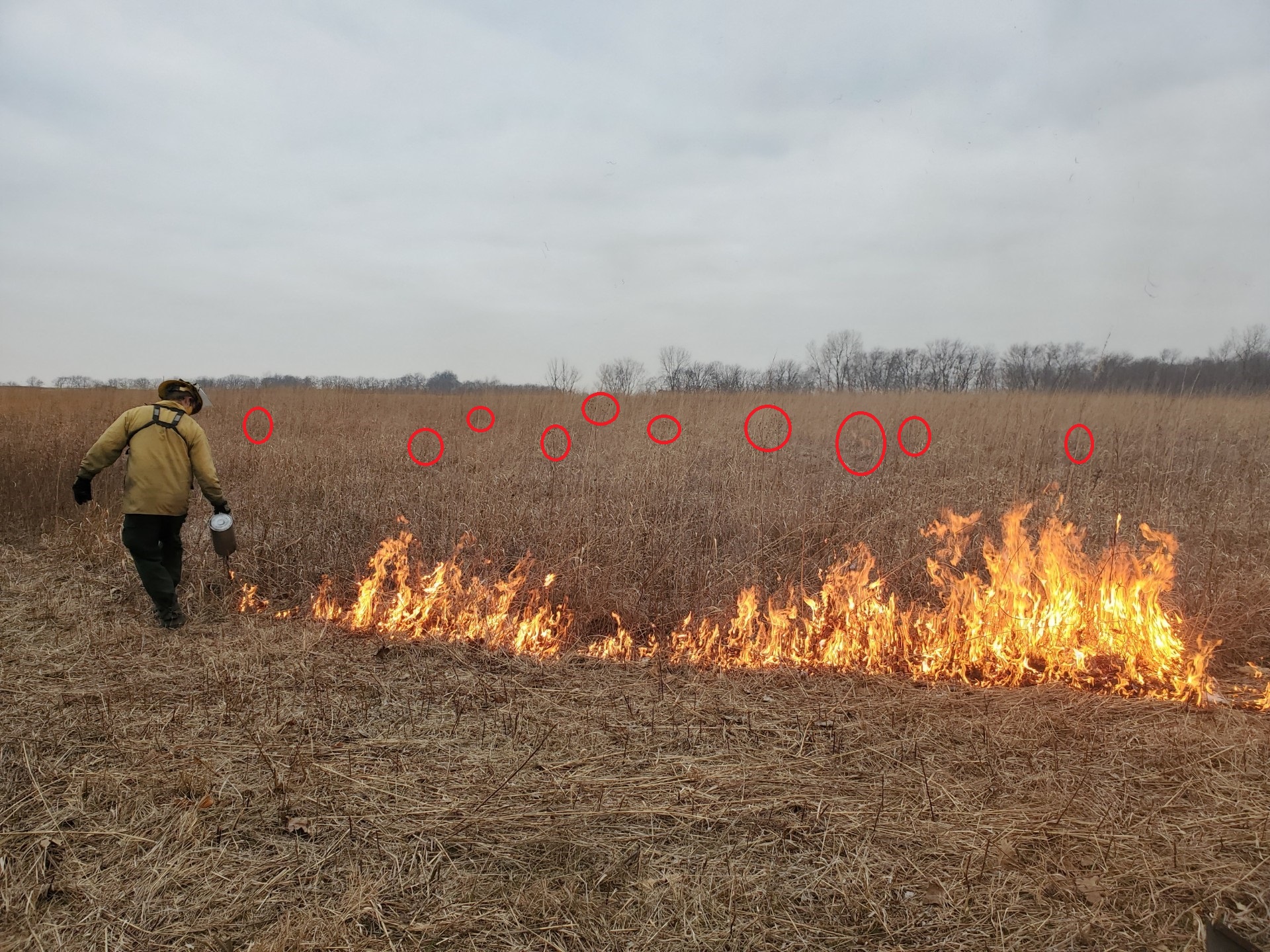
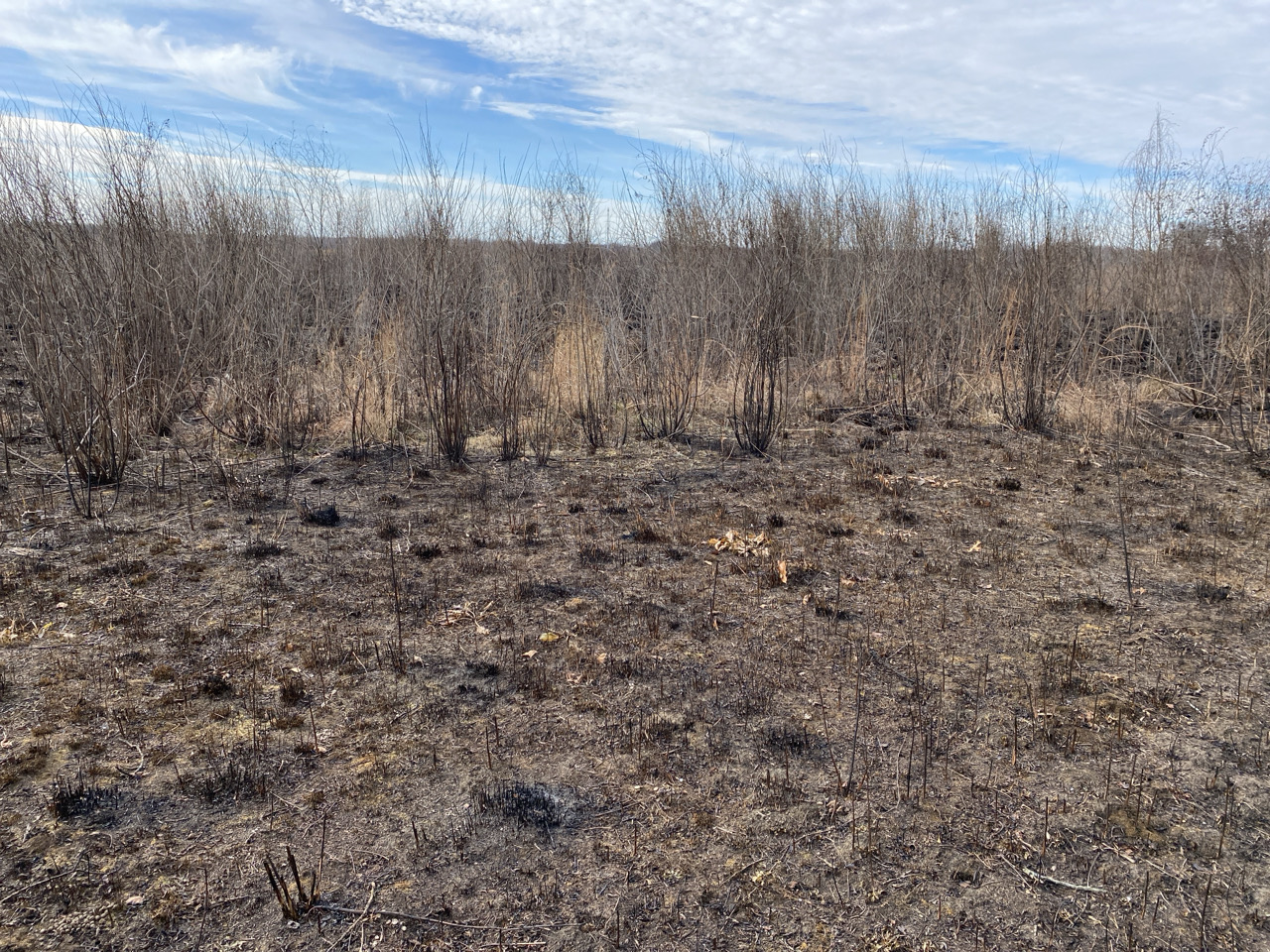
The crew arrived, saw that the entire site had been burned, and decided to proceed anyway. They essentially sprayed the bases of shrubs that had already been top-killed by the fire. When I heard what happened, I was upset that they had wasted time and herbicide treating dead stems that would no longer be able to absorb or translocate the herbicide.
I was completely wrong.
All of the invasive shrubs died following the treatment. Without herbicide, those shrubs would have vigorously resprouted after the fire. In our region, dormant-season fire alone generally does not kill established invasive shrubs. Yet even large, 3-inch diameter bush honeysuckles, autumn olive, callery pear and buckthorns were effectively controlled after the post-burn herbicide application.
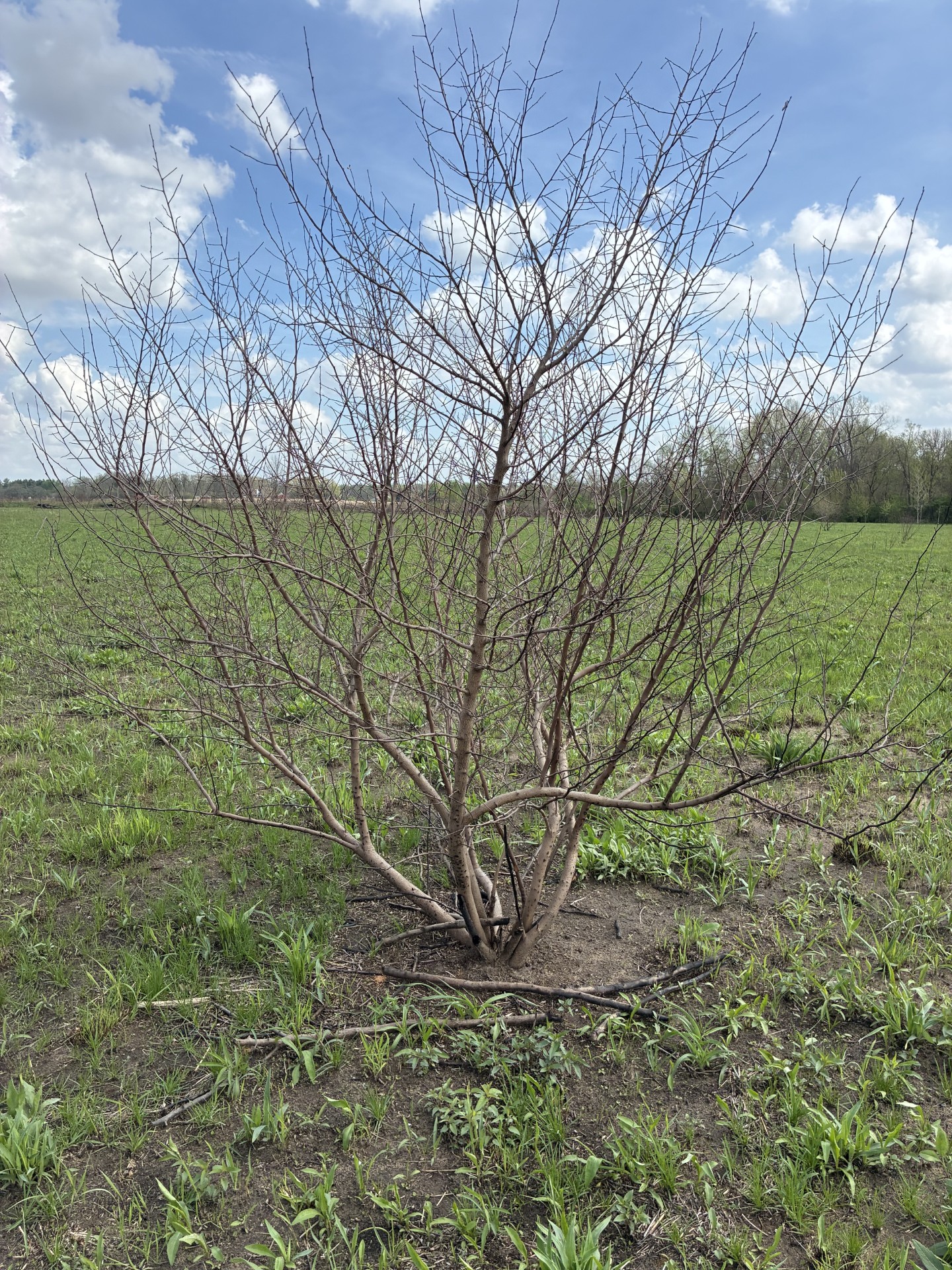
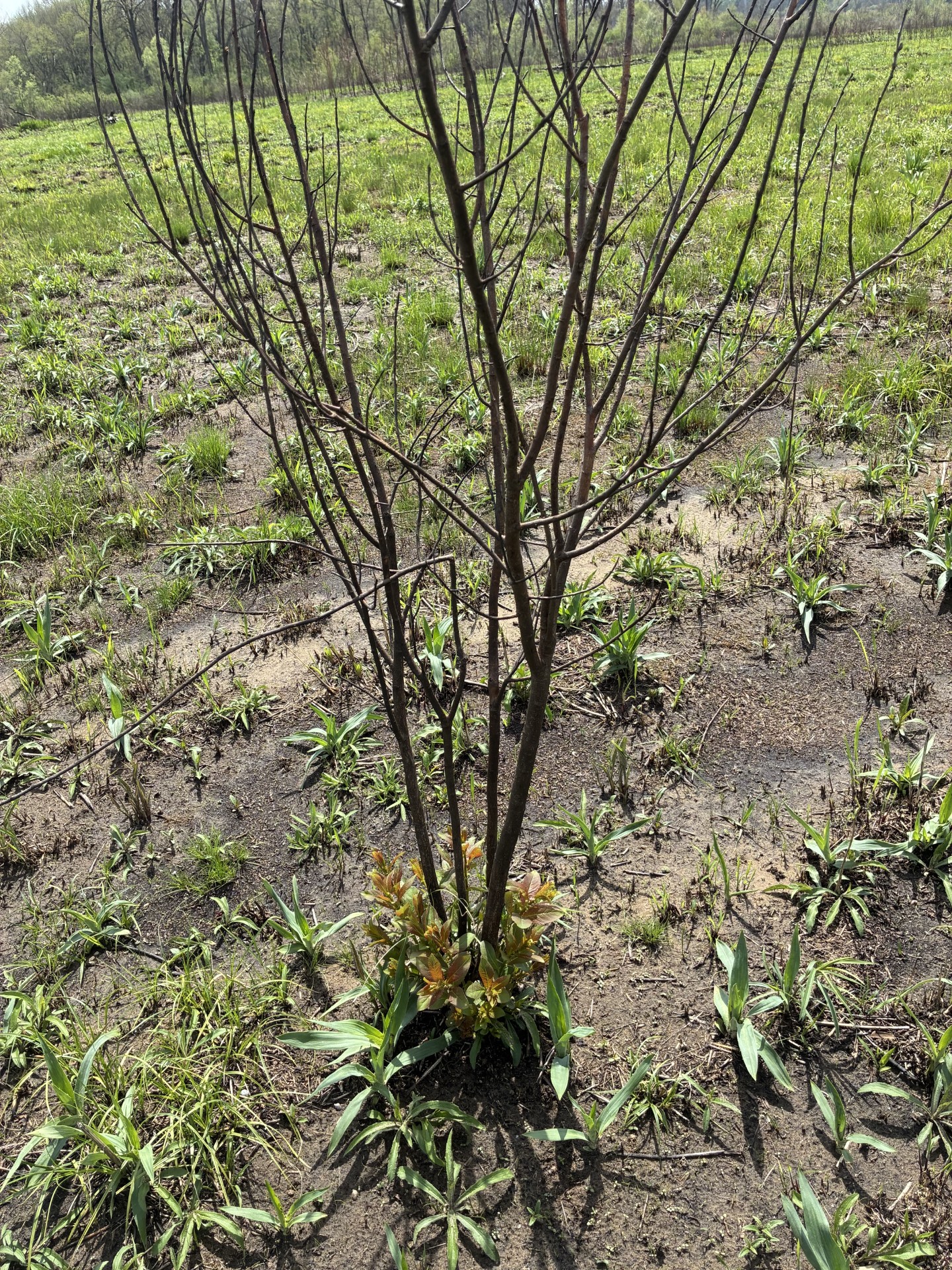
Just as importantly, the treatment proved remarkably efficient. The crew raved about how easy it was to move through the burned prairie. The blackened, top-killed shrubs stood out visually and were incredibly easy to locate and treat.
Encouraged by those results, our crew spent much of the past winter and spring experimenting further with post-burn basal bark applications of Garlon 4 in recently burned prairies. I’m excited to report that the original results were not a fluke.
We’ve successfully treated sites anywhere from a few days after burning to as much as three months post-burn in areas burned last fall. Treatments in recently burned prairies have been especially effective because the invasive shrubs stand out so clearly against the burned landscape. In woodlands, where native and invasive shrubs are more intermixed, it can be more difficult to quickly distinguish which blackened stems should be treated. But in prairies, especially where the shrubs are mostly invasive and visually distinct from native ones, post-burn treatments have been outstanding.
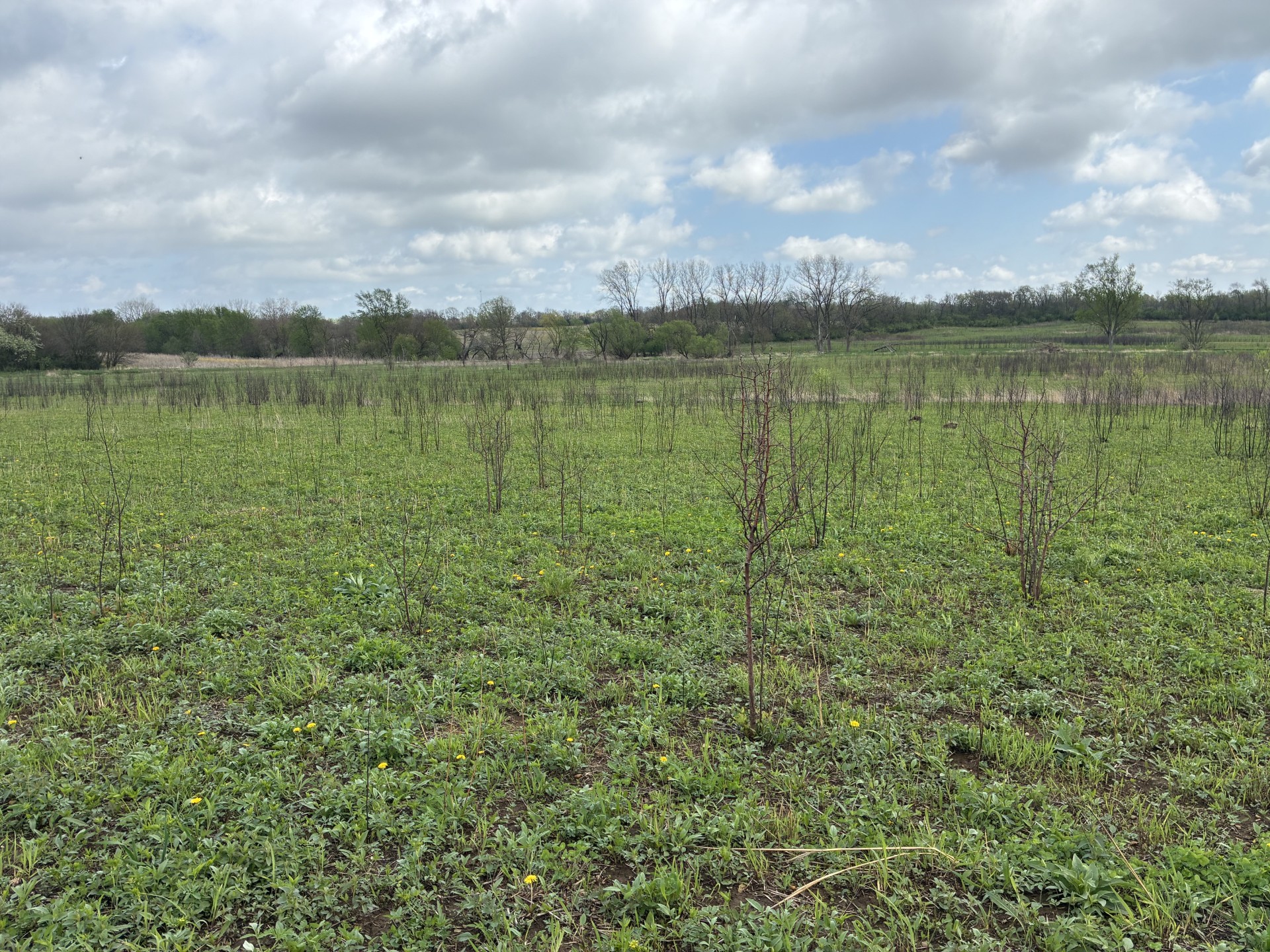
The combination of visibility, ease of movement, and effectiveness has made this one of the most promising invasive shrub control techniques we’ve used in years. So easy, so effective, highly recommended!
p.s. We may have finally defeated common buckthorn on the ridges of several of our dolomite prairie preserves. For more than 30 years, we intermittently cut the invasive shrubs, treated stumps, sprayed resprouts, and repeatedly top-killed them with prescribed fire. After decades of effort, a single post-burn basal bark treatment appears to have accomplished what all those previous efforts did not.
p.s.s. It feels like we’ve stopped spinning our wheels, and can actually make progress addressing the scale of invasive shrub control that’s needed. It’s spring, and hope feels great!


Why no mention of foliar treatments?
Hi Devin, thanks for the question. We have been underwhelmed/ frustrated by the (lack of) long-term effectiveness of foliar treatments for years. The treated shrubs initially look good- the leaves turn brown and fall off – but lots of them come back strong the following year. Here’s a link to the full post about the topic.
Good morning ,are the backpack sprayers you use electric and what brand is effective and will last with the solution you are using. Thank you
I see you are using Triclopyr. I haven’t tried the amine formulation, but we find here that the ester formulations we use do not have great results unless you spray the plant thoroughly at just the right time in its growth cycle. Many plants we foliar spray (Gorse, Blackberry, Broom) will not die completely and need strong followup the next year. Usually, something with Picloram in it (Grazon, etc) or another herbicide like Metsulfuron-methyl will do a better job of killing on first application, of course these are residual herbicides to varying degrees so you have to think carefully about off-target damage and soil persistence. I have had good success spraying Gorse (Ulex europaeua) in native grassland using Metsulfuron, the grassland species (including forbs) seem to come back well within a year. This may vary depending on your local species, soil type, etc.
On the other hand, we do use Triclopyr in sensitive areas if we want to avoid off-target damage. It seems that Triclopyr is not well translocated. It also doesn’t kill ferns very well. So if you accidentally hit a little bit of the native plant next to your target, or if you’re spraying weedy shrubs in a bracken fern patch, you’re less likely to kill the natives. I’ve seen a Eucalypt sapling (native here!) that was up against a Garlon-sprayed Gorse bush. The Gorse was dead, and the half of the Eucalypt adjacent to it was too. The other side of the Eucalypt appeared unaffected.
EXCELLENT. Thank You!
Dana Sievertson Commissioner – Prospect Heights Natural Resources Commission 847.910.5257
Great information!! Nice work fran
Reflecting back to all of the resprouting, burned bramble (Rubus spp.) canes that I have seen, it is obvious now that there could often be life left in various species’ root stalks for which oil-based herbicides could actually be effective. It often takes a serendipitous occurrence like this to remind one that that is so.
Post-burn herbiciding has so many advantages (including avoiding unintended collateral damage with neighboring foliage that is gone) indicated in this report over pre-burn herbiciding that its use should be expanded by others in the future. A brightly colored (red for example) or fluorescent dye might help to avoid missing a shrub or two during herbicide applications.
Is there a dye available that mixes with oil? I’m in Australia, here we have no such dye, they are all designed for water based application.
The bark oil used by the restoration groups with which I have worked was premixed with dye. Using Google to search for “Garlon 4 dye” and “Garlon 4 red dye” and “forestry tracking dye” yields several brands of dye and their sources. Red seems to show up better than blue on dark green foliage.
I see Farm Fleet is selling a ready to use one quart bottle of basal bark herbicide, “Stump Stop”, $20.
Hi Steve Hamman, I know that other people have very strong opinions about the best types of herbicide sprayers to use, but we just use regular ‘ole manual piston or diaphragm pump sprayers that we get in bulk (brands are Solo and Field King). We designate some sprayers for basal bark use and other sprayers for water-based herbicides because it’s annoying to clean them well enough to flip-flop between those uses. …. We’ve talked about budgeting for electric sprayers but that hasn’t gotten funded yet.
Do you have an explanation for WHY this works? It’s exciting that it does, but I’m not sure I understand why. I assume the tissue in the burned stems dies immediately during the fire, right? So that would mean no translocation ability. Do you think the herbicide is just dripping down to the ground where it encounters he suckers as they sprout? If that’s the case, couldn’t you just spray the very base of the stems without having to hit an 3-12″ band? Or, alternatively, do you think the tissue in the stem is still alive somehow and is translocating?
If you’re not sure, it would be an interesting experiment. Is there a difference between spraying a 3-12 inch band and just spraying the base?
Hi Chris, just an assumption, but I assume that the herbicide is sprayed on or right near the crown (root collar) of the shrub, and this is what kills it. We tend to just spray the base of the shrub, which given our spray equipment ends up being a 3-4″ wide band. It would be interesting to tighten up the application and see if a super-targeted 1″ wide application aimed at the crown would be equally as effective (and have less collateral impacts).
I had the same question as Chris. The post-fire resprouts of woody species all originate from the root collar right at soil level, so it feels like a very safe assumption that the basal bark herbicide applied immediately to the root collar is entirely responsible for the effective results and that any herbicide applied further up the stem to the dead vascular tissue above the root collar isn’t actually doing anything (other than perhaps dribbling down the stem a bit to the root collar at soil level). I think it’d be great to confirm those assumptions and assess whether this post-fire basal bark approach would allow for more efficient herbicide use with application only to the narrow band immediately at the root collar.
I also wonder whether a killstick with an angled tip would be an efficient approach for application to the root collar and how this would compare to the efficiency of a backpack sprayer for creating a narrow band around the root collar. Of course, the backpack sprayer has far more volume, so the most effective tool might depend on context.
Quinn and Chris: It sounds like you fine fellows are volunteering to test out an application method that just targets the root collar :). That would be fabulous, thanks for volunteering!
Chris asks an important question. Are you seeing dead zones in the growing season after dormant season application? Especially if rainfall occurred in the days after application. Your picture captioned “Shrub was killed…” appears to show an evenly circular dead zone (seems too small to be due to previous shading from leaves?). That would increase the likelihood that herbicide soaked into the soil & killed the burned plants by contacting the roots or below-ground crown. That would also mean using sprayers instead of wicks/rollers for basal bark may not be a good choice where woody plant density is moderate to high & desirable plants are present.
Also, the Garlon 4 label recommends 20-30% of product in oil for low volume basal bark, so 15% may not work in all situations.
On the point about percent of Garlon 4 needed in the mix. My current supplier recommended 20% several years back and I went with that advice. But before that the mix used to be 17% Garlon 4 and the studies Nachusa did found 100% kill using 17% Garlon 4. So maybe I should save some bucks and go back to that lower percent.
Yes, there is a “ring of death” around treated stems regardless of the treatment timing, and the size of that impact is determined by how careful/ tight the application was as well as weather conditions. In my experience, grasses and sedges within that zone generally recover pretty quickly, often by the following growing season, while susceptible broadleaf species may be killed and need to recolonize over time. In areas with rare plants or exceptionally high floristic quality, more careful and slower applications may absolutely be warranted to minimize collateral damage. However, in my experience the localized collateral damage is tolerable in most of our natural areas and actually more confined than a comparable foliar treatment would be. And, it’s definitely preferable to allowing invasive shrubs to expand unmanaged across our natural areas, resulting in widespread habitat degradation and reductions in native plant diversity.
A note: the only times that we’ve had unacceptable zones of death were when the application was done over snow cover and the herbicide ran when the snow melted, or just before heavy precipitation – definitely conditions to avoid.
Julianne, good summary of the potential downsides of basal bark. That will help folks decide pros/cons of each application method for their particular site. Basal bark spray applicators must be properly trained & must use the appropriate nozzle to minimize overspray.
Reference Bill’s comment, federal pesticide regulations require that the manufacturer submit test data to EPA to support everything on the label, including product performance. Testing must simulate conditions typically encountered when using the product, including low/high precip patterns, low/high humidity, soil characteristics, species treated, etc. So concentrations below label rate don’t have high quality evidence to support it, meaning each practitioner needs to determine efficacy by experiments that include the range of typical variables, such as target plant species, degree of translocation (which can vary by season) & drought stress. For those without the resources to experiment, it’s safer to stick to labeled rates.
Wow, this is amazing and I would never have thought this would work! There are multiple issues with foliar treatment of resprouts so this really will be a game changer in resprout control. Thanks so much for sharing these results!
Great study Julianne, thanks!! Suzanne (NE IL)
This is super interesting. Years ago, I made a little experiment of some willow-invaded areas in a wet prairie restoration. Post-burn in early spring (maybe March), I went in and cut and treated areas that were burned, just cut areas that were burned, and cut and treated the unburned area. The results were really positive in that the cut and treated (with glyphosate) applications saw a drastic reduction in willow compared to all other areas.
So unbelievable were the results that I never repeated the application or really followed up on it. The mechanism never really made sense, but the results you have here are intriguing. I have some data in old field notebooks that I’ll try and dig up.
At least part of the rationale for me doing this was that the willows were growing with dense grass so it’s a pain to cut and treat and find the cut stumps unless it’s completely burned. It’s interesting that the herbicides I used were not oil based but still seemed to be very effective.
Very interesting – I assume that the willows in the burned-over area that you were cutting and treating had been top-killed by the fire?
Has anyone had experience attempting this after a fall burn? This would be a great tool for woodlands as well.
Hi Dan, Yes. We did post-burn basal bark treatments after two burns that were done last fall, and they were totally effective at killing the treated woodies. The burns were done in November 2025, and the post-burn basal bark treatments were done between Jan – Feb 2026. They were both prairie sites, but I would think that it would work in woodlands too.
Hi Julianne. Thanks for the reply! We will try this in the fall. Much of the basal bark work we do on small shrubs is using Bill Kleiman’s paint roller method, which we prefer over spray because it conserves herbicide and minimizes dead zones. The downside to this method is that it is harder to apply herbicide evenly down to the root collar, which will be critical in this situation. I’m looking forward to running the experiment!
Pingback: Sericea Lespedeza Control – Summer Burning and Herbicide Treatments | grassland restoration network
Pingback: Testing Follow-Up Treatments for Honeysuckle Resprouts | grassland restoration network