Written and led by: Andrew Kaul – Restoration Scientist at the Missouri Botanical Garden Team Members: Matthew Albrecht, Cal Maginel, Brad Delfeld, Noah Dell
Key Takeaways:
- Establishment Mowing during the first 1-2 years of development after seeding a prairie is commonly practiced to suppress weeds and improve recruitment of target species.
- Past research on this practice has yielded mixed results and has not considered how mowing efficacy may depend on the number and timing of mowing events.
- We initiated an experiment in 2025 at Shaw Nature Reserve in Missouri testing how establishment mowing effects prairie establishment. We mowed plots 0, 1, 2, or 4 times in the first year. We also mowed one half of all plots in the second year to test whether two years of mowing are necessary.
- Preliminary results indicate that in year 2, differences between treatments were small, but plots mowed multiple times in year 1 had taller vegetation, and slightly lowered richness of target species. We will continue to sample this experiment to see how mowing effects change over the next three years.
Mowing can play a strategic role in managing grasslands during ecosystem restoration. Most research investigating mowing effects on grassland communities has focused on treatments applied to mature vegetation, often designed to simulate natural effects of fire or grazing, but the focus of this study is on the practice of “establishment mowing” (EM), where mowing is conducted in the first 1-2 years of vegetation development following a prairie planting into bare ground. EM is an adaptive approach used to suppress the growth of non-target “weed” species (native or non-native), which establish and grow faster than the seeded native species. Prairie species primarily grow below ground in their first year and they do not produce substantial aboveground biomass until the second or third year. In contrast, annuals and ruderal perennials grow rapidly in the first year and may suppress establishment of seeded prairie species.
The exact method of EM implementation may vary depending on region, seasonal weather, and weed composition, because these factors influence the distribution of plant growth throughout the year. The key features of EM include the number of mowing events, mowing height, and timing of mowing, especially in the first year. This practice dates back at least to the 1970s, but was popularized by Carl Kurtz’s 2001 book A Practical Guide to Prairie Reconstruction. Kurtz recommended mowing as low as 3″ to suppress weeds early in the first growing season, and then moving the mower deck up for subsequent mowing events roughly every three weeks from June through September. Some practitioners also recommend mow treatments in the second year. For example, Kurtz suggests mowing at a height of 6-8” in the second year as often as is needed. EM is widely recommended in nearly every practitioner guideline for prairie restoration and has become common in practice.
Despite these recommendations, there is limited research indicating this practice works as intended. Some managers do not use EM when starting new reconstructions, potentially due to costs and lack of evidence for return on investment. Mowing can be expensive, especially considering the time required to cover large management units multiple times a year. Additionally, EM may be counterproductive if trampling by tractor tires causes mortality of sown species as seedlings.
Past research on the value of EM to restoration outcomes has yielded mixed results. I first became interested in this topic while working on a synthesis of prairie restoration methods and outcomes in graduate school at Iowa State University. We sampled 93 planted prairies across Iowa and tested for the importance of several aspects of the restoration process on predicting diversity and composition of the resulting plant community (Kaul & Wilsey 2021). We found that mowing practice was one of the significant predictors of species richness, with sites established with EM having 4 more species on average compared to those with no mowing. However, that study was observational, and the sites had many other differences. Stronger evidence for the utility of EM would require a controlled experiment to isolate only the effects of mowing.
Several excellent studies on EM have been published in recent years. Experimental manipulations comparing EM to no mowing have found benefits in the first 1-2 years of restoration (Meissen et al. 2020, Glidden et al. 2023, Soley and Wilsey 2025), but not after longer periods (Meissen et al. 2020, Deever et al. 2024). A weakness of these studies is that they did not isolate the effects of EM based on timing or number of mowing events during the first year. This inspired us to develop an experiment that included several types of EM applications.
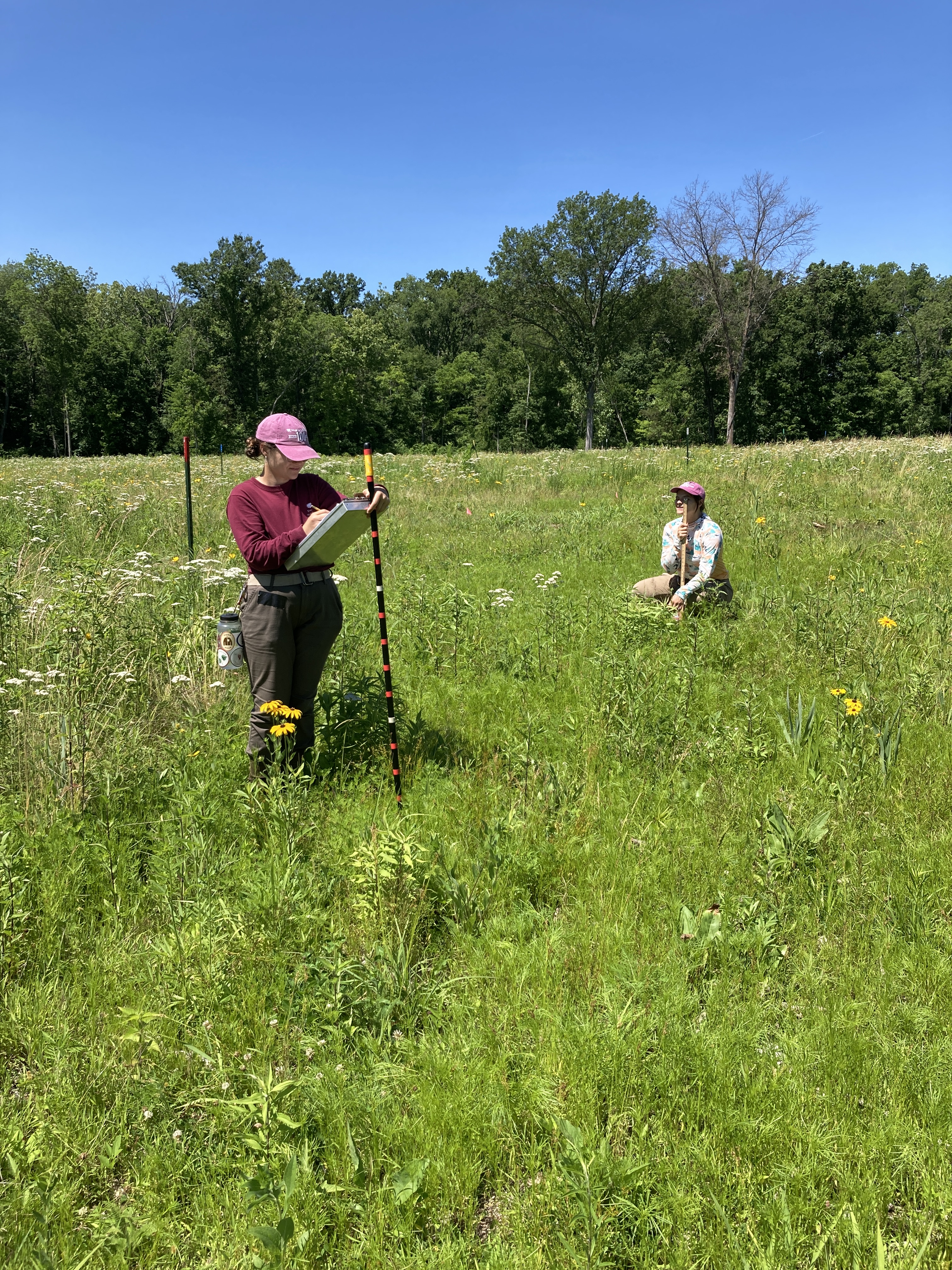
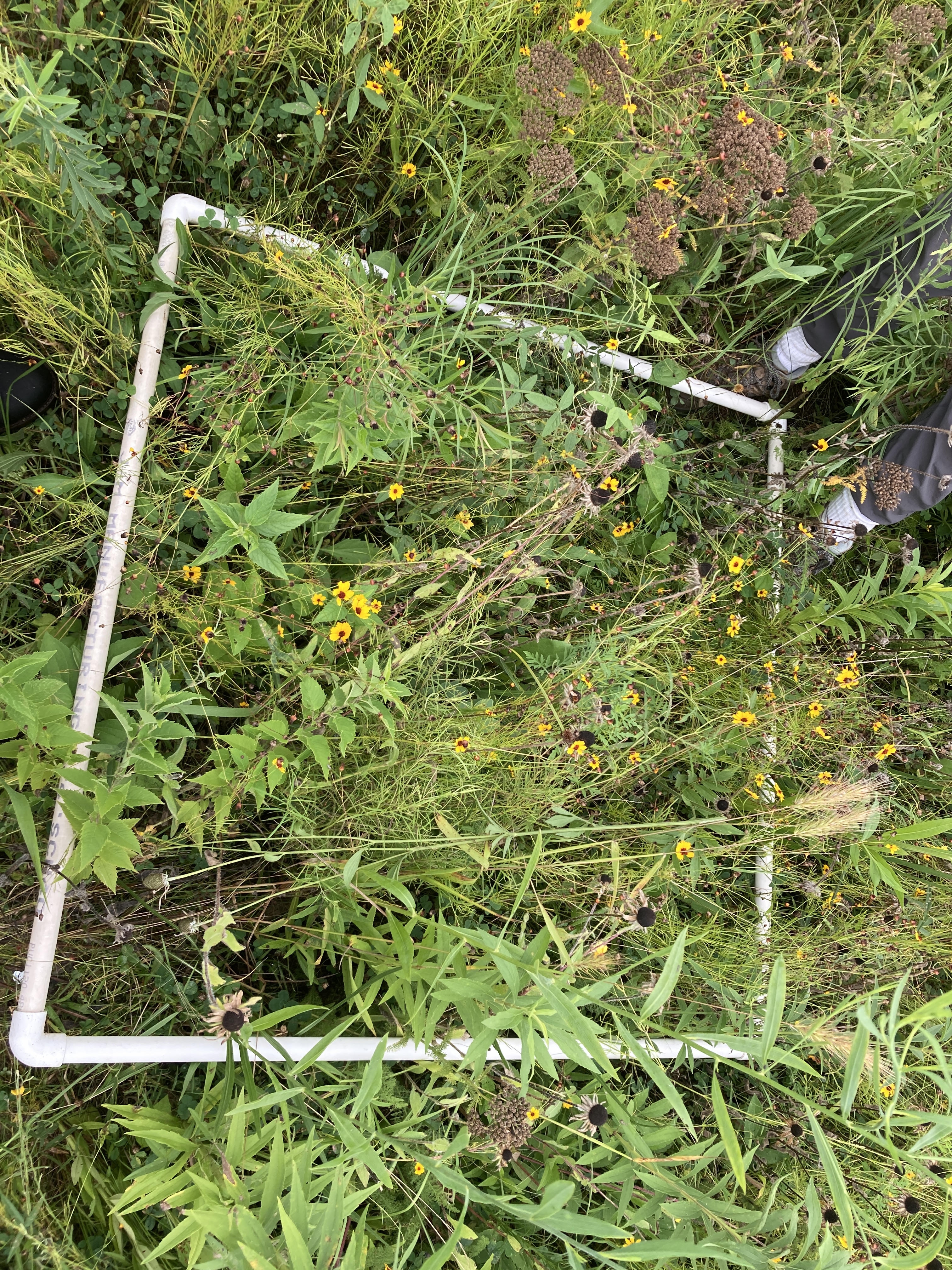
Our project addresses the following questions: does mowing reduce weeds and promote seeded species, and do mowing effects depend on the number of mowing events, the timing of mowing events, or the addition of mowing in the second year? Previous work has focused on the first quest, without considering variation in the method of EM implementation. In addition to control plots, our four mowing treatments include the following: a single early mow (May), a single late mow (July), two mows – early and late (May and July), or four mows – the “recommended” method (May, June, July, August). These treatments were implemented in a new prairie planting in 2025 at the Missouri Botanical Garden’s Shaw Nature Reserve. In 2026, we sampled the plant communities and implemented the 2nd-year treatment, mowing half of all the plots in late May (a split-plot design). All mowing treatments were conducted at approximately 6” using a rotary mower deck.
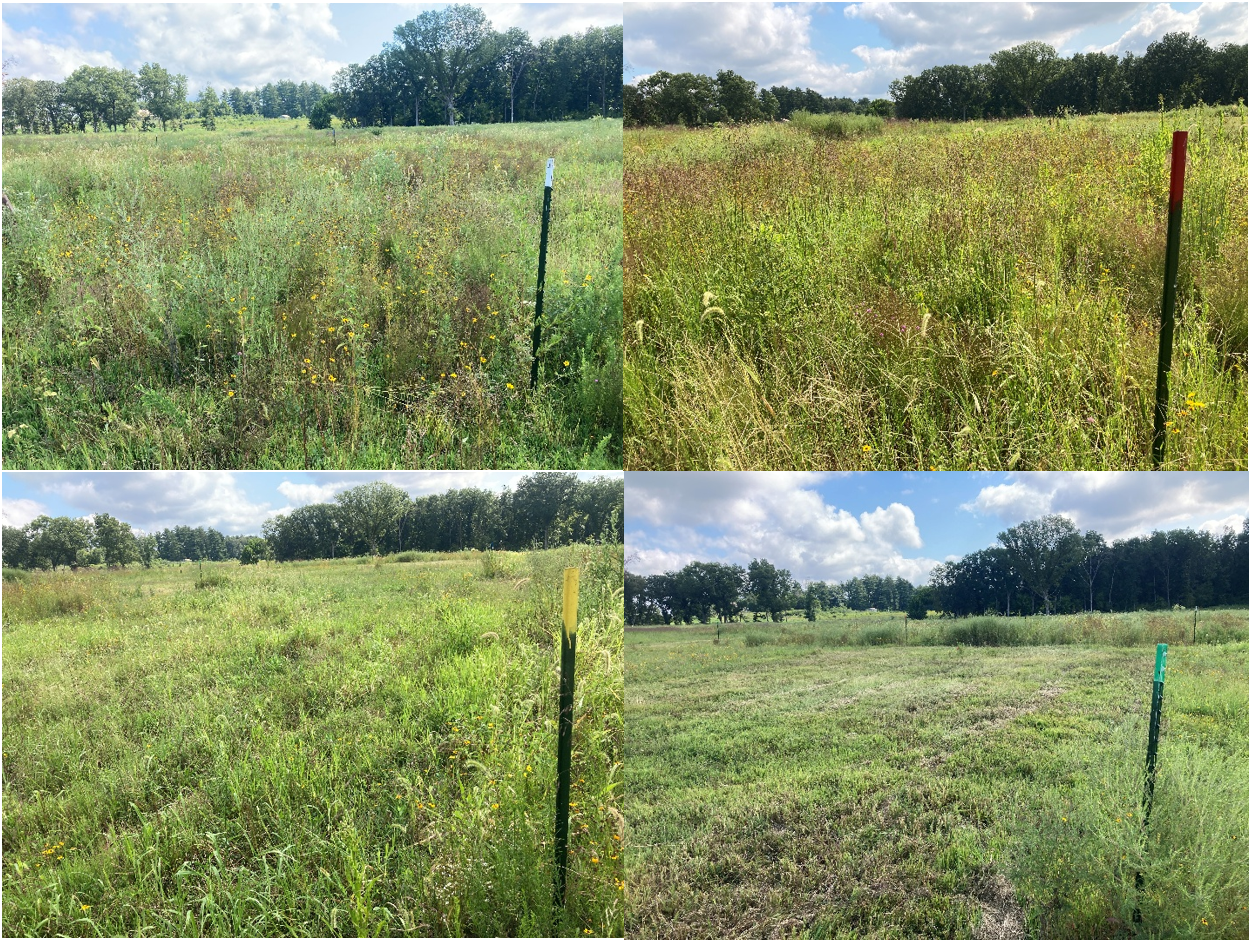
At the GRN conference hosted at Shaw Nature Reserve this past May 2026, my anecdotal impression was that after touring this experiment, attendees were largely split on whether EM is important for prairie establishment. Some attendees swore by it while others insisted it was unnecessary. I am hoping this experiment will put that debate to rest one way or the other! We plan to sample the plant community annually for four years. Below are preliminary results after sampling treatments in 2025 and 2026.
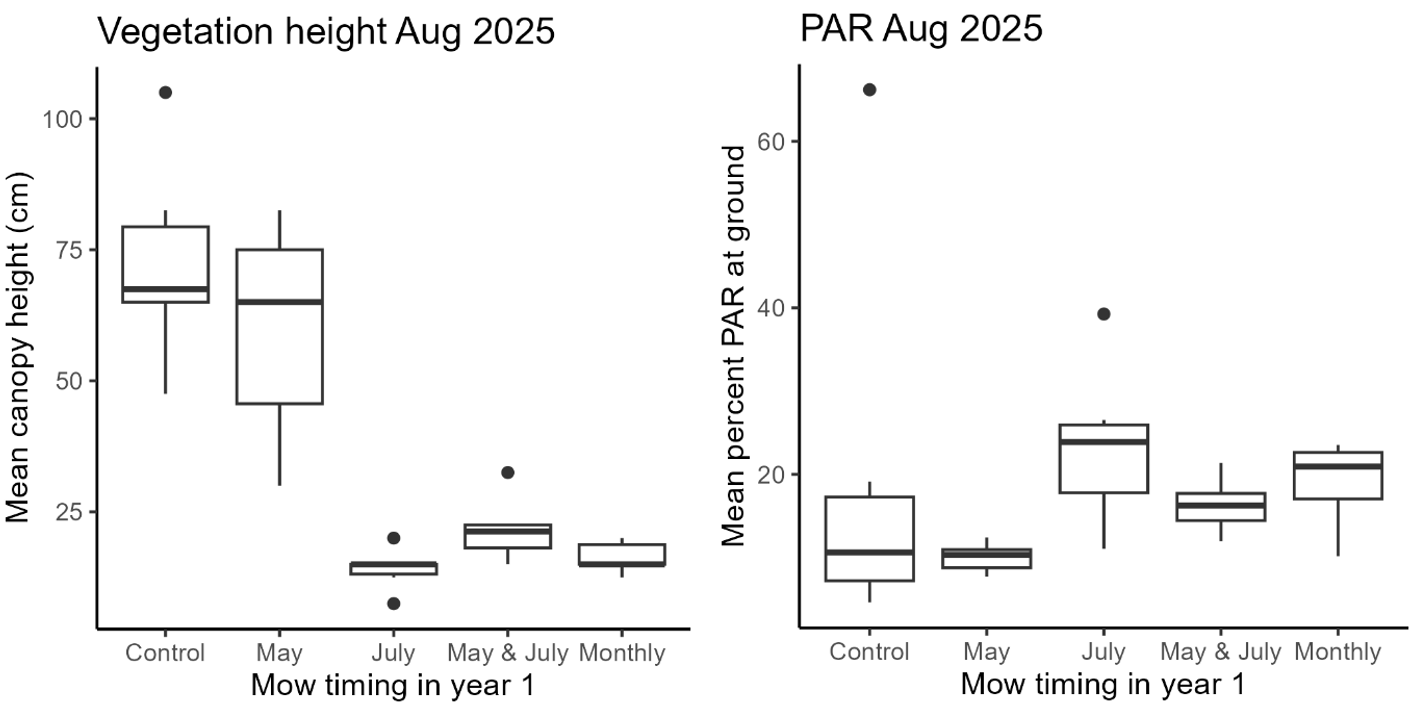
As one might expect, mowing decreased the height of the plant canopy and slightly increased the amount of light reaching the ground, but only in plots mowed in July or later. PAR stands for Photosynthetically Active Radiation.
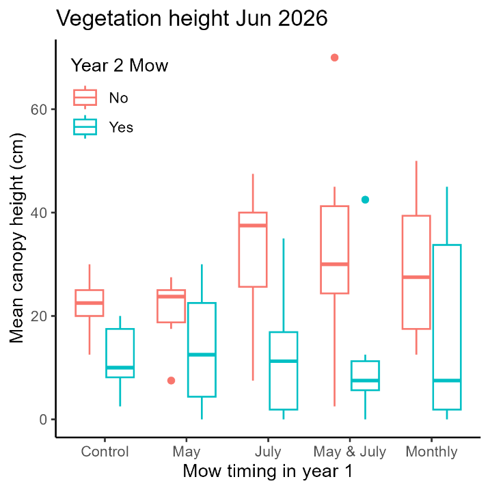
Interestingly, Year 1 mowing treatments also affected the structure of the plant community the next growing season. All treatments that included a July or later mow in year 1 had slightly taller canopies on average in June of year 2 (Red boxplots). The year 2 mow treatment (applied May 21st) resulted in shorter vegetation when measured on June 3 (Blue boxplots).
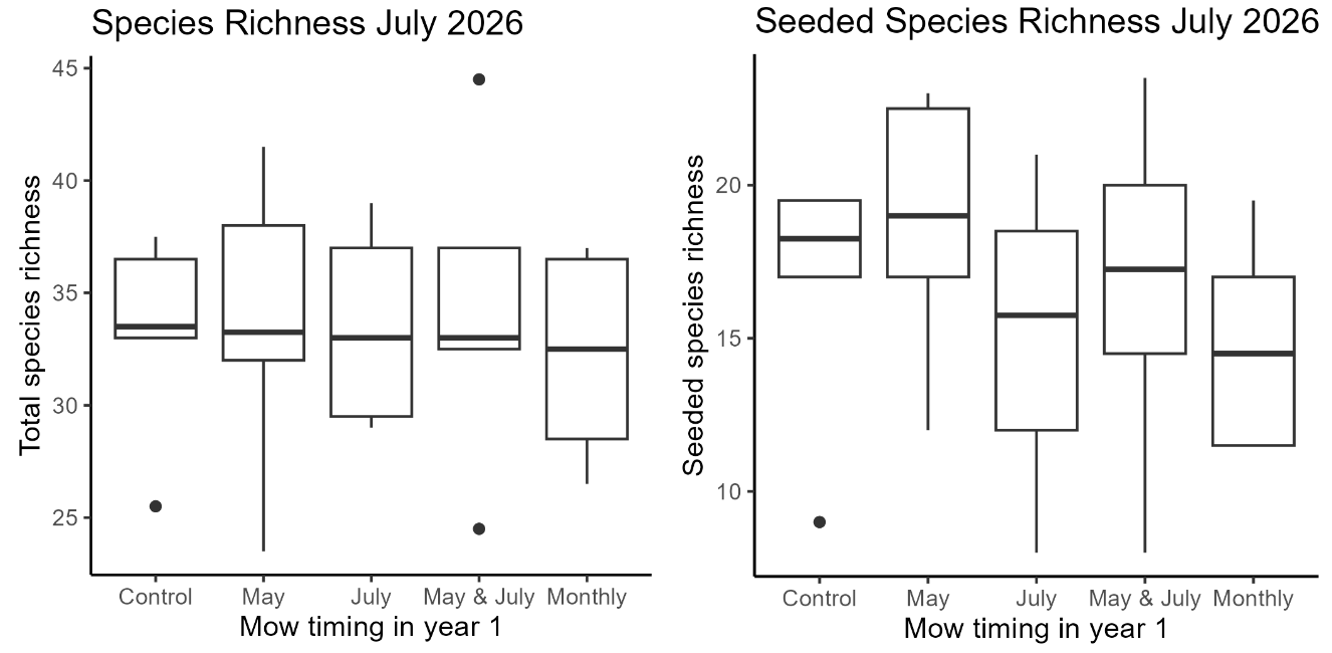
Based on the plant community in year 2, mowing treatments did not appear to affect total species richness. However, there was a slight trend with treatments mowed in July or later having fewer seeded species detected.
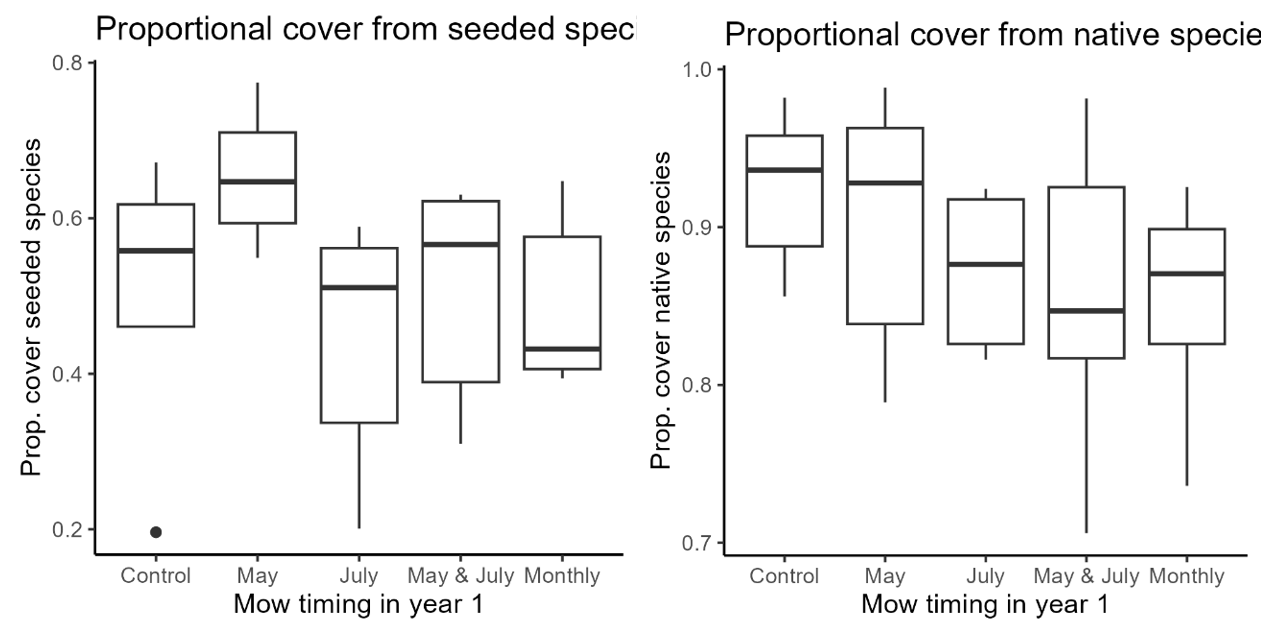
Following a similar trend, treatments mowed in July or later tended to have somewhat lower proportional abundance (cover) from seeded species and all native species (seeded and volunteers).
Prairie composition has high turnover in the first 3-4 years of assembly, so these early indications only provide part of the story. We will continue to track these plots, and next year we will be able to test how adding the 2nd-year mow affected vegetation as well.
References
Deever DT, Soley NM, Fullin K, Wilsey BJ (2024) Recruitment limitation of early- and late-flowering grassland forbs can be overcome with transplanting in prairie restorations. Recruitment limitation of early- and late-flowering grassland forbs can be overcome with transplanting in prairie restorations. Journal of Applied Ecology 61:223–235
Glidden AJ, Sherrard ME, Meissen JC, Myers MC, Elgersma KJ, Jackson LL (2023) Planting time, first-year mowing, and seed mix design influence ecological outcomes in agroecosystem revegetation projects. Planting time, first-year mowing, and seed mix design influence ecological outcomes in agroecosystem revegetation projects. Restoration Ecology 31:e13818
Kaul AD, Wilsey BJ (2021) Exotic species drive patterns of plant species diversity in 93 restored tallgrass prairies. Exotic species drive patterns of plant species diversity in 93 restored tallgrass prairies. Ecological Applications 31:e2252
Kurtz C (2001) A Practial Guide to Prairie Reconstruction. 1st ed. University of Iowa Press
Meissen JC, Glidden AJ, Sherrard ME, Elgersma KJ, Jackson LL (2020) Seed mix design and first year management influence multifunctionality and cost-effectiveness in prairie reconstruction. Seed mix design and first year management influence multifunctionality and cost-effectiveness in prairie reconstruction. Restoration Ecology 28:807–816
Soley N, Wilsey B (2025) Factors that extend flowering phenology for pollinators in prairie restorations. Factors that extend flowering phenology for pollinators in prairie restorations. Perspectives in Plant Ecology, Evolution and Systematics 66:125848


This is a very interesting and relevant study to my current work. I have several prairie reconstruction areas of various ages and am still working out the best way to manage them.Thus far, it appears to me from your study that a single mow at 6″ in May of year 1 produced the best response for seeded species richness in year 2, correct?This study is in Missouri. I am located just south of Shawano, WI. What would an MO May mowing correspond to for me?Thank you for your efforts,Lucinda Lee Lough Lucinda weatherorknot.substack.comTrying to help untangle the knot of Climate Change resulting in unstable weather and general chaos to our world.
Thanks for your questions! The year one May mowing treatment had a slightly higher seeded species component in year 2, BUT this is still early days. That’s not the final answer. We will need to continue watching this community develop for a few years as it stabilizes.
As far as timing, I wouldn’t focus on the exact mowing date, but rather on vegetation height. Folks tend to mow when it feels right based on how tall the plants are and that timing can change a lot based on weather during the spring. Most guides recommend conducting the first mow when weeds are 18-24″ tall.
Hi,Thanks for doing this research it’s an interesting topic. I have heard people discussing this method previously.I was wondering if you’re using a sample that including areas that had no mowing the first year but then mowed the second year, and one that had no mowing the first nor second year but did mow the third year?I’m also wondering if the actual physical act of running a heavy machine that’s used to mow through the plots could be decreasing the survivability of any small seeded plants??SuzanneOn Sep 24, 2026,
Hi Suzanne. Great questions! Yes to the first one. We do have areas that were mowed in the first year, but not the second, and ones that were mowed in the second, but not the first. We are not mowing in the third year. It is possible that the tractor does crush some seedlings and that some species will be more sensitive to this than others. If that happens then perhaps we will have fewer of our target / seeded species survive when there are more mowing treatments. We’ll see!
How many species were in the initial seeding, and which species did not emerge?
There were 151 species in the initial seed mix. Mike Saxton, Quinn Long, and Cal Maginel designed the mix and so far this prairie looks great for its second year. We detected around a third of those species in our year 2 sample. However, they seeded 120 acres, and we only sampled 60 square meters for this experiment. In future years we will be looking at which species performed best and in which treatments.