By Bill Kleiman
How many visits does it take to get an invasive weed occurrence to zero?
For years I have stated this answer of how many visits do we need to make to a weed occurrence as thus:
Visit a problem area once a year and the weeds numbers continue about the same, perhaps increasing and perhaps decreasing.
Visit twice a year to treat weeds and the weed numbers likely decrease by a modest amount. Do this annually for years and maybe you get success.
Visit three times a year and that year’s weed numbers decrease a lot, perhaps nearing zero adults surviving. This does not mean the seed bank is to zero, but that the year’s emerged adult plants are near zero.
What follows is an actual example of this idea.
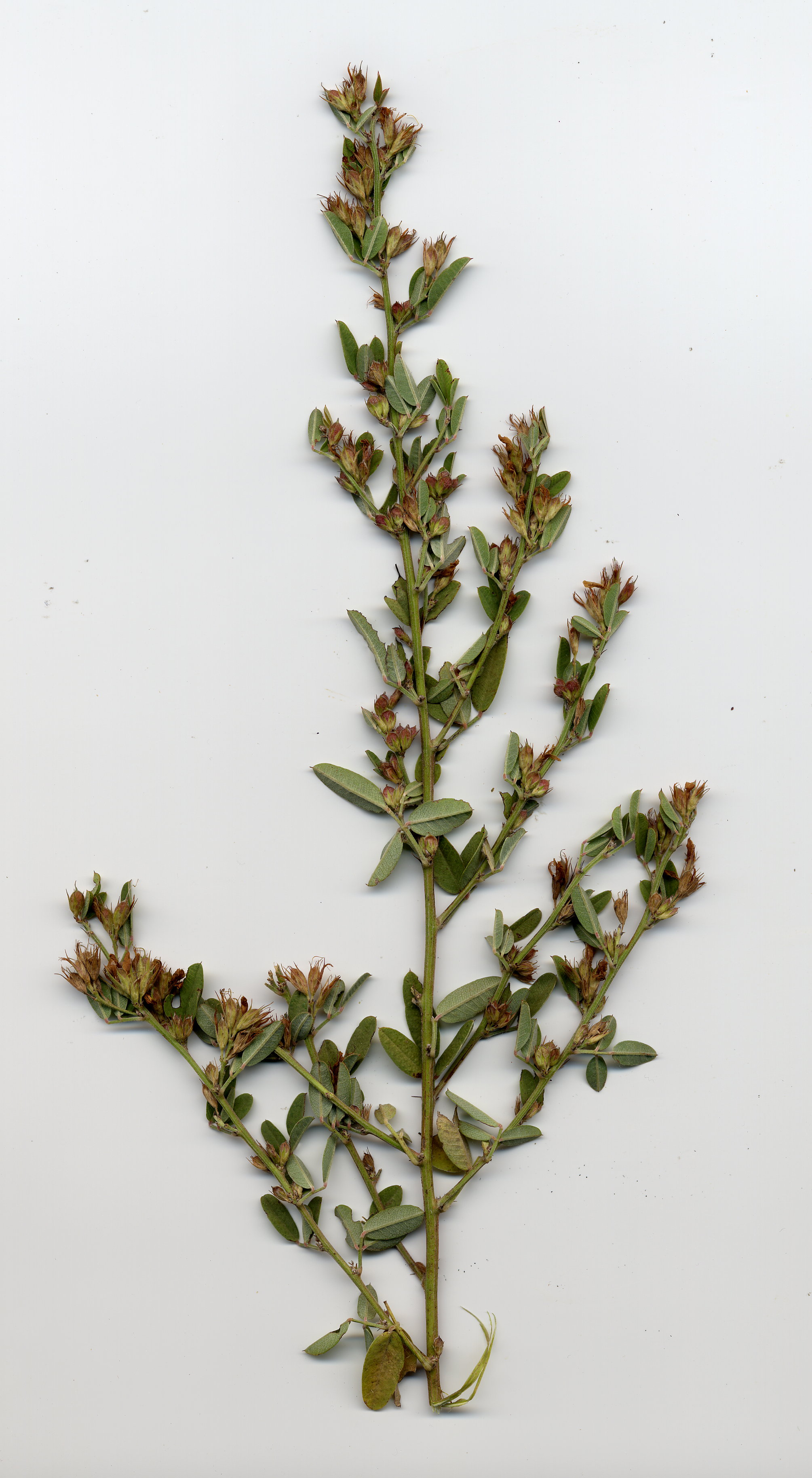
On June 8, 2025 I went to a half acre prairie planting we did years back at our Meiners unit, in a dry upland corner with sandy soils. I looked carefully for Asian bushclover. The scientific name is Lespedeza daurica.
Asian bushclover, we call it ABC, is a low sprawling invasive bushclover. This is not Lespedeza cuneata, which most know as Sericea lespedeza, a weed which stands tall and proud while taking over all your beloved habitat. Both these bushclovers are very invasive, but ABC sprawls.
So on June 8, 2025, I found ten plants. I treated them with basal bark Garlon 4 from a squirt bottle because that is what I had with me. This weed emerges later in the season, and I think the first week of June was too early for this plant, which is why I found only ten plants. But I sprayed these ten.
Five weeks later,on July 12, 2025, I return to this same half acre and find 32 plants, which are mostly small. All the plants I treated in June with garlon 4 were dead. I had marked them with flagging tape so I knew it was them. On this July visit I happen to have a squirt bottle of imazapic and I spray the Lespedeza with it. What the heck, maybe imazapic works too. That I find 32 plants makes sense as mid-July is when ABC is big enough to be seen. All 32 are sprayed.
I return a third time, four and a half weeks later, on August 2, 2025. This is the same half acre of habitat. The same person is carefully searching. How many will I find? The same number? Less? More?
Well, on August 2 I find 29 ABC in about 4 patches with several each. I find the imazapic sprayed on my last visit did smoke them and every other plant in a little circle around the target Lespedeza is dead too. No surprise there. That is what imazapic does. I remember feeling dismayed that I found 29 plants because I think it means I missed 29 plants on my July visit. Ugh!
My final visit of 2025 is 9 weeks later on October 12, 2025. How many plants will I find?
I find only 3 plants with two next to each other, and a single.
So in summary, I made four visits and treated just about all of that year’s plants. And we could argue that my first visit was too early for this weed. So perhaps three visits would have had me find essentially all the plants.
But….I write this a year later on July 20, 2026. Clara and I found 31 plants today on this half acre, which is typical for this seed bank in this place. Weed work is a long game. Most of these 31 were likely just seeds, or little plants last year and now they are big enough to find. But worse, we found three big plants in one patch that were just off the half acre into the adjacent big prairie planting. I think those plants were missed in 2025. Double ugh!
Weed management is a long game. I have been searching this half acre for 19 years, since we first realized a local native plant nursery sold us this invasive Lespedeza. The nursery was apparently wild harvesting it from a site in the region. The problem with a plant nursery wild harvesting is that they send their workers to a site, workers who may not know what they are picking. They were not in a garden picking plants, but in a big area making botanical decisions. They bring back bags of seed that looks like the right seed, but it ain’t. What a bummer. Here is a blog post about that incident: https://grasslandrestorationnetwork.org/2021/09/09/beware-what-seed-you-buy/
And here is a link about the other Lespedeza, sericea lespedeza: https://grasslandrestorationnetwork.org/2025/10/23/control-of-lespedeza-cuneata/
And finally a link to a post describing various Lespedeza with a quiz: Lespedeza: friend and foe | grassland restoration network
So in summary, annually make two to three visits a year to your weed occurrences and you can expect success in the long run.


 grassland restoration network
I could not agree with you more. I am currently doing a second round of pulling Japanese hedge parsley. The first round was done about 10 days ago, and it sure seemed I got it all. Boy was I wrong. The second round has almost the same amount of plants as the first. I believe Japanese hedge parsley, from my experience, requires 2 to 3 passes within a 3 week period while it is in flower. I am several years in the process of restoration on my 78 acre prairie/savanna here in Southwest Wisconsin. I would also add that walking the property as much as you can throughout the growing season helps one to see invasive weeds that have slipped the first or second eradication. Inevitably with each walk you will find something that you missed.
Patience is a prairie word!Sally BaumgardnerSent from my iPhoneOn Jul 23, 2026,
Persistence too!
3 visits seems to be the industry standard on the private side, adjusting up for highly infested or prone areas and maybe down to 2/year for stable well-established areas. Long term, some of the areas we manage that get 2/visits a year for an extended period of time end up having to go back to 3/year at some point in the face of new threats. I think it is primarily being able to comb through during early season, mid-season and late season to catch things that otherwise can be easily overlooked.
Thanks Sam. Good to hear that what I have learned is a norm. We share. We learn together.
Very nice pic of Leah and Jay at work!!! Still love the cover pic on them on the TNC MAg!!
I got off a Metra train once in Chicago and that photo of them was 8 feet wide in the station advertising TNC. Leah is holding a stuffed animal toy and pointing at seeds for Jay to pick. Adorable!
It isn’t just plant nurseries that send plant-ignorant people to do wild harvest. I know a local conservation organization that did the same thing multiple times. Every time they did a planting, exotics and invasives showed up.
The answer to the question asked depends upon the time frame over which the species emerges, bolts, and produces seeds. Find and use a good botanical reference source that has this information. Even then the time frame over which the seeds remain viable in the seed bank affects the answer. If a plant cannot be prevented from reproducing, then it cannot be eradicated.
As an example, consider Alliaria petiolate (garlic mustard) one of the usual suspects. In northeastern Illinois it bolts from approximately April 19 to July 24; once every 2 weeks would suggest that the answer for garlic mustard is 7 times!
Weeding should be a full-time activity every week, because there are so many weed species that are present.
It is not generally known that weeds talk with one another. The conversation goes something like this: “ They see me. I’m doomed. Save yourselves. Duck!” And they do.
I agree that the weeds see us coming and duck! 🙂
Same experience here. In addition to human error, a species might have distinct early & late blooming groups that hinder locating all of them at once. For wild parsnip, when the early ones are in full bloom, the late ones are very short & not blooming at all. To reduce missing plants, it’s helpful to work in teams of 2 or more because each person will have a slightly different viewing angle. To prevent getting too far behind as the season progresses, lately I’ve started to control invasives before they are in bloom. I’ll miss a lot, but I’ll also treat a lot, making the second pass during bloom time faster. Another trick is if you find one plant, look carefully nearby for more because many invasives have patchy distribution.
My husband and I having been stewarding a 7 acre planting in Nachusa for five years. Our focus is Bird’s-Foot Trefoil (BFT). We use a Transline mixture on the leaves. We visit 4 to 5 times a year before it sets seed. The first year it felt like an impossible task. We would work for 2 to 3 hours and only cover a small area. Five summers later we can cover the entire plot in one visit and find mostly small plants. We found only a few monster size plants this Summer. We still need to be vigilant but it is a good feeling to see the native plant thriving.
Pingback: Are Two Sweeps Enough? Conversations with the Crew | grassland restoration network