Seed Hammer Mill

By Bill Kleiman, Nachusa Grasslands TNC

Updated April 2025

This is a hammer mill used to break apart seed heads of all sorts of native seeds.
The mill is under the red housing which has spinning hammers inside.   A mill is like a leaf mulcher.It has a galvanized chute and a custom made seed table on wheels.  Mill is by C.S. Bell Company, which are now closed.  Mike Saxton with Shaw Reserve purchased  a  https://www.meadowsmills.com/HammerMills/Model5 

When we want to mill a barrel of seed we dump the seed on the table, or lay the barrel on the table and use the half moon bracket to hold it steady.  We feed the seed heads, stems and whatever else we have down the chute.  Not the scissors.

Below I am touching a hammer inside the mill and my thumb is on one of four screens we have.  The smaller the screen holes the longer the seed heads are exposed to the spinning hammers.  We feel confident that most seeds are not damaged from the spinning hammers.  If we run some big seed, like a Silphium, then we use the big hole screen.  If you get too aggressive you can see broken seeds, but most of the time they look in tact.

Below is vervain seed heads being run through the mill.  The pvc pipe is used if some clogging occurs at the inlet.  Wear safety glasses.

1,500 pound pile of dry-mesic mix from 2008.

Below we see the blue Baileigh cyclonic dust collector.  This is a few horsepower of air suction and it is hooked direct to the bottom of the hammer mill.  It is typically used in carpentry shops to collect sawdust. The plant parts are all pulled very fast past the mill, up the clear tube, into the blue cyclone.

In the cyclone the plant parts are circling the blue can very fast.  The speed is especially fast in that funnel shaped part of the blue vacuum.  Seed is dense with its DNA, fats, proteins and those seed spin down into the white drum.  Even pussytoes, Antennaria, won’t go out the exit pipe you see going through the exterior wall.  Hard to believe but true.

You can blow seed out the exit tube if you clog the intake tube.  Don’t do that.

Below is another mill we have with the vacuum tube hooked right to bottom of mill, so all the product is going up that tube, into the cyclonic separation of the sawdust collector and dropped in he silver can below.  Just a light dust gets blown outside.

Seed hammer mill IMG_3908 001

The mill and vacuum are 220 volts and lots of amps.  You need an electrician to wire it up.

When you turn off the mill and vacuum the seed and many other plant parts are in the can.  It is still a dusty product so this louvered dust fan helps get the fine dust outside as you pour out the barrel.  As you pour seed keep the barrel close to the fan.

Below is from 2004 with a very similar system.  2022 prices have the saw dust collector at about $3,000, the custom build table $600, the duct work $100. The custom made bag holder about $500. Let’s say the package is $5,000.  The hammer mill costs about $6,000.

A few photos of dust collectors:

Posted in Uncategorized | Tagged , , , | 5 Comments

UTV tanks for prescribed fire

By Bill Kleiman, Nachusa Grasslands, TNC

UTV skid unit tanks:  The best part of a Utility Vehicle is its mobility on prescribed fires.  50 to 70 gallons of water is plenty to carry on a UTV.   At 70 gallons your machine is noticeably weighed down on its springs.   RKO Enterprises ordered me this tank from United Plastics Fabricating as I wanted to reuse an old reel and pump and save money plumbing it myself.

I point to the sump on the bottom of the tank.   If you don’t have a sump then you will carry water around your tank that your pump can’t access to spray.  Make sure you buy a tank with a sump.

The tank has internal baffles that diminish the slosh as you drive.

The skid unit should be small enough to fit in the bed with tailgate up.  You want the weight as far forward in the bed as possible.  The tank should be low enough for the driver to see over the top of the tank.  The pump motor is on a skid platform rear of the tank.  The hose reel is either next to the pump and motor if there is room, or on top of the tank if need be.

I like the half inch thick black polypropylene tanks.

Bolt the tank through the UTV bed and use wide washers to spread the force.

More info here: https://www.illinoisprescribedfirecouncil.org/uploads/1/0/5/8/105892833/pumper_unit_design_suggestions_2019_bk.pdf

Posted in Uncategorized | Tagged , , , | 1 Comment

Fire, Rubus and Geranium

By Bill Kleiman

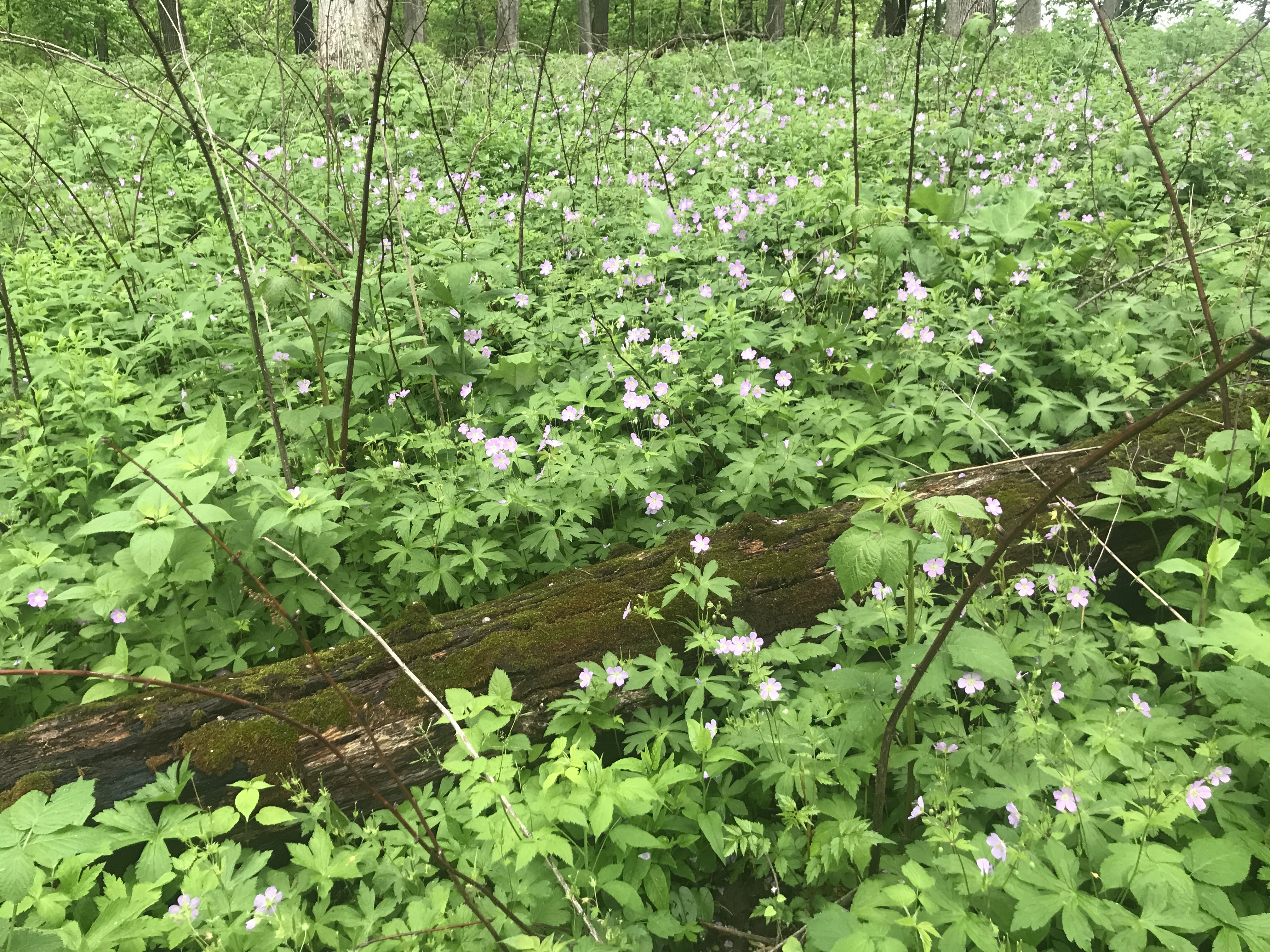
In a closed canopy oak woods we have been doing annual fire for a long time.  The Rubus allegheniensis, common blackberry is slowly fading in stature and density, while the wild geranium, G maculatum, has become abundant.   This is what I think I see.  I don’t have data to prove it.

The invasive honeysuckle shrubs in this woods also keep re-sprouting after our fires.  Those plants are still there, but smaller in size, and not big enough to flower and then seed.

The fires top kill the woody stems of the briars which yields more sunlight to the herbaceous plants of geraniums, and other forbs, sedges and grasses.

Posted in Uncategorized | Tagged , , , | 9 Comments

Wild Parsnip. Is it invasive or just a weed?

By Bill Kleiman, The Nature Conservancy at Nachusa Grasslands

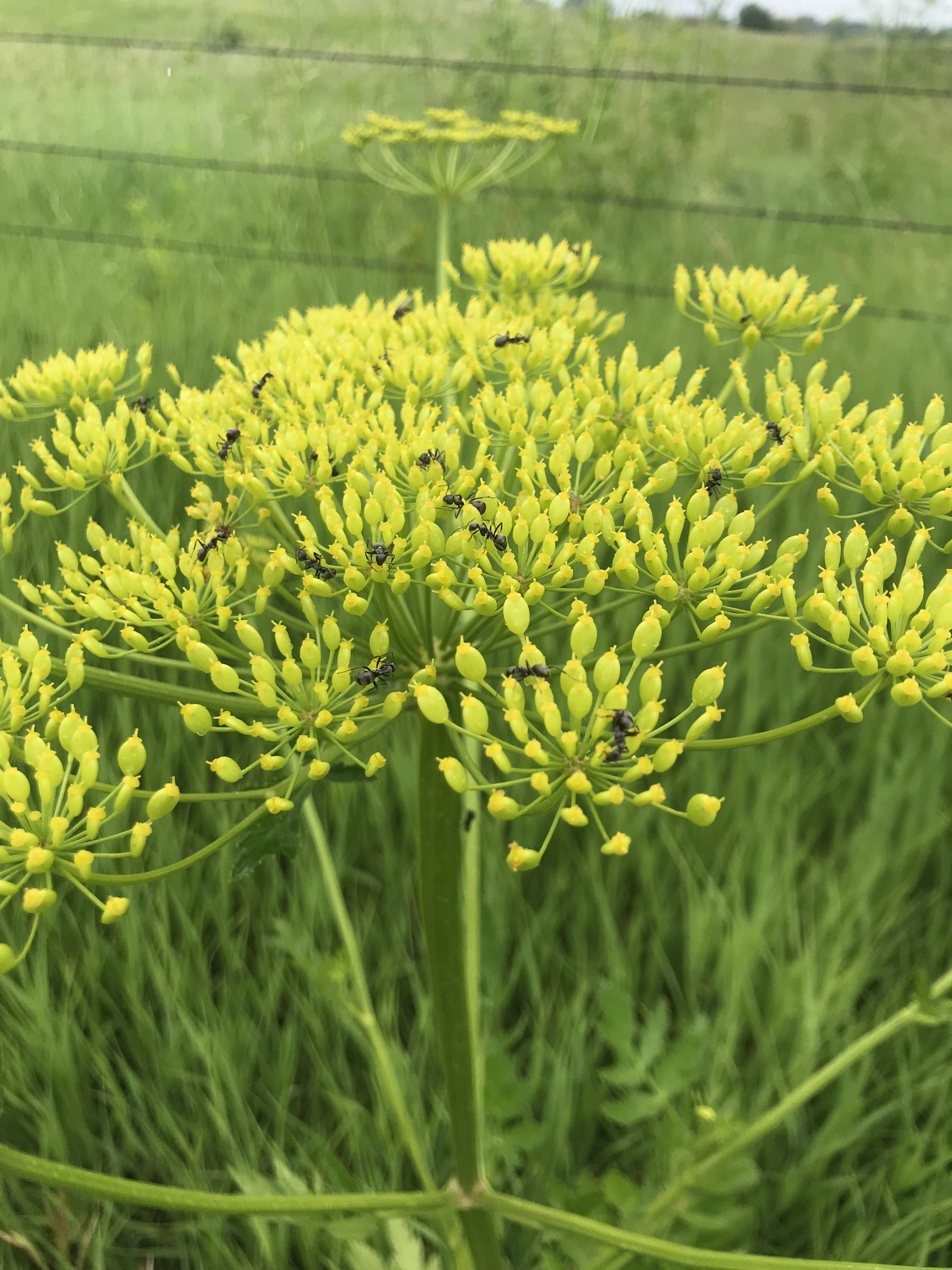
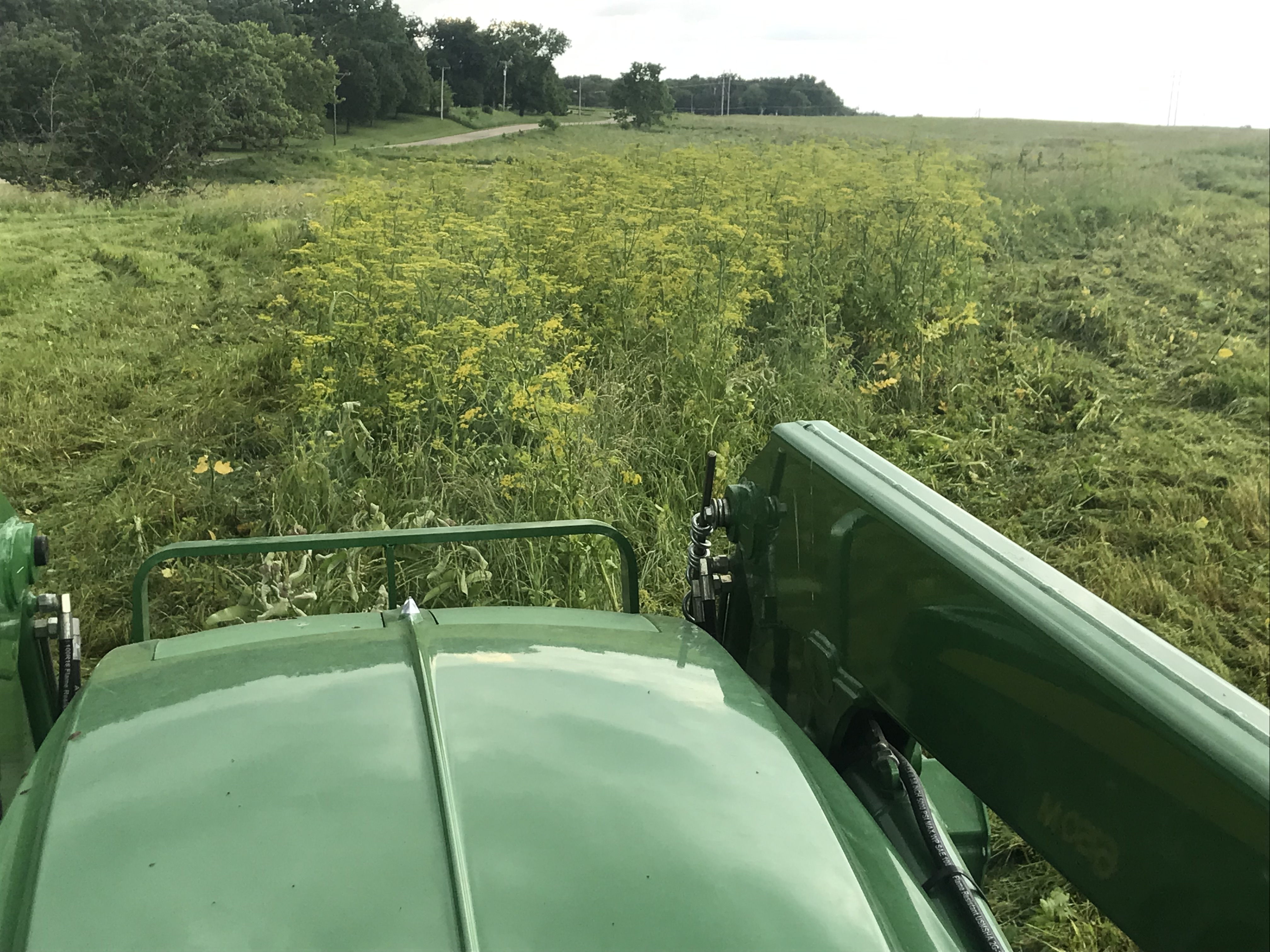
Pastinaca sativa, wild parsnip lives two years, with flower and seed set on year two. Every June you will find us mowing it somewhere on the preserve, as this is when they are in full flower.   We also use our weed spades to cut the root which looks like a carrot.  Before the flower stalk bolts a broadleaf herbicide is effective.

Parsnip does not compete well in prairie plantings or prairie remnants, except where the vegetation has been disturbed by some past issue, like brush encroachment.  Parsnip does well in low competition areas where past disturbance has left a simple plant community.  We mowed a bush honeysuckle thicket several years previously and it filled with wild parsnip a few years later.   I sprayed a pasture to reduce brush and a few years later there was the parsnip.

There are various weeds we put some effort into in case their small populations might increase if left alone.  Weeds like parsnip, king devil, butter and eggs.  You may have such a list.  Then there are weeds that are everywhere, like the exotic cool season grasses, so we shrug our shoulders and don’t attempt to control them.

Our resources are limited so we manage what we need to, and not more.

Here is a link to some resources on invasive weeds:

https://www.nachusagrasslands.org/managing-invasive-plants.html

Posted in Uncategorized | Tagged , , , , , | 6 Comments

Prescribed fire pumper units

by Bill Kleiman, The Nature Conservancy, Nachusa Grasslands

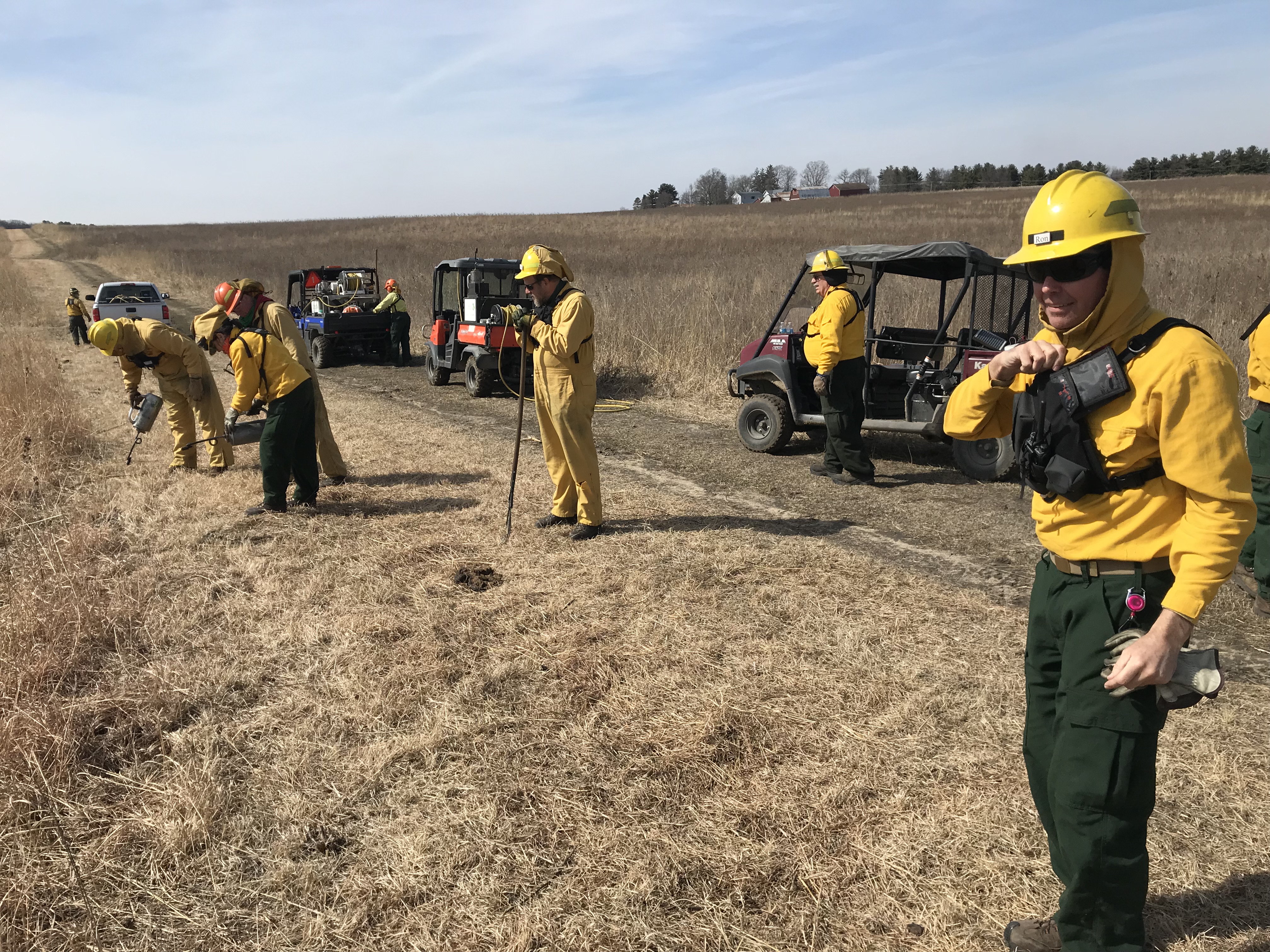
At Nachusa Grasslands we use several vehicle mounted water sprayers on our fires.  We call them “pumper units”.  Photo above is a crew about to start their test ignition.   You don’t see backpack water sprayers as most crew are assigned to a pumper unit.

The pumps we use are piston pumps because they use a small amount of water per minute and produce a high pressure.   These work well for our grass and leaf litter fires and are common in the Midwest.

Centrifugal pumps are the standard on wildfire crews you see across the nation.  Centrifugal pumps typically produce modest pressure, and can pump a lot of gallons per minute. This is good in that you may knock down an escaping fire with all that water output, and bad in that you may run out of water before that escape is extinguished.

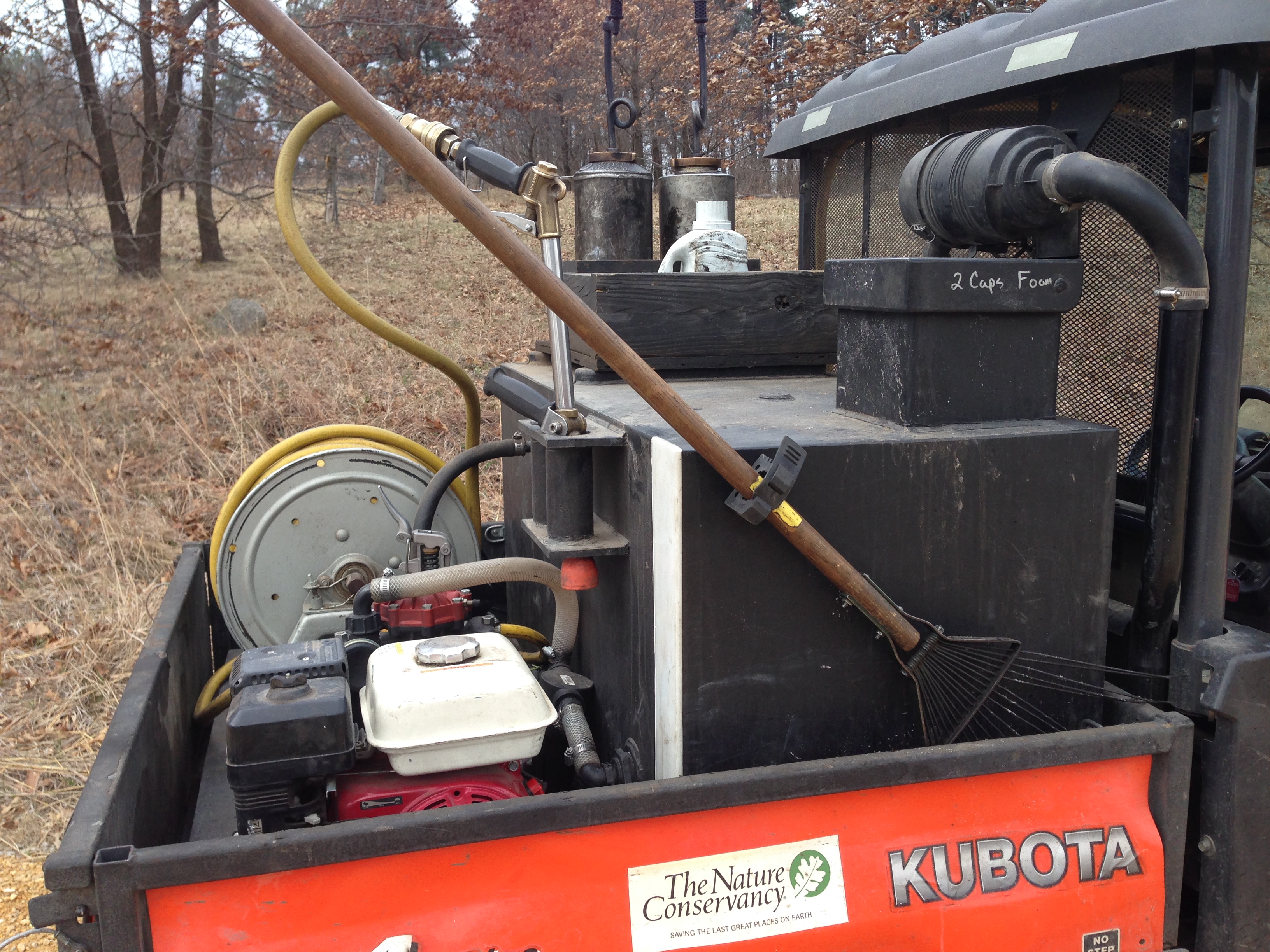
Below is one of our units.  Note rake strapped at an angle such that it does not hit you in the head when you start the pump motor.  Our name is on the rake so we get it back at the end of the day.  The hose is yellow so you see it in the grass. The hose is a narrow diameter so it is light weight to maneuver easily.  The drip torch holders are made from wood painted black. The laundry detergent bottle in the box is filled with Class A foam.  “Add two caps of foam” says the print on the side of the tank fill.  And it all fits in the bed with the tailgate up.  The tank is 70 gallons which is about ten gallons too heavy.

Our water tender is a 425 gallon tank with a high flow centrifugal pump mounted in a truck. It is to fill all the other pumpers in the field and carry extra tools.

I wrote up a short summary of pumper units designs: https://www.illinoisprescribedfirecouncil.org/uploads/1/0/5/8/105892833/pumper_unit_design_suggestions_2019_bk.pdf


Posted in Uncategorized | Tagged , , , | 2 Comments

The Way of the Warrior Sedges

By Kevin Scheiwiller of Citizens for Conservation

As many practitioners know, wetlands can be one of the most frustrating and resource demanding areas to restore. Countless wetland plantings have shown a large flush in native diversity in the first few years just to be overrun by the seed bank of the “wetland thugs;” cattails, reed canary grass, and phragmites. At Citizens for Conservation, we had left most of our wetlands alone for this reason. That was until we enlisted the help of the warrior sedges.

Who are the warrior sedges? These 10 species of Carex were hand selected based on their tendency to be able to withstand invasion by the wetland thugs in the few remaining local remnant wetlands. They are all highly rhizomatous species, that when planted in a focused manner can create a tight native matrix strong enough to keep out the invasion of the wetland thugs.

So what? Why replace one monoculture with another? We have found that while these warrior sedge matrices are dense enough to keep out the thugs, they are not inhibiting the growth of other native wetland species such as Sneezeweed, Monkey Flower, Mad-Dog Skullcap, Blue Flag Iris, and others. All these wetland associates have coevolved for millennia and still seem to understand how to grow together.

The hardened restoration ecologist will wonder how long this wetland planting will keep out the wetland thugs. Time will be the true test, but after a decade of using this technique we have been able to reclaim pothole wetlands and a long stretch of streambank. All of which requires a very small amount of maintenance after year three of this method.

For a detailed explanation of the process see “The Way of the Warriors.” https://www.nachusagrasslands.org/uploads/5/8/4/6/58466593/the_way_of_the_warriors.pdf 

Posted in Uncategorized | Tagged , , , , | 9 Comments

Planting prairie #97 with the full monty

By Bill Kleiman, The Nature Conservancy

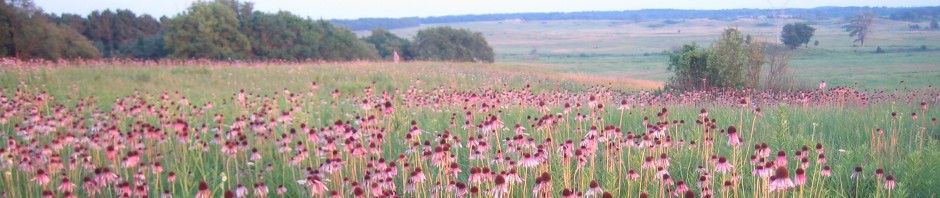
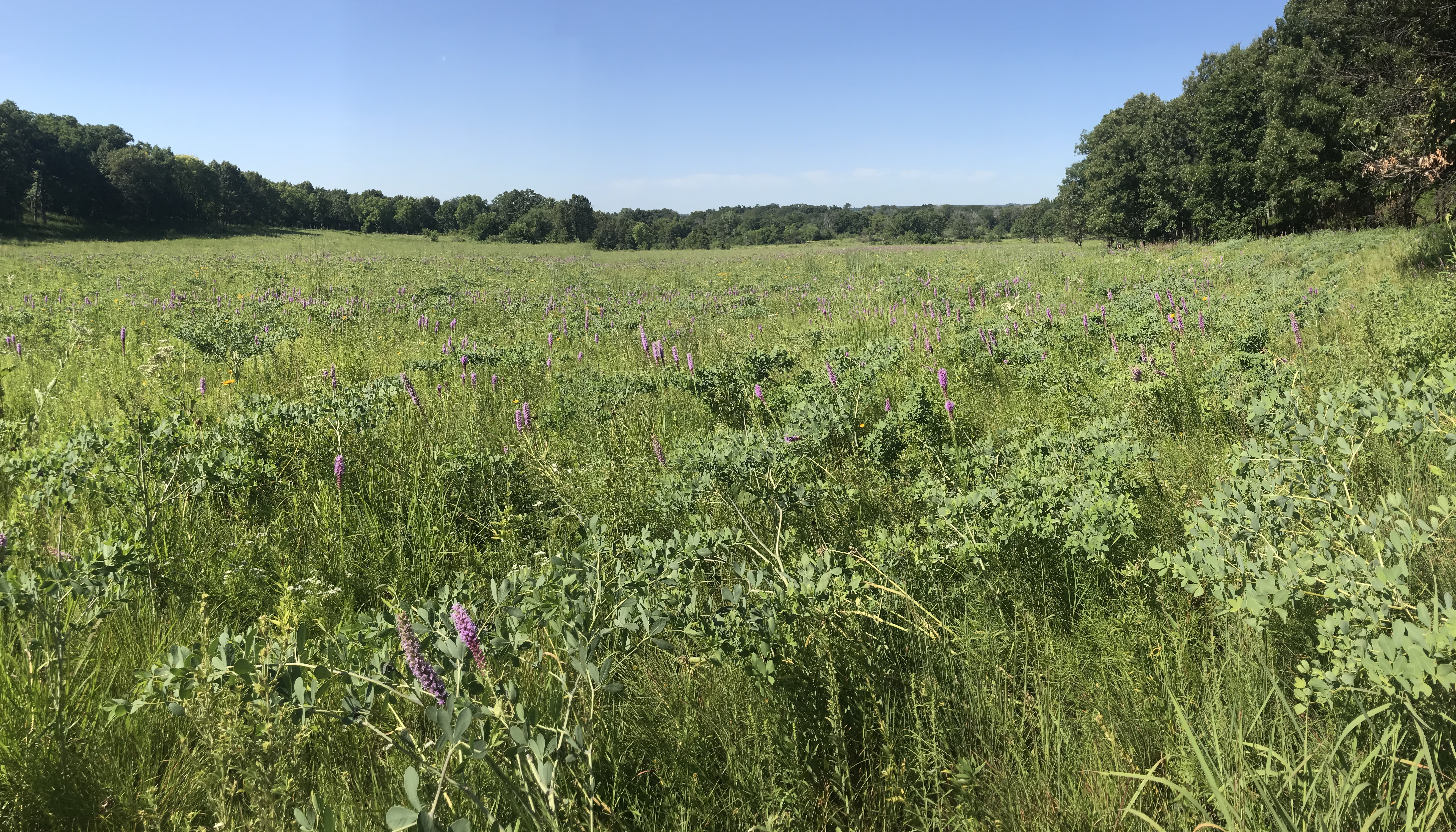
The photo above is from this season of  a 2010 planting, our 97th at Nachusa Grasslands.  There is a lot of gayfeather and white indigo. Harder to see are the thimbleweed, coreopsis, lupine, various sedges and grasses.  It looks great but Cody and I  thought it might turn out dull.

The well drained silt loam soils were planted with hay from 2000 to 2005, then converted back to corn until we planted the field to prairie in 2010.

We were concerned that the seeds and roots of the hay field were going to show up and swamp our prairie seeds.  We discussed only planting seed from combined prairies.  This would have been easy to obtain but lower diversity.
We ended up deciding to plant the full monty of hand harvested seed.  We  planted 134 species at 50 pounds per acre of bulk weight of seed. This weight includes chaff and stems.

This is in our Stonebarn Savanna unit. Here is a link to the planting summary we wrote back in 2010.  It has the species lists, techniques used, map, soil map, etc.:

http://www.nachusagrasslands.org/uploads/5/8/4/6/58466593/planting_97_-_2010_-_tellabs_prairie_east_and_west_-_tellabs_prairie_savanna_unit_-_crew_-_c_considine_and_k_schmidt.pdf


Posted in Uncategorized | Tagged , , , , | 1 Comment

Propagating false toadflax, Comandra umbellata

by Bernie Buchholz, Steward at Nachusa Grasslands

Bastard toad flax (Comandra umbellata) is a hemi-parasitic plant prominent in most of the remnant prairies at Nachusa Grasslands.  It is known to lightly parasitize most all of its neighbors.  Despite collecting thousands of seed over the past 20+ years, we have had virtually no germination in our plantings.  We tried every imaginable combination of scarifying and stratifying, various planting depths and addition of soil from existing stems.

We decided to try a genetic rescue.  We’d move pollen from one population more than a mile to the receiving population and hope the resulting seeds would germinate.  The biggest challenge is that Comandra flowers are a few millimeters across.

With high precision tweezers under a microscope my wife harvested tiny pollen bearing anthers.  She then delivered it to the stigma of the receiving flowers that had been previously bagged with nylon netting to prevent the regular pollinators – flies and small bees – from beating us to it.  I held each stem against the wind, and she dabbed the stigmas with pollen, carefully avoiding the five surrounding anthers.

We’ll soon collect the resulting fruits, plant them, and hope to see seedlings next Spring.  In the meantime, the Chicago Botanic Gardens is looking for mycorrhizae associations among the various populations and a separate genetic analysis to determine if the Comandra is all part of a mammoth clone or distinct populations that we might cross pollinate.

2005 crew at Nachusa who collected Commandra and Stipa.

Update: Our limited experiment of twenty-five transfers yielded only a single fruit. But Emma Leavens, the researcher from Chicago Botanic Gardens, subsequently determined that some of our Comandra populations are significantly different genetically from others. We will use that information next year to select the most promising matches for cross pollination when we try a larger sample.

Posted in Uncategorized | Tagged , | 4 Comments

Baseline vegetation survey linked to photos

By Bill Kleiman

For a recently protected tract I developed a baseline vegetation protocol that seems doable, statistically sound, understandable, and visual.

First I created numbered sequential random points.  There is a way to get GIS to randomize these points but I learned that later.  What I did was lay this aerial photo over a piece of cardboard and used a pin to make random holes.  Then I used GIS to enter the points by eye.

Then the team uploaded this map to Avenza maps app on our tablet.

The survey team walked to where they were hovering over each point on the tablet.  They placed a meter square quadrat and recorded species and cover.

Then they took a photo looking down and a photo looking north.  We used a range pole with numbered tags.  Example photo below.

Here is a link to a summary of the first baseline we did using this protocol:  https://www.middlerockconservationpartners.org/vegetation-baseline-survey.html

Posted in Uncategorized | Tagged , , , , , , | 1 Comment

Seed drier

by Bill Kleiman, Nachusa Grassland Project Director

Updated April 2025

At Nachusa we hand harvest with scissors and buckets several thousand pounds of seed from a few hundred species of plants.  When we bring in our seed it typically needs some time to dry so it does not mold.  We have found that blowing in a small amount of air into a barrel of damp seed will dry it out quickly.  We have 51 drier tubes to dry 51 barrels of seed at one time!

This system is on its second year and we like it so I made a document if you want to build your own.  We placed this document about in 2020 on NachusaGrasslands.org in the Stewardship tab at https://www.nachusagrasslands.org/seed-drier.html

But I will add some photos below that I took in 2025 that might help you build one.

An HVAC contractor can easily install the dryer duct. Note we hung the rack high so you don’t hit your head. We mounted the duct more towards the back to be less in the way.  Hang more tubes than you think you need as they will all be use at high seed season.  

This “PVC 1.5″ extension tube solvent” proved handy. My HVAC contractor bought us a box of them. Note that they flare out a touch on both ends. We cut the tube in the middle.

By coincidence, one half slides inside the black pipe snug enough to not require a clamp. The black tubed is suction hose used on central vacuum systems. You can buy 100 foot rolls of this online. The tube is smooth on the inside which means it won’t whistle as it would if the ridges were on the inside. We tried cheaper sump pump hose but it whistled crazy loud.

The other half of the white PVC slides into the top of the hose. Here we used a hose clamp. The flared end is inside the metal duct. The hole in the duct is drilled just the right size so the flared end supports the tube. Your contractor will have drill bits to make these holes fast. You want to dangle a lot of hose.

The reason for the flared PVC piece previously seen is that is slides into this drier stick fitting. This allow the black drier tube to quickly attach to the barrel of seed to be dried. The drier stick is what goes in the empty barrel that you will dump your damp seed into. This is standard 1.25″ PVC. I purchased the 5 way fitting at bottom online. Glue the pieces together and drill a lot of holes in them to move the air.


The fan I ended up using on this system has the motor inside the squirrel cage fan which helps keep the motor cool. This is important because the fan runs a 24/7, not on and off like on your home HVAC. This model is a Dayton 1XJY1 1/2 hp 1060 RPM 115V Furnace Blower. About $500

Total cost for fan $500 , metal duct installed $600, say 200 feet central vacuum hose $800, and $300 for pvc fittings and pipe. Total is $2,200.

Posted in Uncategorized | Tagged , , , | 1 Comment