By: Clara Barton
Basal bark treatment is one of the most effective methods for controlling invasive Amur honeysuckle, but it is not unusual to find treated shrubs that continue producing living shoots for weeks or even months after treatment. Should these plants be left alone to die from the original treatment? Or should they be sprayed with a follow up treatment? During the summer of 2026, I tested two follow-up herbicide treatments on surviving honeysuckle resprouts to determine whether additional treatment could improve control and reduce the risk of long-term survival.
Key Takeaways:
- Basal bark treatment continued to kill many resprouting shrubs long after application.
- Glyphosate eliminated surviving resprouts faster than any other treatment tested.
- Crossbow was effective but acted more slowly.
- Most untreated resprouts eventually died, though some remained alive and one continued producing new growth.
- Follow-up treatment may not be necessary for every resprout, but it can speed control and reduce uncertainty.
Background
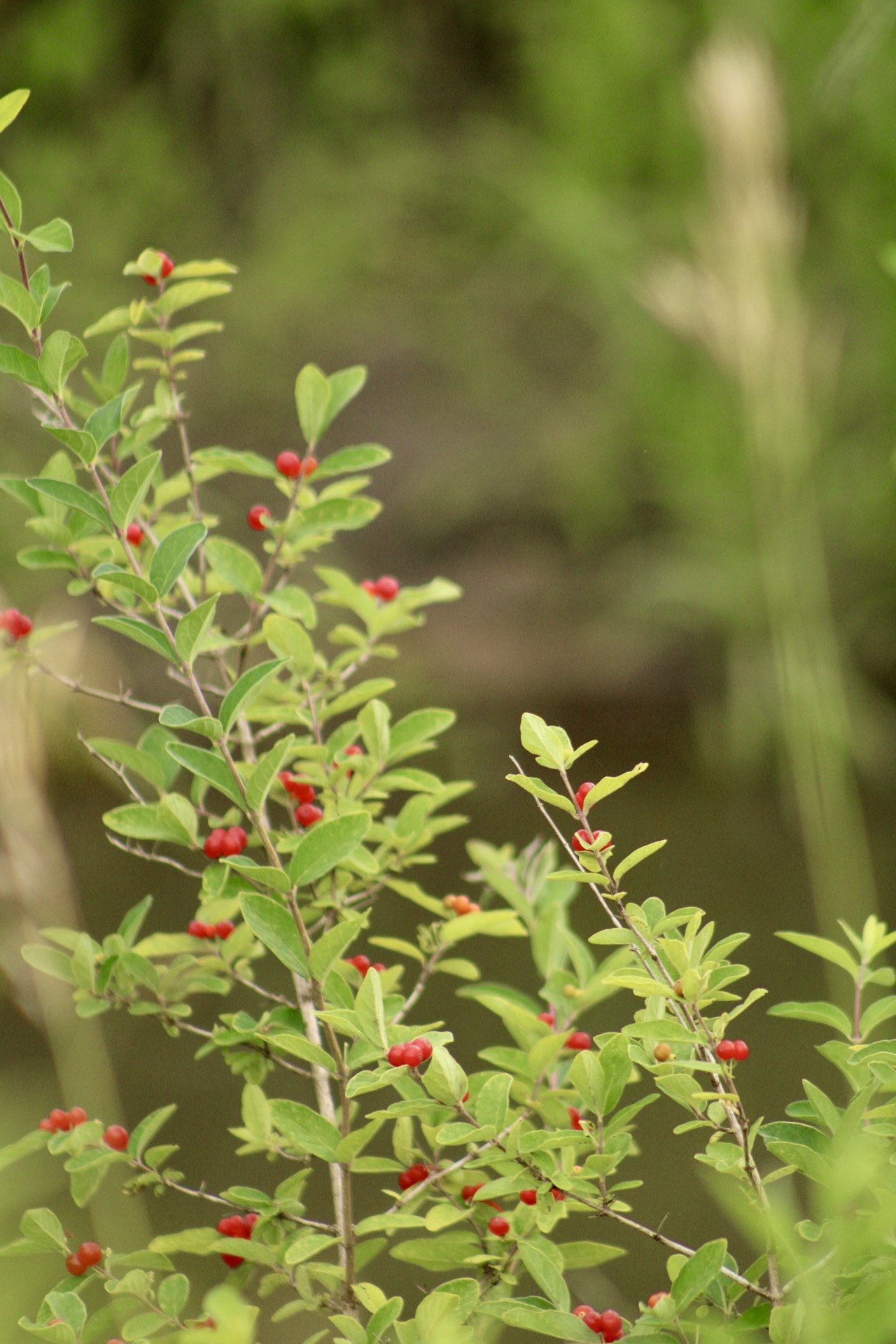
Amur honeysuckle (Lonicera maackii) is one of the most troublesome invasive shrubs in Midwestern woodlands. Its ability to leaf out early, retain leaves late into the fall, and form dense thickets allows it to outcompete many native woodland plants. Fortunately, we have several effective tools for controlling it, including basal bark herbicide treatments.
Previous research conducted at Nachusa Grasslands found that basal bark applications of triclopyr resulted in approximately 98.4% mortality of treated Amur honeysuckle plants (Hogan et al. 2024). The study also showed that many treated shrubs continued to leaf out and appear alive for some time after treatment before ultimately dying.
While monitoring previously treated areas at Oak Corners, I noticed several honeysuckle shrubs producing living resprouts despite having already received basal bark treatment. These observations raised a practical management question. If a plant is still producing resprouts after treatment, is it worth applying an additional herbicide treatment, or is it better to simply allow the basal bark treatment more time to work?
More specifically, I wanted to know whether treating surviving resprouts could improve control, reduce the chance of recovery, and shorten the amount of time managers spend monitoring plants that appear to have survived.
Blog post summarizing paper: A Study on Controlling Bush Honeysuckle | grassland restoration network
Experimental Design
On June 11, 2026, I selected and marked thirty honeysuckle plants with visible resprouts at the experiment site. All plants had previously received a basal bark treatment but were still showing evidence of survival.
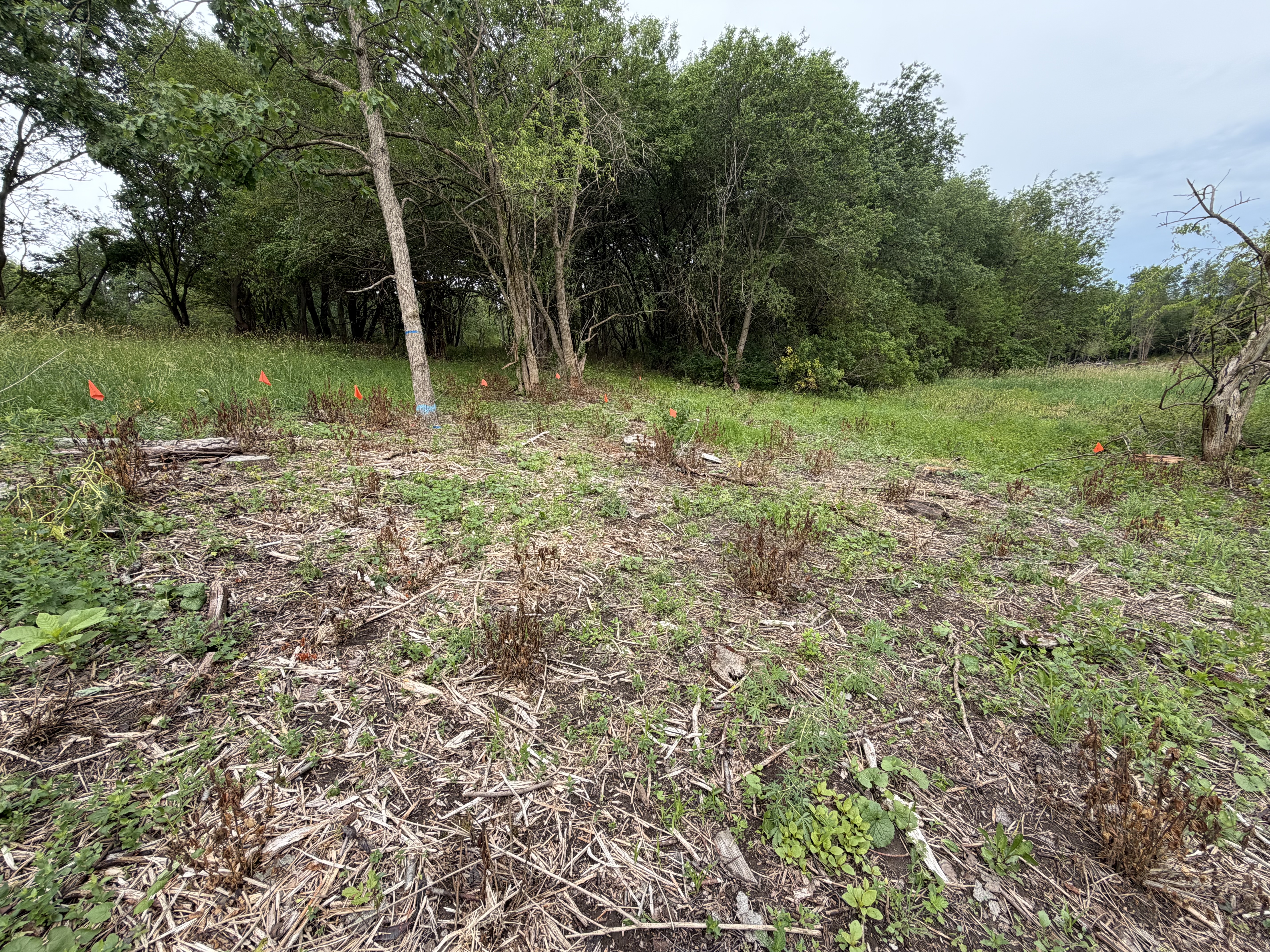
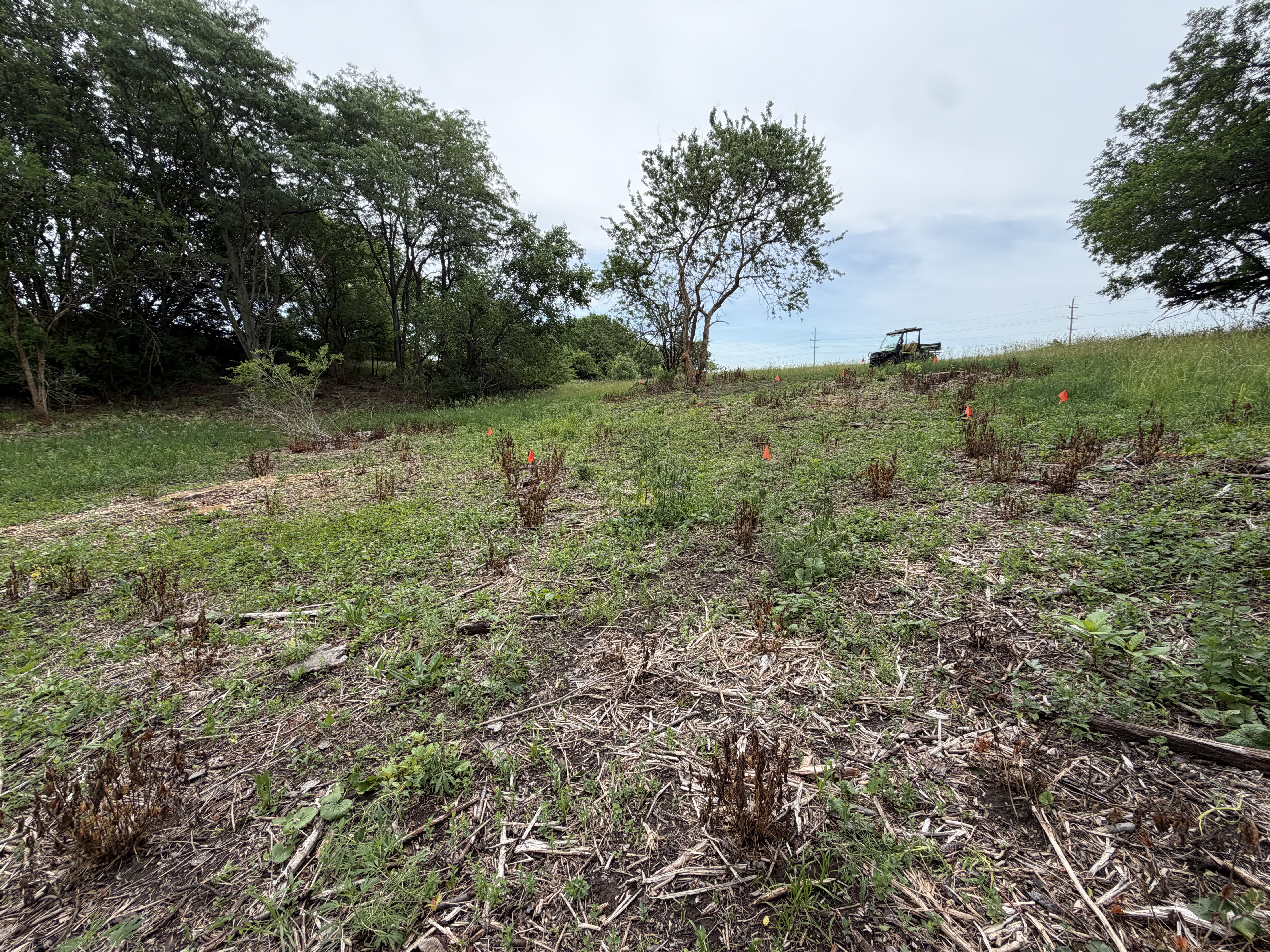
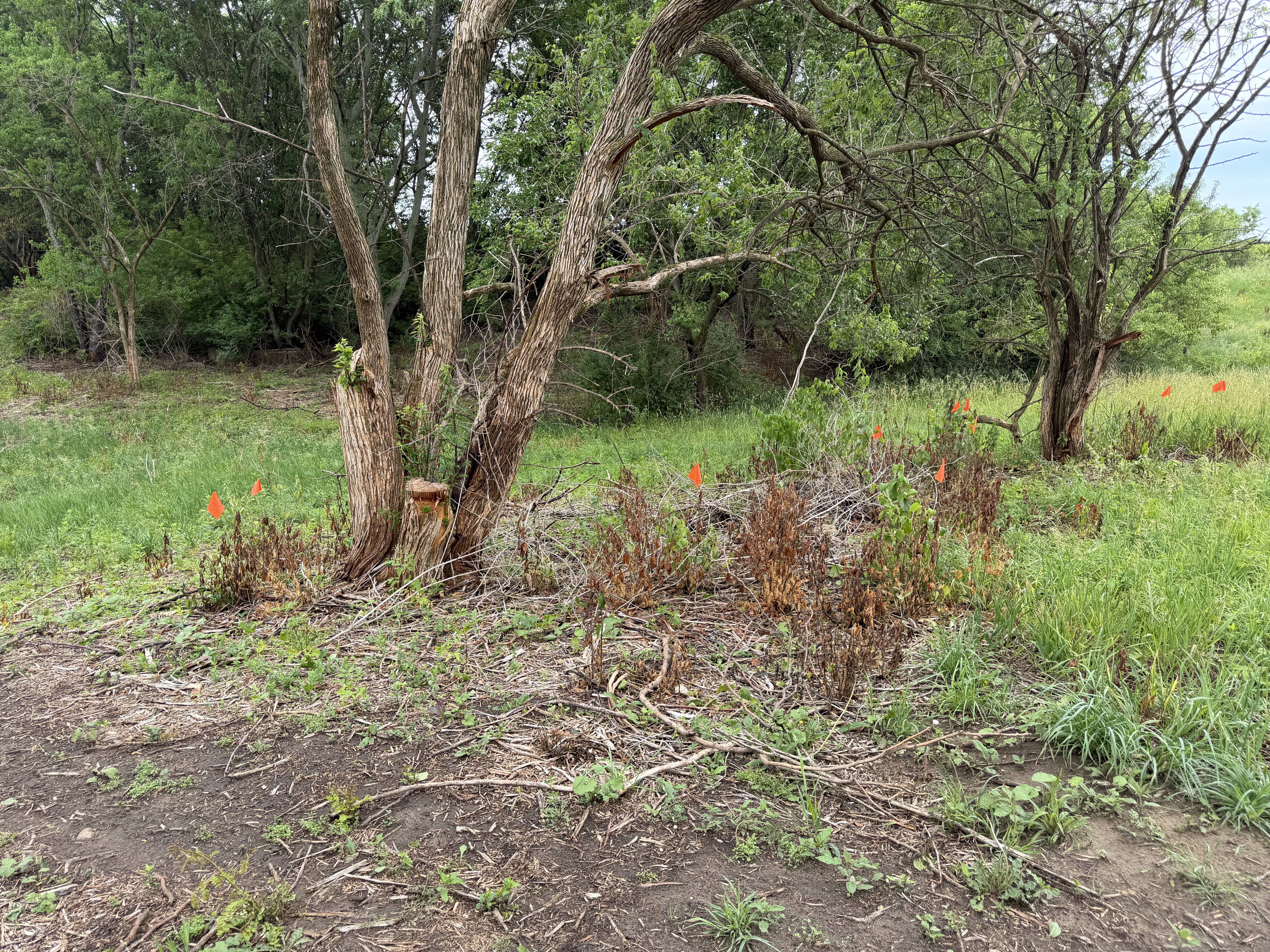
Each plant was marked, flagged, photographed, and assigned to one of three treatment groups:
| Treatment Group | Number of Plants |
| Control (no additional treatment) | 10 |
| 3% v/v glyphosate + 0.5 oz/gal LI-700 | 10 |
| 2% v/v Crossbow + 0.5 oz/gal MSO | 10 |
Results
Key Findings
- Glyphosate achieved 100% mortality within 10 days of treatment.
- Crossbow achieved 100% mortality within 24 days of treatment.
- The control group experienced 70% mortality during the monitoring period.
Monitoring revealed differences among the treatment groups within the first ten days after treatment. At the initial assessment on June 22, all glyphosate-treated plants were dead, while approximately 60% of the Crossbow-treated plants had died. Most control plants remained green and alive at that time.
By July 6, all plants in the Crossbow treatment group had died, resulting in complete mortality for both herbicide treatments within the first month of the study. In contrast, mortality in the control group occurred more gradually throughout the summer. Some control plants steadily declined and died, while others remained alive for the duration of the monitoring period.
During the final assessment on August 18, three control plants remained alive. Two appeared largely unchanged from earlier observations, while one continued producing vigorous new shoots despite having previously received a basal bark treatment. I believe two of these plants were on their way out, but I had to stop monitoring these plants due to some contractor work that was beginning in the area. The remaining surviving plants were treated with herbicide on August 24th 2026.
Discussion and Conclusions
This experiment builds upon previous honeysuckle research conducted at Nachusa Grasslands, but it addresses a different question. Hogan et al. (2024) evaluated the effectiveness of initial basal bark triclopyr treatments and found approximately 98.4% mortality across nearly 800 treated Amur honeysuckle plants. The shrubs included in this experiment had already received a basal bark treatment and were selected specifically because they still contained living resprouts. As a result, this study was not designed to test whether basal bark treatment works, but rather what should be done when a treated shrub appears to survive.
The control plants in this study help reinforce the findings of Hogan et al. Several shrubs that still had living stems and resprouts early in the summer gradually declined and died over the course of the monitoring period. These observations suggest that the original basal bark treatment was continuing to work long after the initial application and that the presence of living foliage or resprouts does not necessarily indicate treatment failure. Glyphosate and Crossbow both accelerated mortality. Glyphosate-treated plants reached complete mortality within ten days, while Crossbow-treated plants reached complete mortality within several weeks. The control plants followed a much slower trajectory, with mortality continuing throughout the summer. The control group also raises an important question about retreatment. Seven of the ten control plants died during the study without receiving any additional herbicide. Given that observation, immediate retreatment of every resprouting honeysuckle may not always be necessary. In some cases, allowing more time for the original basal bark treatment to work may be a reasonable approach, particularly when time and resources are limited.
Not all resprouts behaved the same way, however. While many control plants gradually declined, plant #5 from the control group continued producing vigorous new shoots throughout the study. This suggests that follow-up treatments may be most valuable for plants that continue generating new growth or remain alive long after surrounding treated plants have declined. Waiting to see which plants persist may help identify the individuals most likely to benefit from additional treatment.
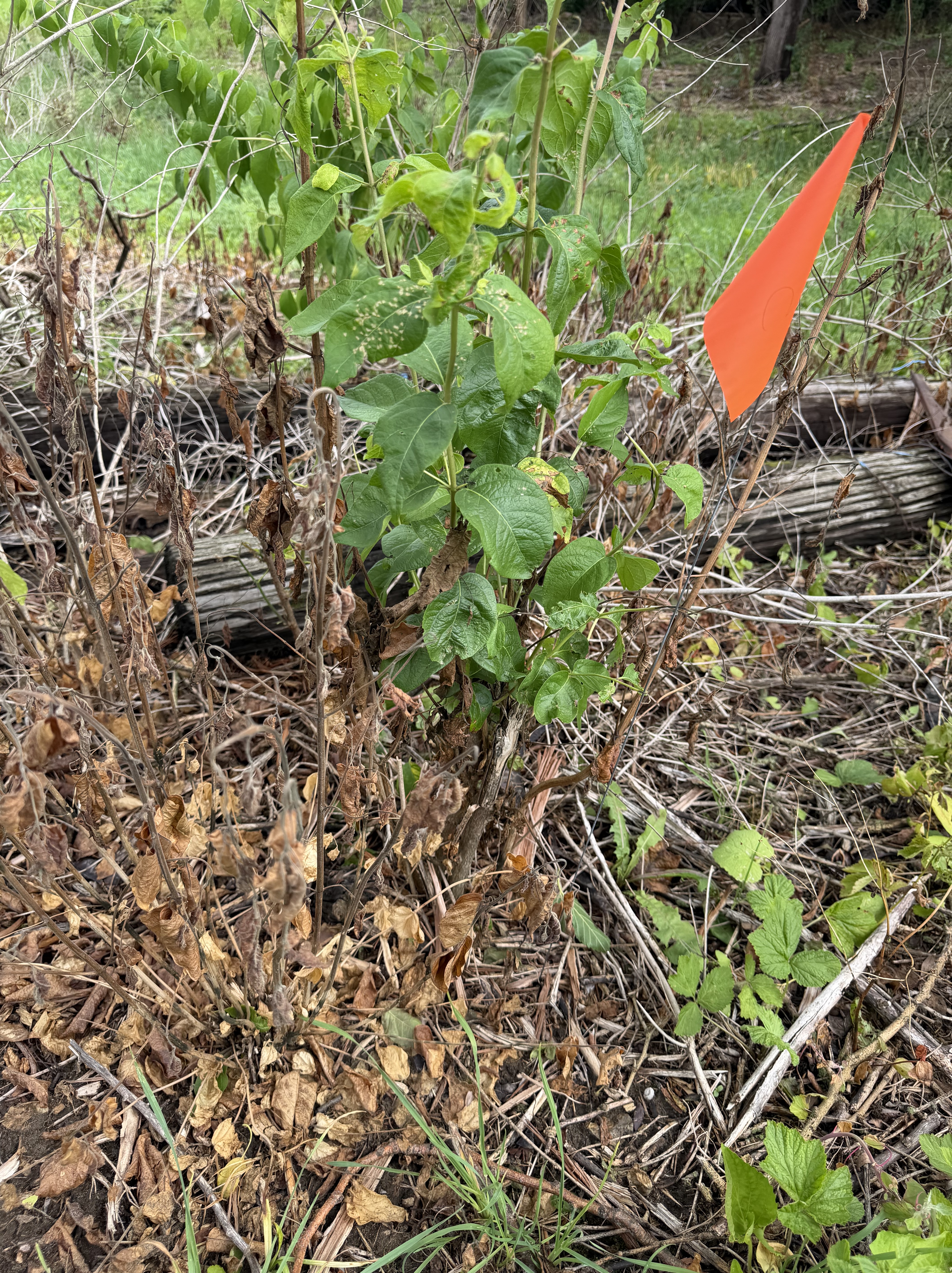
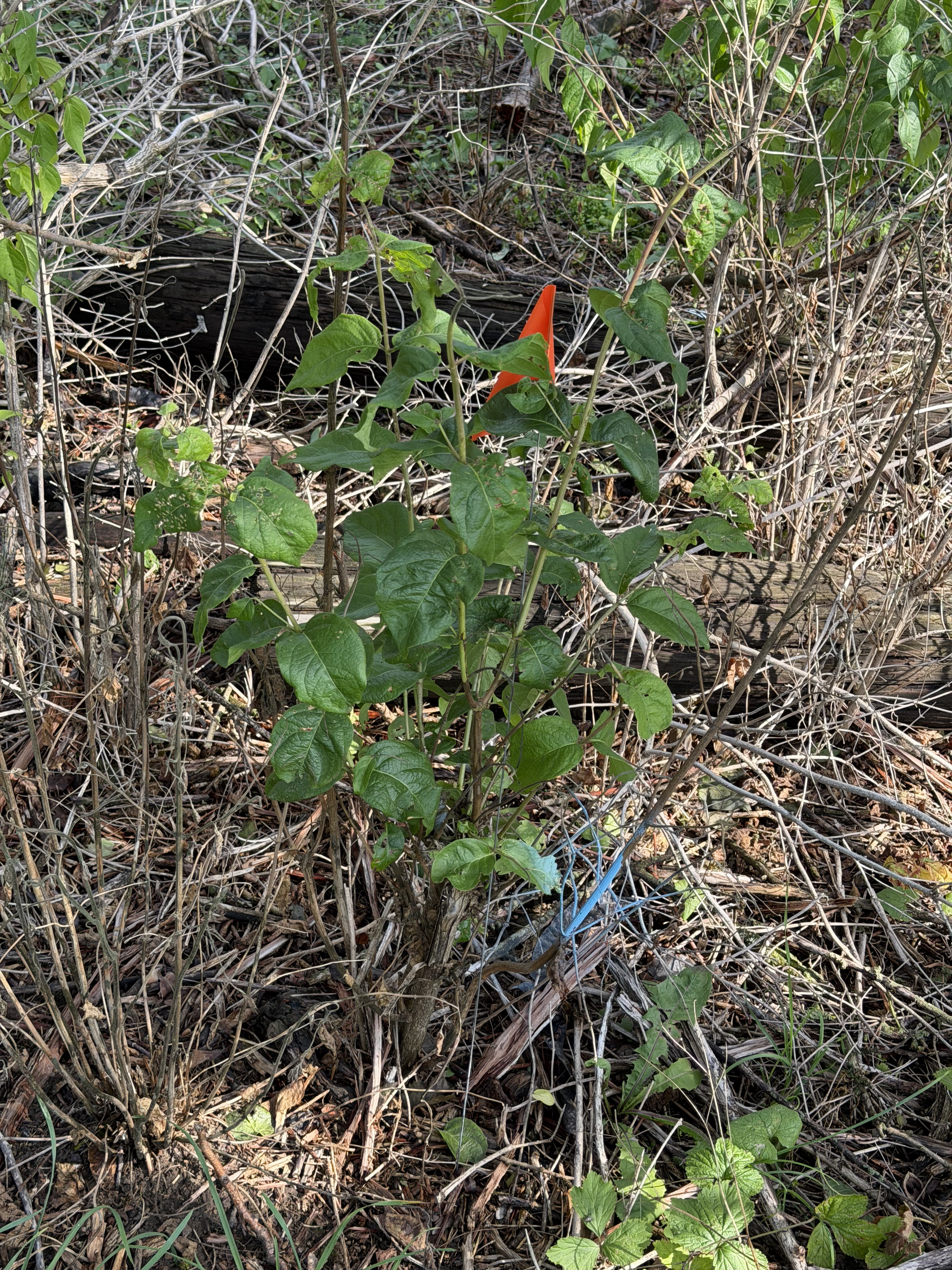
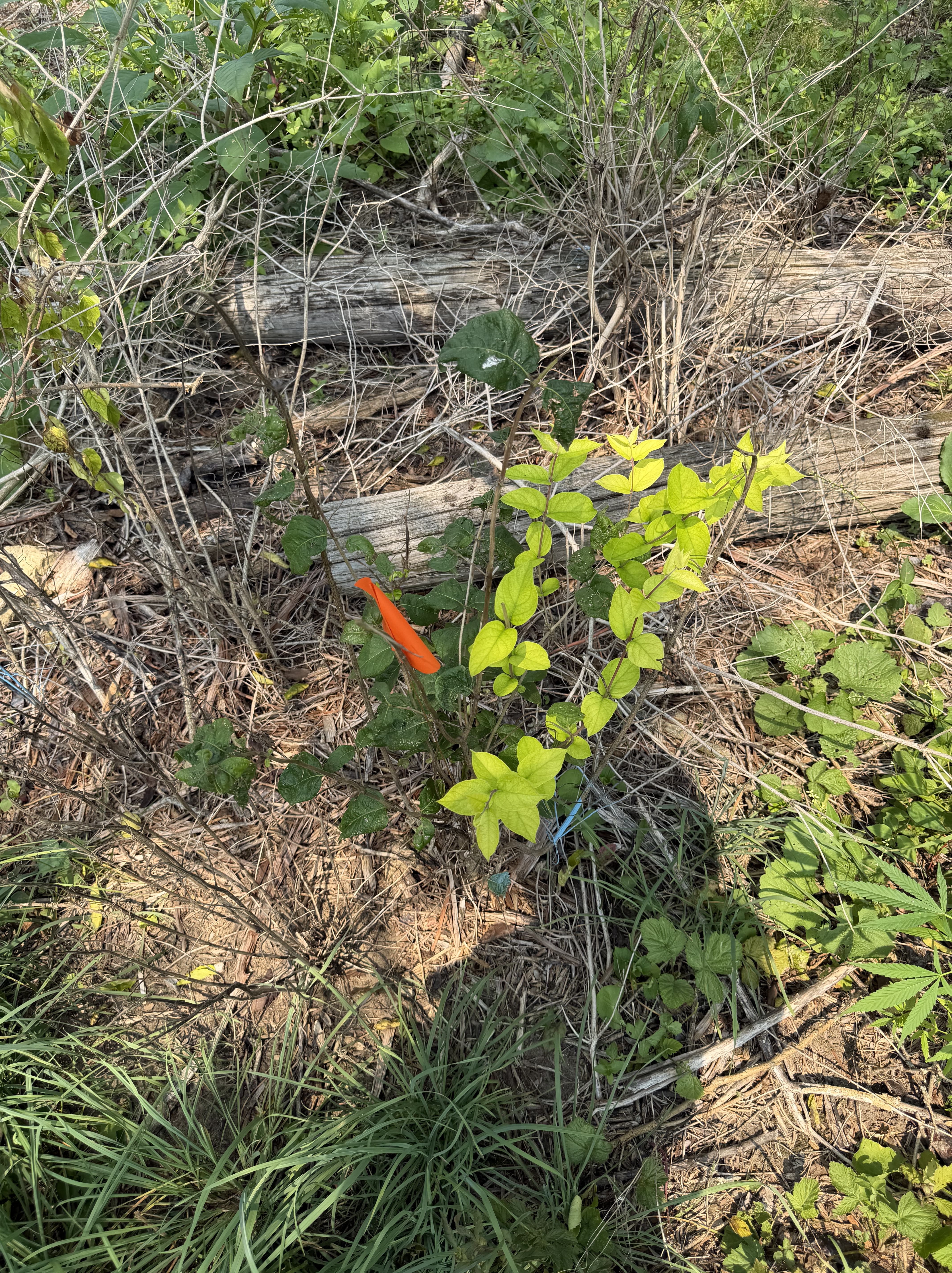
Both follow-up treatments improved control of surviving resprouts, and glyphosate provided the fastest response. At the same time, the control group demonstrated that substantial mortality can continue to occur months after a basal bark treatment has been applied.
Study Limitations
This experiment included only 30 plants within a single management area and was monitored for one growing season. Additional monitoring would be needed to determine whether the remaining control plants ultimately die or continue producing new growth.
Further Readings on Basal Bark from the GRN
- Basal Bark Herbicide Treatments for Invasive Shrubs – the Type of Oil Carrier Matters! | grassland restoration network
- Post-Burn Basal Bark Treatments: A Game Changer for Invasive Shrub Control | grassland restoration network
- Invasive Shrub Treatment Methods – Cut Stump and Basal Bark Comparison | grassland restoration network
- A Study on Controlling Bush Honeysuckle | grassland restoration network
- A family affair: Successful control of invasive honeysuckle with basal bark herbicide | grassland restoration network
Reference
Hogan, K. F. E., Baker, K., Bach, E. M., & Barber, N. A. (2024). Basal bark herbicide treatment of Lonicera maackii (Amur honeysuckle) is effective regardless of application timing, with limited nontarget effects on native plant diversity. Ecological Solutions and Evidence, 5, e12332. https://doi.org/10.1002/2688-8319.12332


The green ash (Fraxinus pennsylvanica subintegerima) that was growing in the parkway in front of my house was cut down and herbicided in the fall of 2012. This year (2026) after disappearing for 14 years, it suddenly re-emerged with vigorous growth! The roots of “dead” woody species apparently can just be dormant for a long time. The follow-up monitoring of each of the “dead” honeysuckle plants ought to be extended for several years.
Interesting thank you for sharing this information and doing the research.I have a couple questions. My first question is when were the plants originally treated? So what season and then how much time elapsed before starting the study.My second question is how sure are you that the basal bark application was applied to all the ones that appeared to survive
Thank you for your questions. The plants were originally treated in the spring, a little over a month before this study began. These were younger honeysuckle plants in an area being prepared for planting, so considerable management work had already been done to remove existing invasive plants. The shrubs selected for this study were mostly defoliated, with only one or two living branches or resprouts remaining. Combined with the visible “rings of death” around many plants, I was confident they had received a basal bark treatment.
As for the plants that survived, I suspect two of the three remaining control plants were still in decline and may have eventually died as well. They were barely hanging on but still retained some green tissue. Unfortunately, I had to end monitoring because logging operations moved into the study area. Plant 5 was the exception. It began producing new resprouts late in the study, despite clearly showing signs of having been basal bark treated. It is possible that plant did not receive complete herbicide coverage during the original treatment, although I cannot say for certain. I did end up spraying the three remaining plants when I removed my flags, so unfortunately I’ll never know exactly how they would have responded given more time. It would have been interesting to see whether they ultimately died on their own or continued to recover.
Thanks for the info. Has anyone put together a book on this stuff? It’d be nice to have a go-to reference in one place for management issues. Also, how do you do basal bark treatments? It sounds like they are a good choice for many invasive shrubs but I haven’t seen exactly what it means. Suzanne
You ask the right question about a book or website that summarizes the info restorationists need. Such knowledge is stored in people’s heads, in peer reviewed studies, newsletters, internal agency documents, blogs, conference proceedings, youtube videos & a few books. Not an ideal situation.
For herbiciding, check out my article at
https://woodsandprairie.blogspot.com/2023/08/bringing-your-game-to-herbiciding.html
For restoration in general, books useful to practitioners are few. The “Tallgrass Restoration Handbook” by Packard/Mutel is excellent but needs updating. It covers prairies, savannas & woodlands. “A Healthy Nature Handbook” edited by Pepper/Parker is useful for certain subjects. I haven’t read “Restoring Ecological Health to Your Land” by Apfelbaum/Haney but it looks promising. Expensive books with “restoration” in the title are often too theoretical or they highlight case studies which probably won’t apply to your habitat. The challenge with such books is a given management plan or method may work at one site but not at another with a different microclimate, land history, degradation level & community type. So it’s hard to summarize info in a way that will apply to a broad geographic area.
ThanksOn Sep 11, 2026,
What is a basal bark treatment? It is the application of liquid herbicide to and around the stem of a thin shrub or around the trunk of a tree at or near ground level. For trees with thick branches within reach of the ground, herbicide is also often applied to them around the juncture as well. For a cut stump, herbicide is applied just to the outer bark or cambium layer. For honeysuckle or multiflora rose it is often applied just to the root knob at ground level.
How is it done? The herbicide can be applied with a variety of different “tools:” a squirt bottle or chemical wash bottle, a sponge tipped brush (or for very rough surfaces a normal brush) dipped into an open container of herbicide, even a backpack sprayer set to a narrow spray, not a wide spray. How open or confined the work area is determines the most suitable tool for the task.