By Bill Kleiman
This is a continuing update on an original post. At the end I post several links to related articles on controlling reed canary.
It is good to do simple monitoring or testing to see if a weed treatment you are using works. I will describe the simple way I tested a herbicide treatment. I retreated this patch and found it did brown it out, but then a year later the plants were still alive but weak looking. Read on.
On May 30, 2024 I sprayed eight distinct mature patches of reed canary grass (Phalaris arundinacea) with clethodim herbicide. Each patch of reed canary was about six feet in diameter, the plants 3 to 4 foot tall, and in flower. So their big growth spurt was done for the season.
As I have read, it is recommended to apply clethodim when the plants have emerged several inches and are actively growing. I have tested this and it works pretty well. I was hoping for a longer application window by spraying more mature plants. Would that work?
The herbicide mix was 1.5% Intensity (clethodim), ammonium sulfate crystals (three cups added to a 50 gallon mix), and a half ounce per gallon of methylated seed oil.
In each of the eight patches I drove in a four foot tall fiberglass rod. The rod could withstand a fire and be noticeable a year later. The rods worked well.
I sprayed the patches so the milky herbicide mix was starting to drip off.
I recorded this information into Field Maps.
I made a calendar reminder for a year later to look at the results.
I looked about a year later on May 28 2025 and all eight patches looked very healthy. The clethodim did not control reed canary grass that was applied when the plants were mature. Hmm. Did I forget to add something to the mix? Is an end of May application too late. See Juli Mason’s post where she found late applications to reed canary were showing control.

I tried a second application. The next day, May 29, 2025, I did make a new clethodim mix and re-sprayed the same 8 patches of reed canary to see what happens. Below are two photos of those patches about six weeks later on July 19, 2025. They are clearly top killed. I was surprised. Top killed but are the roots dead? I will leave the fiberglass rods in them and check back in May of 2026 and report back.
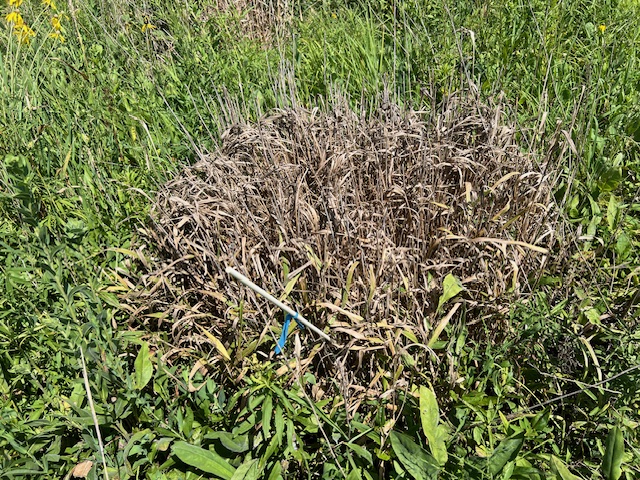

On May 10, 2026 I returned again to spray clethodim in this unit and I found half a dozen of my fiberglass rods still in clumps of live reed canary. All of those reed canary were there and alive, but diminished compared to those around them. The below photo shows two RCG clumps that I sprayed a year previous. These two happen to be pretty robust, but not as healthy looking as others nearby.
Overall, I like clethodim grass herbicide because it is not killing the forbs and sedges. I have seen areas that had a lot of RCG diminish and allow other plants to take over. In this particular case maybe I should have carefully applied glyphosate from a backpack. This is a new planting into a retired corn/soy field and the pattern is that you will see clumps of plants that are doing very well in a small patch. After six years of this new planting you might see a three foot circle of pussytoes, Antennaria plantanginifolia. The soil is pretty empty of competing plants and the pussytoes builds momemtum. I imagine a few decades later the pussytoes will be spread out through the planting. Likewise this reed canary grass established in the new planting and it has not spread very far via its rhizomatous roots. Hence glyphosate carefully applied by a backpack might be the best control in this case.
But let’s say the reed canary is covering an acre and there are some sedges growing in among the grass. A broad spray pattern aiming at the grass has yielded in the past a conversion so that the sedges dominate the ground. I can think of one area where the sedges still dominate there after a decade. I know of another area that floods a lot where the reed canary came back within several years of our ceasing grass spraying.
So the usual response to ecological questions, “It depends”.
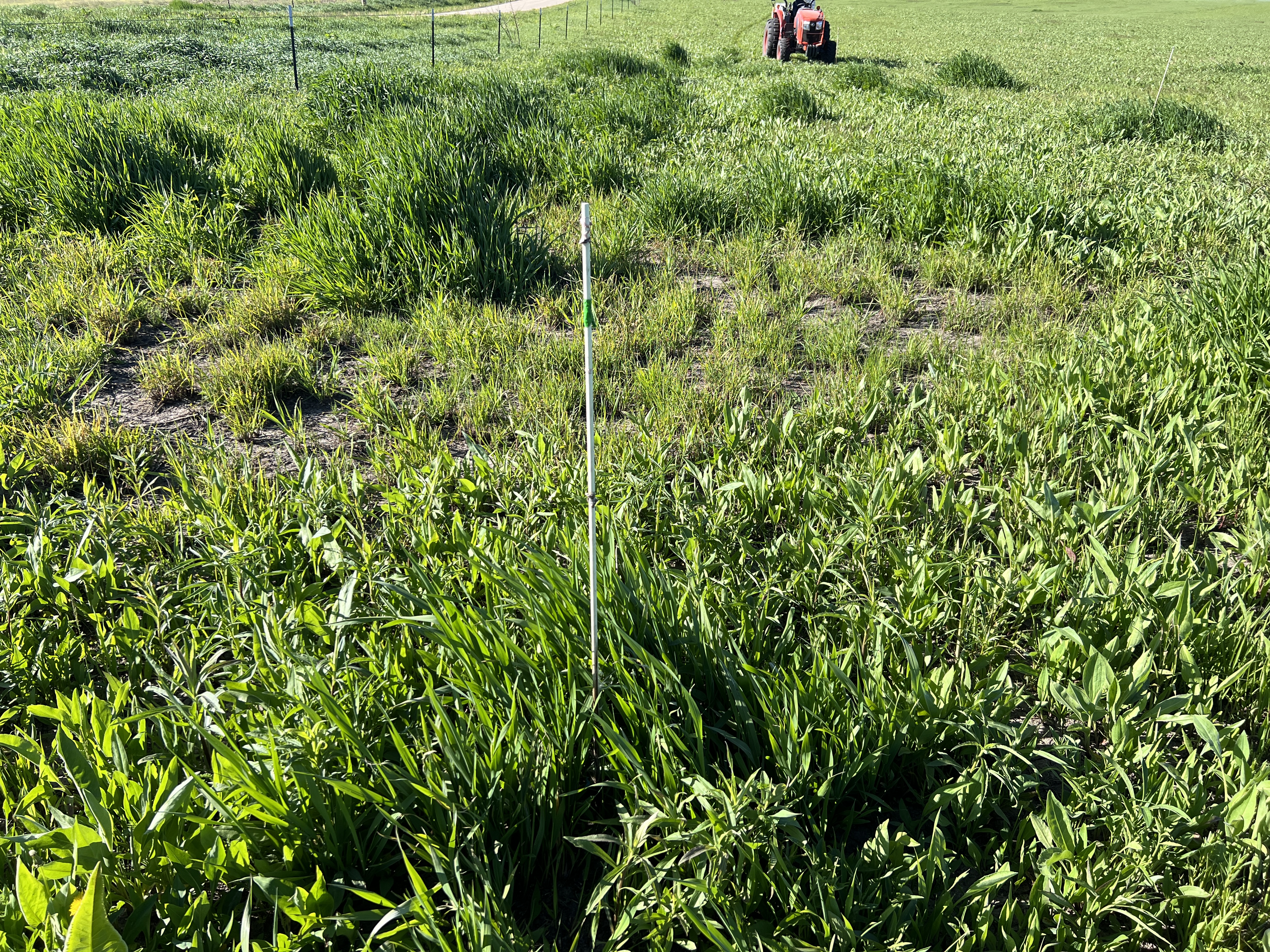
I encourage managers to test out their treatments. It was not hard. It was also not rigorous enough to publish a scientific paper or get a degree.
This GRN site has some great reed canary posts.


Bill, did you happen to check on these clumps last spring after the initial spraying? I would be interested to know if they looked top killed last year after the first spraying as well.
I don’t remember checking on them after my spring spraying in 2024. I should have but forgot.
Clethodim is a weak acid herbicide. Same as Poast, Glyphosate, 2, 4-D, and various others. One implication of this is that if you have hard water…the minerals in the water can bind to the herbicide and render it less potent, less effective. AMS (ammonium sulfate) should counteract the effects of hard water.
Mixing order/procedure is really important. Water, AMS, then herbicide/dye/surfactant. Our crew has sometimes forgotten this and adds AMS at the end of the process…by which point the hard water and weak acid herbicides have already interacted.
I agree you want AMS in the water, and it is the first thing to add. It could be I made an error. In the post I state that AMS was added, but I wrote the post a year after the treatment which makes me consider that maybe I made a mistake in my mix. I will report back next spring.
I weeded a native plant garden for five years. I removed all the reed canary grass by the roots. This garden had no reed canary grass for several years. A few years after I stopped weeding this garden, the reed canary grass again grew in the same place where I had removed it. It is like the soil remembered where the reed canary grass had grown and only let it again establish in those locations. I thought you might find this interesting. Something to consider when you are controlling reed canary grass.
I had some more thoughts on my previous comment. I had thought that maybe the reed canary grass again established in the location because of soil disturbance. I had disturbed the soil when I had removed the reed canary grass by the roots. However, I then remembered that there was construction done adjacent to this garden during Covid. A construction fence was put right through this garden. A shallow trench was dug when the construction fence was installed. It looked terrible. However, it is now years later. The Pennsylvania sedge, wild geranium, and golden Alexanders have now filled in the area where the trench had been dug.
I thought more about why the reed canary grass had returned to the spot where I had eliminated it several years previously. I then recalled that there used to be a bird feeder in the garden near where the reed canary grass had again grown. The lady who volunteered filled the bird feeder everday. The reed canary grass that again grew in this garden appears to be in the location where this lady stood when filling the bird feeder.
Compacted soil could be the reason reed canary grass grew again in the same location in this garden. This is a problem that several years would not have remediated.
You probably know this, but Clethodim is a group 1 herbicide. The whole group is known for some plants in a population exhibiting resistance to it. It doesn’t look like this is what’s happening from your photos, but worth considering. Certainly, if you spray the same patch/field for more than a couple of years with a group 1 herbicide, you may end up with a resistant population, so doing some followup with glyphosate is probably a good idea.
Also, have you tried other group 1 herbicides? Fluazifop is pretty commonly available, it’s unpleasantly toxic and smelly, but (as I understand) a bit more potent/quick than Clethodim (I haven’t actually used Clethodim though)
At Hitt’s Siding, we had a nasty RCG patch around 4000 sf at the north end of the west side right of way that had never been sprayed. The spot finally dried up and we sprayed it in 10/16/2025. We walked the area down this week and nearly 100% kill and sedges and rice cutgrass have filled the area in already. There are no signs of baby RCG coming up either and just a few plants that seemed to escape the spray that look healthy.
We don’t use AMS and MSO but instead use 1% Li-700 (high ph/hardness aquatic surfactant and 0.5% Choice Trio aquatic high hardness conditioner) in addition to 1.5% of the concentrated Clethodim. Prior to the 10/16/2026 spraying, we had same issues with effective kill so using Choice Trio and Li-700 vs. AMS not the reason for October success. We’re thinking it was a timing issue moving carbohydrates to roots and maybe got some “bonus action” with the Clethodim. We have seen improved effectiveness for all foliar spraying since using Li-700 and Choice Trio so there is something to it but not a magic bullet for RCG by any means.
We have some other areas we’re making progress with late summer spraying but cannot risk waiting until October to spray due to risk of rain. These areas had so much RCG, your feet didn’t reach ground while walking in it but now coming in nicely with sedges, rushes, marigolds, bidens, and other plants as the RCG is being diminished.
There was a study done not long ago by a USFS Manager, I am still looking for the study. Fall Clethodim treatments were conducted on Reed Canary grass that had excellent results coming out of the treatment the following spring. There was re-emergence of native plants that were being suppressed by the RCG.
I have not conducted my own trials on this, but her results were very intriguing.
Late-Season Reed Canary Grass Treatments — Forest Service & Research Insights
Late-season herbicide treatments for reed canary grass (Phalaris arundinacea) can be effective if timed to target the plant’s phenology and avoid damaging native vegetation.
Phenology for timing
Late fall applications (e.g., October–November) can still be effective if the plant is actively growing and not yet senescent grasslandrestorationnetwork.org.
Herbicide options