By Bernie Buchholz, Nachusa Grasslands Steward

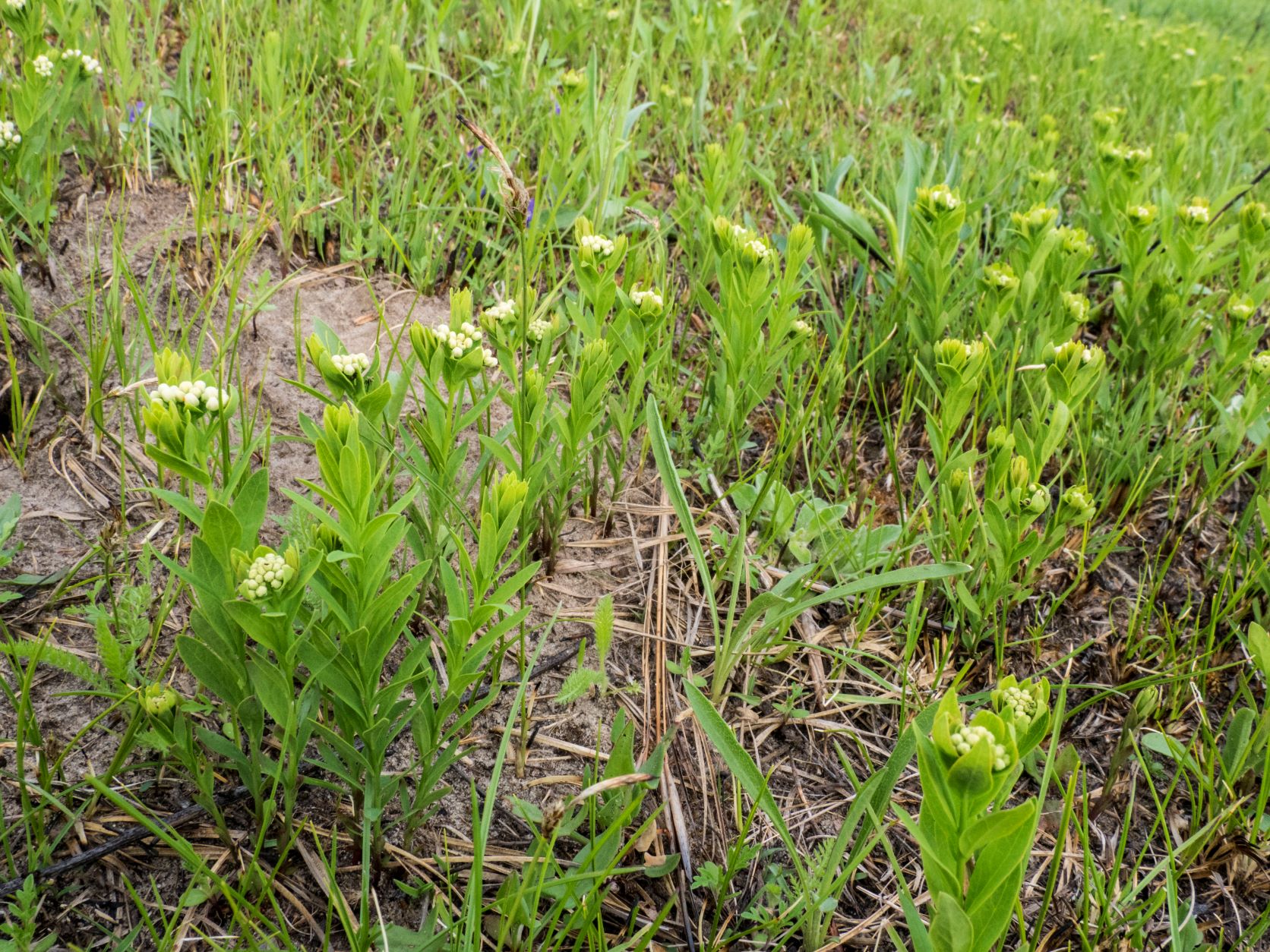
Comandra umbelata (bastard toad flax) is notoriously difficult to grow from seed, but we’ve had success growing it from plugs.

In 2008, we dug five plugs from inconspicuous spots on the edges of a relic prairie, where the grasslands faded into trees and shrubs. We planted them in both a degraded remnant and in a planting. We planted those initial five plugs, they prospered over time and eventually became the source for 175 plugs without putting any pressure on the remnants. It’s been a slow, labor intensive, but very rewarding process.
Here is how the process has worked best in our sandy-loam soils:
- We transplant in both early April, as soon as new growth appears, and in early November when the plants are dormant. You’ll need to mark potential plugs in the summer for fall transplant so you can find them.
- A straight edge shovel is handy for digging nice square plugs. We like them to be about 8” x 8” x 8”, but deeper can be better.

- Since we want comandra to have the opportunity to spread across our entire plantings, we chose to plant them on roughly 25 meter centers. Based on our experience, the plugs might connect in about 15 years. Like I said, it’s a slow process.
- Keeping transplants moist is critical while they get established. That’s why we set the plugs 1.5” to 2” inches below the adjoining surface. Creating this square pool enables us to deliver about a gallon of water with no runoff, both while transplanting and in the following weeks if the weather is droughty. Water your spring transplants before they show dryness. Late watering reduces chances for success. We never water after the first season.
- Reduce the risk of your transplants drying out by applying an inch or more of clean mulch in the “pool” and the edges of the plug where water might tend to escape through evaporation.
- Collect the soil you remove to create the transplant holes and use it to fill where you dug the plugs. The spots where we dug plugs (grown from our original five plugs) and refilled the holes, these areas quickly blend into the adjacent flora and are recolonized by comandra over a period of several years
- It takes about 3 hours to dig and replant ten plugs into nearby plantings and repair the borrow site.
Don’t expect to see much growth the first 2 to 4 years. We celebrate seeing just a couple of surviving stems. The plugs tend to be resilient. We average about 90% survival, although some plugs seem unwilling to expand for quite a while.
Working from seed will ultimately be the way to make comandra a routine part of our plantings. Here is an abstract of recent research into comandra which was funded by Friends of Nachusa Grasslands: science-symposium-abstracts-2019 . Scroll down to Mycorrhizal fungi community and population genetics of Comandra umbellata, Emma Leavens. One of the great joys of spring is to see which plugs send up a few shoots and how much the clones grew from year to year.


Bernie, I continue to be amazed and impressed by all you’ve done and are doing for Nachusa! On top of all you’ve achieved at your site, there’s the fantastic growth of Friends that you’ve spearheaded. You’ve given so much! I feel lucky to have been your friend over these many years. Ron
Sent from my iPhone
>
Ron, you’ve been a great partner since our first days doing stewardship and trying to build the Friends group. Thanks.
Over the years I have dug some plants on organized rescues at sites that were being developed. Some of the plants I intentionally dug were Comandra but I also got some as tag-alongs with other plants. It is fairly easy to suspect a population came from a rescue when it is concentrated in a roughly circular in area. My populations would be 15 t0 20 years old and 20 to 30 feet in diameter.
The growth of your clones seems to support what we see at Nachusa. Have you had any success from seeding them?
Bernie, Our favorite thing to use when we transplant in Texas are restaurant bussing tubs. We buy them in restaurant supply stores. They can keep plants wet if appropriate, they have hand holds, they are about the right weight to lift and carry, they stack well in trucks. They are also good when root balls are all different sizes and don’t fit well into pots.
I was there a few summers back learning from you guys and harvesting a little seed one afternoon. I frequently tell folks and show photos down here about the good things happening at Nachusa.
David
David Mahler
Ecologist, Environmental Survey Consulting
4602 Placid Place
Austin, TX 78731
512-689-3278
http://www.envirosurvey.com
David, restaurant seed tubes are a great tool for safely moving plugs. Thanks for the idea.
It is good that work is being done to establish Comandera umbellata in restorations. I wish people would put effort into establishing Carex meadii and Carex richardsonii too. These sedges don’t require remnant soil and therefore moving transplanting is not required. I have grown these sedges and planted them on a rocky hill with thin worn out agricultural soil. These sedges grew better in this situation than the in the remnant where seed had been collected. What made me think of all this is the grass-like plants in the plugs shown in your picture is Carex richardsonii.
Hi James. Your comment suggests that comandra seed requires remnant soil to germinate. That may be the case. Do you have any literaiure that supports that very logical idea?
No, I don’t have any literature. As you know, Stephen Packard reported that Rob Sulski has germinated Comandra umbellata. However, it seems everyone has had extremely limited success planting seedlings or directly sowing seeds into prairie reconstructions. This makes me believe that remnant soil is not necessary for germination, but rather it is necessary for Comandra umbellata to grow and develop to maturity. Possibly, over a long period of time the exceedingly few Comandra umbellata that have grown in prairie reconstructions will increase necessary mycorrhizae improving the odds for their offspring.
Bill
Have you ever worked with Pedicularis species? We have tried to propagate in a greenhouse without luck. We took half the seed to propagate in the greenhouse and half we put into a reconstruction. Greenhouse = 0 and reconstruction=many specimen. I would love to have more of these hemi-parasitic in our reconstructions!
Pedicularis lanceolata has come up from seed and spread into big patches in various prairie plantings.