Part 2 – Soil Residual Effects of Herbicides
By: Julianne Mason, Restoration Program Coordinator, Forest Preserve District of Will County
To preserve or restore native plant diversity and community integrity, it’s often necessary to apply herbicides to kill invasive plants. However, using herbicides can cause collateral damage to the native plant species that we’re trying to protect. In addition to direct collateral damage, I have begun to appreciate how the soil residual effect of herbicides can inhibit establishment of the native species that we’re trying to restore.
We spend a lot of money and crew-hours purchasing or collecting seeds of native plants to restore native plant diversity. However, I have seen many examples of where we have gotten almost no native plant establishment from these seedings. I started to consider the mechanism of how herbicide use to control invasive plants may be implicated in the lack of success of the seedings.
In a recent mesic prairie restoration project in northeastern Illinois, the PBP project area had been sprayed with Milestone herbicide (aminopyralid) to target Canada thistles (Cirsium arvense). Before I spent a hundred thousand dollars on native seed, I wanted to make sure that the residual herbicide level in the soil was low enough to allow the native seed to establish.
In another prairie restoration area in northeastern Illinois, we boom sprayed the MRP project area twice with Transline herbicide (clopyralid) to target teasel (Dipsacus laciniatus) and birdsfoot trefoil (Lotus corniculatus) before seeding a mesic prairie mix. I wanted to know why the seeding didn’t establish, and whether the residual herbicide level in the soil was low enough to try overseeding natives again.
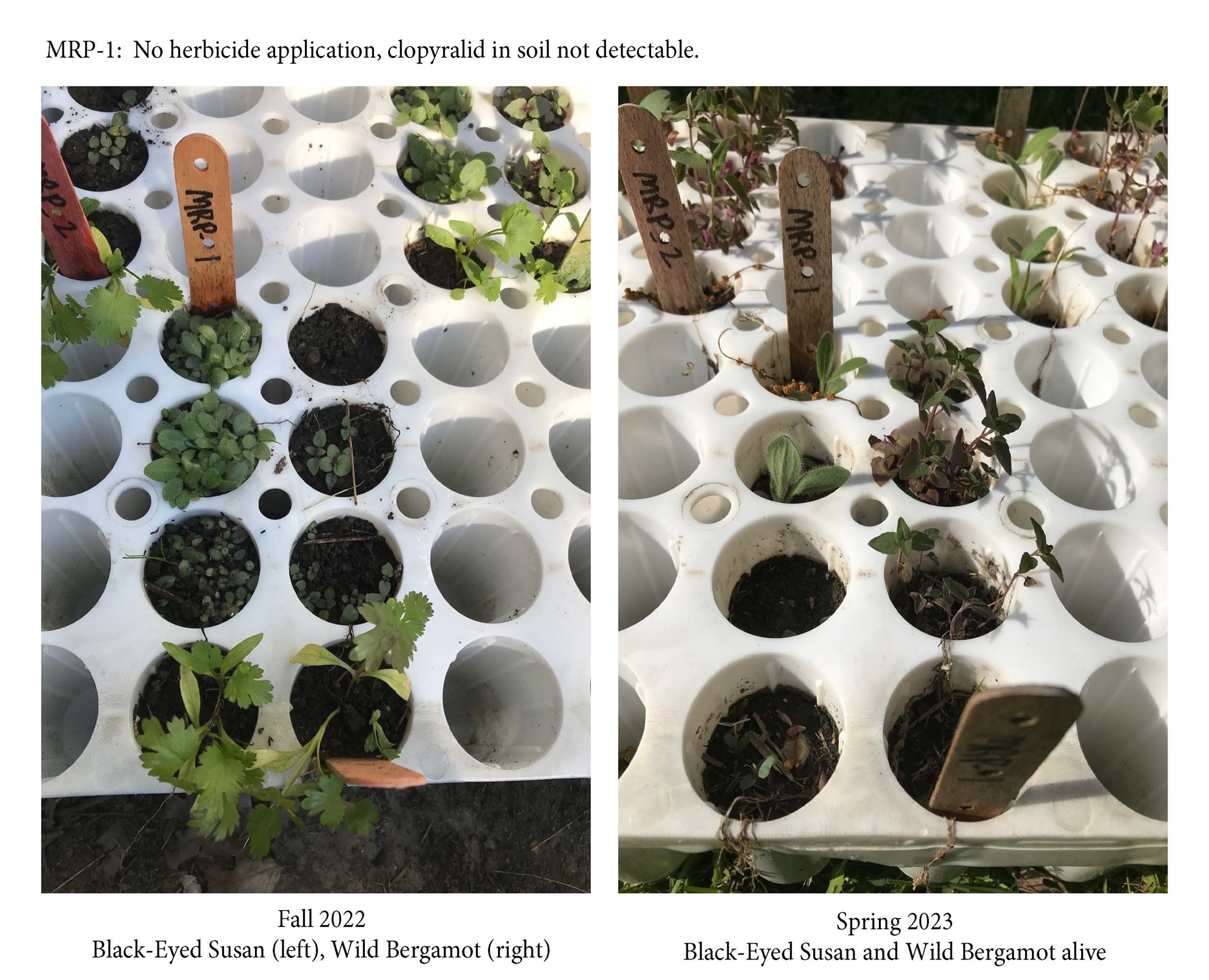
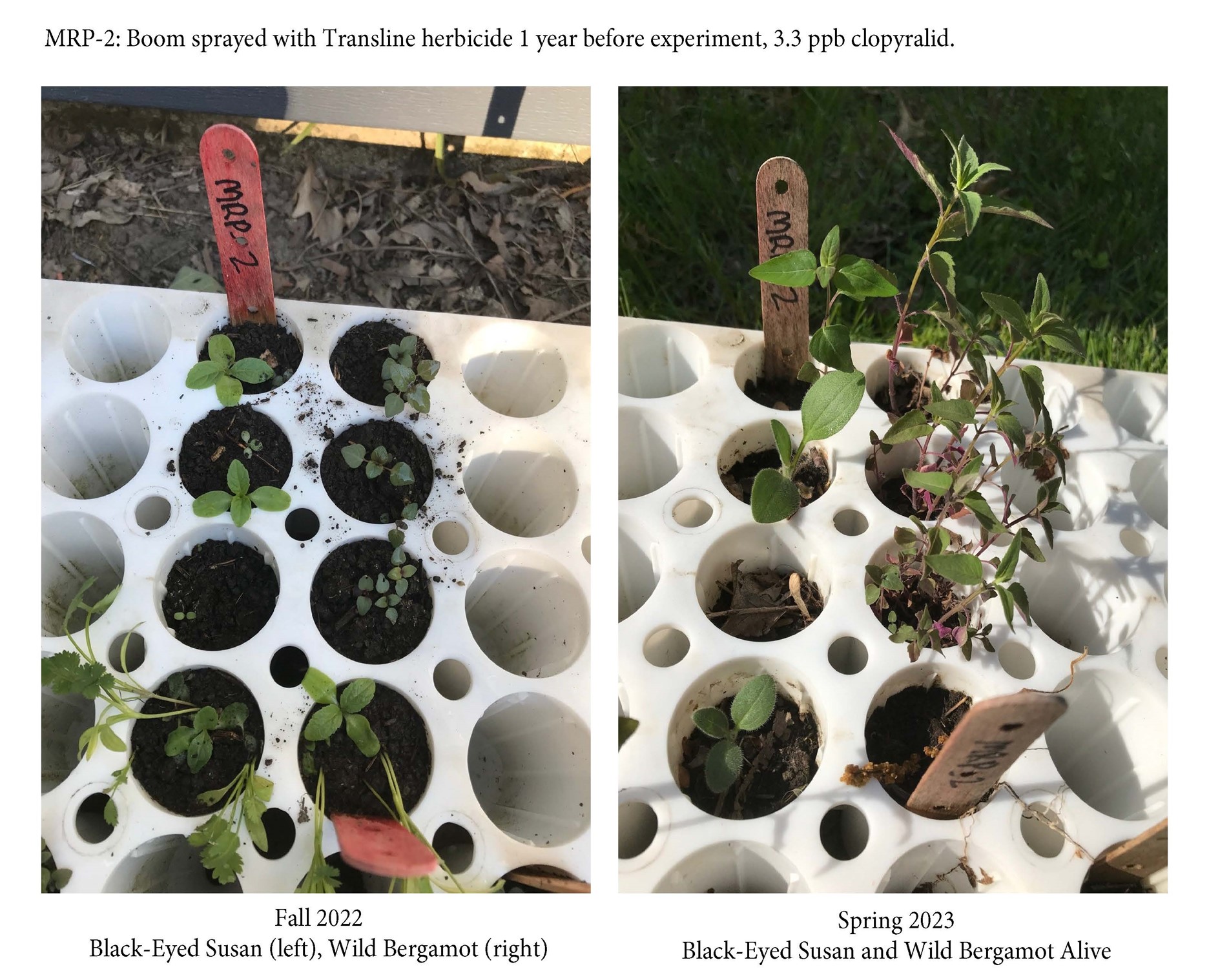
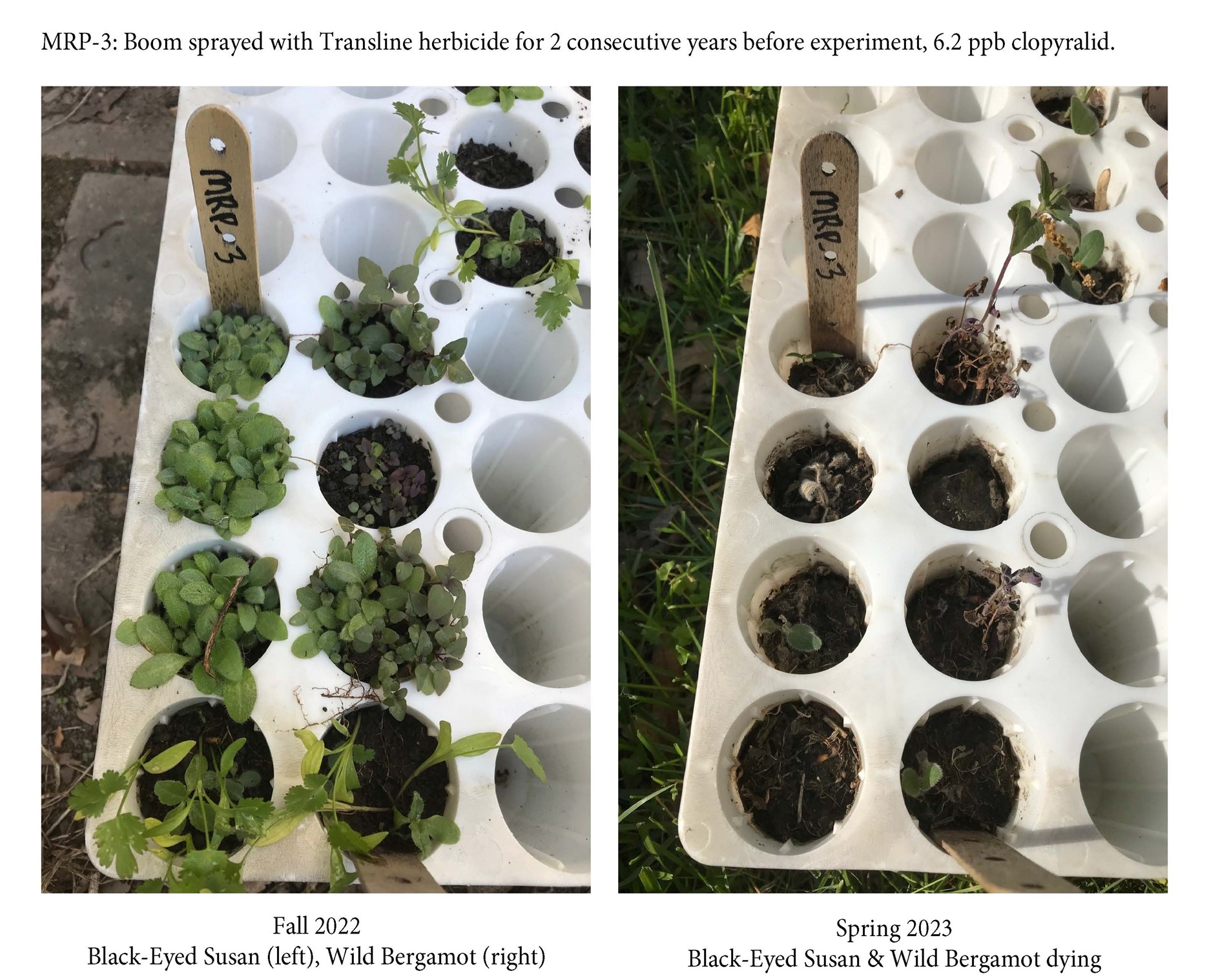
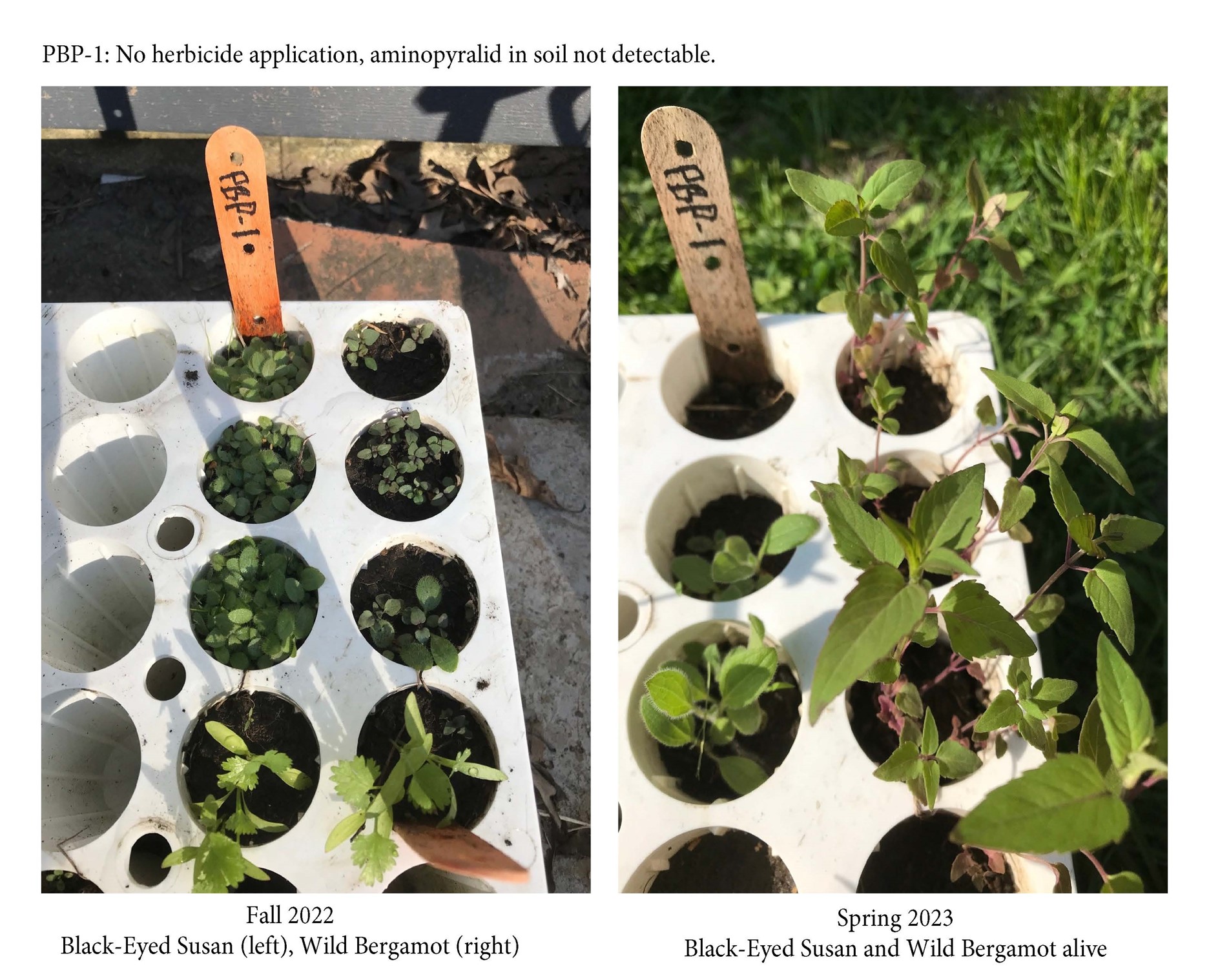
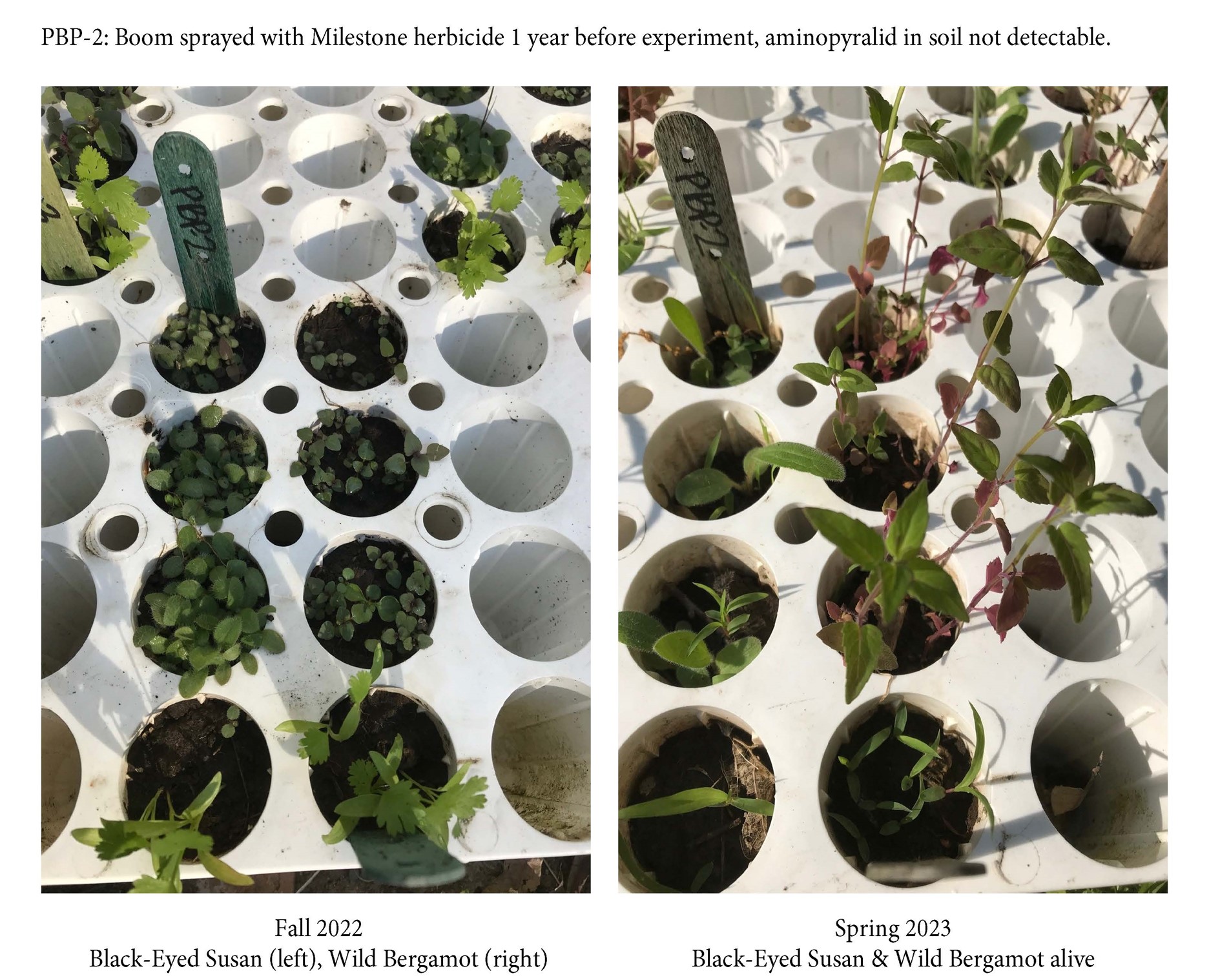
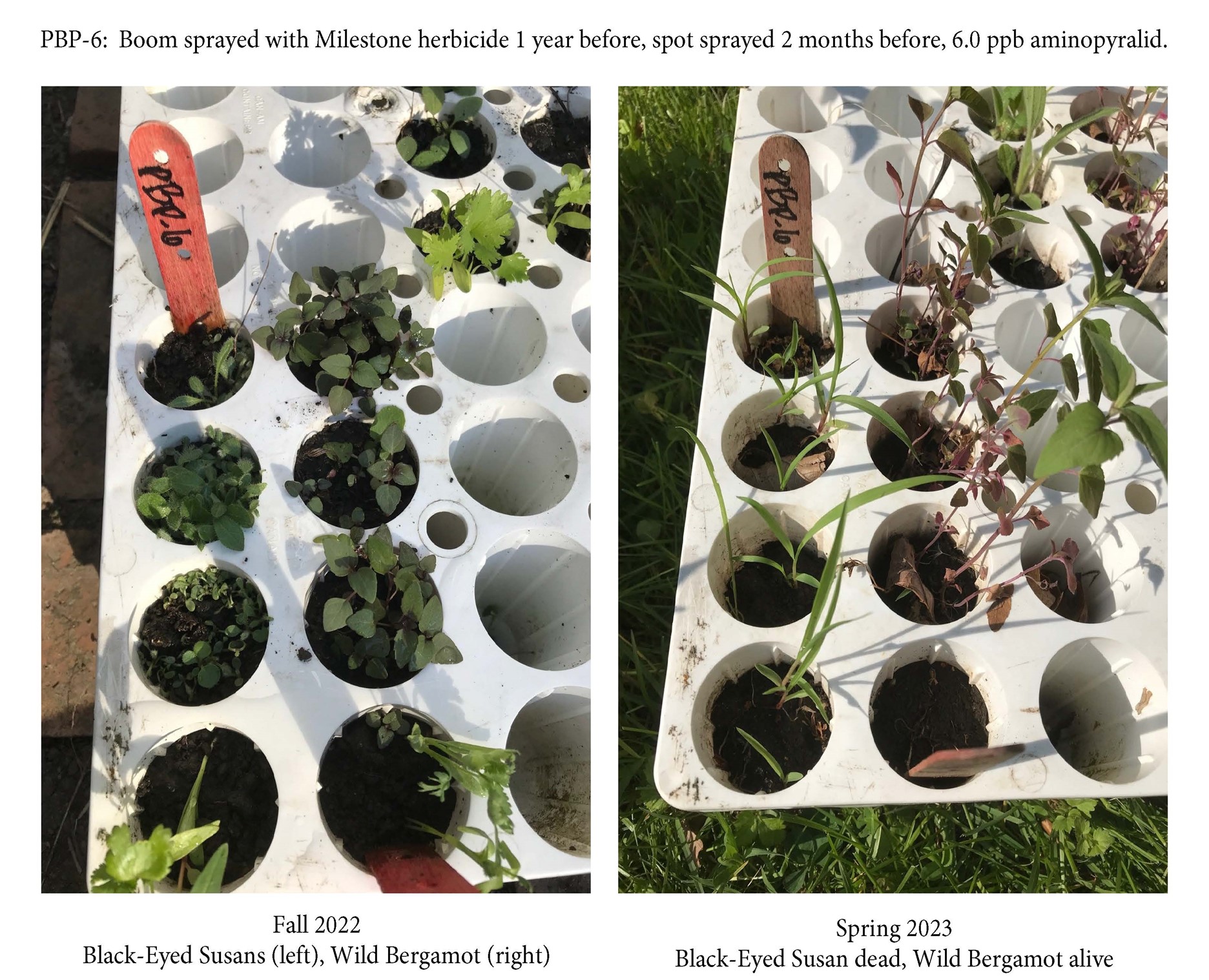
For both areas, I sent soil samples to the South Dakota Agricultural Laboratories for analysis during late August 2022. At the same time, I put soil samples from the two project areas in plug pots and seeded them with black-eyed Susan (Rudbeckia hirta; left plugs), wild bergamot (Monarda fistulosa; right plugs), and cilantro (front two plugs). Black-eyed Susan is susceptible to both herbicides, wild bergamot is relatively tolerant of both herbicides, and cilantro is an annual that germinates readily (and I had extra seed lying around). In the fall of 2022, most seed had germinated of all species, and there was not any difference between the soil samples.
By the spring of 2023, there was a notable difference between seedling survivorship in the soil samples with higher levels of residual herbicide and those without detectable herbicides. In MRP-3, which had the highest level of clopyralid (from Transline herbicide) in the soil at 6 ppb, both the black-eyed Susan and wild bergamot seedlings were dying. In PBP-6, which had the highest level of aminopyralid (from Milestone herbicide) in the soil at 6 ppb, the black-eyed Susan seedlings were dead, but the wild bergamot seedlings were still alive. In nearly all the soil samples where the herbicide levels in the soil were below the laboratory’s detection limit, both black-eyed Susan and wild bergamot seedlings were alive.
Take-Home Messages:
- If you suspect that you might have too much herbicide residual in the soil, get it tested before spending a lot of time or money seeding natives!
- Be mindful of uncalibrated spraying – both uncalibrated boom spraying, broadcast spraying with a gun, and backpack spot spraying. Our two examples with the highest soil herbicide levels had received an uncalibrated spray (via backpack spot spray or uncalibrated boom).
- Be mindful of the accumulation based on consecutive years of spraying. Our two examples with the highest soil herbicide levels had also been sprayed two years in a row.
Here is a summary of the management history, the soil herbicide level, and the germination study results.
MRP-1: No recent herbicide activity.
Clopyralid level in soil: below detection limit.
Germination results: Establishment & survival of black-eyed Susans and wild bergamot.
MRP-2: Broadcast sprayed with Transline herbicide (0.5%; ave 12 fl oz/ac) 1 year before soil tests.
Clopyralid level in soil: 3 ppb
Germination result: Establishment & survival of black-eyed Susans and wild bergamot.
MRP-3: Broadcast sprayed with Transline herbicide (0.5%; 19 fl oz/ac) 2 years before soil tests.
Broadcast sprayed (uncalibrated) with Transline herbicide (0.5%; 40 fl oz/ac) 1 year before soil tests. *Note: this application exceeded the annual maximum application rate (24 fl oz/ac).
Clopyralid level in soil: 6 ppb
Germination result: Both black-eyed Susans and wild bergamot germinated but died the following spring.
PBP-1: No recent herbicide activity.
Aminopyralid level in soil: below detection limit.
Germination result: Establishment & survival of black-eyed Susans and wild bergamot.
PBP-2: Broadcast sprayed with Milestone herbicide (0.25%; ave 2.6 fl oz/ac) 1 year before soil tests.
Aminopyralid level in soil: below detection limit.
Germination result: Establishment & survival of black-eyed Susans and wild bergamot.
PBP-6: Broadcast sprayed with Milestone herbicide (0.25%; ave 2.6 fl oz/ac) 1 year before soil tests.
Then, spot sprayed teasel with Milestone herbicide (0.25%) 2 months before soil tests.
Aminopyralid level in soil: 6 ppb
Germination result: Black-eyed Susans germinated but died (only annual foxtail grass visible in 2023 photo). Wild bergamot established.
Conclusion: Remember, it’s not only Kill, Kill, Kill. In conjunction with killing invasive plant species, it’s equally as important to seed and promote establishment of a diverse native community. To allow native seed to establish, good practices are to avoid excessive spraying, be mindful of the soil residual effects of herbicides, and get the soil tested as necessary to know when it’s safe to apply the precious native seed. A finesse approach is much more effective than brute force in invasive plant management!