Registration open!!! July 11-12, 2017 Grassland Restoration Network Workshop

Join us at Konza Prairie Biological Station in Manhattan, KS for overview and field presentations on long-term plot and watershed-level studies in grassland ecology. This year’s workshop will focus how science at this National Science Foundation-funded Long Term Ecological Research (LTER) site has deepened our understanding of drivers influencing pattern and process in tallgrass prairie. Discussions will focus on how science can inform grassland restoration.

Here is the URL to the registration page for the workshop.  Space is limited so register today.  $155 includes meals.

https://www.enrole.com/ksu/jsp/session.jsp?sessionId=211807&courseId=GRASSLANDRESTORATION&categoryId=10009

Lodging is not part of the registration. There are many hotels to choose from in Manhattan, but the Hilton Garden Inn and Fairfield Inn are walking distance to the Flint Hills Discovery Center (a must see!) and downtown (Poyntz Ave.), which hosts a number of restaurants and the Tallgrass Brewing Company.  There are a few beds or rooms available at Konza. Bill Kleiman is the person to email if you want of those, bkleiman@tnc.org

The meeting will begin at 12 pm on Tuesday, July 11th.

DIRECTIONS: From I-70, you can exit Hwy 177 N, then take a left on McDowell Creek Rd., just before the bridge over the KS River. Alternatively, you can take the McDowell Creek Rd. exit off of I-70 (west of Hwy 177). Turn onto Konza Prairie Lane (there is a sign for the Konza Prairie Biological Station). Follow the gravel road into the Biological Station and continue until you see a large stone house on the right. We will meet in the conference center, which is a renovated stone barn just across the road from the stone house. Parking is available behind the conference center or behind the lab buildings in front of the conference center.

Map: https://www.google.com/maps/place/Konza+Prairie+Biological+Station/@39.1068765,-96.6091402,15z/data=!4m5!3m4!1s0x0:0xc6aebaa3a23af35a!8m2!3d39.1068765!4d-96.6091402

Learn more about the Konza Prairie Biological Station: http://kpbs.konza.k-state.edu/

Learn more about the Konza Prairie Long Term Ecological Research (LTER) Site:  https://lternet.edu/sites/knz

Tentative GRN Agenda

July 11th

Arrive already having eaten lunch because next meal is dinner.

12-5 pm

Welcome presentation – Konza LTER (John Blair)

Walking field tour

Hulbert plots

Belowground Plots (Lydia Zeglin)

Rainfall Manipulation Plots and Irrigation Transects (John Blair)

Refreshments and Discussion (led by Chris Helzer)

5 pm Break/Konza Nature Trail hike

7:00 pm Catered dinner

8:00 pm Keynote: Long-term effects of fire and grazing on tallgrass prairie (Jesse Nippert)

July 12th

8-11 am

Morning watershed tour

Patch-burn grazing (Tony Joern)

Riparian woody vegetation removal (Walter Dodds)

Shrub dynamics (Jesse Nippert)

Watershed Plot-studies (Melinda Smith graduate students)

NEON site (?)

12 pm Catered lunch

1 pm      Short overview of restoration research (Sara Baer)

Visit Restoration plots

2 pm      Refreshments and Departing Discussion (led by Bill Kleiman)

3:30 pm Everybody heads home


Posted in Uncategorized | Leave a comment

GRN July 11-12, 2017 Konza registration delays

Sorry, we meant registration to be open by now but are having some registration/administrative hangups. Any day now registration will open.

Posted in Uncategorized | Leave a comment

30 year fire report for Nachusa Grasslands

Dear Colleagues:

The hyperlink to our report summarizes thirty years of fire at Nachusa Grasslands.  it also describes the current fire year.  Share wit your colleagues.

Click to access nachusa_annual_fire_report_2016_2017.pdf

The July 11-12 GRN workshop at Konza will open registration in about two weeks.

Posted in Uncategorized | Tagged , , , | 2 Comments

Brush mowing

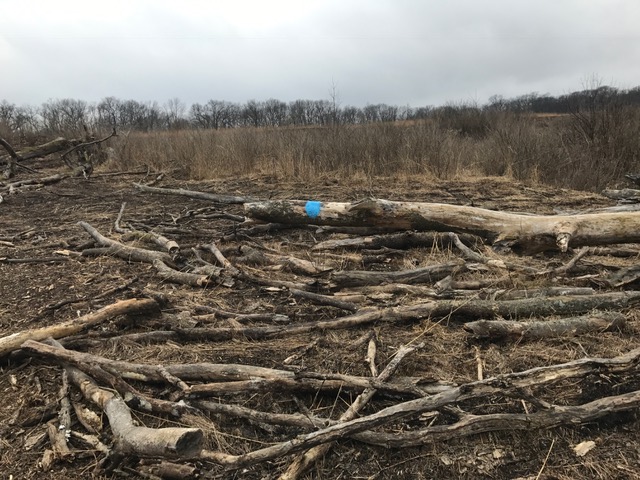
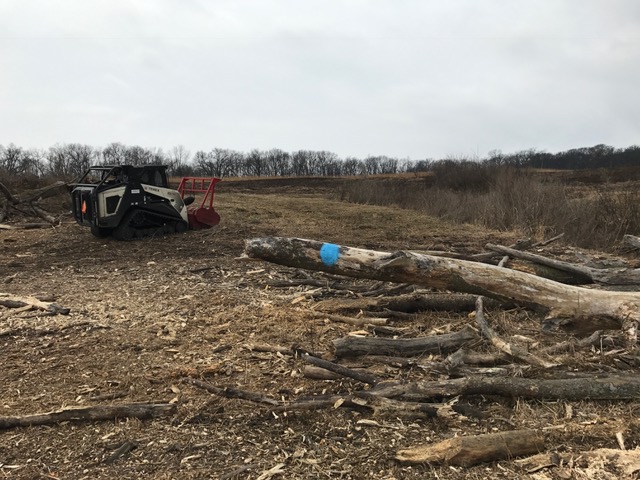
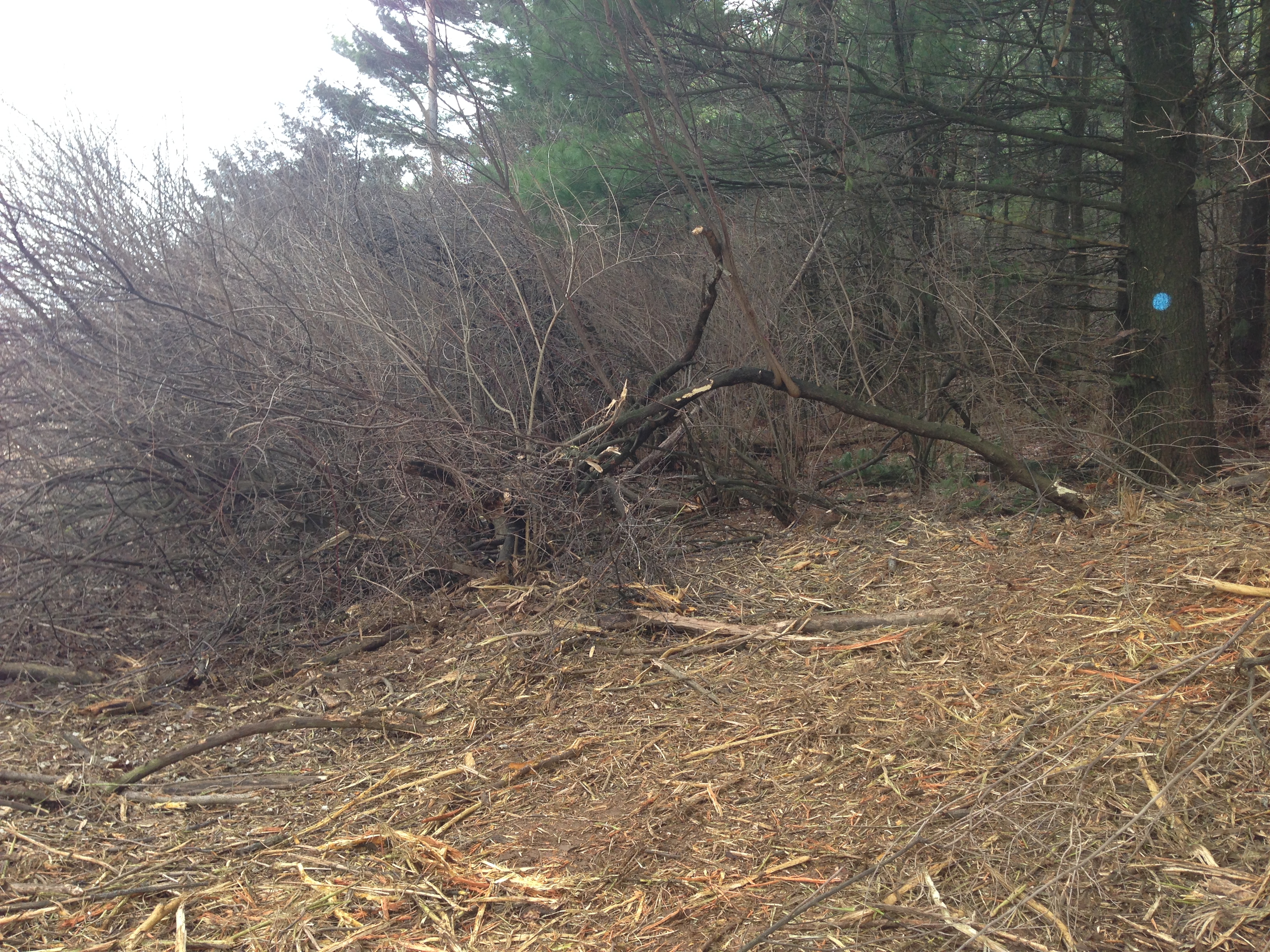
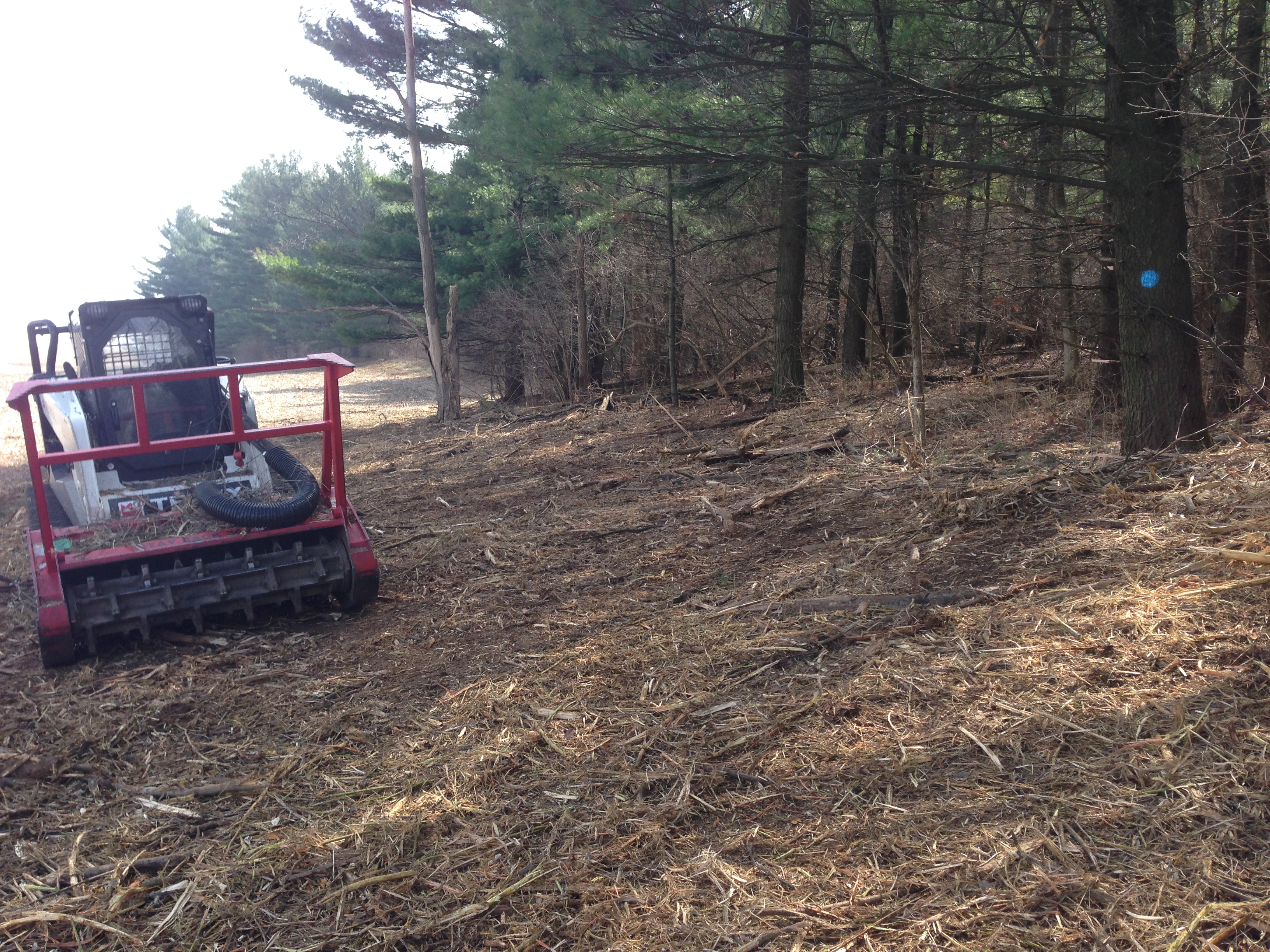
This early spring has us doing prescribed fire and the winter work of mowing brush.  Below is a before and after of some brush mowing I did yesterday.  The light brush is invasive bush honeysuckle thickets, with hundreds of waist high shrubs I was mowing down.  I am also mowing down left over stumps from tree thinning in some of these logged areas.

The fallen tree is a girdled hackberry that died several years back and fell over this year.  I could have left it sit and rot but with all the invasive shrubs in the area I felt I better mulch it up some.  The remainder can be stacked with a grapple after some chainsaw cuts.

The Terex P110 has a Fecon flail style brush mower on it.  These tools are expensive, but contractors are out there who would be happy to pay your site a visit.

img_7791 img_7793

Posted in Uncategorized | Leave a comment

GRN Workshop July 11-12, 2017 at Konza

Save the Date!

Grassland Restoration Network Workshop

July 11-12, 2017

grn-konza

Join us at Konza Prairie Biological Station in Manhattan, KS for overview and field presentations on long-term plot and watershed-level studies in grassland ecology. This year’s workshop will focus how science at this National Science Foundation-funded Long Term Ecological Research (LTER) site has deepened our understanding of drivers influencing pattern and process in tallgrass prairie. Discussions will focus on how science can inform grassland restoration.

Details and registration information coming in April 2017


Posted in Uncategorized | 2 Comments

Mowing and pulling honeysuckle

My comments on mowing honeysuckle are similar to fire.  You can’t kill honeysuckle roots by mowing it.  But you can reduce a huge shrub to a tiny re-sprouting shrub that can then be easily treated with herbicide. Mowing down the tall shrubs also stops them from producing fruits and hence seeds, and gives needed sunlight to other plants you are encouraging.  So mowing is great but follow up will eventually be needed.

When we encounter those big thickets of brush our first step is often to brush mow it with our tracked skid loader.  After mowing, the problem area is open and easier to manage.  Light can get to the ground, air can flow through the habitat working to reverse mesophication (increased shade and moisture changing the composition of the habitat to species liking those conditions).  Fire should be able to carry across the habitat.  It may take a few years for the herbaceous layer to grow back and support fire.   Photos are before and after brush mowing.

001-brush-mow-during002-brush-mow-after-senger

Pulling honeysuckle from the ground.

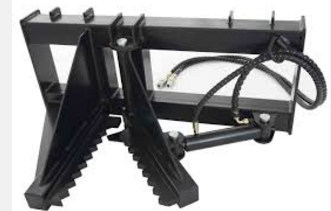
Below is an implement I have not tried.  You attach this to your skid loader and drive up to a shrub, grab it, and pull the shrub from the ground.  I am sure this kills the shrub.  I assume also it disturbs a fair amount of ground.  Try it in ruderal areas and let us know.

skid-loader-shrub-grabber

Posted in Uncategorized | Leave a comment

Foliar application to honeysuckle

I have used foliar application on honeysuckle in the following manner.  On a fire break in a ruderal area with no native plants I had mowed down all sorts and sizes of honeysuckle and other woody plants.  The fire break was about 30 foot wide and maybe a quarter mile long.  I made a solution of 4 ounces of Progeny per gallon with 2% methylated seed oil.  I applied this mix with a boomless 50 gallon Kings sprayer from a 30 horsepower tractor.  After two months the application had a good kill on the smaller sized honeysuckle and other woody plants, and had set back the bigger plants, but maybe it was not  going to kill them.  I expect I should repeat that next year for better effect.  If I tried to do that job with a backpack sprayer it would have taken me days.kubota-boomless

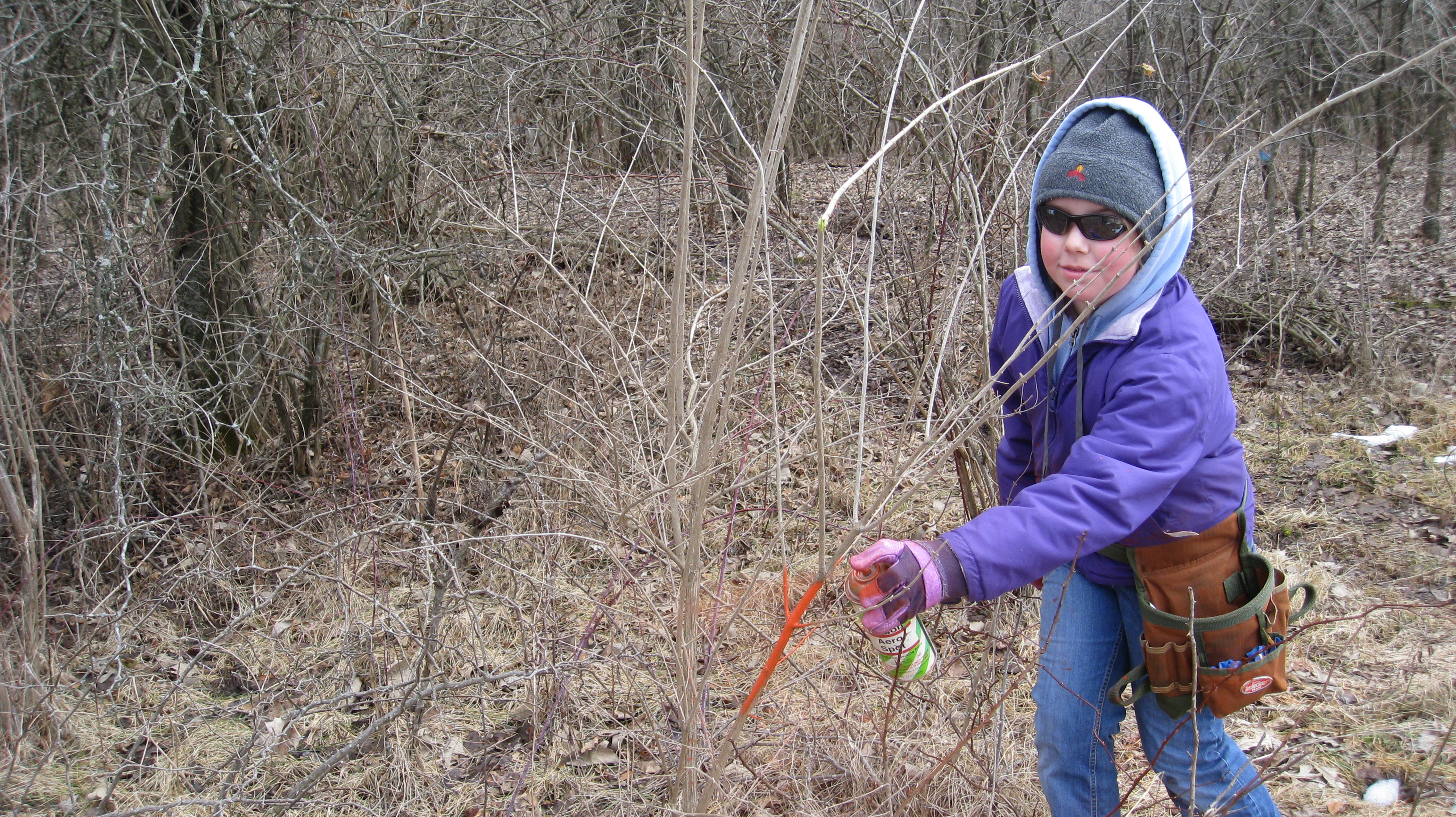
Another time to foliar spray honeysuckle could be when the plant is really short, like when they re-sprout after fire or mowing.  Let the plants emerge several inches and turn green.  I applied our 17% Garlon 4 basal bark mix to the leaves and stems of about 40 plants.  I painted a bit of blue on each one. All were dead after three months.  I bet I could have sprayed them with Progeny or glyphosate and also gotten good results.

So my bottom line is you can use foliar spray in ruderal areas or spot spray on short emerging honeysuckle.  Foliar spraying tall shrubs in good vegetation will yield a big circle of off-target kill.

I have two more posts on honeysuckle, one on mowing and one on  pulling it.

Posted in Uncategorized | 2 Comments

Basal bark application final part 5: Helpful tips

Kleiman L.R crop

Screenshot 2022-11-28 174626

Above is the cover and title from a management note we published in Ecological Restoration.  That was a lot of work.

Some tips to apply basal bark herbicide:

Be careful applying these mixes in quality vegetation areas.  It is not only a brush herbicide, but a broadleaf plant herbicide. It kills forbs!

In nice areas tighten up your application method.  You can leave the pressure very low on the pack, and just gently press the trigger to get a minimum of herbicide on the stems.  Or use a paint brush or paint sponge and carefully wipe the stems with the mix.  You can also cut the shrub and dab on some mix this way, but the cutting is not necessary.  You can wire a sponge to the tip of your backpack sprayer wand and then dab or wipe the mix with little dripping and no overspray.  Don’t drip herbicide on good plants.

I generally don’t apply basal bark mix on hot days because it volatizes and perhaps harms nearby good plants.  In good areas don’t apply unless it is sweater weather or cooler.

Mark some plants with tree marking paint so you can do your own testing. It is fun.

Expect to return to the area several years in a row to treat the ones you missed.

Expect to get some off target kill within 2 to 8 inches of the stems you sprayed, depending on how carefully you sprayed.

While treating honeysuckle also treat the autumn olive, buckthorn, and mesophytic trees like box elder.

Typically, I apply the mix to all the stems and all sides of the stems.  When there is thorny brush in the way I don’t worry about getting all the stems treated.

Go after the scattering of shrubs in a field before worrying about the huge thickets.

Wear safety glasses.  Folks who wear prescription glass might get side shields for the frames or wear goggles over your glasses.

Bring some paper towels to clean up.  Some rubber gloves for when you are filling your pack or fiddling with the pack.  Once you have got the pack working good you can go back to your thicker and warmer gloves.

Don’t fill the pack all the way.  Halfway is plenty and will last a long time.

Take your time.  You are going way faster than those folks cutting the shrubs.  You can whistle while you work while they are still back at the shop preparing their chainsaw.

Elsewhere, I describe how to take care of your Birchmeier pack.

This year, we ramped up our basal bark solution on the advice of Rick Schulte of Crop Production Services.  We increased the Garlon4 from 17% to 20%.  And we add one quart of Vanquish herbicide to each 12.5 Gallons of mix.  Others have adopted this mix so I am trying it out.

Future research question.  If I basal bark honeysuckle in winter, say January, does an April fire that top kills the stems still kill the root of the shrub?  My current sense is yes, but I don’t have the data.  Update of September 2025:  Kaleb Baker demonstrated in a controlled study that prescribed fires done soon after basal bark application did not diminish the effect of the herbicide. https://grasslandrestorationnetwork.org/2024/04/25/a-study-on-controlling-bush-honeysuckle/

Posted in Uncategorized | 15 Comments

Basal bark application part 4

Previously I described success in killing honeysuckle with October and May applications when the leaves were on the stems of the shrub.  Here are a few kill counts we have from dormant season applications with leaves off:

March 6 and 7, 2011:  80% kill from basal bark application to about 70 plants.

April 10, 2010: 100% kill from basal bark to a few dozen plants.

April 1, 2012: 100% kill from basal bark to 24 plants.

Here is a nice quote from an experiment by Ronald Rathfon “…month of application did not affect the three triclopyr-containing herbicide treatment efficacy rates, which exceeded 95%…”  (2006 North Central Weed Science Society Proceedings).

So the last few posts I have made the case that basal bark application works in any season, but don’t apply it in hot weather as it volatizes.

And kudos to Mike Carr, Volunteer Steward of Nachusa Grasslands who has been helping me note basal bark treatments of honeysuckle.

One more basal bark post to follow, then a post on foliar application and mowing.

carr-mike-at-orland-se-img_7529

Posted in Uncategorized | Tagged , , , , , | 1 Comment

Basal bark application part 3

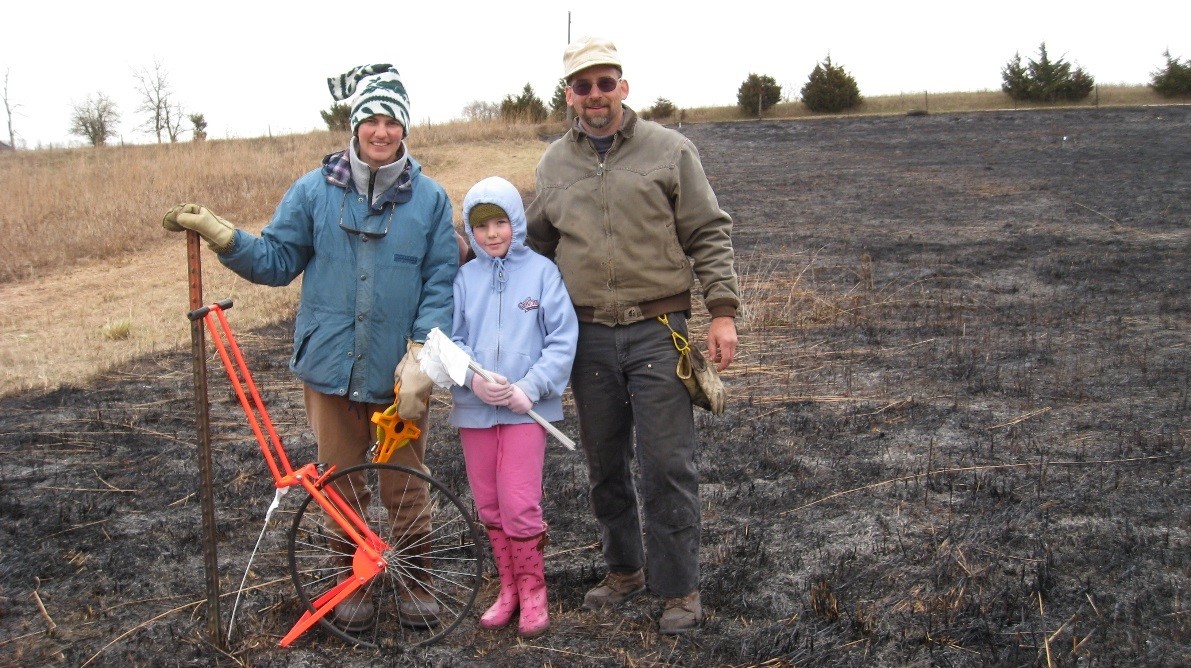
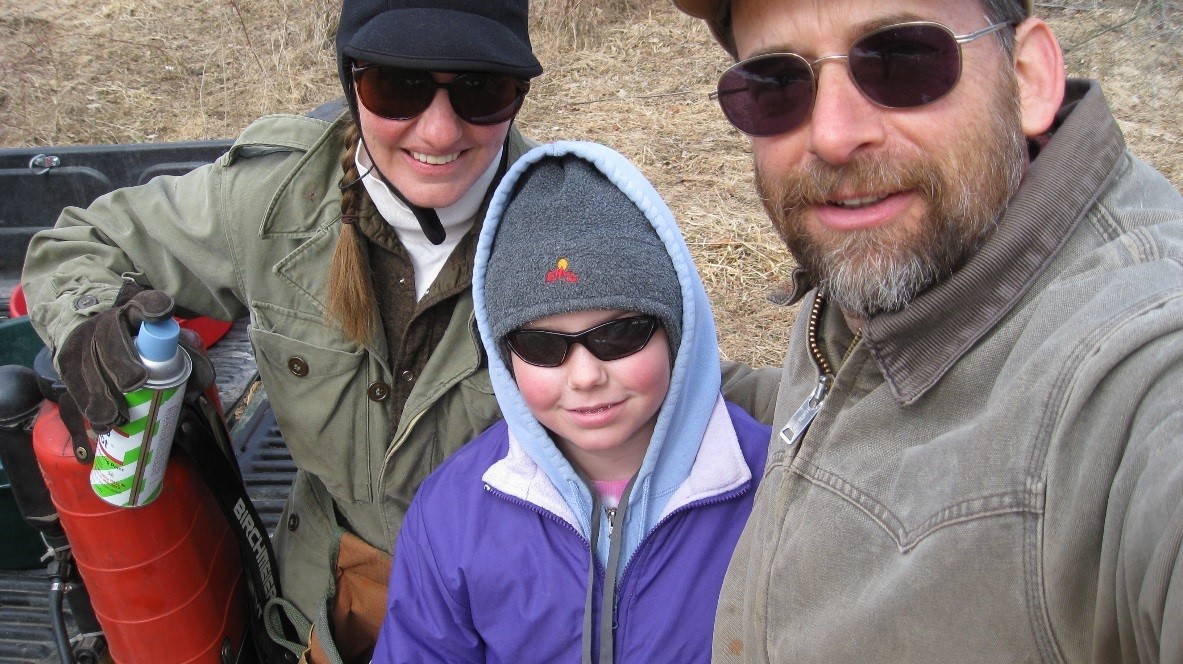
My daughter and wife and I have been doing field experiments and stewardship for years.  We have experience in marking and treating honeysuckle.  In late May of 2014 the three of us treated and paint marked about 250 honeysuckle shrubs with 17% Garlon4 in mineral oil.  We had a control of 180 live shrubs.   The photos below are from a few of our scientific escapades.

kleimans kleimans-3 kleiman-leah-painting-control-honeysuckles-img_7166 kleiman-honeysuckle-experiment-susan-img_7167  kleimans-w-goggles

kleiman-l-range-measures

After that May basal bark treatment we returned in September and tallied our results.  The painted stems made the tally easy. We had 100% death to the Garlon4 treated stems!  This was true in all size classes from dinky to huge honeysuckle.  We did not spray an excessive amount.  All dead.  We can exclaim that when honeysuckle are leafed out in the spring you will get excellent results treating them with basal bark herbicide at that time. It works!

Two more posts to go on basal bark.

Posted in Uncategorized | Tagged , , , | 4 Comments