GRN Konza Workshop well done


The night before the workshop some of us early arrivals met for dinner.

Sara Baer was the lead planner and host of this GRN.  Sara is a researcher at Konza who chairs the Plant Biology program at Southern Illinois University.  She studies various aspects of soil ecology related to grassland restoration.   Thank you Sara for a great workshop!

60 some folks attended. Day one we looked at various long term field experiments.  Here are the underground study plots where ideas are tested to see their effects on fungi and other microorganisms, soil characteristics,  and above ground species composition.

Konza Biological Station has published something like 1,600 papers, currently has about 120 annual researchers!  Their Long Term Ecological Research started in the early 1980s.  It is a very significant research station.

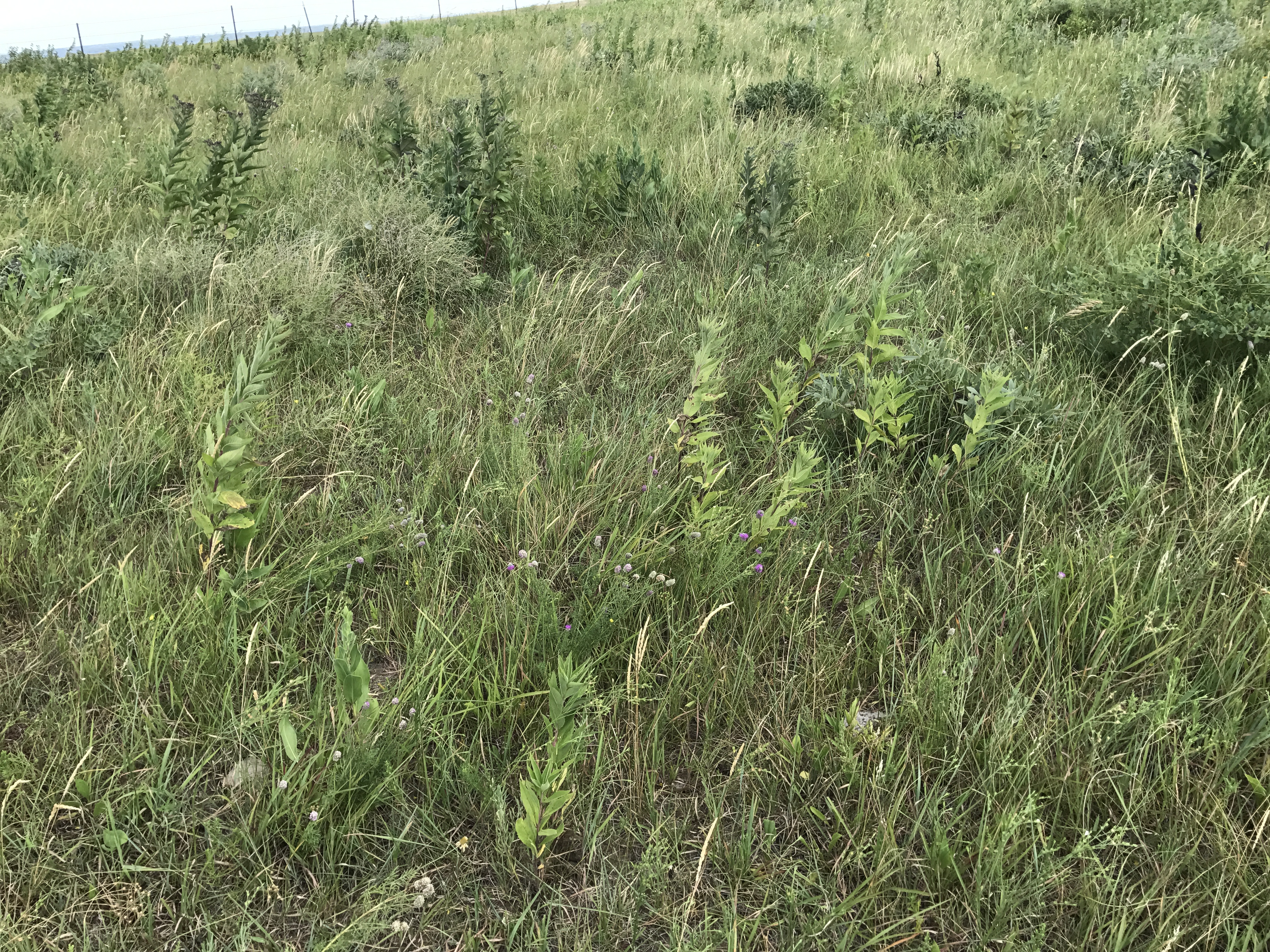
Konza is divided into various watersheds for decades long ecological studies. Here is a photo of a watershed that is Fall burned Annually, with no grazing.  It has a lot of grass and forbs.

Here is a watershed where it is not grazed, but burned annually in the spring. John Blair noted that the fall and spring fires resulted in very similar prairie.

Here is a patch burn watershed where a third of the unit is burned annually and cows choose where they want to go.  They like the recently burned sections and this area was just grazed that morning and likely a number of previous days.  Konza has bison too.

About 50 yards away is an unburned section of the patch burn unit with less cattle grazing.

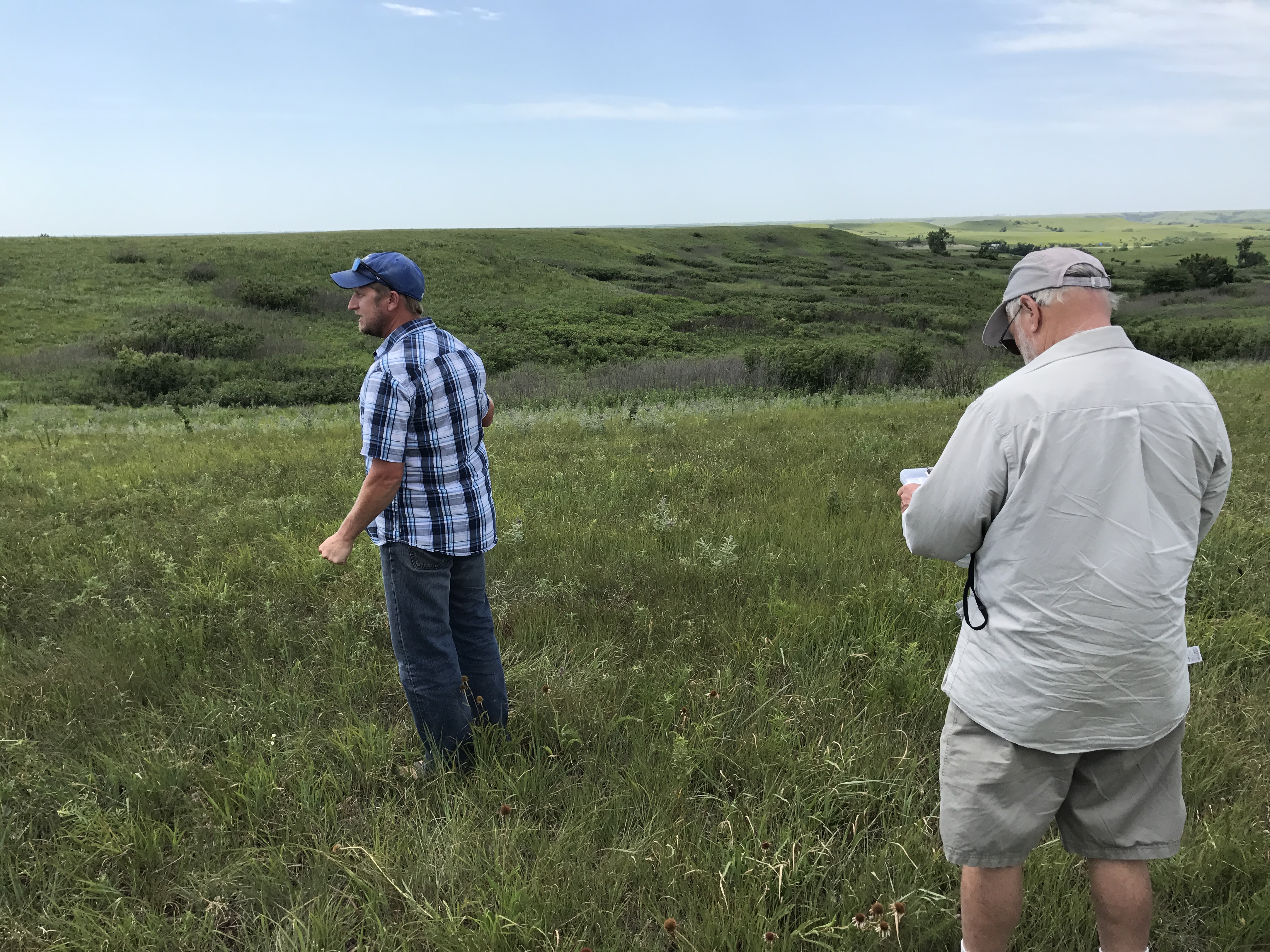
The GRN format has us in the field to see and discuss.  Here are some Konza stars: In the aqua blue shirt is Jill Haukos who runs many education programs at Konza, then clockwise is Walter Dodds who showed us his study of the effects on stream water chemistry after thinning brush from an encroached stream.  John Briggs runs Konza.  Sara Baer, as I noted above, was the lead planner and host of this GRN.  Last with the Western hat is KC Olson who works for KSU on the livestock grazing end of research.

Jesse Nippert shows us the watershed that was on a “no fire” plan for 20 years, and now they are reversing the fire regime to annual fire.  Now they will get to study how to get the grassland back and give us the science we all can benefit from.

End.

Posted in Uncategorized | Tagged , , | 1 Comment

GRN workshop at Konza

Our GRN meeting will be a hot one, both in content and temperature.  Those registered and attending should wear their lightest fabrics, favorite sun hat, water bottle, sun screen.  We will be in the field, but I doubt hiking too far.

We have solid attendance, and a full agenda with a bunch of the Konza experts to talk to.

See you there!

Posted in Uncategorized | 6 Comments

Schedule for GRN 2017 workshop at Konza

GRASSLAND RESTORATION NETWORK WORKSHOP 2017

Konza Prairie Biological Station and Long Term Ecological Research Site

Manhattan, Kansas


July 11th


12:00 pm            The Grassland Restoration Network (Chris Helzer)

Konza Prairie Welcome Presentation (John Blair)


1:00 pm               Headquarters Area Tour (John Blair, Lydia Zeglin, and Sara Baer)

Hulbert plots

Belowground Plots

Rainfall Manipulation Plots

Irrigation Transects


3:00 pm               Refreshments and Discussion (led by Chris Helzer)


5:00-7:00 pm     Break or Konza Nature Trail (Jill Haukos and docent)


7:00 pm               Catered Dinner


8:00 pm               Keynote: Long-term effects of fire and grazing on tallgrass prairie (Jesse Nippert)


July 12th


8:00                      Meet at Konza Conference Center


Konza Watershed Tour

Est. 8:15-8:45                   Riparian woody vegetation removal (Walter Dodds)

Est. 9:00-9:30                   Patch-burn grazing (John Briggs and KC Olson)

Est. 9:45-10:15                 Watershed plot-studies (John Blair/Lydia Zeglin)

Est. 10:30-11:00                Shrub dynamics (Jesse Nippert)


11:30 pm            Catered Lunch


1:00 pm               Overview of Restoration Research (Sara Baer)


Est. 1:45-2:15                   Tour restoration experiments


2:30 pm               Refreshments and Departing Discussion (led by Bill Kleiman)


4:00 pm               End

Posted in Uncategorized | Leave a comment

Registration open!!! July 11-12, 2017 Grassland Restoration Network Workshop

Join us at Konza Prairie Biological Station in Manhattan, KS for overview and field presentations on long-term plot and watershed-level studies in grassland ecology. This year’s workshop will focus how science at this National Science Foundation-funded Long Term Ecological Research (LTER) site has deepened our understanding of drivers influencing pattern and process in tallgrass prairie. Discussions will focus on how science can inform grassland restoration.

Here is the URL to the registration page for the workshop.  Space is limited so register today.  $155 includes meals.

https://www.enrole.com/ksu/jsp/session.jsp?sessionId=211807&courseId=GRASSLANDRESTORATION&categoryId=10009

Lodging is not part of the registration. There are many hotels to choose from in Manhattan, but the Hilton Garden Inn and Fairfield Inn are walking distance to the Flint Hills Discovery Center (a must see!) and downtown (Poyntz Ave.), which hosts a number of restaurants and the Tallgrass Brewing Company.  There are a few beds or rooms available at Konza. Bill Kleiman is the person to email if you want of those, bkleiman@tnc.org

The meeting will begin at 12 pm on Tuesday, July 11th.

DIRECTIONS: From I-70, you can exit Hwy 177 N, then take a left on McDowell Creek Rd., just before the bridge over the KS River. Alternatively, you can take the McDowell Creek Rd. exit off of I-70 (west of Hwy 177). Turn onto Konza Prairie Lane (there is a sign for the Konza Prairie Biological Station). Follow the gravel road into the Biological Station and continue until you see a large stone house on the right. We will meet in the conference center, which is a renovated stone barn just across the road from the stone house. Parking is available behind the conference center or behind the lab buildings in front of the conference center.

Map: https://www.google.com/maps/place/Konza+Prairie+Biological+Station/@39.1068765,-96.6091402,15z/data=!4m5!3m4!1s0x0:0xc6aebaa3a23af35a!8m2!3d39.1068765!4d-96.6091402

Learn more about the Konza Prairie Biological Station: http://kpbs.konza.k-state.edu/

Learn more about the Konza Prairie Long Term Ecological Research (LTER) Site:  https://lternet.edu/sites/knz

Tentative GRN Agenda

July 11th

Arrive already having eaten lunch because next meal is dinner.

12-5 pm

Welcome presentation – Konza LTER (John Blair)

Walking field tour

Hulbert plots

Belowground Plots (Lydia Zeglin)

Rainfall Manipulation Plots and Irrigation Transects (John Blair)

Refreshments and Discussion (led by Chris Helzer)

5 pm Break/Konza Nature Trail hike

7:00 pm Catered dinner

8:00 pm Keynote: Long-term effects of fire and grazing on tallgrass prairie (Jesse Nippert)

July 12th

8-11 am

Morning watershed tour

Patch-burn grazing (Tony Joern)

Riparian woody vegetation removal (Walter Dodds)

Shrub dynamics (Jesse Nippert)

Watershed Plot-studies (Melinda Smith graduate students)

NEON site (?)

12 pm Catered lunch

1 pm      Short overview of restoration research (Sara Baer)

Visit Restoration plots

2 pm      Refreshments and Departing Discussion (led by Bill Kleiman)

3:30 pm Everybody heads home


Posted in Uncategorized | Leave a comment

GRN July 11-12, 2017 Konza registration delays

Sorry, we meant registration to be open by now but are having some registration/administrative hangups. Any day now registration will open.

Posted in Uncategorized | Leave a comment

30 year fire report for Nachusa Grasslands

Dear Colleagues:

The hyperlink to our report summarizes thirty years of fire at Nachusa Grasslands.  it also describes the current fire year.  Share wit your colleagues.

Click to access nachusa_annual_fire_report_2016_2017.pdf

The July 11-12 GRN workshop at Konza will open registration in about two weeks.

Posted in Uncategorized | Tagged , , , | 2 Comments

Brush mowing

This early spring has us doing prescribed fire and the winter work of mowing brush.  Below is a before and after of some brush mowing I did yesterday.  The light brush is invasive bush honeysuckle thickets, with hundreds of waist high shrubs I was mowing down.  I am also mowing down left over stumps from tree thinning in some of these logged areas.

The fallen tree is a girdled hackberry that died several years back and fell over this year.  I could have left it sit and rot but with all the invasive shrubs in the area I felt I better mulch it up some.  The remainder can be stacked with a grapple after some chainsaw cuts.

The Terex P110 has a Fecon flail style brush mower on it.  These tools are expensive, but contractors are out there who would be happy to pay your site a visit.

img_7791 img_7793

Posted in Uncategorized | Leave a comment

GRN Workshop July 11-12, 2017 at Konza

Save the Date!

Grassland Restoration Network Workshop

July 11-12, 2017

grn-konza

Join us at Konza Prairie Biological Station in Manhattan, KS for overview and field presentations on long-term plot and watershed-level studies in grassland ecology. This year’s workshop will focus how science at this National Science Foundation-funded Long Term Ecological Research (LTER) site has deepened our understanding of drivers influencing pattern and process in tallgrass prairie. Discussions will focus on how science can inform grassland restoration.

Details and registration information coming in April 2017


Posted in Uncategorized | 2 Comments

Mowing and pulling honeysuckle

My comments on mowing honeysuckle are similar to fire.  You can’t kill honeysuckle roots by mowing it.  But you can reduce a huge shrub to a tiny re-sprouting shrub that can then be easily treated with herbicide. Mowing down the tall shrubs also stops them from producing fruits and hence seeds, and gives needed sunlight to other plants you are encouraging.  So mowing is great but follow up will eventually be needed.

When we encounter those big thickets of brush our first step is often to brush mow it with our tracked skid loader.  After mowing, the problem area is open and easier to manage.  Light can get to the ground, air can flow through the habitat working to reverse mesophication (increased shade and moisture changing the composition of the habitat to species liking those conditions).  Fire should be able to carry across the habitat.  It may take a few years for the herbaceous layer to grow back and support fire.   Photos are before and after brush mowing.

001-brush-mow-during002-brush-mow-after-senger

Pulling honeysuckle from the ground.

Below is an implement I have not tried.  You attach this to your skid loader and drive up to a shrub, grab it, and pull the shrub from the ground.  I am sure this kills the shrub.  I assume also it disturbs a fair amount of ground.  Try it in ruderal areas and let us know.

skid-loader-shrub-grabber

Posted in Uncategorized | Leave a comment

Foliar application to honeysuckle

I have used foliar application on honeysuckle in the following manner.  On a fire break in a ruderal area with no native plants I had mowed down all sorts and sizes of honeysuckle and other woody plants.  The fire break was about 30 foot wide and maybe a quarter mile long.  I made a solution of 4 ounces of Progeny per gallon with 2% methylated seed oil.  I applied this mix with a boomless 50 gallon Kings sprayer from a 30 horsepower tractor.  After two months the application had a good kill on the smaller sized honeysuckle and other woody plants, and had set back the bigger plants, but maybe it was not  going to kill them.  I expect I should repeat that next year for better effect.  If I tried to do that job with a backpack sprayer it would have taken me days.kubota-boomless

Another time to foliar spray honeysuckle could be when the plant is really short, like when they re-sprout after fire or mowing.  Let the plants emerge several inches and turn green.  I applied our 17% Garlon 4 basal bark mix to the leaves and stems of about 40 plants.  I painted a bit of blue on each one. All were dead after three months.  I bet I could have sprayed them with Progeny or glyphosate and also gotten good results.

So my bottom line is you can use foliar spray in ruderal areas or spot spray on short emerging honeysuckle.  Foliar spraying tall shrubs in good vegetation will yield a big circle of off-target kill.

I have two more posts on honeysuckle, one on mowing and one on  pulling it.

Posted in Uncategorized | 2 Comments