2019 Illinois Prescribed Fires Summary

July 2018 through June 2019

Summary of Illinois Prescribed Fires Accomplished

By Bill Kleiman with map work of Dave Holman

Our Fire Council map of Illinois Prescribed Fires Accomplished highlights our fire community on one interactive map.

Below, the speckles on Illinois are our fires last year.

Below is a view of the Forest Preserve District of Cook County.  Red is the most recent fires.

A fire crew of Forest Preserve District of Cook County

Our annual summary of all fires accomplished, is on the Illinois Prescribed Fire Council website at https://www.illinoisprescribedfirecouncil.org/annual-data-summary.html


Posted in Uncategorized | Tagged , , , , , | 4 Comments

Adding seed

by Stephen Packard

[Editor’s note:  For four decades Stephen Packard has been restoring a wide variety of sites.  His comments are notable, and blogposts are great.  I had asked Stephen for advice.   On a new acquisition, we are about to clear very dense brush on an upland savanna.  The habitat currently has few native plants with the main ground cover being exposed soil.  Should we start adding seed immediately?  With Stephen’s permission I share his response – Bill K ]

The studies I’ve seen suggest that there’s little “seed bank” in badly degraded prairies, savannas, and woodlands. In some marshes, there seems to be a helpful seedbank.

I’ve seen a lot of people try to rely on the seedbank, with dismal results.

We initially waited for “the seed bank to express itself” in some areas, and it just opened the ground to a lot of thuggish or invasive species that – far from reconstituting a natural ecosystem – burned poorly and allowed invasive brush to take over again.

I don’t seem to have any blog posts on quite that question. I do have this one:

https://woodsandprairie.blogspot.com/2015/11/seed-experiments-nov-24-2015.html

It’s about how well it worked in a woodland (lots of leaf litter) to plant into dense leaves without a burn. It didn’t work.

Also of possible interest is this overall summary of some Somme Prairie Grove efforts, starting in 1979. Broadcasting seed into former pasture worked best. On the other hand, this experiment is very different from the site you describe – in that it included many small remnants of good or high quality and more than 250 species of savanna plants including many conservative and even endangered ones.

https://woodsandprairie.blogspot.com/2018/02/the-somme-prairie-grove-experiment.html

It includes the following:

Question: How well will a damaged ecosystem recover, and how much apparently missing biodiversity will just come back in response to remedial care?

Answer: Very few plant species that were not on our initial inventories came back from the seed bank or otherwise appeared. This was disappointing. On the other hand, many conservative species that had been present in small numbers increased dramatically. A few species (notably the endangered Bicknell’s geranium) did seem to emerge in response to the burns.

I suppose a wide variety of experiments are valuable. In more recent efforts I’ve been involved with, we’ve started seeding at the beginning, to get the jump on the thugs like tall goldenrod, to some degree.

Given the charged climate, rain acidity, nitrogen deposition, fragmentation, etc. – it seems to make less and less sense to limit seeding to species that were exactly on that site. We go farther south for seed, but not north. We imagine that the community of species that now best suit the site may be different to some degree from what was there 200 or 500 years ago.

Our goal seems more often to be to restore a high quality, diverse community, and then let the species sort out the rest.

Hope this is helpful.


Posted in Uncategorized | Tagged , , , | 1 Comment

The Case of the Undead Buckthorn (Foliar Treatments with Triclopyr Herbicide)

By: Julianne Mason, Restoration Program Coordinator, Forest Preserve District of Will County

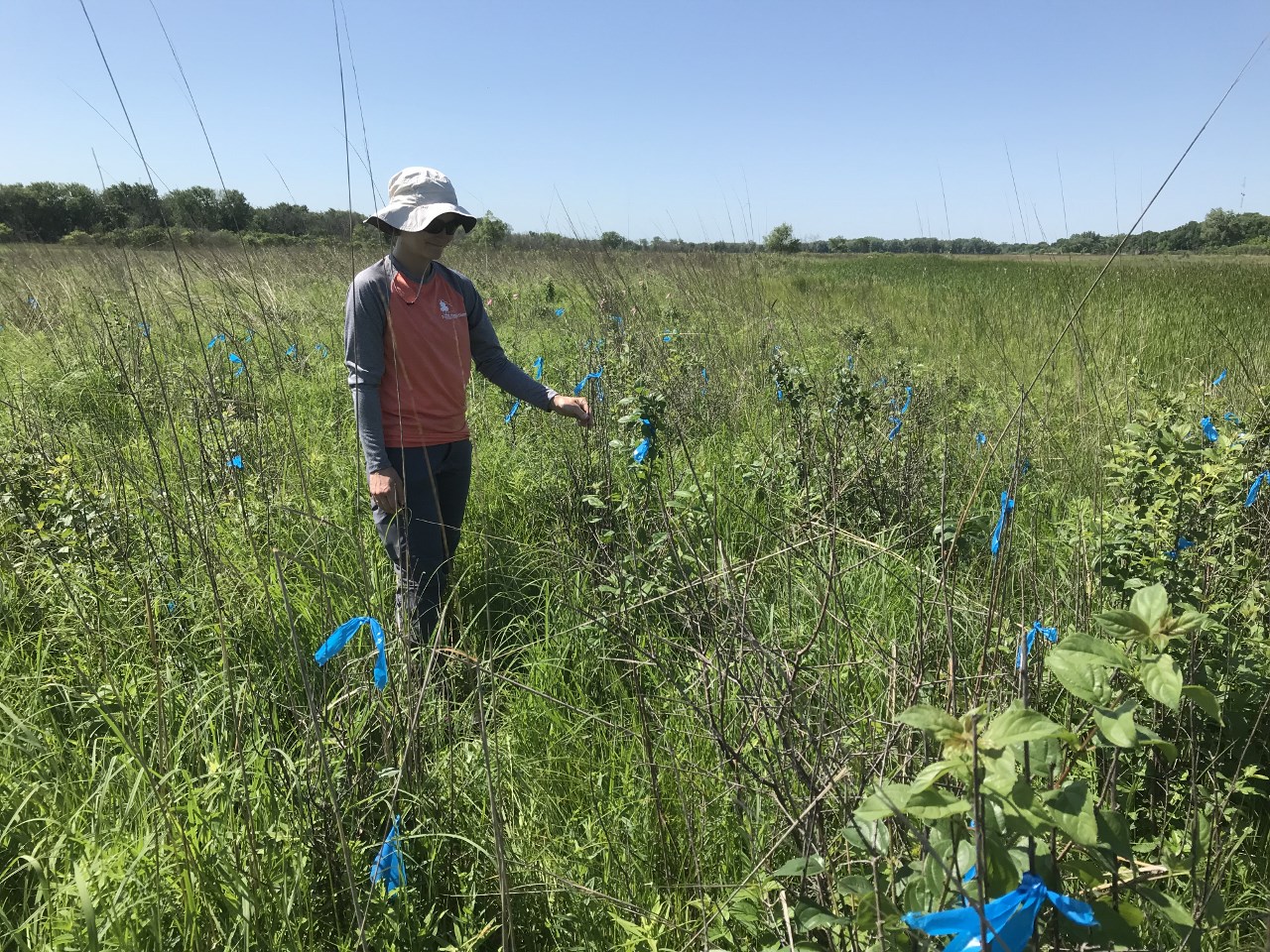
We have had a recurring issue over the past decade with common buckthorn (Rhamnus cathartica) not truly dying after being foliar treated with triclopyr 3A herbicide in dolomite prairie habitats.  The buckthorns are 2-5’ tall, multi-stemmed re-sprouts that have been repeatedly top-killed by fire over the past several decades.  The buckthorns appear to die properly at first.  After the foliar herbicide treatment, the leaves yellow, then turn brown and fall off prematurely.  However, lots of the shrubs re-sprout vigorously the following year.  This has happened with foliar treatments done in the early summer, late summer, and fall.  Apparently buckthorn is a calciphile in its native habitat, so perhaps it is just particularly hard to kill in calcareous habitats here?  Has anyone else observed buckthorn or other invasive shrubs appearing to die after foliar herbicide treatments, only to rebound vigorously the following year?

Photo 1 caption:  Undead buckthorn.  Many of the buckthorns that had been foliar treated with triclopyr herbicide re-sprouted vigorously the following year.  Photo taken a year after the herbicide treatment.

Buckthorn does seem to die reliably from cut stump and basal bark treatments of triclopyr 4 herbicide in bark oil, in the same dolomite prairie habitats.  Therefore, I hypothesized that perhaps the ester formulation of triclopyr might be more effective than the amine formulation.  To test out this theory, I marked buckthorns that were foliar treated with triclopyr 3A or triclopyr 4 at concentrations of 2%, 5%, or 10% during September 2018 at Lockport Prairie.  All treatments included 1% MSO and 0.4% PenATrate II surfactants.  Around 50-100 shrubs were included in each treatment.  We put color coded flagging on each treated buckthorn to keep track of its treatment type.

All of the treated shrubs appeared to die after treatment; their leaves turned brown and fell off prematurely last fall.  However, many of them rebounded vigorously the following spring.  Contrary to my expectation, I didn’t see any significant difference in mortality rates between the two different formulations of triclopyr (3A or 4), as evaluated 1 year after treatment (YAT).  However, there was greater mortality using the 10% concentration of triclopyr herbicide compared to lower rates.

2% Concentration.  Despite the promising results immediately after treatment,  less than 10% of the buckthorns that had been foliar treated with 2% triclopyr were dead this summer (1 YAT); nearly half of them had re-sprouted vigorously from the base while the rest of them fully leafed out from the top.

5% Concentration.  Less than 25% of the buckthorns that had been foliar treated with 5% triclopyr were dead this summer (1 YAT).  Around one quarter of them fully leafed out from the top, while around half of them resprouted vigorously from the base. 

10% Concentration.  Around 70% of the buckthorns that had been foliar treated with 10% triclopyr were dead this summer (1 YAT).  Conversely, nearly one-third of the treated buckthorns had resprouted and were still alive.

Based on these results, I would recommend using 10% triclopyr as a foliar treatment and be sure to follow up on re-sprouting individuals the next year.  Or, I might try basal bark/base spraying them with triclopyr 4 in an oil-water emulsion.

https://grasslandrestorationnetwork.org/2018/11/08/julianne-mason-on-basal-bark-applications-using-an-oil-water-emulsion/

Bottom Line:  Beware of invasive shrubs appearing to die right after foliar herbicide treatments, only to re-sprout the following year.  Has anyone else experienced a similar thing with buckthorn or other invasive shrubs?  I find it hard to believe that our buckthorns are truly unique.  It is a shame to spend time and money on treatments that are not effective.  Plus, herbicide treatments cause collateral damage to other plants.  It is a double shame to kill off-target species and not actually achieve the goal of addressing the invasive species population.  Mark some of your foliar treated shrubs and check them next year to make sure that the treatment actually worked.  Do you have undead invasive shrubs too??

Posted in Uncategorized | Tagged | 28 Comments

2019 GRN Workshop Schedule

MONDAY, AUGUST 19, 2019

5 p.m. pre-workshop dinner at Heartland Grill in the Sheraton Madison

Connect with other attendees at a casual dinner and social time. (Note: this event is not covered by conference fee.)


TUESDAY, AUGUST 20, 2019

8:30 a.m. Workshop check-in and continental breakfast

UW Arboretum Visitor Center auditorium


9 a.m. Welcome

Opening remarks by Bill Kleiman and Chris Helzer of the GRN. Opening remarks by Arboretum Director Karen Oberhauser. Discussion of logistics and agenda by Mike Hansen


9:15 a.m. Arboretum land management and research

Presented by Michael Hansen and Brad Herrick


10 a.m. Restoring and protecting monarch habitat: suburban gardens aren’t enough

Presented by Karen Oberhauser


10:45 a.m. break


11 a.m. Pollinator conservation

Presented by Susan Carpenter, Arboretum native plant gardener


11:45 a.m. Lunch


12:45 p.m. Tours

Tour A: Aldo Leopold Foundation, Baraboo

Tour B: Faville Grove Sanctuary (Madison Audubon Society), Lake Mills

Tour C: Military Ridge Prairie Heritage Area (The Nature Conservancy, The Prairie Enthusiasts). Thomson Prairie, Blue Mounds; Mounds View and Barneveld Prairies, Barneveld


~5:30 p.m. (as buses return from field tours) – Social gathering

Arboretum Visitor Center auditorium


6 p.m. Dinner and cash bar

Arboretum Visitor Center auditorium


8:30 p.m. Day 1 end


WEDNESDAY, AUGUST 21, 2019

8:30 a.m. Continental breakfast

UW Arboretum Visitor Center auditorium


8:55 a.m. Welcome back and announcements


9 a.m. How seed mix design and first year management influence multifunctionality and cost effectiveness in prairie reconstruction

Presented by Justin Meissen, Tallgrass Prairie Center


9:45 a.m. 60 years of change in Wisconsin prairie remnants: resurveying the Curtis dataset

Presented by Amy Alstad, Driftless Area Land Conservancy


10:30 a.m. Break


10:45 a.m. But how do we get people to CARE?

Presented by Chris Helzer, The Nature Conservancy, Nebraska


11:30 a.m. Lunch


12:30 p.m. Tours

Tour A: Goose Pond Sanctuary (Madison Audubon Society) and Arlington Agricultural Research Station (UW–Madison College of Agricultural and Life Sciences), Arlington

Tour B: Holy Wisdom Monastery and Walking Iron County Park (Dane County Parks), Middleton and Mazomanie

Tour C: Curtis and Greene Prairies (UW–Madison Arboretum), Madison


~4:30 p.m. (as buses return from field tours) – Workshop end

Thank you for coming and safe travels!
Posted in Uncategorized | Tagged , , , , | Leave a comment

GRN Workshop registration ends August 5

The link below has the agenda and workshop registration.

July 26 was the last day for the discounted block of hotel rooms. But ask for the rate and see what they say. Remember to book a hotel room if you need one.

Registration closes August 5.

Kudos to Mike Hansen for coordinating the workshop!

https://arboretum.wisc.edu/land-stewardship/grn-2019-workshop/


Posted in Uncategorized | Tagged , , | 2 Comments

Managing invasive cattails by Nathan Herbert

Nathan Herbert

Managing wetland habitat inevitably involves controlling cattails. Recovering a wetland from a well-established cattail colony is a 5-to-10-year project that requires persistence and multiple herbicide application methods. In colonies with a high density of cats, a two person or ATV mounted boom is a good way to cover a large area relatively quickly. With low concern for non-target damage (there is usually little else in dense cattail stands) an herbicide-soaked boom can be dragged over the cattails; literally painting the plants with herbicide. This method can reduce stem density of a cattail colony by 50% or more in two treatment seasons.

As the treatment area recovers, or when managing cats in high quality wetlands, a finer approach is needed to avoid non-target damage. Hand-wicking (aka the Glove of Death) is a popular method to address low density cats. A thick cotton glove wetted with herbicide is worn over a nitrile glove. Individual cattails are then treated by grabbing and pulling them through the glove. When using this method, I use 5% wetland safe glyphosate. There is virtually no non-target damage when treating cattails this way. However, it is not very versatile, and it’s messy. You will get herbicide on your hands, arms, face, and neck despite efforts to minimize exposure.

In most situations, my preferred method for dealing with lower density cattails is to spray the base of the plants with 3-5% glyphosate. Using a sprayer to target individual plants gives you more flexibility in the field. Isolated plants can be targeted with precision and clumps of cattails can be quickly dispatched with a foliar spray (directly to the leaves) if appropriate. This method also has a lower risk of direct contact exposure to herbicide than hand wicking. A one-gallon hand sprayer or a backpack sprayer is appropriate for this method (I’m quite tall and prefer the reach of the backpack sprayer). Apply just a milliliter or two of herbicide to the region of the cattail stem from which the leaves fan out.

Photo 1: Applying a small amount of herbicide to the base of cattail leaves.

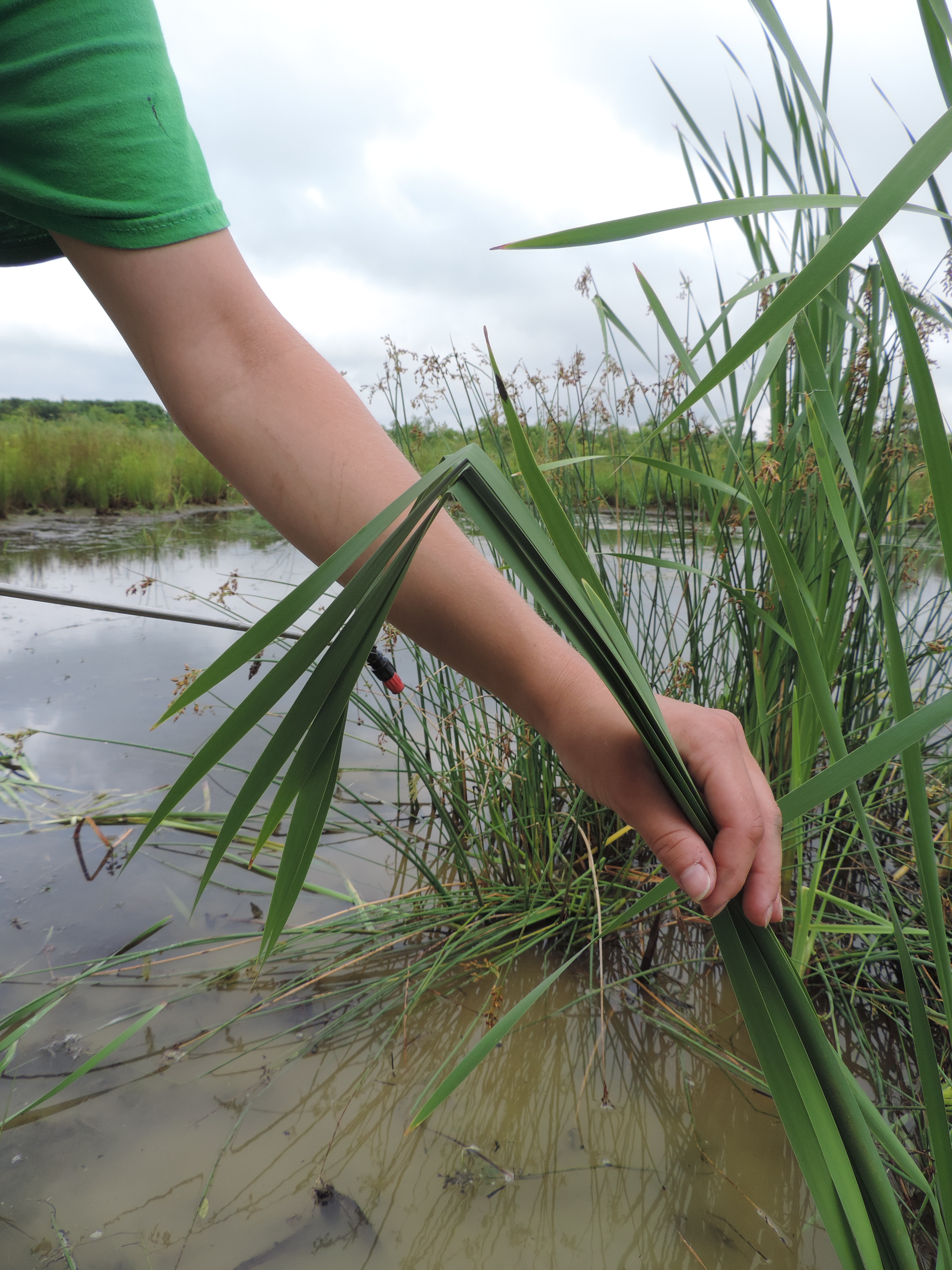
I often use my free hand to pull on a few leaves and open the base of the plant. Done this way, herbicide will funnel down into the stem. There is minimal overspray if done carefully and with low pressure. After treatment, fold over the top 6-10 inches of the leaves to mark the plant as treated.

Photo 2 Fold and crease the leaves over to clearly mark the plant as “treated”. This is very helpful when working with a crew; it’s also nice to turn around and see your progress.

As with any established invasive species, eradication is usually not possible. Cattails quickly take advantage of disturbance and changes in hydrology. Exposed muck and soil in wetland restorations is an open door for cats. Quality, remnant wetlands require annual vigilance to prevent cattails from setting up shop. Cattail work is time-consuming and done at the hottest time of year here in the Midwest. Despite that, it is satisfying to see to see the contrast of yellowing cats against the green of other wetland plants. Also, because of their stature and dominant presence, any reductions in cattail density are easily appreciated from year to year. Applying herbicide in a precise, efficient, and tidy manner leaves a smaller management footprint in a wetland and avoids creating an “invasive treadmill.” If you’re looking for a quicker, less messy alternative to hand wicking, give sprayers a chance.

Posted in Uncategorized | Tagged , , , | 6 Comments

GRN Workshop Registration deadlines!

The link below has the agenda and workshop registration.

Friday, July 26, is the last day for the discounted block of hotel rooms. Remember to book a hotel room if you need one.

The field trips are filling up fast.

Registration closes August 5.

Kudos to Mike Hansen for coordinating the workshop!

https://arboretum.wisc.edu/land-stewardship/grn-2019-workshop/


Posted in Uncategorized | Tagged , , | Leave a comment

GRN Workshop Registration Open!

The link below has the agenda and workshop registration.  Remember to book a hotel room if you need one.  Kudos to Mike Hansen for coordinating the workshop!

https://arboretum.wisc.edu/land-stewardship/grn-2019-workshop/


Posted in Uncategorized | Tagged , , | Leave a comment

Weed spade a mighty tool

Below I am carrying a bottle of broadleaf herbicide in a nail pouch and a “Parsnip Predator” weed spade.  This weed spade is offered by The Prairie Enthusiasts.  They have a nice description online.  The spade is light weight and effective at spading parsnip, poison hemlock, and burdock.  It is also great for loosening soil around sweet clover to make them easier to pull.  You can lean on the spade handle so your back does less work.  You can dig an occasional birdsfoot trefoil.  You dig a tiny hole.

Below is a weed spade with a white sweet clover root. The spade loosens the soil and makes pulling these plants easier on your back.

Below, the right one is the Parsnip Predator weed spade which was made from a standard spade, similar to on left, with metal cut away to make it light weight.    I have one that is a modified Green Guard spade.  Note handle is re-mounted to be 90 degrees which should be easier on the wrist.

Below on the left is a narrow spade I purchased and cut it with a torch and ground it to my liking.  Originally it was a single point to the center and would deflect off of roots.  Here, the center of the tip is notched “upwards” in the middle so the spade stays on the root and cuts it.

These are all Big Box store purchases. That left spade is not good because you can’t get your heal on the spade to push. The others are fine.

Below are a few version we have. The left one is my least favorite with no heal.  Then the orange Ridgid is fine at 4 pounds and looks unbreakable. We have a Jackson J250 that looks the same.  Next, the wood handle Ridgid (and we have a Kodiak brand too) weighs 3.5 pounds,  and the Parsnip Predator of TPE at only 3 pounds.

Which one do you want?   If you have rocky soils the Predator blade can bend and be ruined, but it is shorter and lighter and fits in my vehicile bed easier and I tend to use it. The two in the middle are perfect for young crew with less restraint.

Posted in Uncategorized | Tagged , , , | 2 Comments

Prairie seed planting machines

by Bill Kleiman, Nachusa Grasslands

I first saw a picture of an old pull-behind seeder Chris Helzer was using in Nebraska and I started looking for one.  We now have three of these drop seeders.  If you buy one get one that has been stored in a shed.

These seeders have a rotating mixer in the bottom of the hopper.  They have adjustable holes in the bottom to set a seed rate.  The tires turning rotates the mixer.  Everything needs lots of grease.

Below is a photo of a test where I sprayed glue on paper and ran the drop seeder over it one time to see how it spread the seed. I liked the results.

Below Nachusa crew are planting a big field to prairie with four seeders.  The orange cone helps us line up.

A loader is typically needed to lift the seeder to a trailer. Russ Brunner taught me you can unload by slowly going back and forth, each time moving a foot towards the rear.  I assume going back up the trailer would be harder.

Below is a small version by James Alwill with aerators for a bit of disturbance.

We also have a Vicon pendulum seeder that we use for areas up to a few acres.  These are good for areas with stumps, brush and other obstacles.  We extended the mixer rod inside the hopper to keep the seed from bridging.

Jay Stacy and Dee Hudson loading a mix.

Below is that same test with the Pendulum seeder.  Good results.  The seed does not fling far from the pendulum seeder so your passes back and forth need to be tight.

We have also used air seeders which work well, but loading a seed mix at their plant spills precious seed.   Using an end loader in the field might work better. These contractors tend to be a bit busy to deal with our small fields.  We got tired of waiting.


Posted in Uncategorized | Tagged , , | 1 Comment