By Bill Kleiman

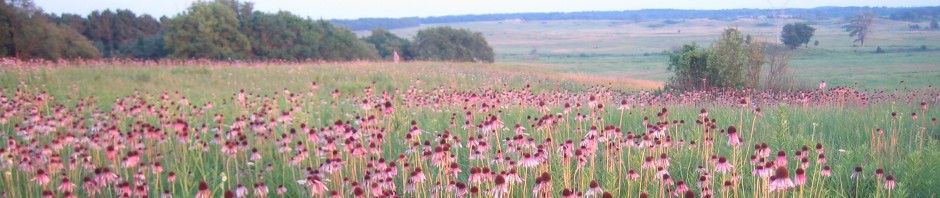
We recently heard from Emily Wedel who worked on her doctorate at Konza Biological Station, looking at shrub encroachment in seldom and frequently burned units. Konza has been studying and pondering the shrubs which have established on their plots that have had infrequent fire. Emily showed us the photo above where the infrequently burned unit was full of top killed shrub stems, shrubs that would all re-sprout come spring. On the other side of the fire break was an annually burned prairie that had no shrubs.
Emily also showed us maps of shrub encroachment where a 20-year fire return interval looks to have the same heavy shrub encroachment as the 4-year fire return interval. To me this suggests that the fire return interval should be one, two or three years. The unit with annual fire had essentially no shrubs even though just across a mowed fire break was a 20-year fire unit full of shrubs.
Emily shared this too. “I attach a paper from Konza where they reversed the fire treatments after 22 years. The infrequently burned watershed became annually burned and vis versa. Figure 3 has some good photos of the areas before and after the reversals. Burning every year opened up the canopy and increased grass biomass, so fire carried through, but the shrubs were still there at shorter heights. [this paper has a fire wall and it is technical] https://url.us.m.mimecastprotect.com/s/71aaC1wpMjIMXpmj5HLfkfVEGiI?domain=onlinelibrary.wiley.com
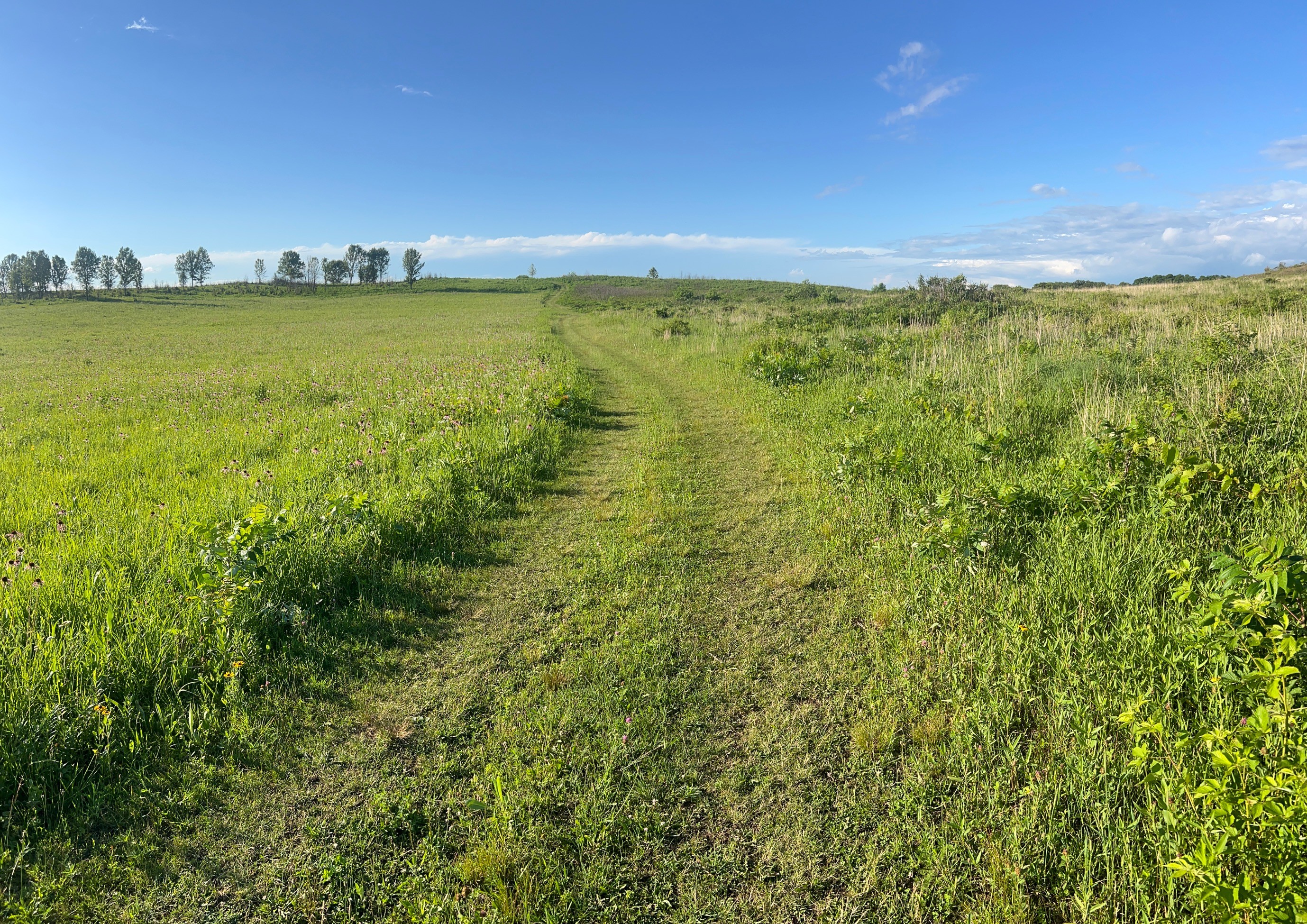
The above photo is at Nachusa Grasslands in our East Heinkel Unit, due north of Schafer Knob. On the left is a prairie planting that is about a decade old and frequently burned. It established well and is handsome this time of year with pale purple coneflowers and white baptisia. My photo does not do it justice. It has essentially no shrubs and has been burned every year or every other year since its planting in 2013.
On the right of the photo is a fallow prairie pasture that the former owner sprayed with broadleaf herbicide a number of times and then grazed horses on it. The prairie was nearly vanquished, but some diversity remains. This herbicide sprayed field likely supported shrub establishment. Notice all the shrubs in it. Abundant are smooth sumac, various Rumex briars, some multiflora rose, honeysuckle, cherry, and black oak.
This unit with shrub buildup has not been burning enough to top kill all the shrubs. It is on a gentle north slope which may lower fire intensity. We had shrub buildup in there before bison, and we have the shrub thickets now, ten years after bison have had access to it. The grazing at times makes the fires patchy with low intensity, which has benefits, but likely supports the shrubs.
This winter we hope to brush mow the unit to see if that later helps the fire come across the unit and top kill the shrubs. We work to keep shrubs and trees out of our open prairies to leave some habitat as full open prairie.


Excellent Bill, Always good to see you and Susan . Safe travels, fran
I suggest you mow during summer instead of winter. If you mow in winter, the shrubs will just sprout and grow back with many more stems. This makes more work for herbicide applicators. If you mow in summer, at a height maximizing foliage removal from shrubs and minimizing impacts to herbaceous species, then you will make a significant impact on the shrubs. I wrote about this in the following blog post.
https://stewardshipchronicles.blog/2025/08/15/poplar-creek-gray-dogwood-mowing-10-7-2024-and-8-12-2025/
This area has rare ornate box turtle so that I hesitate to mow it during the summer.
When I said, “maximizing foliage removal from shrubs and minimizing impacts to herbaceous species,” I was thinking you would set the mower a foot, or more, off the ground. Box turtles should not be impacted unless you run over one with a tire. You could get the dogs to come out and locate the box turtles before mowing was done. A through check should reduce the chance of impacting any turtles.
It would be more difficult to avoid impacting birds. Taking a day to make observations before mowing should allow you to locate and avoid any nests. You would be selectively mowing the clones of brush and not the entire area. Therefore, areas with nesting birds could be avoided. Mowing near nests may cause birds to abandon the nests. I do not know if this would happen or not.
A less invasive way would be to send out a crew with brush cutters. If impacts to wildlife from noise was a concern then electric brush cutters are quieter. This would require more organization than mowing. Having a bunch of people with rotating knives on a stick requires training and care to be safe. It is an alternative, if reducing impacts on wildlife is priority.
Here is what I found while researching control methods for clonal woody plants like dogwood.
9 sources say pre-settlement fire return intervals in tallgrass prairie was 3-4 years, but it’s unclear how they arrived at that & its possible those sources were biased towards the Great Plains. It’s possible that such an interval could prevent clonal shrub establishment, but if there is even a temporarily longer interval that permits establishment, intervals greater than 2 years are unlikely to reduce clonal shrub % cover.
are you experimenting with early fall mowing or burning? We did an early September burn that seem to really set back shrubs even late into the next year, and even killed quite a few.