by Bill Kleiman
Our area has five species in the genus Lespedeza, and two are invasive. Here is a quick summary of the five species and a link at the end to a lengthier set of images with pointers.
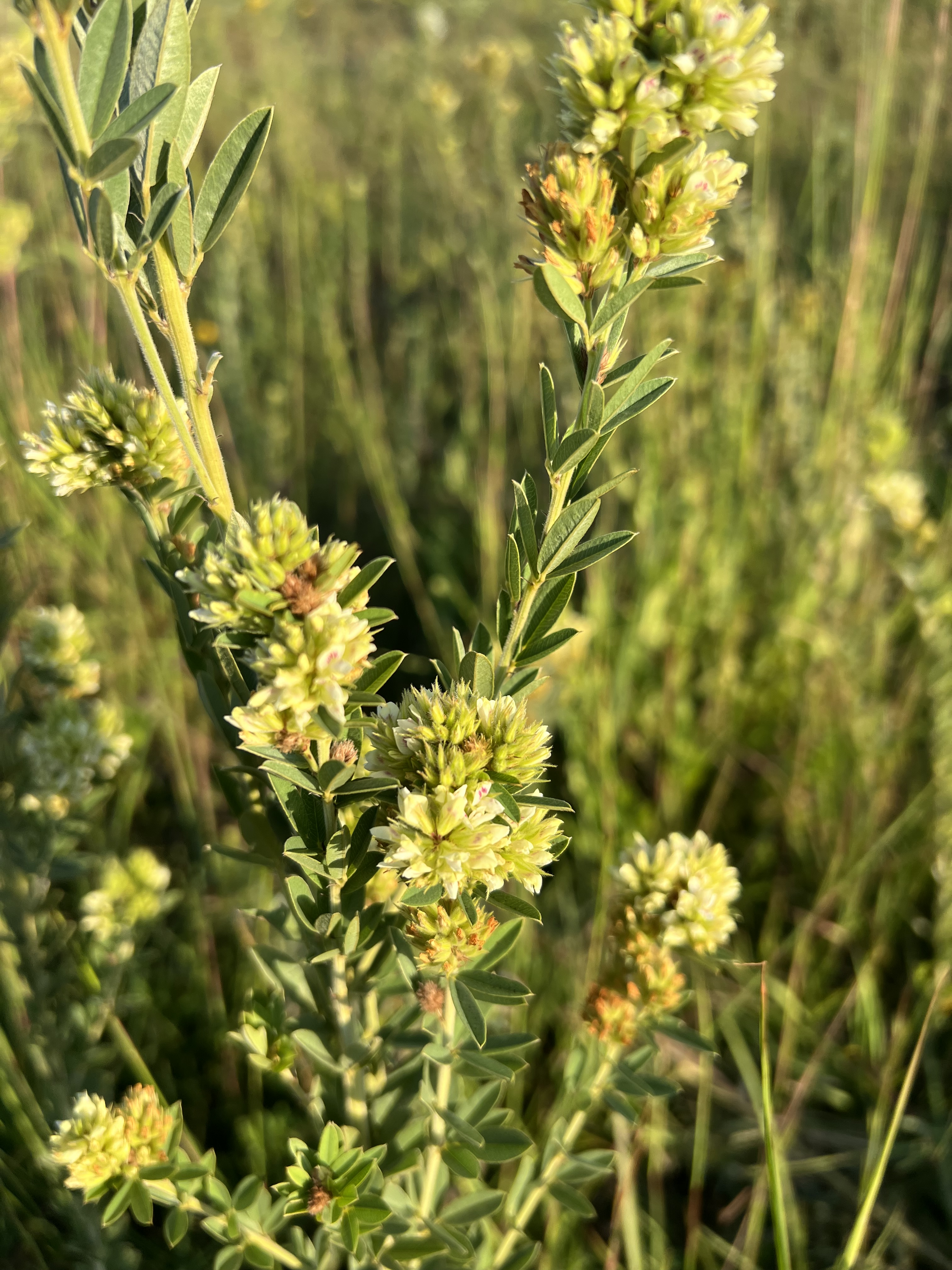
Lespedeza capitata, round headed bushclover. Native. Upright with modest size leaves of three that are more fuzzy with hairs.

L virginica, native, slender bush clover. Upright with slender leaves.

L leptostachya, prairie bushclover. Native and rare. Stands upright but a dainty plant with narrow leaves and small flowers.

L cuneata, sericea lespedeza, invasive. Stands tall like this, with many small leave of 3. This invasive is known to many.

L daurica, Dahurian bush clover. Invasive. The main way to know this Lespedeza is that it sprawls in the vegetation. L daurica is not known to many, but it occurs in the counties by Nachusa Grasslands. It is at McCune Sand Prairie, Mineral Marsh, and sadly Nachusa. We are pushing hard to get this plant gone but it is tough to find in a tallgrass prairie.
To make progress with weeds you need your crews, scientists, and citizens to recognize them as they are hiking about. Once we find the occurrence we can deal with it. Which is why I made a longer version of the above photos with identification pointers. You can find this on the Friends of Nachusa Grasslands website under stewardship resources:
A post about treating L cuneata: https://grasslandrestorationnetwork.org/2021/09/30/needle-in-a-haystack/
A post about L daurica: https://grasslandrestorationnetwork.org/2021/09/09/beware-what-seed-you-buy/


Literature sez Sericea Lespedeza adult plant makes 30,000 seeds per plant per year. And the seeds last 20 years in soil
treatment of Sericea (L cuneata) – tons of data/info from K-State and various sources. Early season when the plant is 12in, bump up to 1.5% v/v triclopyr ester. You can also mow dense thickets mid-summer and they’ll stand out like sore thumbs a few weeks later, making finding/treating more effective.
You can use Pasture Guard (triclopyr ester + Fluroxypyr) but it’s more expensive and my experience is that G4 & water is extremely effective.
Hmmm…my less than & greater than symbols messed up the formatting. I don’t think WordPress likes those characters! Less than 12in, use .75% v/v. Greater than 12in, use 1.5% v/v of triclopyr ester and water.
Pingback: Weed management | grassland restoration network
Pingback: Make repeat visits to reduce weed occurrences | grassland restoration network
Pingback: Testing Herbicide Options for Dahurian Lespedeza Control | grassland restoration network
Curious if anyone has tried tank mixing with indaziflam (Rejuvra, envu) for helping control the seedbank. We use it along the front range here in Colorado for great success on a lot of our invasive species, primarily annual grasses and biennial weeds. We do not have lespedeza here so I am not sure how it would perform on that seedbank.
My neighbor back in the Flint HIlls of Kansas is getting highly frustrated with Korean Lespedeza in his tall grass ranges.
Has anyone tried tank mixing indaziflam (Rejuvra, envu) in their treatments for controlling the seedbank? We do not have Lespedeza along the front range here in Colorado where I am located. I have a neighbor in the Flint Hills of Kansas who is frustrated with Sericea Lespedeza and feels like he can’t get control of it.