Arc GIS Field Maps, known previously as Collector, is a powerful phone app. The app is free, but you do need a GIS online program to run it, which typically means you need your employer to support you. On this image you see random round dots of a few colors, each color represents a different invasive weed. There are green diamond shapes which are native plant occurrences, which represent cool plants we want to remember to come back to, perhaps to pick seed. This morning, I noted starry campion for seed picking later.
These dots/waypoints/geo-referenced points….whatever you call them….are really handy. For instance, they help us see the pattern of infestation of weeds where sometimes a strategy can come to mind. Over time we hopefully have fewer weed dots.
Now differently, note the east west line of red dots. Each dot represents at least one birdsfoot trefoil, BFT, Lotus corniculatus. I started on the east end of this field and used my phone compass to aim west and found a district tree to aim for. I took a step, looked down for BFT. If there was a plant, flowering or not, big or small, I dotted it. There was a plant sometime every step, sometime every two steps, but rarely could I go more than 5 steps without a plant within three feet of my boots. This transect took about 45 easy minutes. I tore the plants out that I found as I did not want to carry a sprayer.
Why walk a line instead of recording all occurrences in this field? I don’t have time to record every BFT in this field. That would take a week. The point of monitoring with quadrats, whether on a transect or randomly placed, is to help us understand a field by sampling a small part of it.
I know this field rather well. In the 1980s the farmer planted birdsfoot trefoil in this pasture. The soil became full of BFT seed. Three decades ago I started to boom spray the former pasture. After this decade of boom spraying we erred in deciding to plant prairie in this field. Then we had about two decades of hard labor of back pack spraying BFT, but you can see the BFT is still there. I did this monitoring transect after we had been through the field for eight hours with seven people with packs. So these are the plants we missed. Sigh.
Lesson learned: Do not plant prairie into ground that has invasive weeds.
This method of monitoring with Field Maps is intuitive, visual, easy to understand, and stored automatically with your other data. I don’t need to write a report about these weeds. You can see the pattern as well as I can.
Here I zoom out for a more complete sense of our preserve and its weed occurrences. We spend a lot of time on these spots. How can we get to treating the weeds faster and with less time, but without doing more harm than good? No easy answers, as you know.
by Kelly Schultz, Stewardship Ecologist, Lake County Forest Preserves
This post is an introduction of one of four hikes we have for our upcoming GRN workshop.
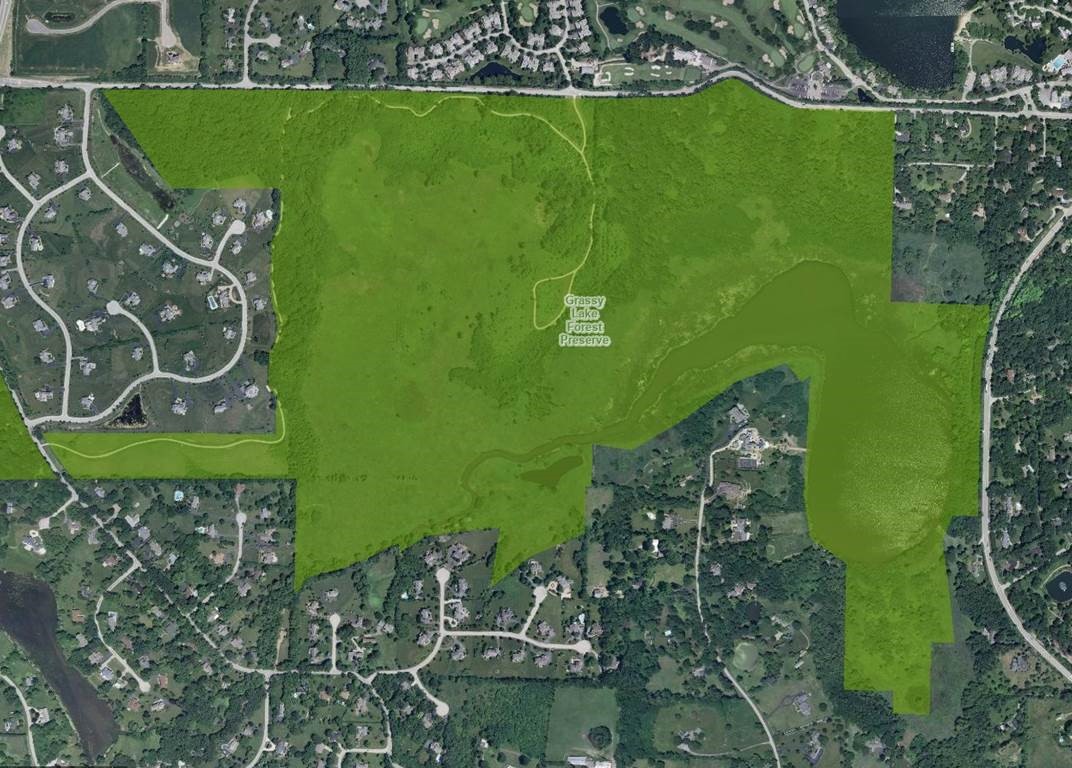
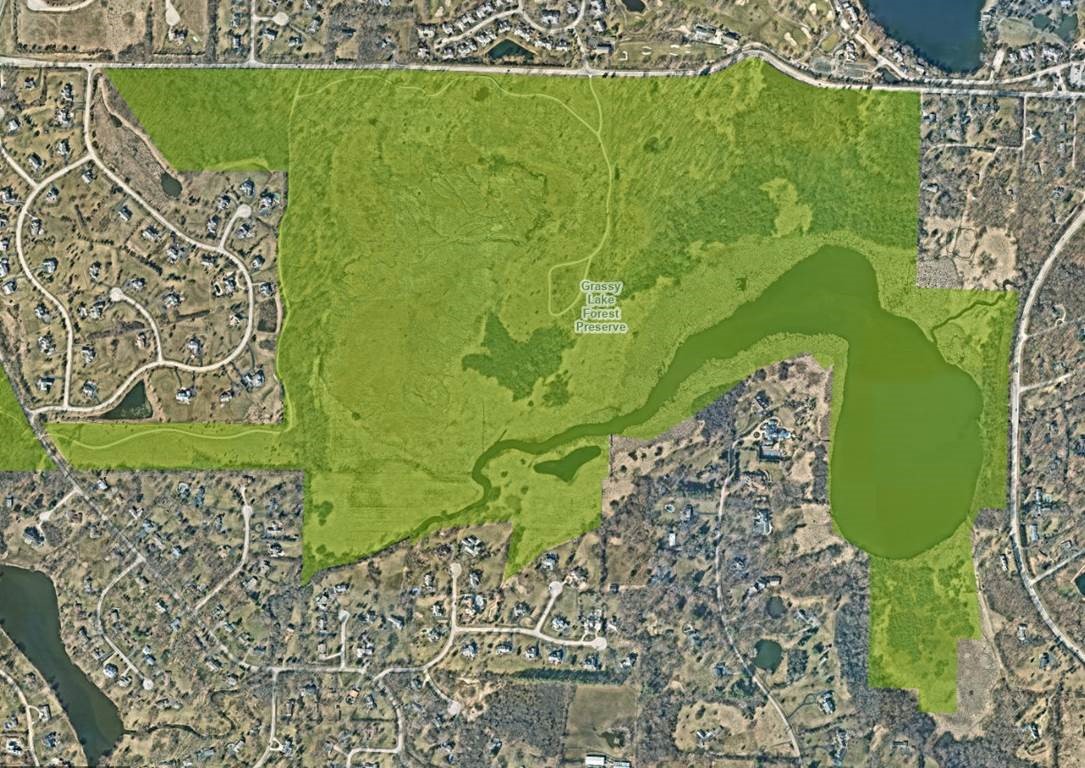
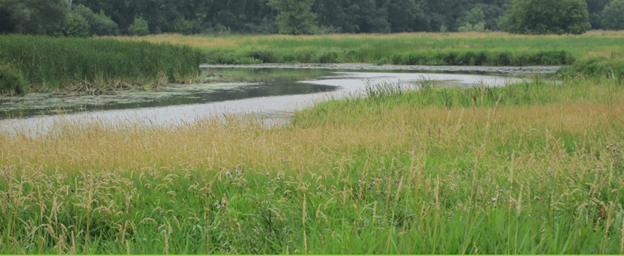
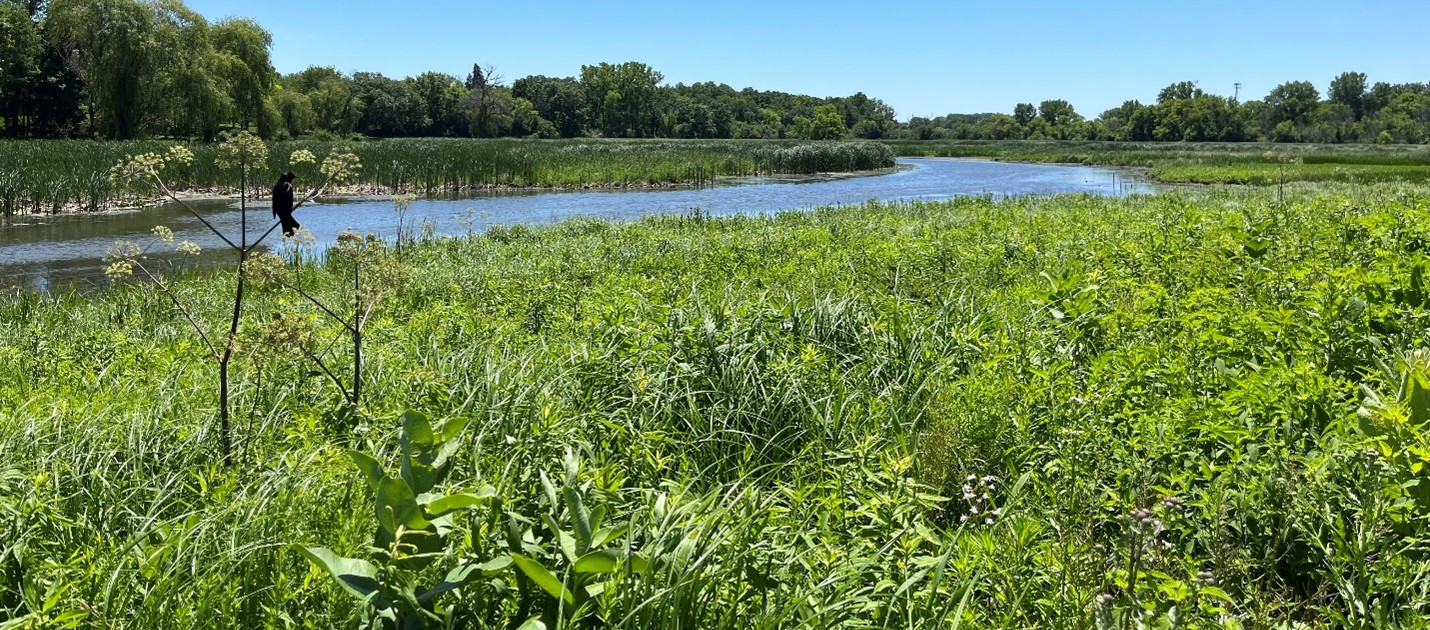
This 700-acre preserve is home to a high quality sedge meadow, prairie, and mesic woodlands, but you wouldn’t have known that 12 years ago. Two incredibly dedicated volunteers took on this preserve and have now improved 100 acres, removing mature buckthorn thickets and the tedious small stems, managing cattails, spraying invasive plants, and adding seeds and plants to bring back the missing flora. Staff and contractors joined the ongoing land management, providing more extensive wetland management, Rx burning, seeding, and planting. Wildlife staff have rounded out the restoration efforts with deer management, jumping mice, and loosestrife beetles. Birds flock to Grassy Lake; snipes and orchard orioles have come to call it home. Tiger salamanders and frogs also live in this preserve, and are thankful for the removal of buckthorn and its emodin.
Much of the work is also thanks to the Barrington Greenways Initiative partnership! BGI workdays are responsible for several big planting projects, not to mention sowing, collection, and buckthorn workdays. The BGI restoration crew has been a regular asset in land management and the jointly funded Technician has been working to expand volunteer efforts at this preserve.
Today you can find dozens of sedges – Carex stricta, pellita, lasiocarpa, interior, lupuliformis, lacustris – rushes – including the state endangered Scirpus microcarpus and more common bulrushes – alongside ferns, yellow and purple loosestrife species, gentians, pale spike lobelia, several milkweed species, and many other pollinator favorites. The namesake lake is now visible from the trail. The woodlands have been transformed with brush removal, seeding, planting, and deer management. The volunteers’ dedication was the impetus for changing our brush pile burning policy across the District (formerly staff only), they have been an inspiration & beneficiary of the BGI partnership, and they were recipients of a national award for outstanding volunteers.
Find a technique that can be used to sustainably rebuild streamside marsh, sedge meadow, and seeps in areas formerly dominated by wetland invasives through small trial areas (<1 acre)
If trial plots appear effective, then use this technique on a larger scale (≥ 3 acres) to reclaim wetlands lost to Reed Canary Grass, Cattails, and Phragmites
Measures of success:
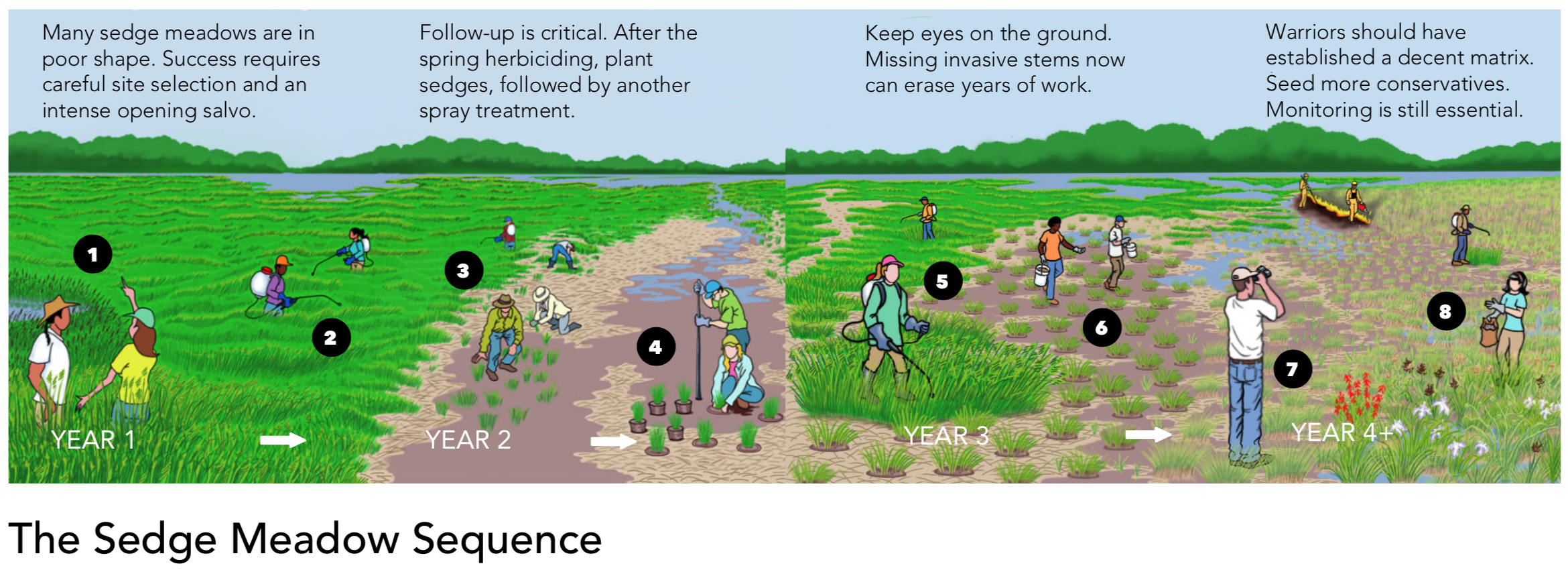
Success is defined as the elimination or heavy reduction (>95%) of wetland invasives, with establishment of a diverse matrix of native sedge meadow species.
Technique:
Areas with heavy infestations are herbicided using a 3% glyphosate mixture in the Fall (September through November) of the year prior to planting. Project area is burned in the dormant season after initial herbicide application to remove thatch and flush seed bank. Area is then sprayed a second time with the same mixture in April.
After site prep, areas are planted during volunteer workdays using the 10 warrior sedges (List Below) based on the perceived moisture gradient of the site. Each plug is planted on 2-3 foot centers, tighter if budget allows.
In the Fall (November) areas are then seeded with custom “Sedge Meadow” and “Marsh” seed mixes. All mixes purposely keep native grass species out. This allows for the follow up of the site with a grass specific herbicide.
Two to Five years after original planting, project areas are spot treated for remerging wetland invasives. Reed Canary Grass is sprayed with a 1% Clethodim Solution during Mid-April through May. As no native grasses are present, this allows for quick application with fairly effective results (see GRN post about Clethodim vs. Glyphosate). Cattail and Phragmites are hand wicked in July and August using a 20% Glyphosate solution.
Project Area:
Plantings over the last 5 years are found on the following map and table. 2017-2020 are considered smaller trial plots. 2021 is considered a larger planting as outline in the Goals section.
Planting
Size of Area (ac)
Approx. plugs installed*
Overseeded in:
Approx. total amount of seed since planting (lbs)**
2017
0.35
–
2018, 2019, 2020
28.75
2018
0.18
2,166
2018, 2019, 2020
28.75
2019
0.38
1,900
2019, 2020, 2021
19.15
2020
0.43
2,166
2020, 2021
21.41
2021
3.38
11,096
2021
92.78
*only includes plugs purchased, additional “rescued” sedges and volunteer propagated added to areas as well **seed weights include some amount of chaff, not PLS
Topics to be covered during Grassland Restoration Network Workshop
Visiting each “stage” of a planting from newly planted to 5+ years establishment
Successes and challenges presented by each planting area
Evaluation of the technique and discussion on the practicality of using it on a large scale
Future uses, Erosion Control, and use on incised creeks
Warrior Sedges
Wettest
Carex lacustris
Carex aquatilis
Carex utriculate
Carex stricta
Intermediate
Carex sartwellii
Carex trichocarpa
Carex atherodes
Carex emoryi
Driest of the wet
Carex buxbaumii
Carex pellita
Seed Mixes Used in 2021, most other years feature a similar mix
9:30AM – 11:30AM: Third Tour Rotation: The same four concurrent tours
12PM – 1PM: Lunch and driving to next site
1:30PM – 3:30PM: Fourth Tour Rotation: The same four concurrent tours
We have these four tours and guests will be able to participate in all tours on a rotating basis
The four tours:
Flint Creek Savanna – Citizens for Conservation – Restoring functioning sedge meadow using the 10 warrior sedges
Grassy Lake Forest Preserve – Lake County Forest Preserves – Volunteer-led effort to restore one of the largest remnant sedge meadows in Lake County
Spring Creek Forest Preserve – Forest Preserves of Cook County – Large-scale grassland restorations will be evaluated using the “Qualitative Rapid Assessment,” a tool designed for adaptive management and constructive feedback for stewards and land managers.
Poplar Creek Prairie – Forest Preserves of Cook County – a remnant gravel hill prairie surrounded by large grassland restorations accomplished over 30 years of community stewardship.
As described in Plants of the Chicago Region, “Phalaris arundinacea, reed canary grass, is introduced from Eurasia. This grass is planted by farmers for pasture and erosion control. It is very common in marshes and other moist ground, often forming nearly pure stands…”
Below are two photo of recent treatment of RCG at Nachusa Grasslands.
A riffle with RCG treated with glyphosate and imazapyr a few weeks back. This herbicide mix is approved over water.Glyphosate & imazpyr on RCG along Wade Creek. Sedges and forbs dominate this section of stream which also has marsh marigold, skunk cabbage, riddel’s goldenrod, and grass of parnassus.
The bright green plant is not a grass but a sedge. The yellowing reed canary grass is hurt by the clethodim herbicide, but not sedges, rushes, forbs, shrubs, trees. But…most of us conclude some of the grass roots will still be alive and slowly emerge next year. Of late we are adding ammonium sulfate and a non ionic surfactant to the clethodim mix. If we knock back the invasive grass can the sedge meadow hold its own?Clethodim sprayed on RCG. At first glance you see just yellowing reed canary grass, but look for the tall thin bright green sedges that are unaffected. I saw those sedges and felt confident that a quick spray of this entire RCG patch would next year show sedges and forbs starting to dominate the ground. This is the attraction of a grass herbicide. From 2020, RCG yellowing while sedges are bright green with some sedges seeding. A missed RCG is bolting in the back ground. We use backpacks too, but this 50 gallon sprayer on the back of the 30 hp tractor is quite nimble for getting access to modest size patches for spraying RCG. The hand nozzle on the sprayer is used much more often than the boom-less tips on the back. A JD-9 nozzle allows spot spraying from the tractor cab or on foot with the hose on the reel. Jim Alwill shares this image of showy goldenrod plugs in a propagation setting where clethodim suppresses the cool season grass sod.Why we push back against invasive RCG: A 2007 image of a meadow at Nachusa dominated by plantain (Arnoglossom plantagineum) and culver’s rootA 2007 image with volunteer steward Kevin Kaltenbach in the same sedge meadow with those plantains in the distance.
A thriving copse of low juneberry is an attractive feature on several remnant knobs at Nachusa Grasslands. These dense clusters of identical plants offer a strong visual contrast to the lovely chaos of diverse prairie surrounding them.
In our sandy soils Amelanchior humilis, aka low juneberry or shadblow, grows about 18 inches tall in dense copses about 30 feet across. Prescribed fire tends to burn only part way into the cluster and fire only top-kills the perimeter plants.
Could we create a copse on the highly degraded, but recovering, Fame Flower Knob that we’ve been restoring since 2006? We had previously planted scattered low juneberry plugs and none survived, probably due to repeated prescribed fire.
Below photo #1: Shadblow on Doug’s Knob remnant; copyright Charles Larry.
The Flora of the Chicago Region by Wilhelm and Rericha says the species occurs in mesic to dry-mesic woodlands and savanna. At Nachusa, copses of low juneberry are found in upland sandy soils underlain with sandstone, arguably in both historic open prairie and historic savanna habitats. It is promising that our remnant seed source is thriving on the same soil types as our target plantings on both remnant and adjacent planted prairie areas.
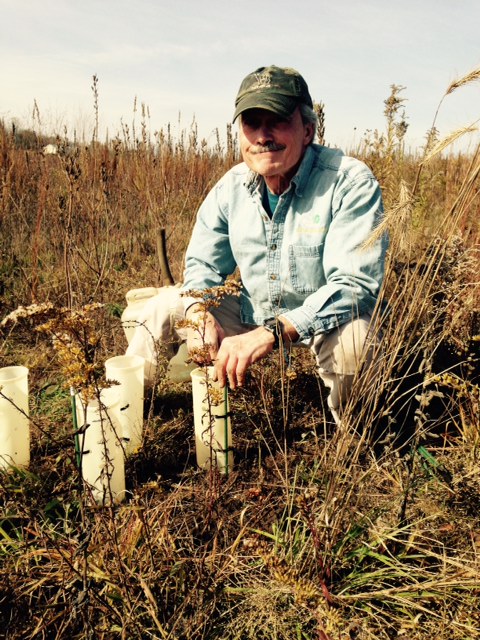
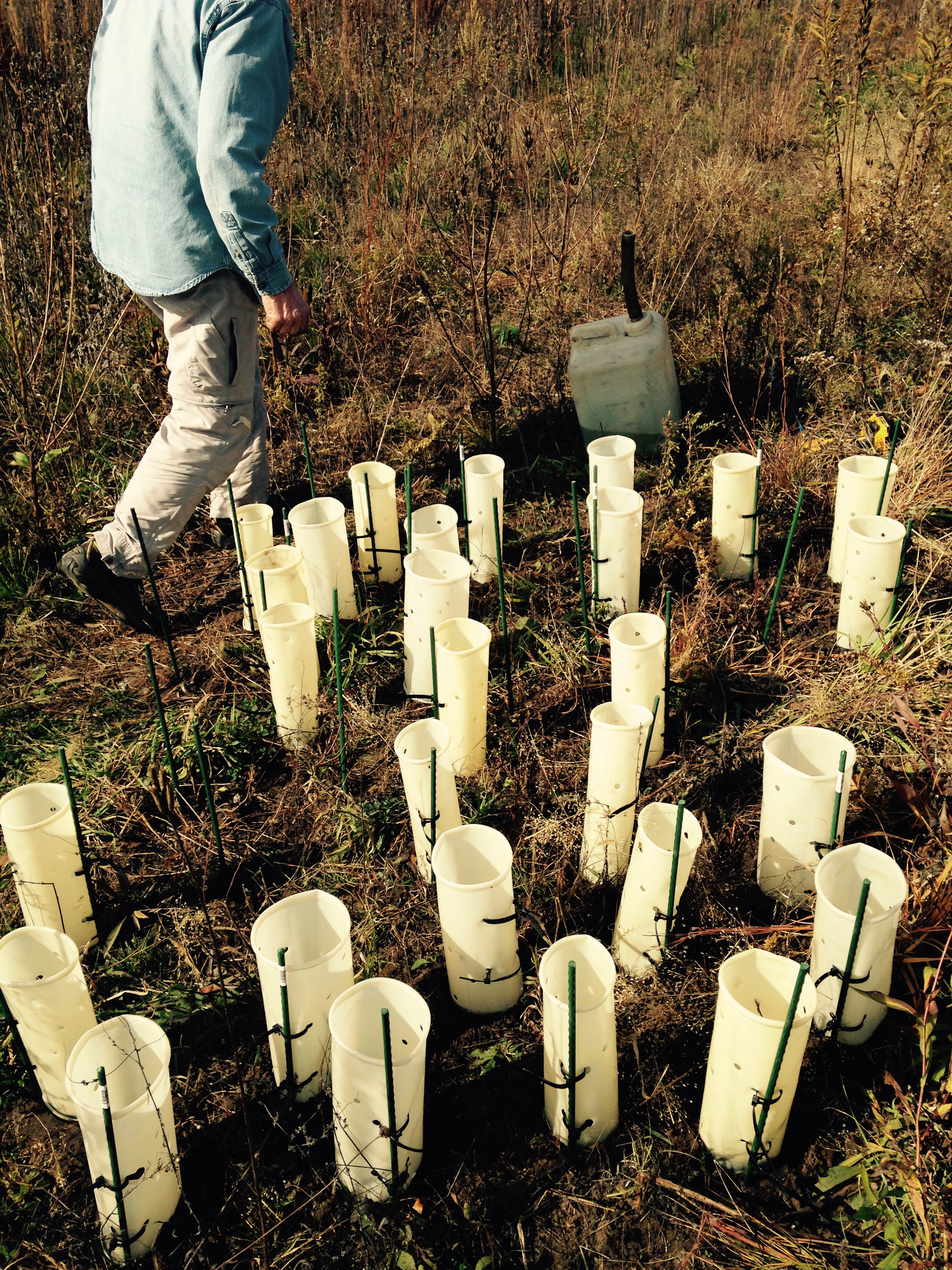
Larry Creekmur of Creston, IL grew three trays of 38 plugs each and generously assisted with the plug planting on October 26, 2014. We targeted one site on the remnant with the same northeast exposure as the seed source and two sites immediately adjacent to the remnant in a 2012 planting. We tried three elevation levels on the knob. The moisture levels appear similar.
Photo #2: Larry Creekmur with planted plugs protected with plastic cylinders.
At each of the three planting sites we planted 38 plugs on 6-inch centers to mimic the dense growth of existing copses. To deter predation while the plants were establishing, we placed a translucent plastic tube around each plug, each supported by a metal stake. After the first winter, the survival rate was about 85%, although we did not do an actual census.
Photo #3: Finished installation.
Our management practice has been to burn the remnant and surrounding plantings almost annually during active restoration. We believed, however, that prescribed fire posed a considerable risk to the shrubs’ survival while the plugs were getting establish. We tried to protect the plugs from prescribed fire in different ways: by reducing adjacent plant matter within 5 feet; heavily wetting just before fire; and with fire retarding foam, also just before prescribed fire.
We were very frustrated when fire repeatedly burned through our defensive efforts. We finally had success in fall 2020 by erecting used corrugated steel panels, but we only had the resources to protect the remnant site which was about 6’ x 5’.
Photo #4: Corrugated protection.
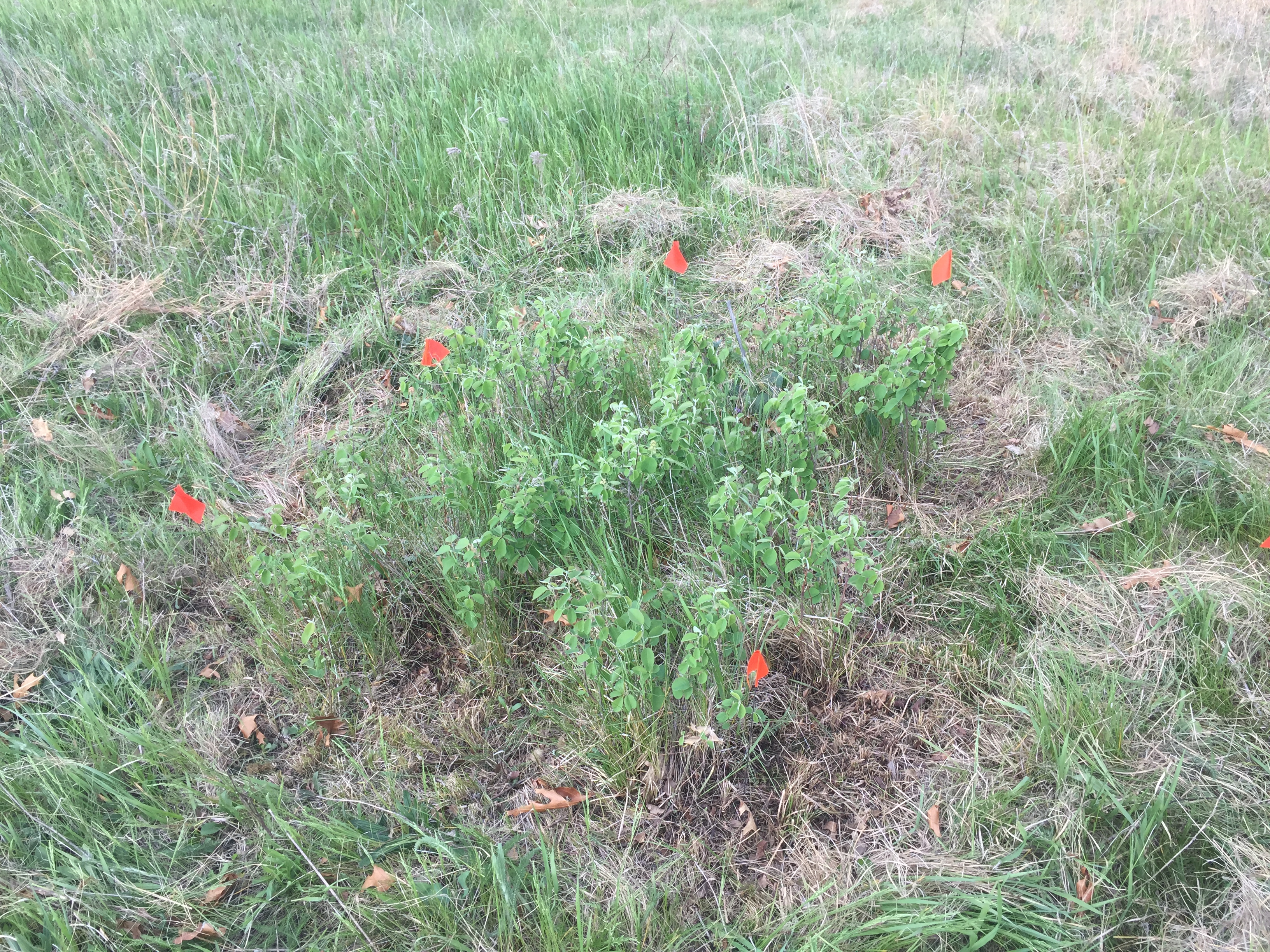
After eight years only the remnant planting site shows the making of a copse. There are now about 150 stems of various sizes compared to the 38 stems planted. The perimeter of the cluster, however, is not noticeably larger than the original planting.
Photo #5 Remnant location after 8 years.
Observations about the process:
Planting plugs in close together seems like a sound strategy.
Fire will likely penetrate, but not kill the copse for years to come.
We might have planted all 114 plugs in one location creating a larger starting copse.
Only metal panels protected the new plugs from fire.
The other two planting sites were not protected from fire and are much less vigorous and less dense.
Effective protection from fire might have accelerated the plugs’ development.
We might have done simple soil cores to possibly find a planting site with “depth to sandstone” like the source site.
It looks like it will take at least another decade or two before the planted copse is wide enough and dense enough to act as a barrier to prescribed fire, thereby protecting its core.
We think this effort will ultimately succeed. Check back in a decade, but don’t wait to try it yourself.
Tom Mitchell is famous. We all have fame within various sized communities in which we live. Tom is certainly known in Monroe Wisconsin as he was the captain of his high school basketball team when they won all 26 games and then won the state championship in 1965. This September Tom will be inducted into the Wisconsin Basketball Hall of Fame.
1968: Tom Mitchell at University of Wisconsin
Tom is also famous at Nachusa Grasslands for being a really active and effective volunteer steward. With his wife, Jenny, they would volunteer a few days a week at Nachusa from about 1998 through about 2008, a decade of energy and fun. Tom and Jenny started off joining the Saturday morning workdays, and quickly ended up as unit stewards who created four really nice prairie plantings. They also cared for an important remnant prairie. Tom was on many prescribed fires, led many VIP tours, and mentored new volunteers.
2001: Tom Mitchell2002: Tom Mitchell2006: Mary Scott, Tom Mitchell and Jenny Mitchell with Mary’s treats.
Tom says he was mentored by Bill Kleiman and Jay Stacy. But below is a 2005 photo with fellow super stewards Hank Hartman and Chris Hauser, who also worked hard and loved to share ideas.
So Tom and Jenny retired from Nachusa to move back to their beloved Monroe Wisconsin where Tom immediately became the most active volunteer steward in the area, volunteering with The Prairie Enthusiasts. Tom and his cohorts care for the 135-acre Muralt Bluff Prairie, and several other sites nearby. Before Tom, the volunteer group had been meeting once in a while to do some work. Now with Tom doing stewardship 7 days a week the group is getting a ton done.
Tom is famous. All of us are famous in our various circles.
2022: Tom Mitchell
Cool bonus: A wonderful five minute NPR radio piece featuring Tom and others with photos is here: https://youtu.be/-tABkRbXzPI
A Healthy Nature Handbook. Illustrated insights for Ecological Restoration from Volunteer Stewards of Chicago Wilderness. Edited by Justin Pepper and Don Parker. Available at Island Press https://islandpress.org/books/healthy-nature-handbook and here is a 20% coupon code HNH2021
Daniel Suarez
Aldo Leopold once wrote that “One of the penalties of an ecological education is that one lives alone in a world of wounds. Much of the damage inflicted on land is quite invisible to laymen. An ecologist must either harden his shell and make believe that the consequences of science are none of his business, or he must be the doctor who sees the marks of death in a community that believes itself well and does not want to be told otherwise.”
Written nearly a century ago, Leopold’s words still ring true for many. In places like Chicago, where prairie was converted to farms and then homes, subdivisions, neighborhoods, and one of the largest metropolises in the United States over 100 years ago, we struggle to find the scars of past sins on the landscape. However, for nearly half a century, everyday people have taken up Leopold’s challenge and accepted that the consequences of science are their business, that there are marks of ecological decay all around us, that in fact communities can make a difference. These everyday people have congregated on weekends and weekdays, in the heat and mosquito-ridden humidity and in the piercing cold to begin putting small fragments of our ecological heritage back together. They’ve come from backgrounds as schoolteachers, pharmacists, lawyers, artists, and activists, learning from established professional experts but most importantly from each other. The result is a network of highly-motivated, generous individuals who are driven by the idea that to restore an ecological community, a human community must be formed around the cause.
For many, however, this network is inaccessible. Chicago, while highly manipulated and fragmented, does have an abundance of parks and preserves that set it apart from many large metro areas. In more rural areas, or areas lacking access to nature, finding like-minded individuals and progressive institutions that value the contributions volunteers can be exceedingly difficult.
That is why books like the A Healthy Nature Handbook: Illustrated Insights for Ecological Restoration from Volunteer Stewards of Chicago Wilderness, edited by Justin Pepper and Don Parker, are so needed. Breaking down the barriers for access to some of the most forward-thinking, hard-working volunteer stewards in the region, this volume will help connect isolated individuals with the thought processes, ingenuity, and innovation that are hallmarks of the volunteer stewardship community in the Chicago Wilderness region.
As a college graduate during the Great Recession of the late 2000s, I found myself in a difficult situation. Armed with a dual degree in Art History and Religion, I was unable to find work in galleries and museums, leading to a less-than-ideal job of bagging groceries at Whole Foods. I felt lost, stuck, and in need of a new direction. Someone turned me on to the idea of volunteering at the Indiana Dunes National Lakeshore (now National Park), and I fell in love with the idea of becoming a National Park Ranger. Having grown up never camping, hiking, or even visiting a National Park, I didn’t have a grasp on what exactly I could accomplish or what I could learn. After making the long weekly trek to the Dunes on the South Shore Line for almost a year, I was tipped off that there were actually opportunities to volunteer doing habitat restoration closer to home. I attended one workday at Somme Prairie Grove with Stephen Packard, one of the volunteer stewards highlighted in A Healthy Nature Handbook, and my life was never the same.
Stephen and the Somme volunteers lit a fire under me. I had a radical awakening that challenged everything I thought I knew about nature, Chicago, and humans’ ability to restore what was lost. I immediately started spending my days off and time before or after work at Somme and other preserves, meeting stewards, asking questions, tagging along to mark areas for future workdays, collecting seeds of rare species, or hand-pollinating endangered orchids. It wasn’t easy or comfortable, and I was pushing myself outside of my comfort zone to spend time with unfamiliar people in unfamiliar places. However, before long I had established a strong network of teachers and mentors. This privilege afforded me the opportunity to eventually get an internship doing prairie restoration at the Chicago Botanic Garden, which developed into a temporary job with the Plants of Concern community science project, and eventually a career with Audubon Great Lakes, where I have worked for the past eight years.
What does my story have to do with A Healthy Nature Handbook? As I read through this impressive volume, I found myself with that familiar feeling I first felt at Somme. Hearing about innovations in restoration directly from the people that developed them, I felt that fire being lit under me again. And I know that others in the Chicago Wilderness region and beyond will feel the same.
The book focuses on particular restoration techniques, like the oft-duplicated Sedge Warrior process innovated by Tom Vanderpoel and Citizens for Conservation, or the backyard seed propagation efforts of Rob Sulski and the North Branch Restoration Project. Peppered throughout are nuggets of wisdom that are useful not only to those in the Chicago Wilderness region, but beyond. That’s because the conversational style of teaching that volunteer stewards excel at is faithfully reproduced throughout the book. Therefore, even if you’re restoring Longleaf Pine forests in Georgia, you can learn about the thought processes and can-do attitude that resulted in a regionally significant rare plant propagating effort and apply them to your own geography.
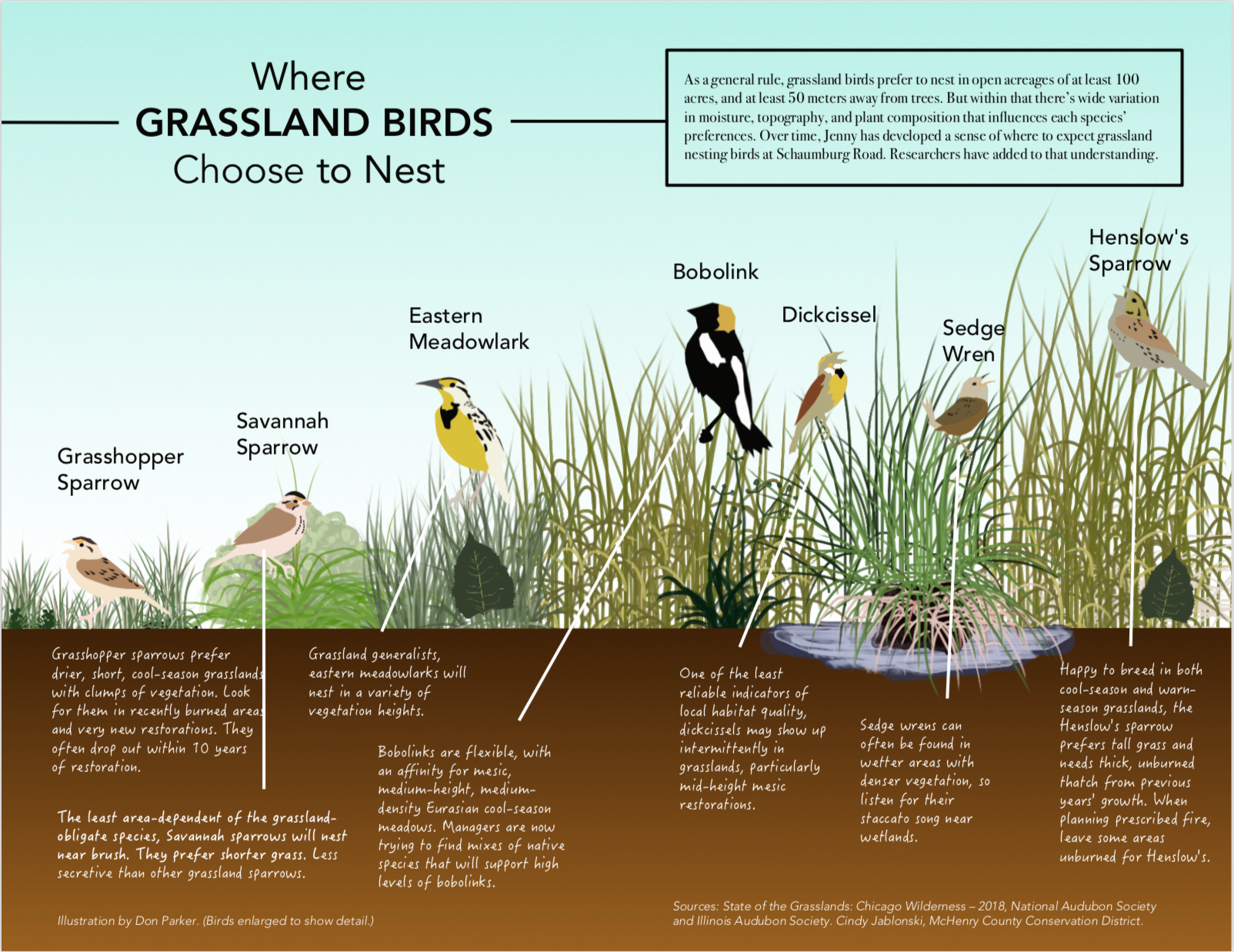
Similarly, one does not need to be able to identify Henslow’s Sparrows or Bobolinks to be able to understand Jenny Flexman’s ability to “see ecosystems in 3D” and thus change their observational skills to interpret restoration through the lens of savanna or woodland birds. The book provides specific information that some may benefit from, and general ways of viewing ecosystems and the challenges of restoration that everyone can apply to their local habitats. This, in turn, should spawn creativity and experimentation from a new generation of stewards, which are sorely needed in our age of rapidly-declining biodiversity.
The visual format of the book will appeal to everyone, especially younger stewards who are familiar with bite-sized pieces of information that are rich with graphics that mimic social media and blog posts. The authors imply that one of their goals was to build a Cook’s Illustrated for habitat restoration; the book acts not like a traditional recipe book that teaches you how to cook a specific dish, but rather teaches you how to build skills and techniques so that you can cook a great dish using the ingredients you happen to have on hand.
A Healthy Nature Handbook will surely influence a new generation of stewards. I know I’ll be sharing this volume with future Audubon interns and volunteer stewards – both in and outside of Chicago – for years to come. Tools like this help build more ecological literacy, which is essential if we are to combat the biodiversity and climate crisis at hand. One doesn’t become a steward overnight. It requires patience, curiosity, hard work, and access to innovative teaches and ideas. A Healthy Nature Handbook takes the onus off of the individual to make those connections and helps fast track the development of ecologically-literate communities that can help us reimagine a brighter future for nature and humans.
One of my goals that I wanted to achieve this year was to begin trials on the propagation of hemi-parasitic native plant species. The challenge with these is that they need a sufficient host plant for these plants to grow and develop. While some of the methods I have read about didn’t use a host plant, the overall vigor and development of hemiparasitic seedlings without a host greatly declined in their growth, which mostly lead to mortality of the young plants. With this in mind, I decided to first try one species that I thought would be a good introductory candidate for hemiparasitic plant propagation, and that species was Swamp Betony (Pedicularis lanceolata).
An uncommon species within the region, Swamp Betony is found in a variety of wetlands that include Sedge meadows, fens, wet prairies, and marshes. Like other Pedicularis species, it is a generalist when it comes to hosts, but generally gravitates towards using graminoids and composites. From my experience, Swamp Betony does fairly well from sowing seeds into restorations, and slowly increases in numbers over time. However, the number of plants is still few compared to what you may see in remnant habitats. The flowerheads of Swamp Betony are heavily browsed on by deer, and this makes it a challenge for seed collection in area where deer densities are high. This along with habitat degradation are some of the factors of why Swamp Betony is declining in the region. By propagating plants within a nursery setting, I wanted to see if I could successfully reintroduce Swamp Betony into the wild with plugs, and if there is the potential to plant plugs in protected nursery beds to increase seed production, or directly into the restoration.
Understanding the nature of Pedicularis species, I wanted to use the right host plants for this trial. Swamp Betony can drain a lot of energy from its host, so having a vigorous host in a plug would give enough energy for the developing Swamp Betony seedling. I chose to use Common Lake Sedge (Carex lacustris) and Hairy-leaved Lake Sedge (Carex atherodes) for the trial since they have an aggressive, rhizomatous nature to coup with the Betony. After their needed stratification period, I sowed the sedge seeds roughly a month before the sowing of the betony seeds. This would allow enough time for the sedge seeds to grow and develop into a sizeable seedling so that the betony will have enough root mass to attach to.
When the seeds of the sedges germinated, I transplanted them in small plugs (88 trays). I did this rather than directly into larger plugs with the idea that the root system of the sedge would be more condensed, allowing the seedling of the Swamp Betony to have a greater chance of attachment before being transplanted into a larger plug. Seeds of Pedicularis were sown with a host on April 8th, 2021, approximately 150 days after a cold, moist stratification period. Each plug received one seed to keep track of germination rates and to not overwhelm a sedge plug with more than one Swamp betony plant. First signs of germination began on April 20th, 2021, and continued sporadically for a couple weeks. Once the host sedge was large enough, and the Betony seedlings had a couple pairs of true leaves formed, I transplanted them into larger plugs, where they would continue to grow for the next two months. Growth and development was slow at first, but increased greatly once the summer months hit. In July, volunteers planted the plugs directly into the sedge meadow restoration.
Plugs of both the host and the betony progressed in growth once planted, but the host sedge was less vigorous than regular sedge plugs. Many of the Swamp Betony plants did flower and set seed this first growing season. I’m planning on trying this approach with Wood Betony (Pedicularis canadensis) with upland sedge hosts for the upcoming 2022 growing season.
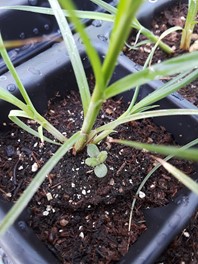
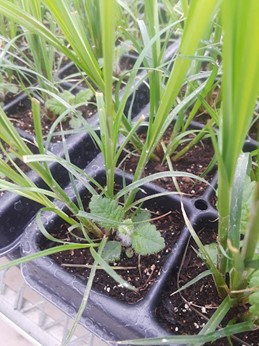
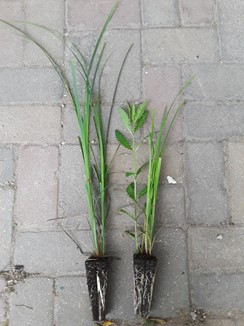
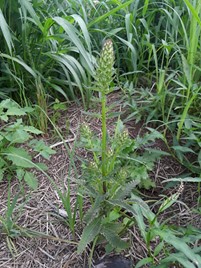
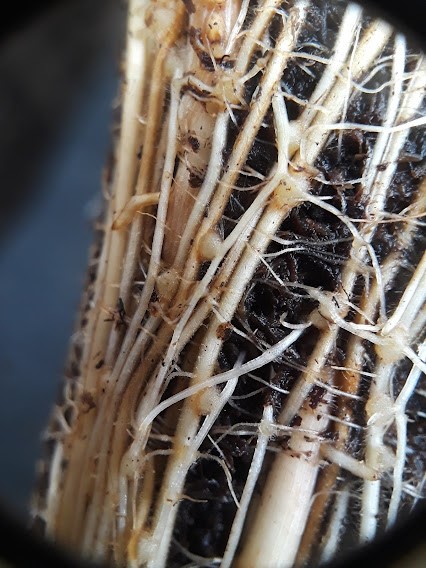
Seed sowing of Pedicularis lanceolata on 4/08/21 with Carex lacustris hostPedicularis lanceolata seedlings on 4/20/21 with Carex hostsPedicularis lanceolata seedling with first true leaves on 4/29/21Pedicularis lanceolata seedlings on 5/17/21Pedicularis lanceolata plant on 6/08/21Pedicularis lanceolata plug and Carex lacustris plug 7/08/21. Note how the host sedge is less vigorous in growth than a normal sedge plug.Pedicularis lanceolata with flower stalk 8/19/21Pedicularis lanceolata roots under a hand lens 7/08/21. The swollen areas are where the Haustoria have inserted into the Carex roots.


















 grassland restoration network