Mike Saxton – Executive Director – Friends of Nachusa Grasslands
The Friends of Nachusa Grasslands recently protected a 195-acre tract adjacent to The Nature Conservancy’s Nachusa Grasslands. The new acquisition is an important site with restoration potential for high-levels of native biodiversity.
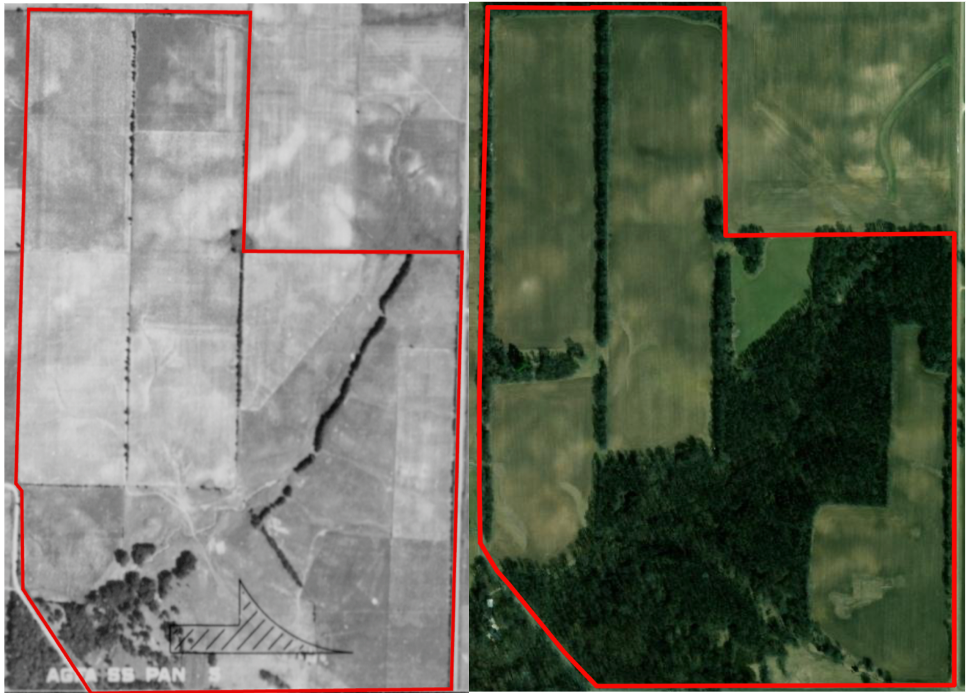
In the 1939 aerial (left), you can see row crop fields and can make out cattle paths through pasture (likely native prairie). Oaks are scattered in the southwest corner of the unit.
In the current aerial (right), the row crop acreage remains virtually unchanged while all of the pasture has gone through old field succession, transitioning from open prairie to closed canopy woodland. The formerly open oak corner is now fully stocked and densely treed.
When Friends of Nachusa Grasslands protected this tract in December 2025, the woodlands were an impenetrable thicket of bush honeysuckle. The once open pasture (presumably prairie plants in 1939) is now a majority black cherry and Osage orange. The south, southwest and west facing slopes have pockets of little bluestem in scattered eastern red cedar openings. In the late 1990s, prairie petunia (Ruellia humilis) was still growing in the few remaining light gaps.
Eventually, we will restore the row crop fields to high diversity, rich habitat for which Nachusa Grasslands is well known. Going from row-crop to prairie is a fairly straightforward process.
But restoring and caring for 65-acres of formerly open prairie/pasture which is now a cherry and Osage orange woodland is a much more challenging task. What can our investment of time, energy and stewardship restore?
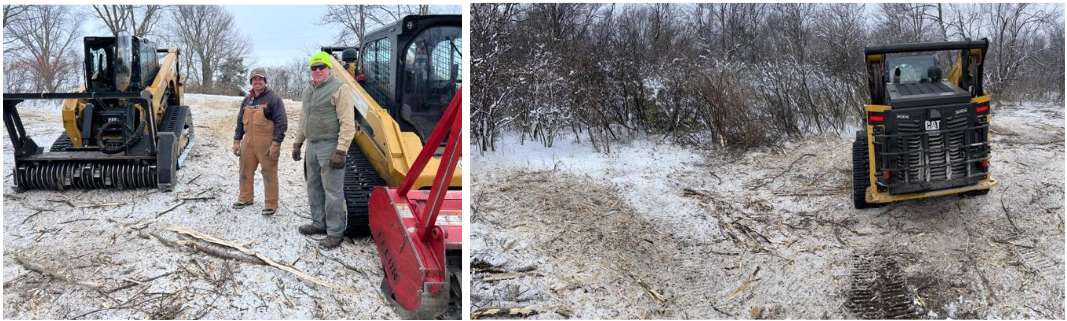
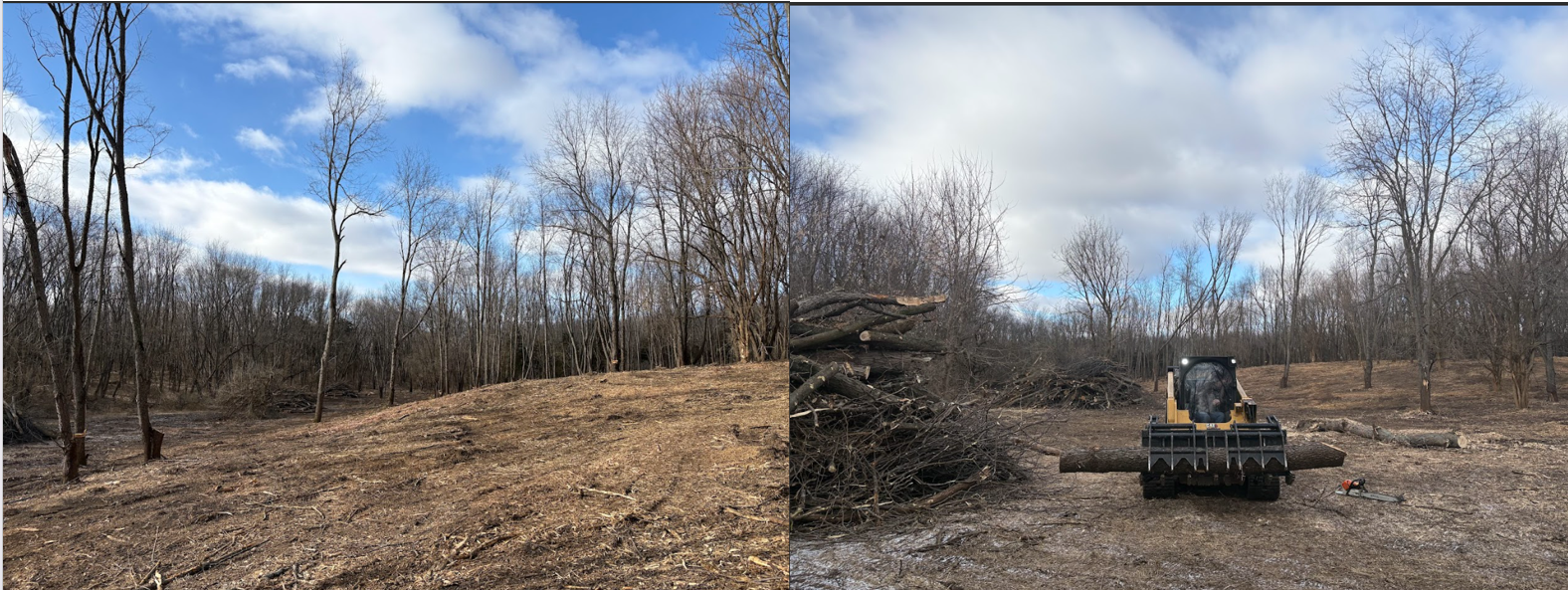
We are assessing the challenges and opportunities this project presents and after just a month of ownership, nearly 50 acres of brush has been mowed and scores of trees felled. We are energized and eager!
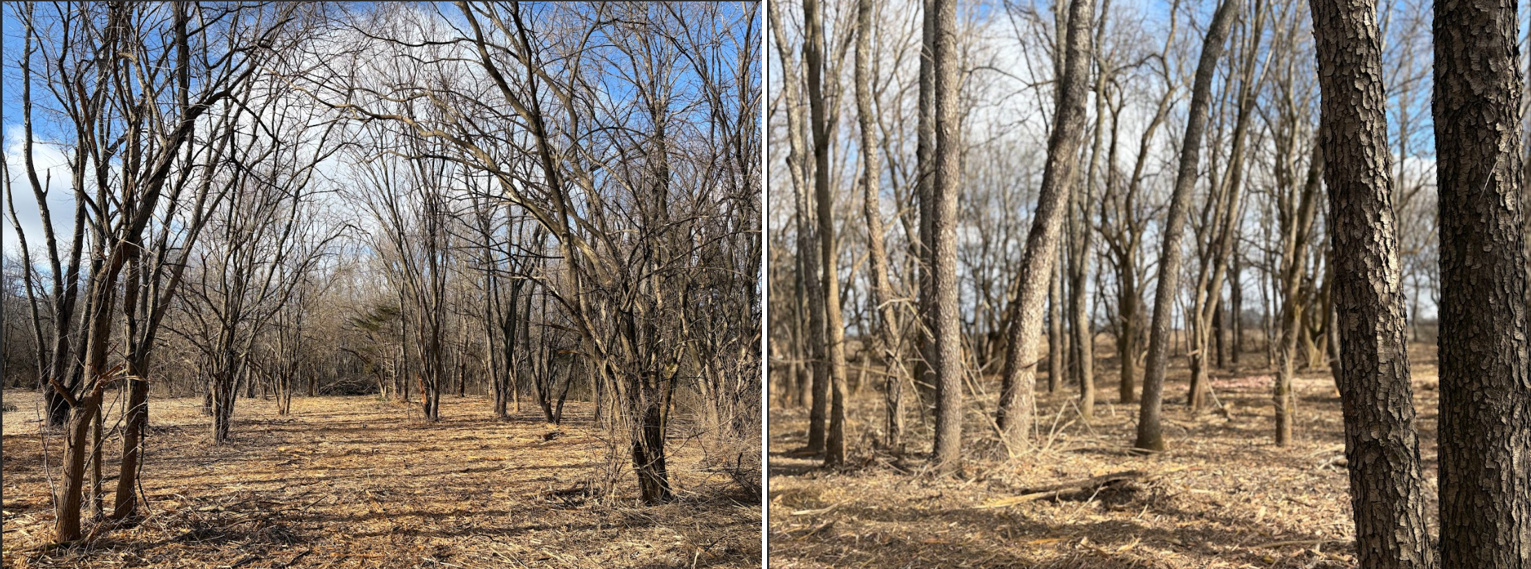
How soon can we begin to manage the area with fire? How much (perhaps precious little) remnant prairie was hidden in the thickets? After decades of shading and successional transition, will there be unforeseen invasives springing up? At what point do we actively begin seeding? What is a realistic timeline for our stewardship efforts? These and many, many others are the questions we are pondering.
Our work is that of trial-and-error and we learn by doing. In the months and years to come, a combination of invasive species control, Rx fire, and generous seed addition will be invested in the site. We will document progress and share our results. Stewardship has a beginning but no end!


 grassland restoration network
Mike, Congrats and welcome back. Very nice article. fran
Thank you, Fran! Good to be home 🙂
Have you considered killing the trees in place with drill-and-fill and leaving them to die upright, creating red-headed woodpecker habitat?
Nachusa Grasslands has a robust population of red headed woodpeckers which can be seen in various areas throughout the year. They seem to love open woods that are free of invasive brush and oak woods that experience frequent prescribed fire.
In this new property – perhaps 15 acres of the unit (still assessing as we remove invasive brush) is comprised mostly of oaks and hickories. These are the areas where trees occurred in the 1939 aerial. Large, gnarled bur oaks are hanging on but there has been little oak recruitment due to limited light availability, lack of fire, competition, etc. There are some juvenile oaks, though not many. There are many dozens of bitternut hickory in the area in many size classes. Over time, we’ll remove Osage orange and thin cherries, elms, walnuts and hackberries. I can image basal barking / girdling trees in this area to create high quality woodpecker habitat.
In the areas that were formerly prairie and where small pockets of remnant prairie vegetation might be holding on, our vision will be to restore rich prairies that will create critical habitat for imperiled grassland birds such as Henslow’s sparrow, bobolink, meadowlarks, etc.
Great read Mike! These areas that show great restoration potential are fun to hear about and fun to watch heal through the years. Great photos to help illustrate how old pictures can inspire efforts to restore forgotten prairie. Thanks for posting.
Thanks, Paul. As we invest time and care into these forlorn acres, we’ll be excited to see how the plant communities respond. We’re in it for the long haul!
For the former pasture, what are the range of options & pros/cons regarding control of woody resprouts? Reports of foliar herbiciding vary a lot in efficacy. If foliar is used, would seeding occur afterwards? It seems to me a particularly difficult problem is if the foliar application partially fails in an area with small diameter dense brush, because subsequent foliar applications will negatively impact the herbaceous layer that was seeded in.
Would the weed wiper described in the 8/26/21 entry for this blog be cost effective for resprout control if shared among agencies?
A big unknown will be how much native vegetation bounces back. We expect to find some nice plants in small patches, and hopefully these prairie patches recover more diversity/abundance with fire and sun light. Some areas of been densely encroached for many decades. We’re less optimistic about native vegetation bouncing back in those acres. We can likely be more assertive in our control efforts when there is little to no remnant vegetation.
Another consideration is that the surrounding row crop fields will eventually converted to high diversity prairie. So what about the extremely degraded former pasture now invasive brush/dense tree area? What if we used combine mix in the former pasture? Tons and tons of seed but many fewer species. Hand collected seed is precious. Combine mix is less so. Can you be more aggressive in your invasive control efforts (tolerate more collateral damage) if diversity is lower and combine seed is readily available? Can you speed up the seeding timeline with combine seed as compared to hand collected? Tough calls!
It’s always a balance between speed, efficacy, scale, and expectations. We intend to monitor vegetation response and utilize a combination of basal bark application and foliar spraying. TBD, at this point.
In terms of the weed wiper – I think the wiper has some utility but it is certainly not a silver bullet. When using the wiper, the ground speed is slow so covering large acres if tricky. Woodies are harder to kill than herbaceous weeds. It only selects for height (anything above a certain height is treated, that is) so it lacks precision.
Mike, when will you start herbiciding?
When using basal bark (triclopyr ester and oil), you can apply any time, of course. But since most of the area is mowed, we’ll have to wait for the shredded stems to resprout. Once you see any vegetative response, basal bark is a good option. Basal bark seems to always be effective but it’s much more expensive. Foliar treatments are typically much cheaper but you have to wait longer until you have plenty of leaf area. By the time you have plenty of shrubby re-growth, your existing vegetation has emerged and seeds have germinated. Always trade offs!
I just found this really great resource from the UW-Madison Renz Weed Science Lab – Demonstration of Bush Honeysuckle Management with Herbicides They have some great resources on treatment efficacy post-mowing.
Mike, having trouble commenting, so this might be a repeat. Thank you for this update. Preserving more land is why my wife and I support Nachusa. Appreciate your communications on this important work. It would be nice to see a map that shows how this new acquisition fits with the other Nachusa lands. Thanks again!