Year-Three Results – August 2025
By: Karen Glennemeier – Habitat Research LLC
and Jeff Weiss – Living Lands Conservation Company
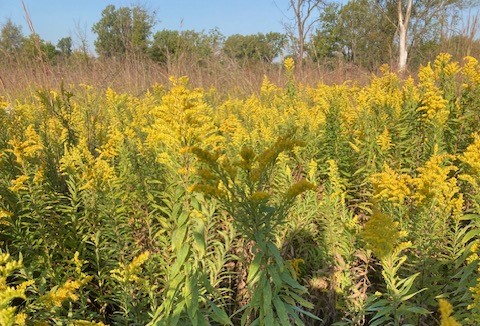
Tall goldenrod (Solidago altissima) has become one of our most aggressive invasive species, especially in newly-opened woodlands and young prairie restorations in northeastern Illinois. While dense monocultures of this native species may have been present in patches across the historic landscape, most of us agree that we don’t currently have the luxury of allowing it to run its course within our small, fragmented natural areas.
We’re all trying various control methods and sharing our anecdotal successes and failures. This study set out to test a few of the more common methods systematically, to see what more we could learn.
We focused on seven different management methods commonly used (or newly of interest) in mesic to wet-mesic prairies. We would have liked to include more treatments and combinations of treatments, but we needed to keep the study manageable in scope!
We’re only three years into the study, so these results are very preliminary, but we thought we’d share what we’ve got so far.
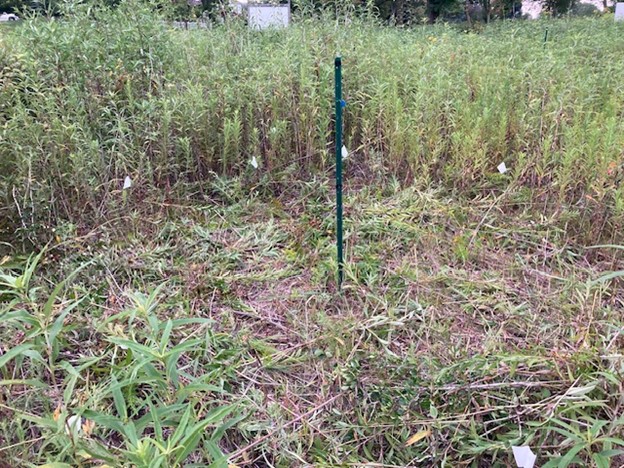
The treatments consist of eight circular, 9 m2 plots. Within each plot, we have conducted each of the following treatments annually since 2023:
- Control
- Wood Betony – scattered approximately 500 stratified seeds of Pedicularis canadensis.
- Dodder – scattered approximately 25 seeds of Cuscuta glomerata.
- Both Wood Betony and Dodder, as described in #2 and #3 above.
- Mow without seeding – mowed all plants within the plot (brush cutter, scythe, or clipper).
- Mow with seeding – mowed as in #5 above and scattered 1.5 cups of cleaned seeds. Seeds were Citizens for Conservation’s prairie “power mix” (see species list below).
- Herbicide without seeding – spot treated tall goldrenrod with foliar application of selective herbicide (1% clopyralid).
- Herbicide with seeding – spot treated as described in #7 above and spread seeds as described in #6 above.

In our mowing treatements, we cut everything in the plot in order to mimic the typical mowing control of large goldenrod monocultures. In our herbicide plots, we only selectively herbicided tall goldenrod, again to mimic the way this treatment is typically employed (mostly in smaller sites). This difference means it may be harder to draw apples-to-apples conclusions about what’s behind the results, but ultimately what matters most is studying the methods that people are actually using in the field, so we’re ok with the trade off.
We are monitoring two responses to the treatments:
1. Tall goldenrod abundance
2. Overall floristic quality
To monitor the response to our treatments, we estimate percent cover of all species within four 1/42m quadrats within each test plot. We first took data in early August, 2023, and then we cut and herbicided the treatment plots the following week. In December of 2023, we spread seeds in the seeded plots.
We repeated this monitoring and treatment in 2024 and 2025. We have four replicates, doing all eight treatments at four different sites in Cook County, IL.
It’s very early, and we plan to continue the study for at least another five years, but here’s what we’re seeing so far:

(Error bars are standard errors of the mean. If they overlap, this roughly means the differences are not statistically significant between treatments.)

The main takeaway thus far seems to be that selective control plus supplemental seeding is the most effective strategy. If one wanted to avoid the drop in FQI with the herbicide-only treatment, which presumably is due to underground collatoral damage, one could try selectively cutting rather than selectively herbiciding, as some stewards do (typically using scythes).
Other thoughts:
1. We haven’t yet seen any betony germination, so it’s too early to know its impact, although the slow pace certainly suggests betony is not a quick solution to an emergency infestation. Anecdotal reports from other stewards suggest it may be a very effective long-term solution, though.
2. Dodder has not yet been recorded in all of its treatment plots, so, as with betony, we are still waiting to see its full impact. Anecdotal reports from other stewards suggest it is a very promising management tool, although germination of the seeds can be hit-or-miss, so this could limit its effectiveness until we figure this part out.
3. Oddly, cutting alone isn’t affecting FQI after two years. We’d have expected it to suppress FQI, since we’re cutting everything in the plot. We’re not sure what to make of this and are going to see how it plays out over time.
Thanks to Openlands for supporting this study and to the Forest Preserves of Cook County, ComEd, Citizens for Conservation, and the Village of Buffalo Grove for site access and research permission. Thanks for field assistance to: Luke Dahlberg, Adhya Garapati, Deepthi Garapati, Sue Gorr, Elizabeth Plonka, Karl Rosenberg, Ken Schaefer, Dana Sievertson, Anne Stake, and Agnes Wojnarski.
Seeded Species List
| Allium cernuum | Nodding Wild Onion |
| Anemone cylindrica | Thimbleweed |
| Asclepias syriaca | Common Milkweed |
| Asclepias verticillata | Whorled Milkweed |
| Bouteloua curtipendula | Side-Oats Gramma |
| Bromus kalmii | Prairie Brome |
| Cirsium discolor | Pasture thistle |
| Coreoposis palmata | Prairie Coreopsis |
| Elymus canadensis | Canada Wild Rye |
| Eryngium yuccifolium | Rattlesnake Master |
| Euthamia graminifolia | Grass-Leaved Goldenrod |
| Gaura biennis | Biennial Gaura |
| Helianthus pauciflorus | Prairie Sunflower |
| Heliopsis helianthoides | False Sunflower |
| Monarda fistulosa | Wild Bergamont |
| Oligoneuron rigidum | Stiff Goldenrod |
| Parthenium integrifolium | Wild Quinine |
| Ratibida pinnata | Yellow Coneflower |
| Roegneria trachycaula | Slender Wheat Grass |
| Rudbeckia hirta | Black-Eyed Susan |
| Schizachyrium scoparium | Little Bluestem |
| Silphium integrifolium | Rosin Weed |
| Silphium laciniatum | Compass Plant |
| Solidago juncea | Early Goldenrod |
| Sporobolus heterolepis | Prairie Dropseed |
| Symphyotrichum novae-angliae | New England Aster |
| Tradescantia ohiensis | Common Spiderwort |


 grassland restoration network
Pingback: Goldenrod – Pretty Flower or Evil Invader? | The Prairie Ecologist
I am involved in ecological restoration where I have sown wood betony seed this summer (not in a tall goldenrod or woodland sunflower thicket) and hope to see it germinate next spring, so I am curious about the wood betony part of the study, particularly how, when, and where the wood betony was sown. Friends have told me they got good germination of wood betony by throwing down clusters of pods in June as soon as they turn brown (but before they open) or just in general sowing it (probably removed from the pods) the same summer it ripens. I wonder if stratified wood betony seed (hopefully with warm and then cold stratification based on the study posted by Luke Dahlberg) is likely to survive in the ground where it may be primed to germinate immediately but could encounter adverse conditions, such as drought, right after it germinates. Whereas when it is sown in summer, it sort of gets to decide the best time to germinate based on conditions the next spring. And maybe it struggles in the middle of a dense tall goldenrod patch where it may not get enough light as a young seedling before it attaches its haustoria to the goldenrod roots, but has to make its way in from the edges. I don’t have first-person experience with wood betony seedlings to answer these questions.
I don’t know if throwing pods or cleaned seed around in summer, as opposed to stratifying 100 seeds and sowing them in spring, is replicable enough for a study, but maybe it would get more seedlings to show up and be more representative of what volunteer ecological stewards could do when they have a population of wood betony to gather seed from.
We’ve been asking ourselves similar questions about the timing of sowing betony, which until now we’ve sown in winter when we spread our larger seed mix. Luke and others have suggested it does better when sown right after harvest (which makes some intuitive sense for all species), so we may try this next year.
Your study is fantastic because it includes elements necessary to determine efficacy like multiple sites, performing measurements & a long monitoring period. Many practitioners don’t have the time or people to pull that off.
Since you aren’t treating the entire clone, it’s possible nearby untreated stems are sending resources to rhizomes in the plots, potentially making results less effective than if the entire clone had been treated. It would be interesting to duplicate the cut/no seed & transline treatments (the ones involving the least effort) on obviously isolated clones large enough to have a decent root system. I might start such a cutting experiment next year.
For what its worth, I cut-stump herbicided small, scattered brush patches in a dry-mesic prairie & didn’t seed due to lack of resources. For the last 4 years, in late August or early September, I’ve hand-wacked weedy goldenrod that colonized the patches. In 2022, most plants were tall & blooming & it took me about 8 hours of wacking. In 2025, most plants were short & not blooming & it took me 4 hours. Some patches are being invaded by indian grass, which I’m also controlling. So goldenrod is quite persistent even when the clone is small & isolated, but lack of competition is no doubt a factor. Cutting earlier in the season or cutting twice a season would probably be more effective, but I don’t have the time for that due to the presence of other invasives.
Your transline results are interesting. I got almost complete kill of scattered small goldenrod patches using 1% concentration & that success persisted when I checked a few years later. But that was in a woodland with dappled sunlight, so the plant was probably stressed compared to being in full sun.
Hi Don,
Following up on your last paragraph, we’ve similarly found that we have less and less goldenrod to spray each year in the herbicided plots, so the suppression is lasting for at least a little while. We’re considering whether to stop doing the treatments at some point and just continue monitoring, to see how long any effects last, in case a steward wanted to turn their attention elsewhere. It would be nice if, eventually, strong competition was the primary means of goldenrod control!
I checked my notes & as an example, one spot with high goldenrod density was sprayed on Aug 22 & a year later there were only a few living stems. However, I had 2 things in my favor: heavy shade & small to medium, fairly young goldenrod patches that probably didn’t have a well developed root system.
The Transline label says to spray when plants are young & actively growing. So it may work better on large, sunny patches if sprayed earlier in the season and/or the entire clone is treated. To those who never used Transline, it’s persistent & harms some natives, so the pros & cons of its use must be carefully considered.
Karen and Jeff, great report, thank you! I’ve been waiting for this! Couple of questions: 1) when did you apply the cutting and herbiciding treatments? 2) when was seed applied?
Thanks!
Hi Pete,
We cut and herbicided in early August, and we spread seeds in December. We’re thinking we might change betony sowing to the summer, but we’re still trying to learn more on this.
Why were Dodder and Wood Betony chosen as control species? I am not familiar with either, and have never personally heard of using them as control species. What can you tell me about them (in 50 words or less😁)?
Betony is a hemi-parasitic perennial, and dodder is a parasitic annual. Both are native species known to suppress other, aggressive natives. For example, betony has a good track record of knocking back monocultures of tall grasses like big bluestem. Dodder is known to go after rhizomatous species like tall goldenrod and sawtooth sunflower. Anecdotal reports suggest both might be good tools against tall goldenrod.
I love that this is a long term study. Too much work is too short term. And the use of parasitic plants, just great. Why did you cut the goldenrod in August and not much earlier when it would do more damage? By August the plants have sent a lot of energy to their roots and are kind of set for the season. I seems like a cut in June or so would set them back more.
Yes, we agree that June cutting would likely be more damaging to the goldenrod. But we are trying to replicate common methods currently in use by stewards and land managers, and many large grasslands are mowed in August to minimize harm to nesting grassland birds. In smaller prairies where grassland birds aren’t likely to nest, and in recently-opened woodlands where goldenrod is taking over, cutting or scything in June would likely be a better option. Thanks for your comment!