Reported by Bill Kleiman
Agnes Wojnarski using a herbicide wicking wand on cattails. She used Aquaneat (glyphosate) with surfactant and blue dye. Label states up to 33% glyphosate for wick/wiper applications. A coverage of about half the plant gives good control. She used that backpack with only 2 gallons of solution for weeks.
Agnes says “the hardest part is to not get any herbicide on yourself. I use breeder gloves and extra thick gloves and take a break every 45 minutes to check my body. So far so good! As long as you avoid wind and swaying cattails trying to touch your face.”
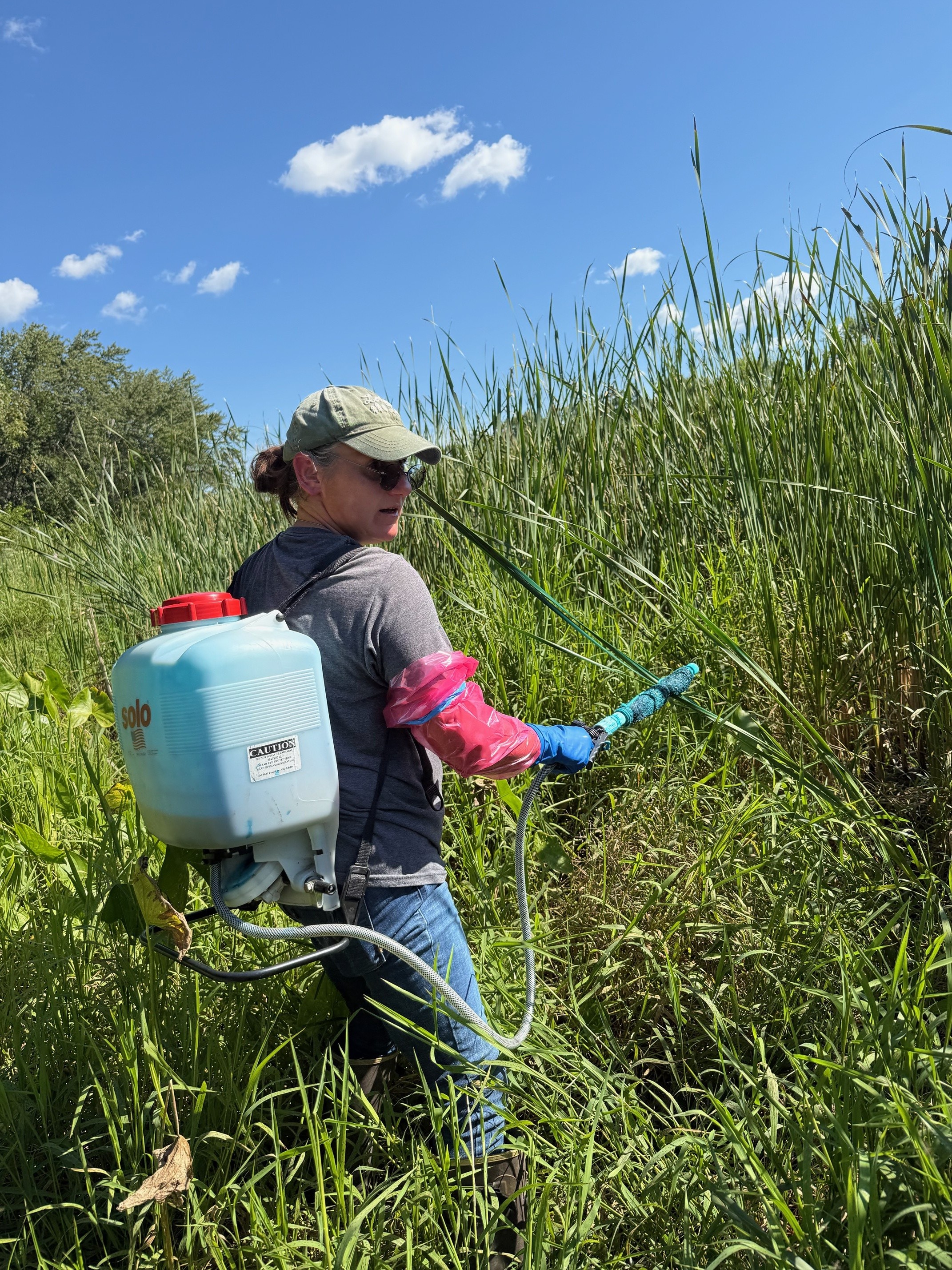
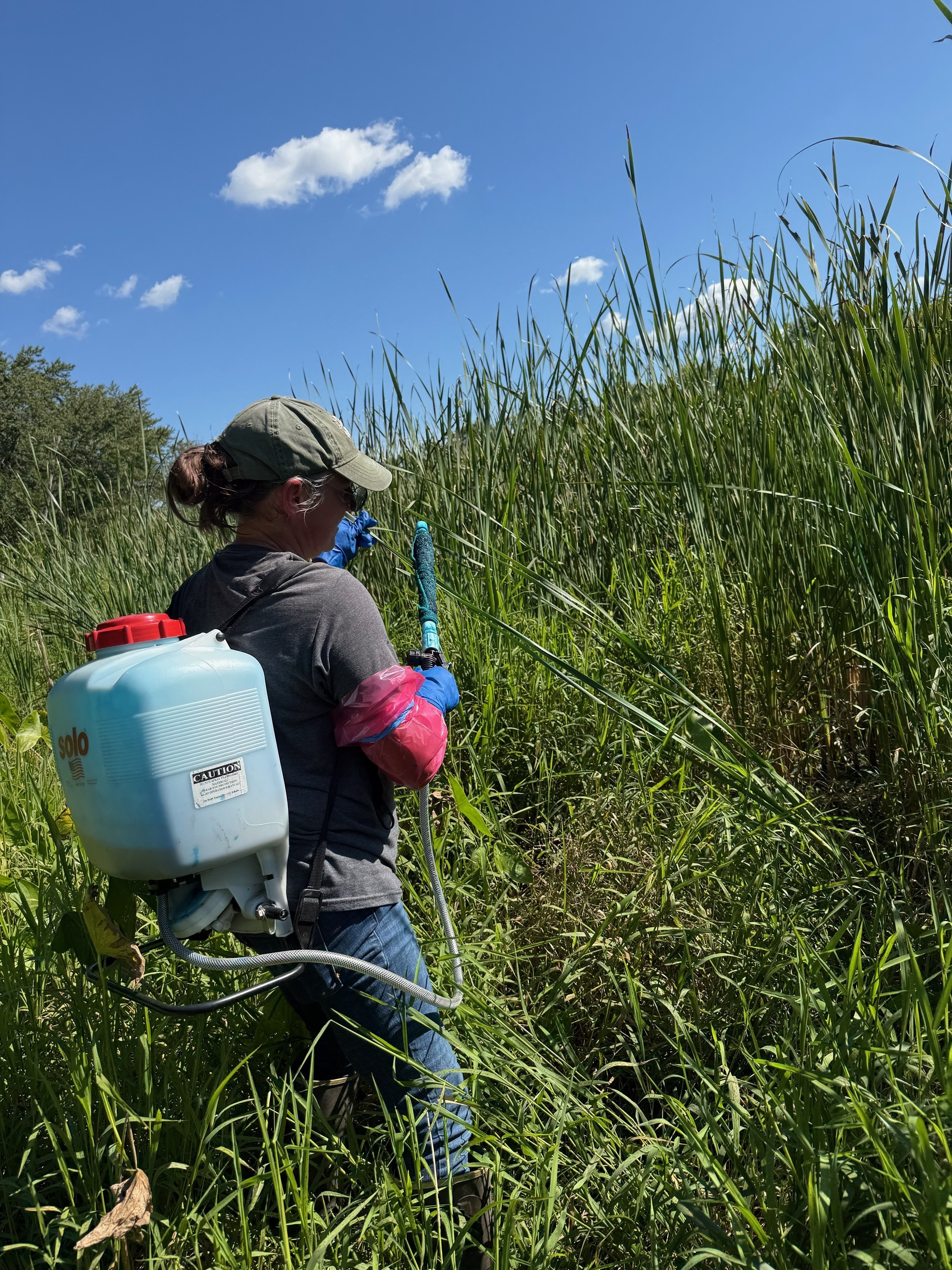
Dana Sievertson says this wand design is by Stantec, a contractor in our region. It has a microfiber towel as the wicking pad. They store it in an empty bucket.

After treatment photos showing browned cattails:


 grassland restoration network
Is the aquaneat concentration supposed to be 5%? 50% is extremely high and significantly exceeds the label guidelines (and potentially legal guidelines).
Ha, it was 5%. I changed the wording.
I’d love to know how to get one of the wicking wands. I’m in Ohio and work with Beavercreek Wetlands Association to restore wetlands. We’ve just been using cotton gloves over latex gloves to do swiping on cattails but this is much better.
Those wands are do it yourself made with off the shelf parts.
Austin, I hope you are able to construct a wand because chemical resistant gloves are not barriers & should not be deliberately exposed to chemicals. They are tested for breakthrough time, the time for a given chemical to permeate through the glove & produce a given amount of herbicide on the inside surface. Almost all testing is done using industrial chemicals or common solvents, not the products used by us. In general, oils & solvents have faster breakthrough times. Some herbicide labels will tell you what glove material to use. I do have info from the manufacturer of Roundup showing 4 to 8 hour breakthrough for natural rubber, neoprene & nitrile. The caveat is that other glyphosate products may use different additives & have different times. Considering all possible chemicals, natural rubber & PVC are not recommended. 15 mil thick nitrile, neoprene or PVA are good choices, but since we don’t have data on specific herbicides, gloves should be tossed if exposed to strong herbicide concentrations (unless they are immediately rinsed) & periodically tossed even if unexposed.
Thanks for posting! I have used the same wicking apparatus, and I got the idea from the same source. Works great! It can be tricky not getting herbicide on you, so you have to be careful not to walk into a covered area. I usually walk along a cattail thicket along the edge of a remnant sedge meadow and step into the cattail about a meter, then I reach forward and wag the bar back and forth, backing out as I do this. Then, move over a bit and repeat. Every year I push the cattail wall back a bit further. I have been using 20% AN with good results.
Some may wonder why not just spray? The reason I use a wicking bar is that it is easier to target cattails without killing everything underneath. Often there are sedges and other conservative plants below the cattails. I do my wicking up high so that I miss most of the conservative natives below. Also, it is a bit faster than hand-wicking. The only downside, aside from the need to work carefully to avoid dripping etc., is that the method is less effective with narrow-leaved cattail, which does not provide as much resistance to the bar as other cattails. So if I am working on mostly narrow-leaf cattail I may still hand wick.
This looks awesome. I am going to try it out. For equivalent work here I use the “spong-tong” where you zip-tie sponge pads into a pair of tongs and apply the herbicide to them from a squeezy bottle. But it’s also very easy to get herbicide all over you doing this and you have to refill the bottle fairly frequently.
I registered with email , my name is Michael Campbell. I was interested if anyone reading this article could share some insights on using Clearcast for Cattail in high quality areas? It seems to be a very popular and effective herbicide for use with backpack sprayers along the east coast but I’m researching usage in IL. I’m in the process of reaching out to public groups that do spraying on natural areas. The collection of data is the first step in developing treatment guidelines and it is not being used now.