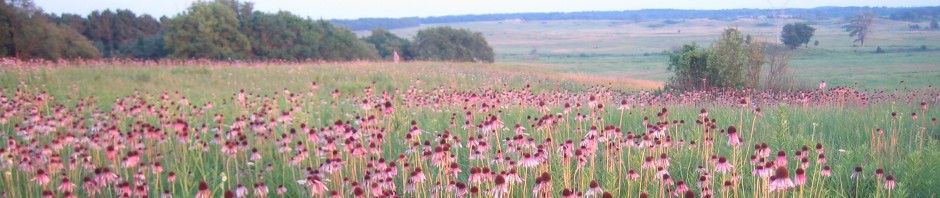
By David Crites, Niobrara Valley Preserve Program Manager, The Nature Conservancy
Grazing is an important tool in managing grasslands and can be used to effectively limit dominant grasses from eliminating many forbs from a healthy prairie. While managing grazing on a Turner bison ranch I wondered if we could somehow use these same grazers to negatively impact invasive species.
That summer I was responsible for managing a herd of around 1,000 yearling bison. We utilized high intensity short duration grazing to manage a complex system of wet meadows on the ranch. One of these meadows had a fairly large stand of narrow leaf cattail growing around an artesian well site. You can see the dense cattail outlined in red in photo 1 below.

In this next photo the yearling bison are just moving into the pasture. The area circled in red is approximately 5 acres in size with the total paddock being 10 acres in size. The bison were held in the area by 3 strand high tensile electric fence 42 inches high on three sides. The fourth side was a single electric poly wire.
Narrow leaf cattail is actually very nutritious grazing forage. The question was how can I encourage the bison to eat that nutritious forage. To accomplish this, I lightly spread loose bison mineral in several spots among the cattails. The bison moved into the dense cattail to retrieve the mineral and while doing so grazed on the cattail. Once they tasted it, they readily ate large amounts.
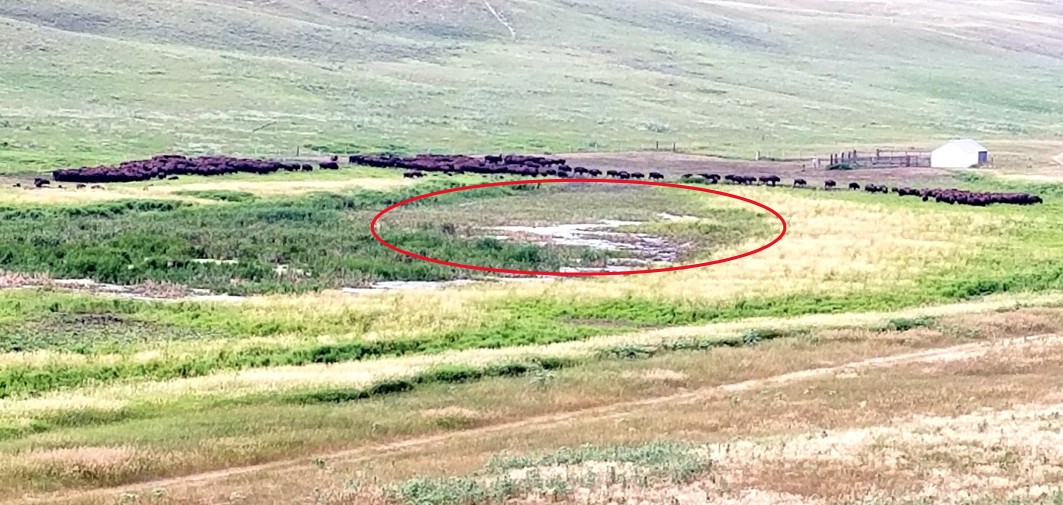
In photo 2 above you can see that the bison heavily grazed a large portion of the cattail down to the ground/water level. The mineral enticed them into the cattail patch, and once they tasted the forage, they continued to consume large quantities of the cattail.

In photo three above you can see the herd of yearlings leaving the pasture having consumed the vast majority of the cattails. The total elapsed time for this grazing was around 28 hours.
As I continued to manage this herd of bison, they targeted cattail anytime it was available for the rest of the year. The really amazing part of this experiment came when we introduced several of these yearlings into the main herd on the ranch. For lack of a better term, the yearlings taught the main herd animals to target cattail whenever available. Four years later, that learned behavior still exists in the herd and they continue to eat cattail.
In addition to cattail I was successful in getting the bison to target Canada thistle. I used the same process as with the cattail and although the thistle is not as palatable, the bison ate it as well. The more important result with the thistle was that they trampled the entire patch into the ground. As long as you can get the animals on the thistle prior to flowering/seed production, the trampling is equal to or better than mowing and a lot less work for the land steward.
This isn’t a solution for everyone, but if you have grazers, put them to work for you!


 grassland restoration network
Really interesting, David. Thanks for posting this.
Very encouraging post and very helpful – yay! Thank you!
Will catt
I am trying to register for the Grassland Restoration Workshop. Is the workshop full? It will not let me register. Bill
The workshop did fill up. Your interest is duly noted in your comment. Any others out there wanting to attend?