By: Bill Kleiman – Director Nachusa Grasslands, Elizabeth Bach – Research Scientist Nachusa Grasslands, Elizabeth Becker – Doctoral Student SDSU / UC Davis Joint Doctoral Program in Ecology
Restoring any ecosystem is extremely difficult and getting it right on the “first try” nears impossibility. For tallgrass prairies, attempts to leap from an abandoned agricultural landscape to a highly diverse prairie are often thwarted by non-native species and an over-abundance of warm season grasses like big bluestem. How then, can we go from an established prairie with moderate forb diversity to a high diversity prairie?
Over a decade ago, Bill Kleiman, the Project Director of Nachusa Grasslands, asked this question and wanted to know if adding seed to an already restored prairie (i.e., overseeding) would increase diversity. He established treatment plots across three sites at Nachusa in 2009 and 2012 that varied in seed inputs and disturbance intensities to test this. The full details of this experiment can be found here, but the abridged version of the treatments is below:
- Control plots: no manipulations
- Seed: overseeding only
- Low intensity disturbance: harrowing and overseeding
- Intermediate intensity disturbance: harrowing, overseeding, and additional applications of Poast grass herbicide during the growing season
- High intensity disturbance: Disking, harrowing, and overseeding
In 2023, species composition and abundance data were collected in each of the treatment plots (photo 1). Data collection consisted of identifying all species and their percent cover in three 1m x 1m quadrats that was then averaged across each treatment plot.

Photo 1: Species composition and abundance data collection in a treatment plot.
When compared to control plots, it was found that the high intensity disturbance treatments increased native species richness by over 40% and native species diversity by 15%. The low intensity disturbance plots also increased native species richness and diversity by 20% and 12% respectively, when compared to controls. In high intensity plots, we found an average of 23.2 native species averaged across all plots compared to only 16.4 native species in the control plots. In the low intensity plots the average number of native species found was 21.6 native species. This data can be seen in the graph below.
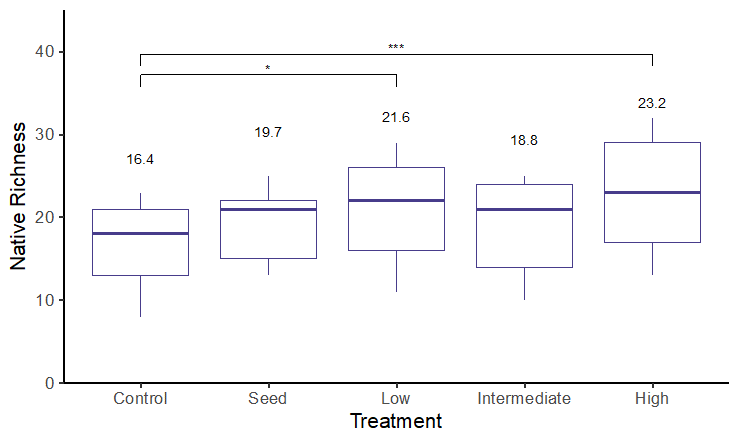
Figure 1. Average native species richness across each treatment. The number of native species is indicated at the top of each box. The stars on the graph indicate the amount of significance compared
In short, we found that overseeding paired with topsoil disturbance is key to increasing plant species richness and diversity in established prairie plantings. Overseeding alone did not seem to result in significant increases in richness or diversity over time in this instance. This could be because this was a singular overseeding event and multiple rounds of overseeding may be needed for it to successfully increase native species richness and diversity.
Disturbance is likely important in this scenario because it disrupted the roots of some established species and reduced competition above- and belowground for newly sown species. Even the low intensity disturbance, which may not have fully disrupted the rooting structures of established species, was likely important for forming microsites in the soil which allowed some seeds to successfully germinate and establish over time.
Contrarily, we found that additional herbicide application may negate the positive impacts of disturbance, inhibiting native species richness and diversity. This is likely due to non-target effects of the herbicide though it is unclear what was driving these non-target effects in this experiment.
Finally, as Bill noted in previous posts, it is difficult to distinguish these treatment differences by just walking through the prairie. Since the treatments can be resource intensive, mangers should weigh these differences with respect to their specific goals before implementation.
If you would like to read the full research article for this published work, please contact Elizabeth Becker (ebecker(at)sdsu.edu) and she can send you copy. Thanks for reading!


 grassland restoration network
Excellent article!! Congratulations to all! Fran
What about floristic quality, in particular mean C? It matters what comprises increased richness. Richness can be positively associated with both positive changes and with degradation–even if expressed only in terms of native plants.
Also, how many times in their first decade were plots burned, and critically, were they burned to remove thatch prior to the time that added seeds would be emerging?
Hi prairiebotanist! Thanks for your questions. I am not sure about mean C but our treatments did seem to improve native species richness and diversity as a whole though it’s tough to see by just visually looking at the plots.
As for the burning regiment, all the plots were burned beforehand to remove the thatch and the regular burning interval was about every 1.5 years for all the treatments!
The article that describes the methods in more detail is linked in this article as well!
Hope that helped and glad you read this article!
Liz B
Sites were burned frequently but I am away from the office to give details. Likely every others year. All burned before seeding.
This study was not just one random block but three. I went overboard.
Hi,
Thanks for sharing. I have a couple of questions and observations. What do you mean by native species richness? Also I didn’t see you mention the seeding alone in your summary of outcomes but I see it in the chart. Also are the differences in the test plot results statistically significant?
Thanks,
Suzanne
Hi Suzanne,
Native species richness just means that we only used the number of native species present in the treatments for some of our analyses. For the treatments, we only want to implement them if they increase the number of native species present rather than native + non-native species.
The seeding treatment wasn’t statistically significant like the other treatments mentioned (low + high disturbance). In this case, we didn’t detect that overseeding alone would improve native species richness or diversity compared to the control unless it was paired with a disturbance.
I hope this helps! Let me know if you have any other questions 🙂
Best,
Liz