Mike Saxton – Manager of Ecological Restoration and Land Stewardship – Shaw Nature Reserve – Gray Summit, MO
Over the course of ecological time, large portions of the Midwest have been a shifting mosaic of prairie, savanna and open woodlands. 500 wet years might have meant less fire on the landscape, which allowed trees to establish in new places and in greater abundance. 500 dry years might have pushed the gradient in the other direction with more intensive fire limiting the establishment and persistence of trees in a prevailingly grass dominated ecotone.
In their seminal paper The Demise of Fire and “Mesophication” of Forests in the Eastern United States, Nowacki and Abrams described how the demise of fire has led to “a cascade of compositional and structural changes whereby open lands (grasslands, savannas, and woodlands) succeeded to closed-canopy forests, followed by the eventual replacement of fire-dependent plants by shade-tolerant, fire-sensitive vegetation.”
We can’t burn our way out of a century of tree establishment in our formerly open and sun-lit natural communities. This is where hack and squirt can be a fast and effective treatment. In areas where you have large diameter oaks and hickories, thousands of small maples, virtually no oak-recruitment, and a bare, sun-starved woodland floor, this can be a great approach.

We like to use the Fiskars hatchet with the fiberglass handle. The 2-liter Solo hand sprayer works well. The smaller squeeze bottle runs out of herbicide too soon. We do our treatments in the dormant season, usually starting in November and going until February. We use JLB basal oil and triclopyr ester (Garlon 4, Remedy, Element). Typically, we mix in bulk with 12.5G of oil mixed with 2.5G of herbicide.

The area pictured above (with glade in the background) was treated in December of 2020. Small trees might require 6 or 7 hatchet strikes. The more thoroughly the tree is frilled, the higher chance the tree dies.
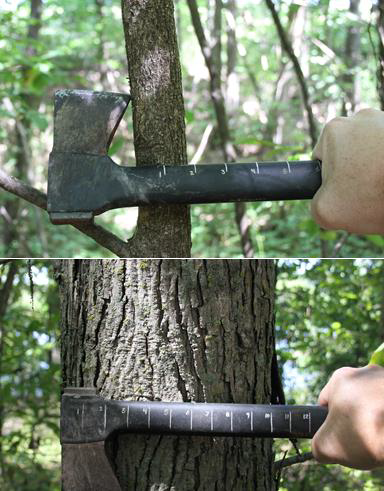
Photo credit to Matt Arndt for the above picture. Matt (contractor here in Missouri – Matt’s Healthy Woods & Wildlife) recommends 1 hatchet strike for each 1 inch in diamter.
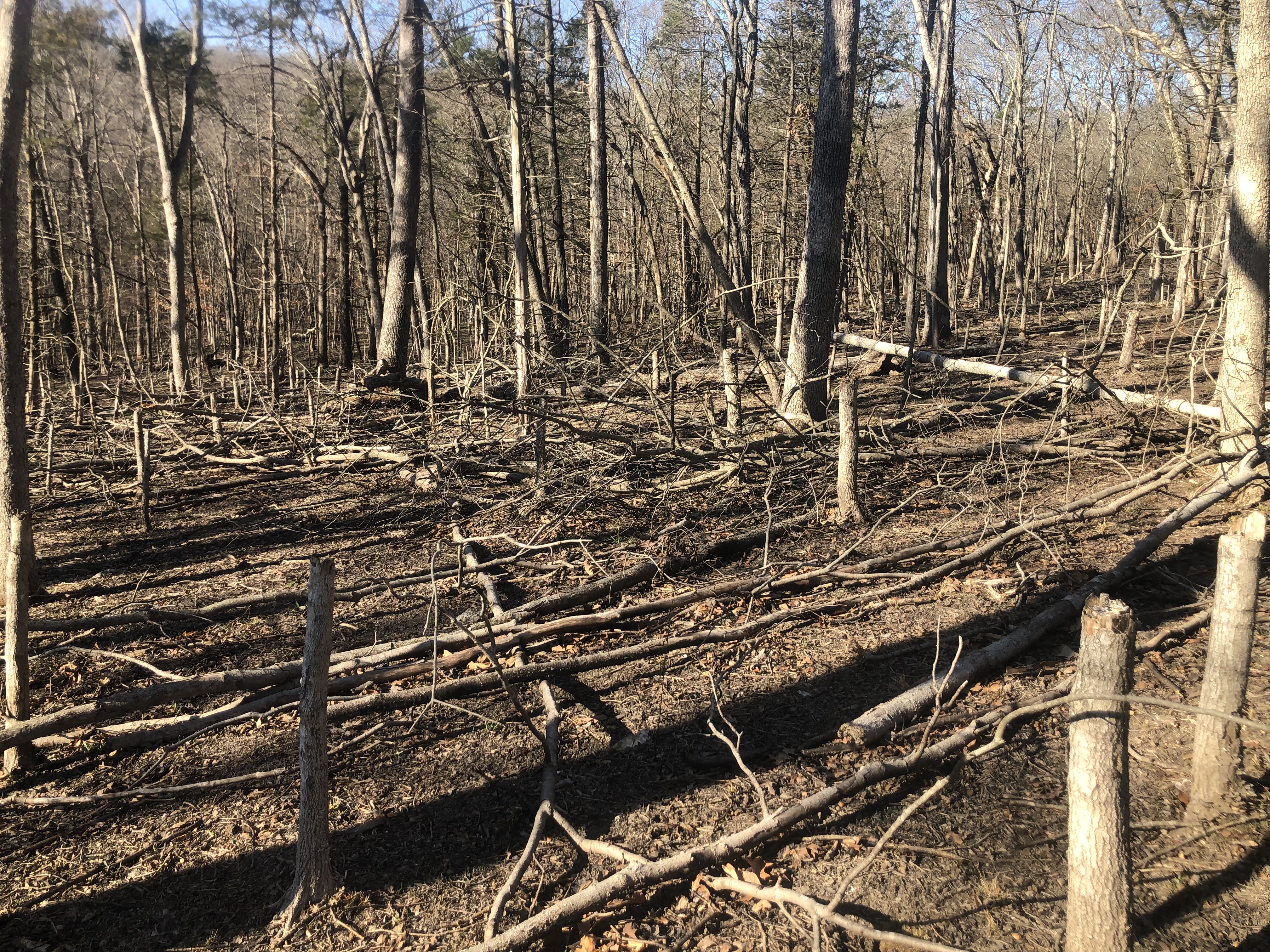
Above – treated in December 2020. Typically, the tree will leaf out poorly the first growing season. It usually won’t leaf out the second growing season. By the third growing season, fine twigs and branches drop. And by the forth growing season, the trees break off at the hatchet marks. In the picture, you can see that fire carried thoroughly through the area. Small diameter trees crumbling over a few years has not led to major fuel loading.
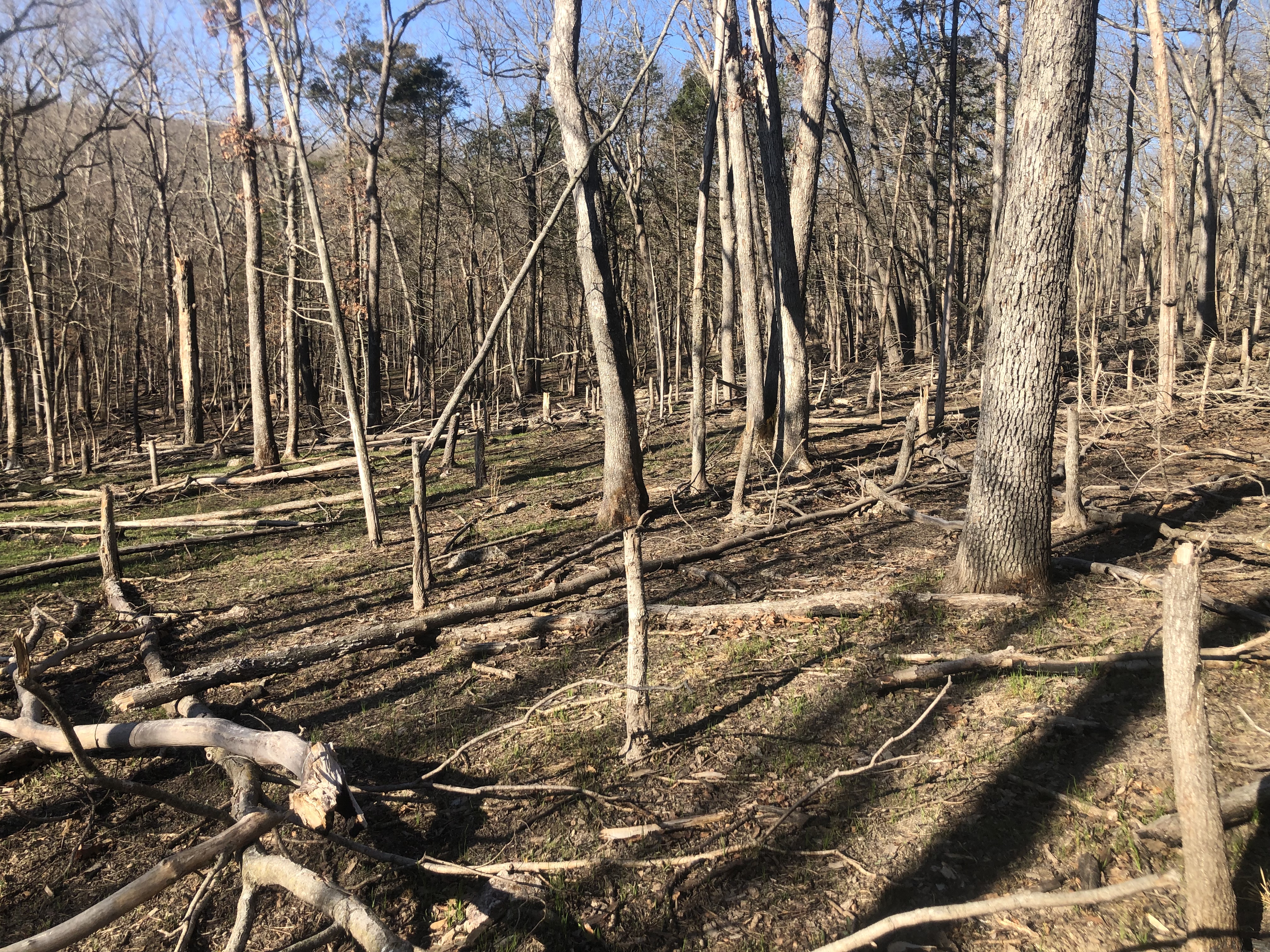

Large diameter trees are tougher to kill and take longer to crumble, but hack and squirt can be effective even in this large size class.
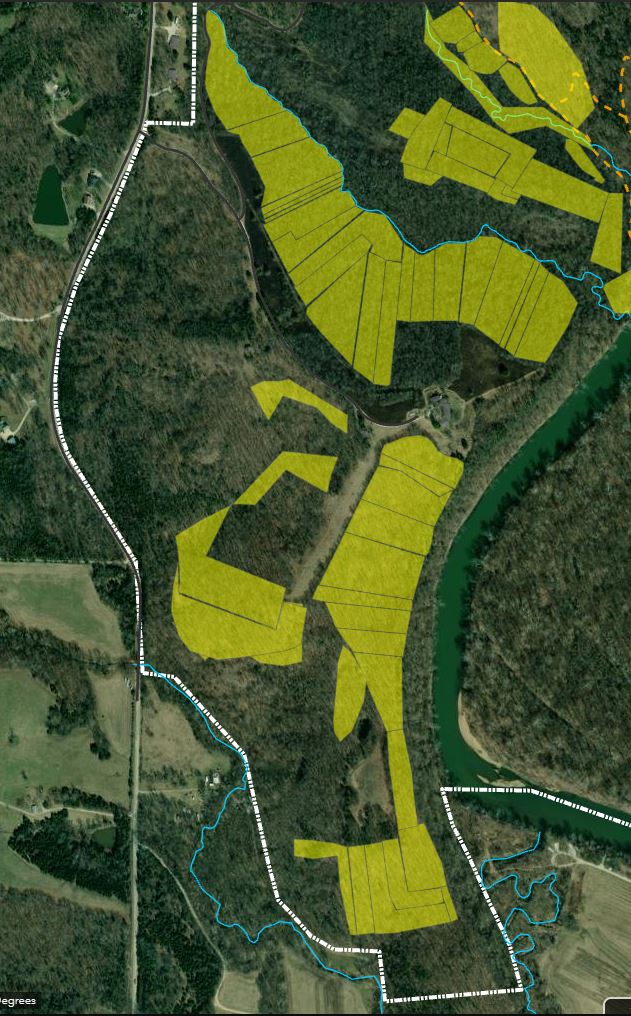
Yellow polygons represent 100 acres of treated acres with 240 staff hours. We targeted , perhaps, 70% of the maples.
This treatment is fast and effective. I like that the trees slowly crumble. I also like that you can make return trips in subsequent years and thin more until you reach your desired outcomes.


 grassland restoration network
Two additional comments:
-Mike
Mike , great work! fran
Mike, thanks for sharing a valid alternative basal barking. Bernie
I’ve used crop oil and triclopyr ester for the past 3 years on volunteer Chinese Elm and Green Ash in our two pastures. I only spray trunk and leaf tops in the Fall before the green leaves transition. It seems to wotk pretty well…each year some escapees have to be treated again.
I am puzzeled by the 6 X quantity of oil vs herbicide that you use…”Typically, we mix in bulk with 12.5G of oil mixed with 2.5G of herbicide.” Am I missing something???
Hi Bruce,
The Remedy Ultra label states,
“Low Volume Basal Bark Treatment
To control susceptible woody plants such as mesquite, huisache,
red maple, red and white oak, birches and aspen with stems less
than 6 inches in basal diameter, mix 20 to 30 gallons of Remedy Ultra
in enough oil to make 100 gallons of spray mixture.”
The label suggests ~25G of Remedy to 75G of oil for 100G of spray mixure.
This guide from Corteva (who manufactures Remedy Ultra) includes a table (table 6.2) for tank mixing amounts of oil and herbicide. The guide suggests, “For a 25% mix with Garlon 4 Ultra, use 25% Garlon 4 Ultra + 75% Oil-Based Carrier)”.
We apply less Triclopyr ester and get great results.
I had no idea…I could up my crop oil and use less Triclopyr ester…running low on it anyway and the Mrs isn’t fond of the cost!
Another question please! How is the grass/vegetation reacting to the mixture you are using? I’m seeing no grass/forb kills with my old traditioanl 1.5 oz crop oil to a mixed gallon of Triclopyr ester.
I have not seen any translocation or off-target damage with our hack and squirt treatments. No impact on forbs or grasses. This might be because 1) we’re treating in the dormant season so forbs/grasses are senesced 2) we’re treating the trees 3 or 4 feet off the ground so there is no herbicide contact with the soil.
There are other great GRN posts that discuss basal bark treatments. See Juli Mason’s Basal Bark Herbicide Treatments for Invasive Shrubs – the Type of Oil Carrier Matters and Kaleb Baker’s A Study on Controlling Brush Honeysuckle . Kaleb does discuss “the ring of death” associated with basal bark treatment.
Thank you!
This is a technique I can endorse. It is an efficient use of time, effective, uses less herbicide than other methods, prevents harm to non-target vegetation, and avoids burn scars.
I have not tried this technique personally, but I often use a similar technique with glyphosate.
Instead of making cuts just above waist high, I make the cuts just above ground level. Knee pads are helpful. Even when making cuts just above ground level, softwood trees often break at about the same location as the trees shown in your above images. In contrast, harder wood trees tend to rot at the roots and fall over entire.
I am surprised you are able to use this technique throughout winter. I find cutting into trees to be difficult when they are frozen. I only use techniques where I must cut into the bark when the temperature is above 28 degrees F.
To have better control of where I make cuts, I hit the hatch into the trunk with a rubber mallet. Using a rubber mallet to drive a hatchet into trunks might help reduce impact injuries from swinging a hatchet so many times.
You are getting a better response than I am seeing from where trees have been removed. Where a tree dies naturally (even in areas that are frequently burned), the area under the dead tree fills with common buckthorns that are responding to the increase in light. In areas where mesophytic trees have been removed, typically a lot of raspberries, multiflora rose, and patches of tall goldenrod dominate. The more trees that have been removed from an area the more coverage/density there tends to be of tall goldenrod. Local restoration practitioners are scything the tall goldenrod. I have noticed that in one area receiving regular burns, the raspberries that appeared after tree removal have decreased over many years.
It can be difficult to transition an area that has developed mesophytic trees back into savanna or woodland. Trees take up a lot of nutrients. Removing trees increase nutrient availability, both from decay and a lack of uptake, resulting in plants of eutrophic conditions that are not what is desired. Dr. Daniel Carter recommends annual burning to reduce nutrients, and for a number of other reasons.
https://prairiebotanist.com/2024/02/06/stability-part-one-why-i-recommend-frequent-dormant-season-burning/
I don’t have any fast and easy answers. My observation is removing mesophytic trees is just the beginning. Invasive species must be controlled, burning must be done, scything has been reported to be helpful. Depending on the situation, it may take continuing work and many years to restore savanna/woodland to previous conditions. The images in this post show a better recovery occuring faster than I am seeing where I live.
This works great. I have been doing this on my own property. I basal bark very small trees that I don’t want growing there but for the large trees it uses much less herbicide and leave the tree standing for woodpecker habitat. I just use a hand sprayer and focus the spray to a stream and don’t pump up the bottle pressure very high. This way it doesn’t splash when i squirt the cuts.
This is a good method. For larger trees I take the battery-powered chainsaw and ring the trunks with two cuts to just inside the bark/cambium layer, 6″ apart. Then squirt with aforementioned triclopyr (and 3% aminopyralid) mixture. Deadly, but may take 1 or 2 years to achieve full kill. Meanwhile, trees are great for woodpeckers and I can pick & choose when/which to drop for firewood or removal of biomass. Some tree species stand for 10 years or more and slowly drop their branches before the trunk comes down. This could be problematic during a prescribed burn if you’re not on top of the smokes with a backpack or other water source.
I’ve used an east wing hatchet with a very thin blade that works well but my forearm and shoulder don’t like all the chopping so have purchased a Milwaukee “hatchet” basically a one handed chainsaw with an 8” blade. It can drop smaller trees or use it to do a girdling cut that spray can be applied to.
has anyone else tried these mini chainsaws in this application?