
By Bill Kleiman
The last year we purchased a knife mulcher and have been comparing it to our 15 year old hammer mulcher. This post is to compare knife vs hammer mulchers for these expensive attachments.
Link to a 2 minute time lapse video of a hammer mulcher clearing small brush to show off a treasure: https://youtu.be/6SrNRwR49tY
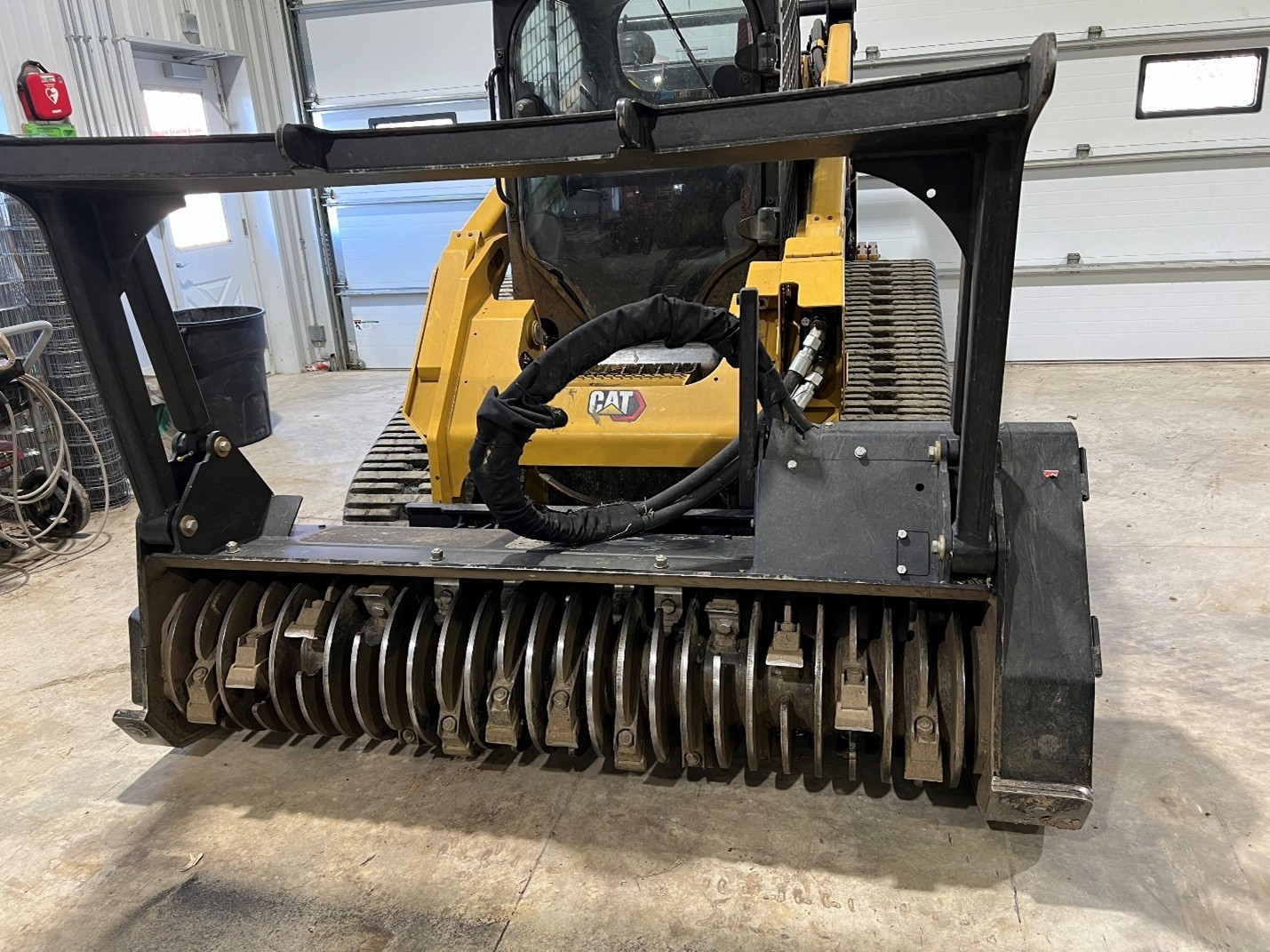
Above is a Cat 110 horsepower 299 D3XE skid steer we use with a new Denis Cimaf DAF-180D brand knife mulcher. You can see some of the 27 knives there which are bolted to the rotor. Note the thick ribs that go around the rotor. The ribs keep the knives from grabbing too much of a bite of the wood. Like on a chainsaw chain the rakers in front of the cutters keep the knives from grabbing the wood and stopping the saw abruptly (which leads to kickback in the case of a chainsaw). Without the ribs the knives would grab say a stump and stop instantly, causing a lot of stress to the machine. The ribs keeps the rotor spinning fast so the knives can slice off wood in bite sized pieces. The dealer claims the hydraulic motor that spins the rotor is also well designed to spin fast and recover its speed when it does get slowed down. The rotor does slow down when you are cutting. There is a limit to the magic.

Above shows a brand new knife and a partially worn knife. We tend to sharpen our knives about every 8 hours of cutting.

Above shows a typical result. Minimal ground disturbance and small wood chips.

Above, the knife mulcher makes a fine mulch. The knives can clear more habitat because of this clean cutting. This style mulcher cuts very fast. It also looks tidy.

Above is a brand new knife and a very worn down knife. There is a day and night difference in the performance of a sharp vs a dull knife, similar to a chainsaw chain. The knives are dulled by rocks, fence posts, and I assume a bit from dirt. We have had a few teeth get broken from encountering hard objects. The knives cost about $30 a piece, so you want to sharpen them until they are used up.

Above I am sharpening knives using the sharpener supplied with the purchase of the mulcher. This sharpener has a powerful two stroke motor that is spinning a 3M brand of very course sand paper. The sanding paper disc lasts a long time. The teeth can be sharpened in about 15 to 20 minutes. The sharpener is loud and we leave the shop door open to vent the shop. We also grease the zerks and do other work on the skid loader.

Above shows my tools splayed out as I change a bunch of worn out knives. The nuts are held on with 400 hundred pounds delivered by a large torque wrench. To get the bolts loose it takes a breaker bar and extension tube and your body weight. Once loose, then you can switch to the cordless nut driver. This Denis Cimaf mulcher came with clear instructions and a kit of tools needed. The teeth can last for a few to several months, or a few can be trashed on the first junk you run into.

Above shows a damaged tool holder, the part that holds the knife. This is a bummer. I mowed into some buried two inch thick steel junk and it tore off the knife, broke the bolt, and bent the holder. The mulcher has been down ten days now as I wait to get a welding shop to fix it. The welder will weld some bead here and grind some metal off there, and the bolt hole is in the wrong angle. I don’t know how they fix the bolt hole. A mess. If they can’t fix it then they use a cutting torch and remove the holder and weld in a new one which I have in stock, and hopefully the rotor is still balanced. I had this happen once to a hammer mulcher, and maybe it won’t happen again, but…so it goes. Are knife mulchers prone to this damage? Could be.
Hammer Mulcher:

Above is hammer style brush mulcher. Those hammers are tipped with carbide, the twin V you see on the ends. This design can take a lot of punishment from hitting rocks and abandoned junk. This is a big advantage to this hammer style.
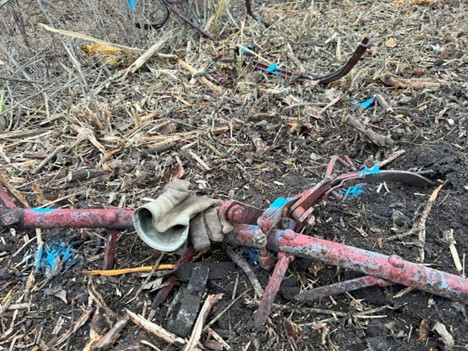
Using the hammer mulcher I mowed this abandoned implement. The hammers showed no damage but I tore this junk in several pieces. Would the knife mulcher take this abuse?
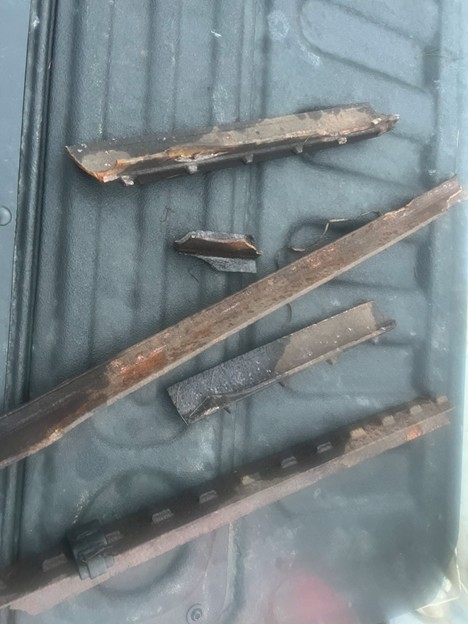
Above is a fence post mowed into pieces by the hammer mulcher. No harm done.

Above, the hammer mulcher leaves a bit more of a rough mulch. The hammer mulcher takes longer to mulch trees. Mowing shrubs is about the same with either mulcher.
Bottom line advice on knife vs hammer mulchers:
- Both are expensive.
- The hammer mulcher is good for sites with rocks and abandoned junk.
- The knife mulcher is very productive, cutting through wood much faster.
- The knife mulcher needs sharpening every 8 hours or so, and knives replaced at times. Do you have a shop to get out of the weather to do this? You can tough it outside, but you might be wishing you had those hammers instead.
- Don’t trade in your old hammer mulcher. We have a 15 year old Fecon and it is built to last for a long time. We currently are using our hammer mulcher on a tract that has a lot of abandoned metal junk, and we will use the knife mulcher when we get to cleaner ground.

Above, knife mulcher is clearing invasive honeysuckle and small trees from an oak savanna. Note minimal ground disturbance.
Link to a 2 minute time lapse video of a hammer mulcher clearing small brush to show off a treasure: https://youtu.be/6SrNRwR49tY


 grassland restoration network
Excellent Bill, Fran
We have a Fecon BH74SS (hammer style) that we run on a Kubota SVL90-2. The Fecon wants 30-50 gallons per minute high flow hydraulics. Our machine delivers 36GPM. Definitely in the range but on the lower end of the range. I would not want to have any less power/GPM.
Our mower head has about 500 hours on it. I’d say 70% of those hours have been mowing/clearing the dregs of logging slash and eating stumps. It is not a stump grinder…but it can eat stumps if you have a good operator. We’re very diligent about working the entire head left to right, so as to not wear down teeth at a different rate. After 350 hours of eating stumps, our carbide teeth have lost minimal carbide. I’m talking 2-3 milimeters. Our site isn’t rocky, so that hasn’t been an issue. Thus far, no broken teeth and very little wear. The BH74SS has proven to be a work horse, a commercial grade tool. You get what you pay for!
Thanks for feedback Mike. I forgot to mention our knife mulcher is crazy good at taking stumps down. We have a stump grinder but did not bother to use it last year because the knife mulcher did what we needed. You do have to sharpen after a few hours of stump grinding, The knife mulcher mulches tree logs very fast too. Rather amazing.
We have a 12 year old Fecon Bullhog with double carbide tipped hammers that has probably cleared several thousand acres, in total. That thing is an absolute glutton for punishment. We hit an old concrete manhole and aside from the awful noise and a partially broken tooth, there were no issues at all. We just replaced the belt for the first time, and the old one shows very little signs of wear and is being stored as a backup. I know other managers with different styles that seem to constantly be down, but ours just chugs along. It’s definitely a bit slow and leaves a less clean product behind, but its realibility has never been questioned.
Thanks Bill, that is really informative. Suzanne
Thanks, Bill. Very interesting. As a honeysuckle warrior I looked into a mulcher head for our skid steer, but at 75 hp it’s too small. Our “Mega-Mower” rotary head can handle the small stuff only. I lust after a larger machine and mulcher, but after seeing the cost and maintenance involved maybe the $2200 per day I paid recently to a man with a full-blown dedicated Fecon mulching machine is a good deal!
Hiring a contractor, or renting a machine, is a good thing to do if someone is new to this game. If you need such a machine several times a winter then owning it is not efficient. We use out skid loader about every day all late fall, winter, and into spring. During the field season we use often for various tasks. It is a core machine for us. Skid loaders come with high flow options. The capacity to mow brush is horsepower, but also the high flow option on the skid loader. A knife mulcher on a high flow 75 hp skid loader would do pretty well.
PS….is that a VW Thing?
Yes, Volkswagon Thing from I think late 1970s.