By Bernie Buchholz, Volunteer at Nachusa Grasslands
The recent GRN conference at Nachusa Grasslands included “Prairie Tours” of new plantings and remnant restorations. It was a very experienced group with about 90% of attendees having either planted a prairie in former crop fields or having restored degraded remnants. About 90% were also working professionals and the remainder were devoted volunteers. We were a knowledgeable group.
ORGANIZATION: Nachusa has had success with an “ownership” model where individual volunteers can “own” a unit of the grasslands where, after extensive informal mentoring, they make the decisions about what to plant, how much to plant, seed harvest, and weed management. Nachusa staff provides support with some tasks like chain sawing, mowing, prescribed fire, and heavy equipment, if needed. Volunteers become quite devoted to their units, with pride being an additional motivator.
OBJECTIVES: Many attendees use maximization of plant biodiversity as the goal, which is effectively a proxy for maximizing habitat resilience and function. The group discussed plant assisted migration, but there was support for the idea that maximizing diversity with existing species builds resilience while the concept of assisted migration is developed elsewhere.

SEEDS: Nachusa’s approach to is to plant every species desired in the plantings in the very first year. For example, we don’t start with extraordinary amount of adventive plants with plans to add conservative species later. Volunteers have noted that it takes 350 to 400 hours to collect 175 species for a five-acre planting. (For more see Plant High Diversity ) Use of plant plugs is limited due to the demands of planting and watering them. Many participants shared the species they had the most trouble growing, including Comandra umbellata and Lilium philadelphicum.
Nachusa does not clean its seed of chaff. Target weights are 45 pounds per acre of which maybe 30-50% may be seed. Grasses may be up to 20% of the gross weight with Indian grass and big blue stem used vary sparingly, or not at all, depending on soil moisture and other factors.
WEEDS: Former row crop land offers relatively “clean” soil for native plantings, but there are still occasional surprises, including large amounts of yellow and white sweet clover, for example, and birdsfoot trefoil has a decades long life in the seedbank. We had a lighthearted, but thoughtful conversation about managing non-invasive weeds like wild parsnip and Queen Annes lace which are addressed only after the true invasives are dealt with. There was strong support for the aesthetic and emotional value of eliminating highly visible but non-threatening weeds. It gets down to priorities.
FIRE: At Nachusa we burn plantings as soon as there is enough plant matter to carry a fire which is often the second year. A new planting is usually burned annually until it is well established, which could be 5 to ten years. It is important not to burn the entire preserve at the same time for fear of diminishing insects. However, we look at plantings as part of the whole, rather than trying to burn portions of individual units.
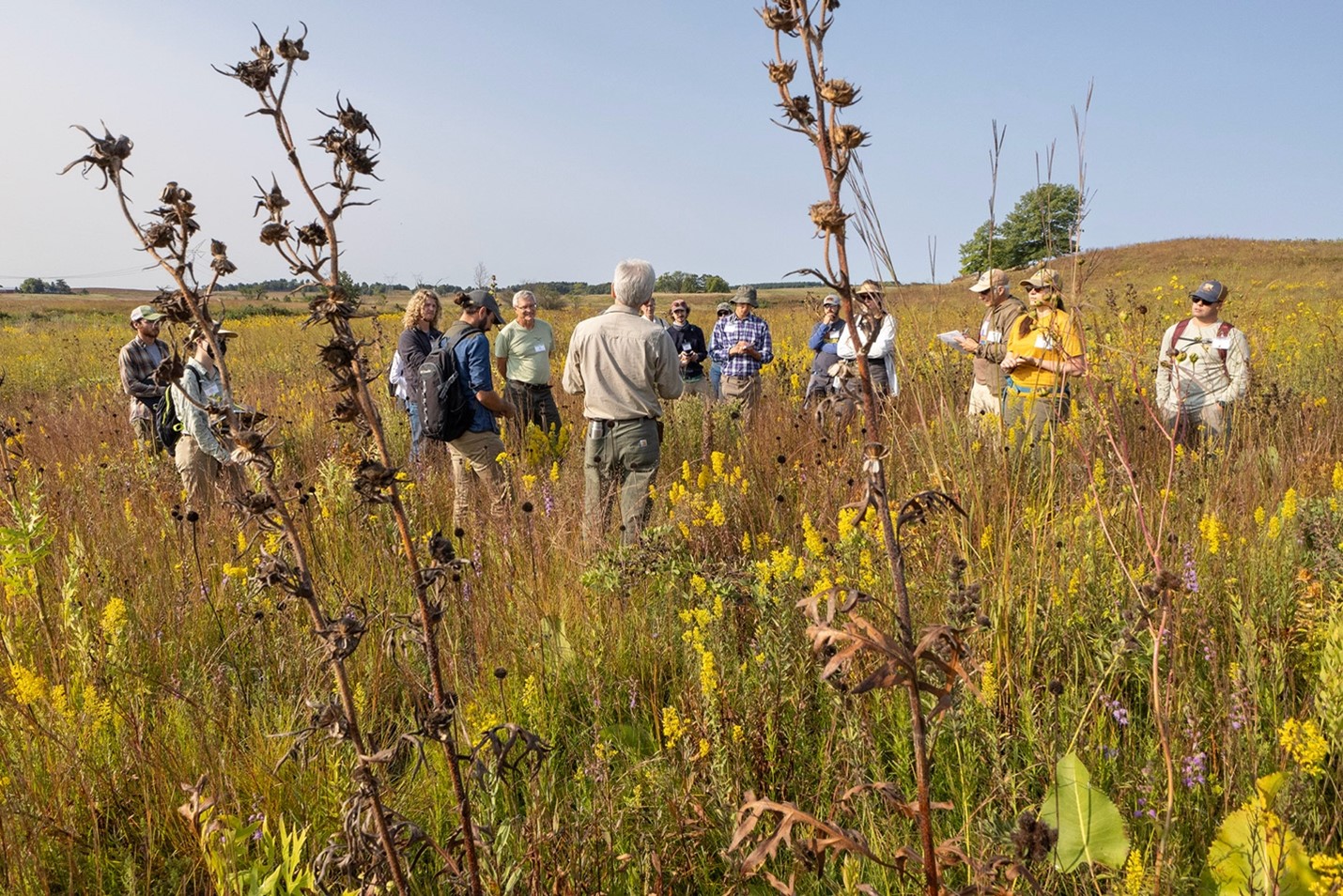
REMNANTS: It’s a very favorable and special situation when you can simultaneously do cropland plantings and restore an adjacent remnant. Look for a comparable remnant of similar soils and contours,but with higher plant diversity to use as a model. Eliminating non-invasive weeds like wild parsnip and Queen Anne’s lace completely can take six to seven years, while invasives like birdsfoot trefoil can persist for decades.

OVERSEEDING DEGRADED HABITAT: There was considerable discussion about the best technique for overseeding pastures. Seeding directly into existing vegetation, including dense non-native grasses, seems counterintuitive to first treating the area with herbicides. Our experience at Nachusa, however, indicates that heavy seeding into existing vegetation, when supported with frequent prescribed fire, can be very successful over a period of five to seven years. For more see Converting Pasture to Prairie
PASSION FOR BEAUTY: The opportunity to convert row crop land to thriving prairie is an intoxicating idea. The passion of a volunteer or professional land manager may provide the necessary dedication and hard work to make the most of a planting. There can also be ego (or hubris) compelling the volunteer to establish a great planting. Hopefully, the beauty of a diverse and functioning native grasslands is a result and reward for devotion.


 grassland restoration network
As a prairie steward on the Schulenberg Prairie at The Morton Arboretum, I would have loved to have attended this! Nachusa is only an hour from me.
Put together a group to come out and we will take you around.
Wild parsnip should be classified as contingently invasive instead of non-invasive, as Bill pointed out in his 12/19/19 blog post. A high quality west facing mesic to dry mesic remnant on my site has no parsnip at it’s central core, but otherwise the weed is widespread within the remnant. This is partly due to dense parsnip occupying adjacent draws. A nearby south facing dry mesic remnant is not seriously invaded yet.
This gets into a dilemma where the best way to know if a species is invasive (meaning it significantly displaces native plants) is by performing long term monitoring. Waiting that long gives the invader such a head start that it will be difficult or impossible to control. So I try to combine my own observations with reports from others & the academic literature before deciding to control a given weed.
Thank you for the informative walk. It is really impressive and uplifting to see some really good restorations. The one you showed us had incredible diversity and not much in the way of undesirable or invasive weeds.
Thank you again
thanks for writing this up! Appreciate the wisdom you collected here!