By Bill Kleiman
There are likely a lot of opinions about if and how sweet clover should be controlled, and I encourage you to share your experiences in the comments. What follows has been my experience over 30 years at Nachusa Grasslands.
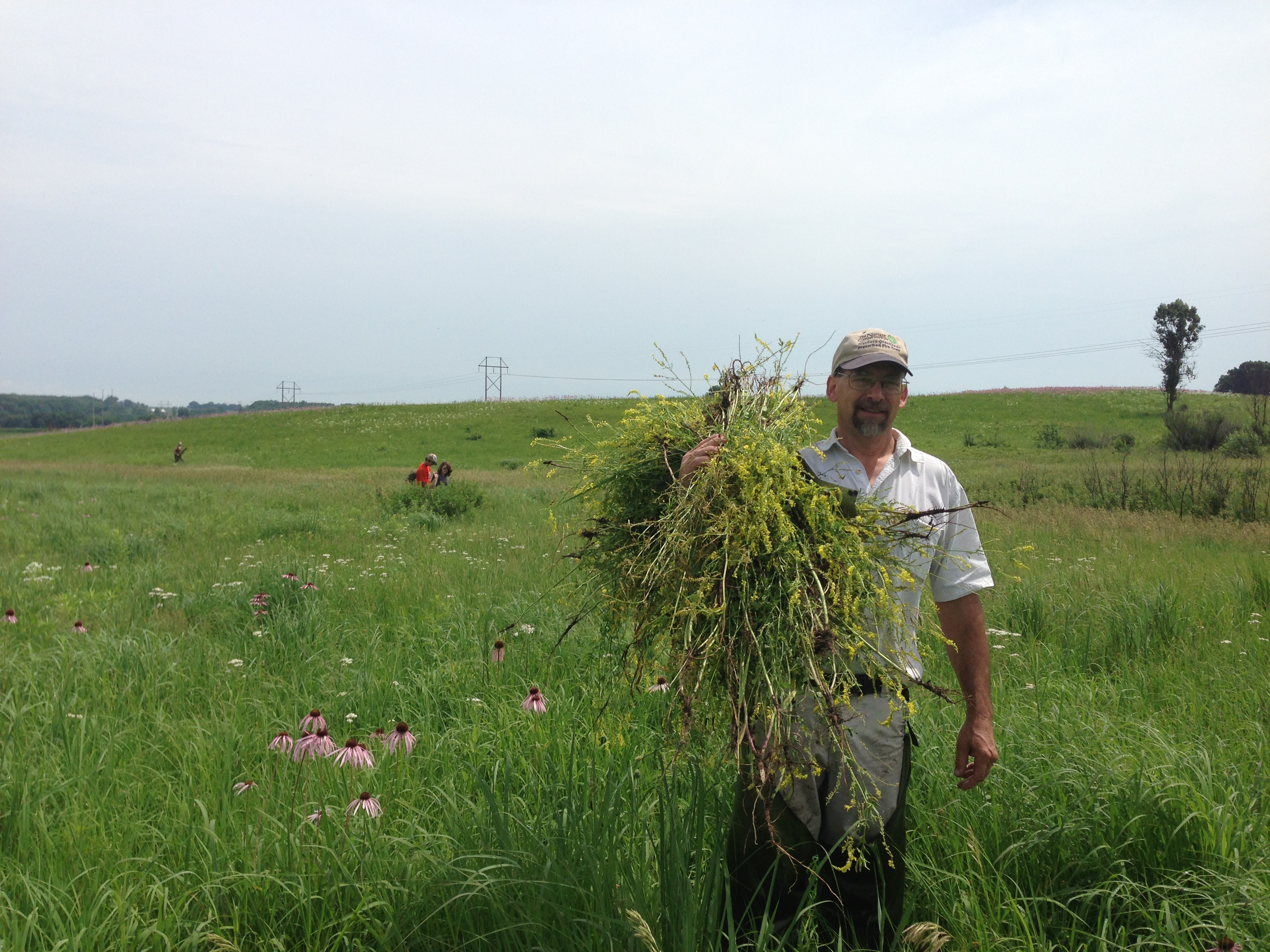

When I first started in 1993 there were two prairie plantings that were several years old and had come up in a lot of white sweet clover. We decided to mow it as low as we could after the Fourth of July. The above photo shows one of these prairie plantings with a very thick cover of white sweet clover. If we had chosen to spray this there would be no prairie planting remaining. So we mowed it.
The rule of thumb is to mow below the lowest leaves of the sweet clover. The clover drops its leaves starting from the leaves closest to the ground. By the Fourth of July the lowest leaves of white sweet clover are several inches above the ground so the mower can cut them below those leaves. The plant is a biennial so by the second year it is quite tall, and if all the leaves are mowed off there is no signal from the plant to re-sprout. Therefore it dies and no seed sets. But don’t wait too long to mow such that seed is on the plant.
Did this work? Very much so. We did occasional patch mowing over the next several years but at this point 30 years later there is just a sprinkling of sweet clover to chase down. Now, some might say it would have gone away on its own, with episodic flushes now and then. Maybe. We left no patches to test this idea.
The mowing must be very close to the ground. An offset hay mower does the best with this because the tires then don’t crush the stems and make it hard to mow the plant. Twice we had an offset hay mower do the task. The other times we had a standard rotary mower with a sharp blade running as low to the ground as possible. We also will use a batwing mower. We have used long hand scythes too for small patches.
We also do a lot of spading of sweet clovers. We haul them out if in seed. And we spot spray them at times if the situation seems to call for that. Most any broadleaf herbicide will work.
Some areas we have are simply ruderal junk, and you might have a flush of sweet clover, essentially no native plants, and the ground is too rough to mow. In such a place we might broadleaf spray across the patch. This quiets the situation for the season, but at some point we will want to establish native habitat and will seed this spot and try to manage it. When to plant a formerly ruderal area is tricky. Is the soil full of invasive weed seed? Do we have the time to care for it if it comes up in invasive weeds? I am not as intimidated of sweet clover as I am of say birdsfoot trefoil or those invasive Lespedezas.
For yellow sweet clover, the timing of the mowing is important. If mowed too early, before late flower, the plant will re-sprout and bloom and we assume set seed as little bonsai yellow sweet clovers.
Here is Kevin Scheiwiller on sweet clover:
I have a response that reflects my personal opinions that have been formed from working with multiple agencies who may or may not agree with my opinion.
Having a group of dedicated people who care about the ecological health of a site is the most important and effective way to treat sweet clover or any weed really. Continued hand pulling is incredibly labor intensive, but has produced great results in many instances. This can take one or multiple decades just to clear out a moderate sized (50-100ac) restoration. High-quality, smaller restorations are important, but will not achieve our goal of large scale biodiversity conservation.
Some groups choose to ignore sweet clover completely in order to go after other more aggressive, exclusionary weeds. Many land managers have an anecdotal story of mowing sweet clover and reducing it by X%. We know that Transline and Milestone work great on it, but Juli Mason’s most recent post has got me thinking that this approach could be creating more harm than good by leaving high levels of residual herbicide in the soil.
I’m starting to believe that the best approach is to spot mow the large patches while it is in full bloom and continue to overseed these areas with more prairie forbs. I don’t think this will necessarily get rid of the Sweet Clover but will continue to add competition and make it more palatable to spray or hand pull the stragglers.
More passionate stewards across more acres is the best solution.


 grassland restoration network
We have yellow sweet clover on our rocky, high quailty glades. So mowing (rocks) and spraying (high levels of plant diversity) are not effective treatment options. Yellow sweet clover is short and in dry conditions, usually snaps off. Instead of backbreaking pulling and ineffectual spading in rocky soil, we use Stihl FS 240 (professional series string trimmer – can easily handle a brush blade too – and are half the price of pro series brush cutters) to weed whip. We make return trips to ensure that we get the respouts and late flowering plants. A couple technicians with these tools can cover a lot of ground and make a big impact. For spotty/sparse populations, weed whips can be more selective than mowers too.
As with any invasive species control, it’s always an issue of scale and site specific context. Because we do not have extensive sweet clover, weed whipping is a great option for us that leaves our native, diverse flora relatively intact.
Yellow sweet clover is considerably smaller than white sweet clover (shorter in height, much smaller stem diameter). A good, high quality string will cut through YSC. WSC, on the other hand, just eats up string, even the most sturdy string. We typically use brush cutter blades to cut WSC and use string to whip down YSC.
I have never tried an electric trimmer for this purpose. I like the idea of cruising around in a UTV, hoping out quickly and grabbing a quiet battery tool with no pull start.
To learn more about white sweet clover resprouting, in early September 2023 I pulled resprouting plants that were previously mowed to about 3” high in late July. All size classes were represented but the majority were small to medium size. 40% of the plants had at least one resprout originating from at or just above the root crown, which is at or just below ground level. This was rarely seen in small plants but otherwise wasn’t correlated to root diameter. The resprouts of the other plants all originated above ground level. An old anecdotal report indicated 30% of plants resprouted no matter how low they were cut by hand (https://www.invasive.org/gist/esadocs/documnts/melioff.pdf page 6). It would be interesting to monitor plants cut at various heights above ground (where the cut stems aren’t heavily shaded by other vegetation) to see if there is a height below which plants never resprout or if there are a percent of plants that resprout & reflower no matter how low they are cut. This would have to be done in a drought-free year. I noticed that plants I hand wacked at a height of about 6” had much more robust resprouts than the 3” mowed plants, confirming your advice to cut as low as possible. Supervisors should personally observe each worker to verify they are indeed cutting low, unless rocks pose a safety concern.
The number of racemes on resprouted plants varied widely (most had 4 to 13 racemes with a max of 26) & didn’t correlate to root diameter. However, plants with larger roots had higher combined length of resprouted stems. Better photosynthesis from those leafier stems might imply a higher chance of producing viable seeds before first frost, but that is conjecture.
Pingback: Weed management | grassland restoration network