By Jason Johnson, Natural Resource Manager with Forest Preserve District of Kane County


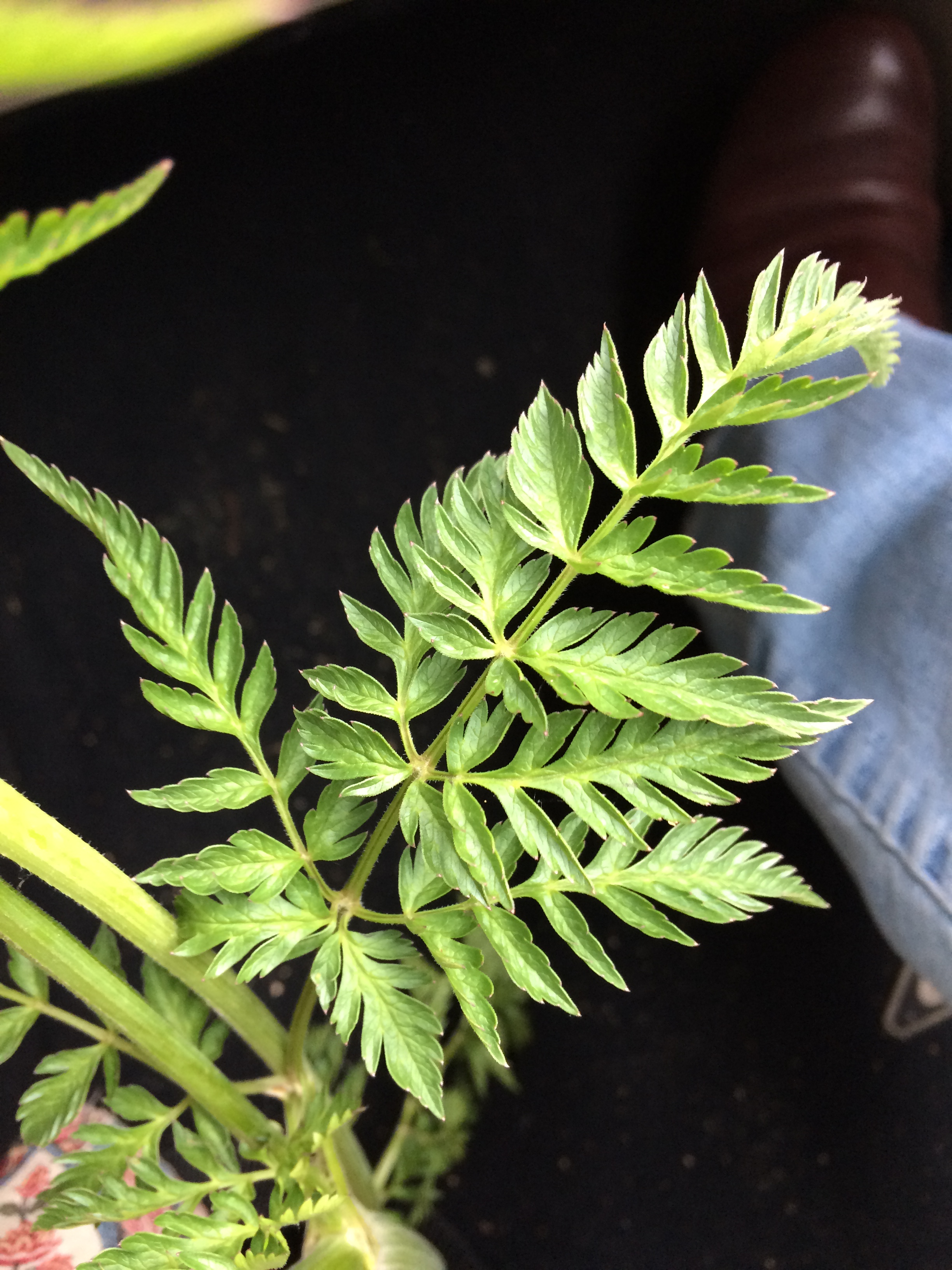
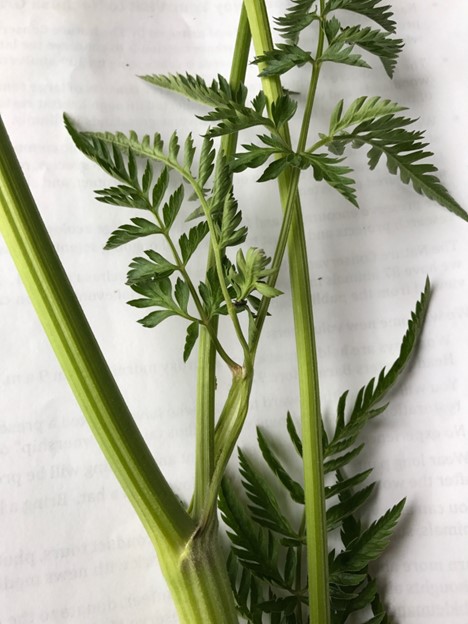
Wild Chervil (Anthriscus sylvestris) is an herbaceous biennial or short-lived perennial introduced to the US from Europe, is about 3 feet tall, and in the Apiaceae family. It has a hollow stem, white umbel flower, and tripinnate leaves. Chervil blooms before most of these other common look-alikes such as Queen Anne’s Lace (Daucus carota), Japanese Hedge Parsley (Torilis japonica), Sweet Cicely (Osmorhiza longistylis, O. claytoni), and Poison Hemlock (Conium maculatum). Chervil spreads rhizomatously as well as producing large quantities of viable seeds. It forms dense stands, displacing native species. Shaded lowlands, especially near creeks, seem to be a favorite habitat for this invasive species. Flowing water and human activities, especially mowing, are the most common means of dispersal. On the plus side, the seed bank is very short lived. Seeds only survive one or two winters.

Chervil was first observed in Kane County, IL in 1975, but was not widely distributed until the late 1990’s or early 2000’s. By 2007 it was exhibiting rapid spread throughout the county; particularly in roadside ditches and has since spread to many of the surrounding counties. By my observations, Kane County has seen the worst of it in northern Illinois for some reason.
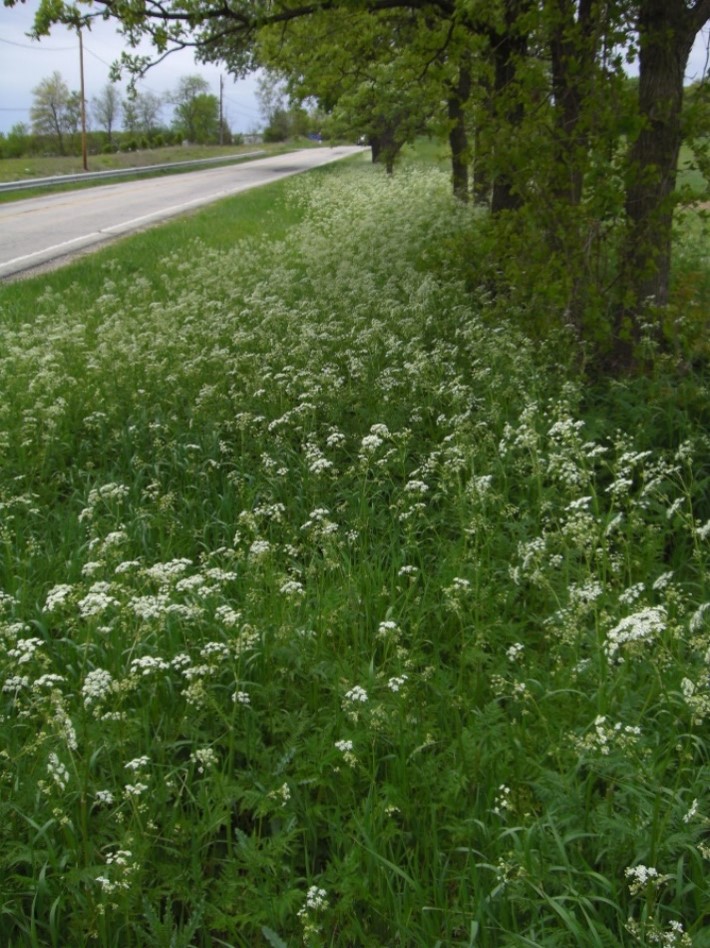
Forest Preserve District of Kane County staff began noticing large populations of Chervil in a few preserves in the mid-2000’s and began treating them. From about 2007-2012, Chervil populations were exploding across the county and they were spreading into more and more County Forest Preserves. Roadsides in some townships were full of it and it was spreading into preserves from those road ditches. Creek corridors in a few preserves also had large infestations with very low native plant diversity. Because the Forest Preserve District holds land in so many disjunct parcels, we have a significant amount of edge. All of those edges are incredibly vulnerable to invasion by weeds. As Chervil spread around the county, we decided that it was necessary to focus a large effort on controlling it as part of our overall mission to preserve and protect the public lands of Kane County. Over the years, our list of Chervil populations has grown, but fortunately the size and density of those populations has been reduced. It is difficult to eradicate weed populations when you have a constant influx of new seeds, but even the densest populations on neighboring property are being held at bay with annual follow-up visits to treat scattered individuals that are trying to reinvade the preserves.

When the District first began treating Chervil around 2007, we used glyphosate. Glyphosate is effective, but is not ideal due to its non-selectivity. An attempt at mowing it was made, but quickly abandoned due to how highly labor intensive it was. Also, the large root system of the plants allowed them to re-flower rapidly; defeating the efforts of the mowing crew. District staff began looking for an effective broadleaf specific herbicide to use on Chervil. Ben Haberthur, Restoration Ecologist at the time; now Executive Director, ran a field study in 2012 testing several different herbicides and determined 0.5% Transline (Clopyralid) as the best option. We have since increased the concentration to 0.75%, or 1 oz/gal., which provides better results. Rodeo (Glyphosate) was tested at 2.5% and it did the job, but as previously mentioned, is non-selective. Escort (Metsulfuron methyl) and Milestone (Aminopyralid) were also tested but did not have as favorable results. In hindsight, I think that Milestone may in fact work, but it was tested at too high a concentration; which killed all vegetation.
After almost 15 years of consistent field use, 0.75% Transline has shown itself to be very effective at controlling Chervil. Today, District crews begin spraying Chervil populations as early as March. Chervil is one of the first plants to green up in the spring, so is easy to locate early. Once flowers form, crews clip the heads to prevent them from going to seed. Follow-up visits continue into May until seed set. Due to the short-lived seed bank, large infestations are relatively easy to bring under control, however, if there is an off-site seed source the area will need to be monitored annually.
It is possible to treat large, established Chervil populations late in the year. Chervil seems to green back up in the fall and existing populations may be sprayed with glyphosate as late as November or December if the weather is mild. Native species have gone dormant by this time and thus will be protected from the effects of the herbicide. This method does only provide partial control of Chervil, but is helpful in reducing the size of large populations that were not discovered or not able to be treated the preceding spring. The reduced population size makes follow-up treatments easier the next spring.
Bill Kleiman notes he tried spading chervil and found it difficult, but ok for a few plants.

Here are a few sites to look at:
https://www.nwcb.wa.gov/weeds/wild-chervil https://www.vtinvasives.org/invasive/wild-chervil https://kingcounty.gov/en/legacy/services/environment/animals-and-plants/noxious-weeds/weed-identification/wild-chervil


 grassland restoration network
I had noticed infestations along rt. 72 as I was driving but did not know what it was. Thanks for this article, I finally saw it up close in White Pines. Just curious as to why Garlon 3 or 2-4D was not attempted?
We have got to stop saying that non-selective applications in November (or winter) avoid impacts to native species without buttressing it with a lot of qualifying statements. There are specific situations where that is true, but there are many, many native species that produce basal rosettes in fall or retain green foliage over the winter that will be harmed if sprayed, particularly in nicer settings. Most rosette panic grasses, many sedges, Carolina vetch, many asters (sky blue aster), kittentails, many more.
You make a very good point and it is well taken. I oversimplified the situation. Perhaps I should simply have said that we had more available time and the weather was mild enough to use herbicide, so we tried a mini experiment to see what would happen. The treatment area was a very dense stand of chervil with all the appearances of a monoculture. I would expect anyone applying herbicide to be familiar with the area they are treating and to make every effort to avoid off target kill.
Is it the same as culinary chervil? Is it safe to eat?
It is not the same species.
Thanks for sharing this good information, Jason. Are you saying aminopyralid did work but overkilled due to the high a concentration that was used? Do you know what concentration was used?
Best regards,
Nathan
Yes, the aminopyralid was tested at 5%. I don’t know the reason why. A more appropriate concentration would be 0.5 to 0.75% I think. Check the label to be sure.
The information from Dow Agrosciences, now Cortiva is to use .25% to.5% for spot spraying for Milestone. https://www.corteva.us › us-land-management
Yes, check the label, but be aware that this number is not on the Milestone lable that comes with the product. That lable only gives a gallons per acre amount which is useless for determining a percent ratio for spot spraying.
This goes to the heart of what Julianne Mason was saying in her previous posts about herbicide over use, particularly those with long soil life like Milestone. I suspect the test zone sprayed with 5% Milestone will be a broadleaf dead zone for quite some time.
We have a unit with a lot of birdsfoot trefoil, which we inherited. Here we just work to keep it off the lane system and our fire breaks. I use Milestone on these lanes because of its residual. I don’t want to return every year to spray. With Milestone I can spray every other year.
I’d love to see practitioners move away from using % volume to mix backpack sprayer herbicide for the multiple reasons I gave here in the comments:
https://grasslandrestorationnetwork.org/2024/05/30/finesse-vs-brute-force-in-invasive-plant-management-2/
Sprayers, nozzles & operators are all different & the only way to know the rate you are applying is by doing a simple calibration. That number is used to convert volume/acre on the label to % volume of herbicide you add to the sprayer. Calibration instructions are here on page 17:
https://www.corteva.us/content/dam/dpagco/corteva/na/us/en/products/us-land-management/DF_Milestone_InvasivePlantManagement_Broch.pdf
I cannot locate the source Robert posted but my guess is there is some sort of caveat that the spot % volume is only an illustrative example for typical sprayers/operators. The Corteva document above only talks about calibration for spot spraying, not % volume.
Thanks Don. I read that Milestone link and looked at page 17 and then page 19 mentions you can spot spray up to 19 fluid ounces per acre. It seems worth a half hour of fiddling to figure out how heavy a pack sprays. To show someone how our packs spray I will set a piece of paper on the ground and spray it as if it is a plant. The colorant makes it clear that a quick pull of the trigger puts dots of blue all over the paper.
Using paper to assess spray coverage is a nice method.
Correcting a typo: spot spray for Milestone can be up to 14 oz/acre, not 19. It’s double the normal rate of 7 oz because it only applies if you treat half of an acre per season. Just thinking out loud & probably embarrassing myself in the process, if they are ok with the higher rate over half an acre, we could use much higher rates than that for typical small invasive patches, but that doesn’t pass the common sense test that they would allow very high rates of a persistent herbicide in small areas. I wish I knew the reasoning behind this max application rate spec. Maybe I’ll contact Corteva & ask.
Don’t be embarrassed Don, I’ve seen this high rate issue over and over with Milestone. In fact just last week a similarly high recommended use rate was given by the National Forest Service for a range of invasives. I contacted them and they did recognize that there was a significant math problem in their recommendations.
Anyway, using 5% at 40 gal/acre would lay down 256 oz of Milestone per acre which is 18 times the maximum 14 oz/acre rate. Generally with broadcast treating I would probably dispense 40-70 gal/acre by backpack whereas spot treating would probably be an even higher rate.
For Milestone susceptible species, I use 0.1585% Milestone (6.0 mL/gal) for spot spraying and this is on the high side for this herbicide.