By Alex Conley and Dr. Andrew Kaul, Missouri Botanical Garden’s Shaw Nature Reserve
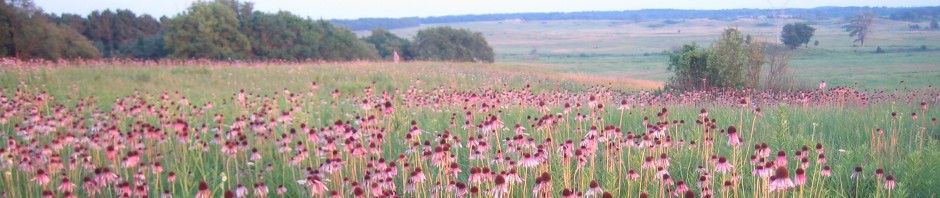
Shaw Nature Reserve (SNR) is a division of the Missouri Botanical Garden, located 35 miles west of St. Louis and containing roughly 300 acres of restored tallgrass prairie as well as managed oak/hickory woodlands, glades, riparian corridors, and other habitats. While some prairie units are quite rich with moderate forb diversity and short-statured grasses like prairie dropseed (Sporobolus heterolepis) and little blue stem (Schizachyrium scoparium), a majority of our prairies have less than desirable diversity and are dominated by warm-season grasses such as Indian grass (Sorghastrum nutans) and big bluestem (Andropogon gerardii). In the early days of restoration at SNR, seed mixes were grass heavy with limited forbs included. And late-spring burning, a management practice that encourages warm-season grasses, was a common practice. This history is evident when looking out over our prairies today. During early summer, you can see a variety of flowering species. By the end of summer, when the grasses begin to bolt, you can only see a sea of tall grasses. Without grazers, restored prairies often become excessively dominated by warm-season grasses, consequently leading to decreases in wildflower diversity and abundance.

Hiking trail through tallgrass prairie at Shaw Nature Reserve in early September.
Grass Specific Herbicide Treatment
Three years ago, a volunteer steward set up two 20×20 ft plots to experiment with using a grass specific herbicide, Fusilade II, to suppress the grasses and—hopefully—increase forb diversity. For two years, we sprayed out the grasses during the growing season then sowed seed in winter between applications. In the summer, we monitored diversity and abundance inside and outside plots. The results from these observations were encouraging. While there were still some clumps of big bluestem and Indian grass, the existing forbs were noticeably more robust and abundant. Likely, suppressing the grasses for two growing seasons released existing forbs from competition. We will continue to monitor to assess whether seeded forbs establish in the future.

Above: June 29, 2023 – Grass specific treatment area on right.

Above: September 27, 2023 – Untreated control on left
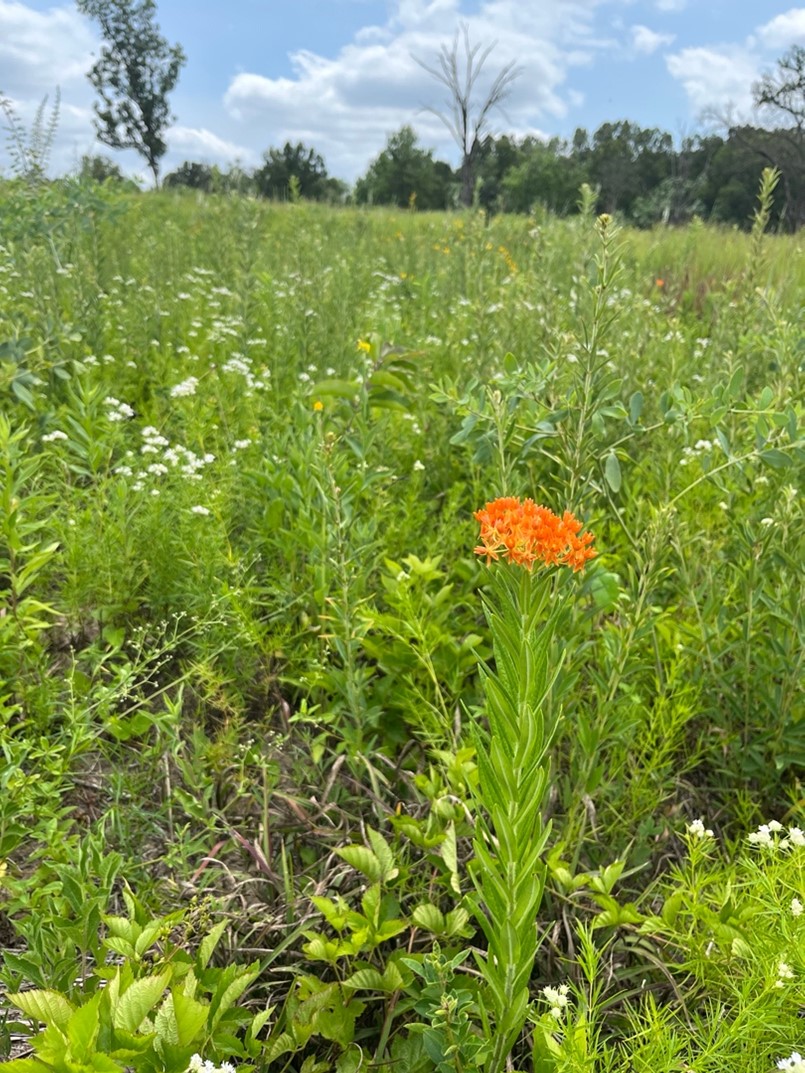
Above: Butterfly Milkweed (Asclepias tuberosa), Slender Mountain Mint (Pycnanthemum tenuifolium), White Wild Indigo (Baptisia alba) flowering in the grass specific treatment plot.
Larger Scale – Grass Specific Treatment
The restoration team at SNR decided to experiment with a larger ½ acre plot in an area that has little Sericea Lespedeza (Lespedeza cuneata), an invasive species we actively manage during the growing season. The plot was burned in late January 2023. We added seeds from 20 species not observed prior to the study’s beginning, including Golden Alexander (Zizia aurea), New England Aster (Symphyotrichum novae-algliae), Cream Gentian (Gentiana alba), and Pale Purple Coneflower (Echinacea pallida). Following the label for Fusilade II, we treated the area at the beginning of May and then a follow up treatment mid-June. In late June and September, we conducted basic presence/absence vegetation sampling inside and outside the plots.
In the first growing season post-treatment, there was little difference in species composition between the control and the treatment area. However, the species inside appeared to be more abundant and vigorous. We did find Nabulus asper – rough white lettuce in the treatment area and not in the control.
Our observations are encouraging as we look to better manage and diversify grass-dominated prairies. The next challenge will be to establish more forb species from seed, not simply releasing existing forbs.
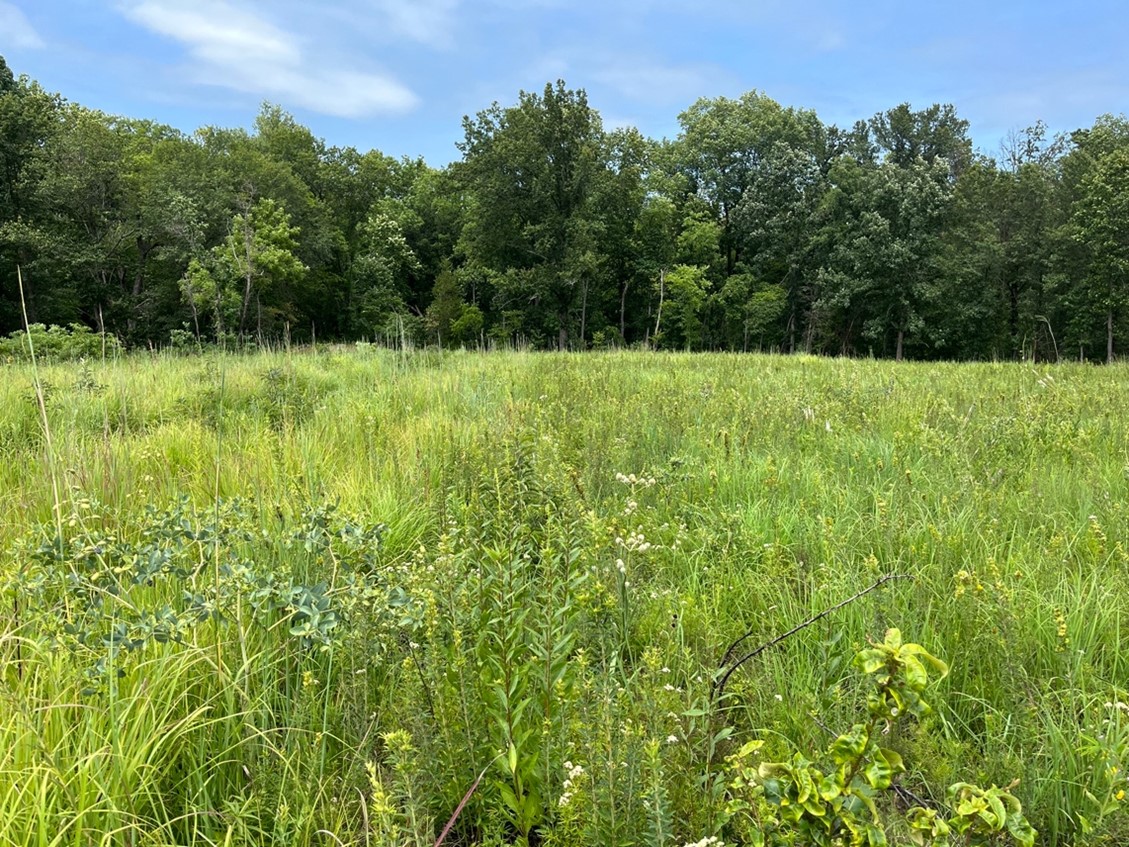
Above: June 29, 2023 – treatment area on the right.

Above: September 27, 2023 – control area on the left.
Peer Reviewed Research – in progress
Dr. Andrew Kaul, a former postdoctoral fellow in the Center for Conservation and Sustainable Development at the Missouri Botanical Garden, has been leading a project studying how to diversify grass-dominated prairies at SNR over the past three years. He tested how three management interventions 1) herbicide application, 2) forb seed additions, and 3) mowing affect species diversity, forb abundance, and degree of invasion by nonnative species.
This study seeks to identify a management strategy to favor forb recruitment and growth that could be applied at large scales and does not open the prairie up to increased invasion from non-native species. Treatments included glyphosate, Fusillade II, or no herbicide to 2 plots of tallgrass prairie. Within each of these three herbicide treatments, ½ the plots received seed addition from 25 desirable prairie forbs and ½ the plots were mowed once during mid-growing season after the seed addition.
After two years of plot level sampling, the preliminary results indicate that using fusillade II (grass specific herbicide) in combination with seed additions increased forb abundance and diversity compared to controls, while also avoiding invasion.

Without seed additions, fusillade II slightly decreased the number of species present.


Plots treated with glyphosate did increase in their forb:grass ratio, but their composition was highly variable, very different from other treatments, and many became more invaded by non-native species.

June 2022 – before the mowing treatment, you can see the effects of both herbicide treatments on the vegetation. Left-Glyphosate (treatments completed August 2021). Right – Fusilade II (treatments complete May & June 2022).


 grassland restoration network
“Without grazers….” As mentioned, many plantings (and mismanaged remnants) become over-dominated by tall grasses because of mid- to late-spring burning. This also can happen with insufficient burning, becasue big bluestem and Indiangrass can elongate rhizomes up through thatch relatively well. Grazing isn’t needed to maintain low stature and small-scale richness–long term stable conditions with frequent dormant season fire is. There are plenty of illustrative examples. Grazing increases forbs, but what people miss is that the “intermediate” disturbance curve actually swings up again with long-term stability, at least in terms of mean C. Grazing pushes it to the left, but higher floristic quality (mean C) can continue to increase in the long-run, and conditions more old-growth-like can be acheived. See this presentation by Justin Thomas (the graphical relationship I refer to is just before the 9 minute mark (https://www.youtube.com/watch?v=3euqfbW3QPs&t=8s). In degraded systems we usually operate on the left side of that curve, and push it left when it is in that middle trough. How to push it to the right when it is dominated by the tall grasses or more opportunistic forbs like tall goldenrod? I’d say never stop adding seed (including those lower stature bunchgrasses–old growth composition is dropseed, porcupine grass, Leiberg’s panic grass, little bluestem in most of the central tallgrass), dormant season burning, maybe middle to late summer haying if the problem is grass. Add wood betony and other partially parasitic plants in particular (research shows it reduces grass productivity, even if it doesn’t directly benefit forbs–it’s an indirect benefit, so no surprise there). The soil needs to recover too. It takes time.
Mike Saxton – Manager of Ecological Restoration at Shaw Nature Reserve – Thanks for your thoughtful post. A lot of our prairies were planted in the 1980s and early 1990s and were planted with lots of grass. Management back then did include mid & late spring burning. Now our fire management prioritizes fall and winter burning. The first week of March is getting “late” for us, most years. Our biggest challenge is Sericea lespedeza, which is rampant in many of our prairies. Agreed that overseeding is needed. Improving low-diversity prairies is one of our biggest opportunities to enhance native species richness and to create a more resilient landscape.
Thank you for a very pertinent study and for sharing it. To be clear, the grass richness is unchanged and grass still has appropriate, healthy abundance? What application rate did you use? Would you expect any different effects using another grass-specific herbicide? Thank you
Mike Saxton – Manager of Ecological Restoration at Shaw Nature Reserve – Thanks for your questions. The Fusilade II (fluazifop-P) label calls for .75oz/gallon for spot treatment (with surfactant). I do not have experience with other grass specific herbicides like Poast (sethoxydim) or Clethodim.
In the treated areas, the grasses are still present, but greatly reduced. The grasses have not been fully eliminated and it will be interesting to see these areas change over the years to come. Will the grasses be back, thick and heavy, in 2-3 years? We’ll see!
Instead of thickets of big bluestem and indian grass, we’d love to see more june grass, porcupine grass, drop seed and little blue…it’s a work in progress!
Thanks for posting! Hope you don’t mind me posting a link to my thesis work, which looked very similar: https://pillars.taylor.edu/mes/7/ “Testing Disturbance Methods to Aid Interseeding Forbs in a Grass-Dominated Prairie Restoration in Northeast Indiana”
Thank you for posting! This is a place to share ideas and to connect. There is a lot of trial and error involved in our work…and sharing lessons learned is incredibly important.