By Jeffrey Zajac, Area Wildlife Manager, Minnesota DNR
They have the best of plants, they have the worst of plants…
This August 22st and 23nd, 2023 the Grassland Restoration Network workshop comes to southwest Minnesota. Registration begins early July.
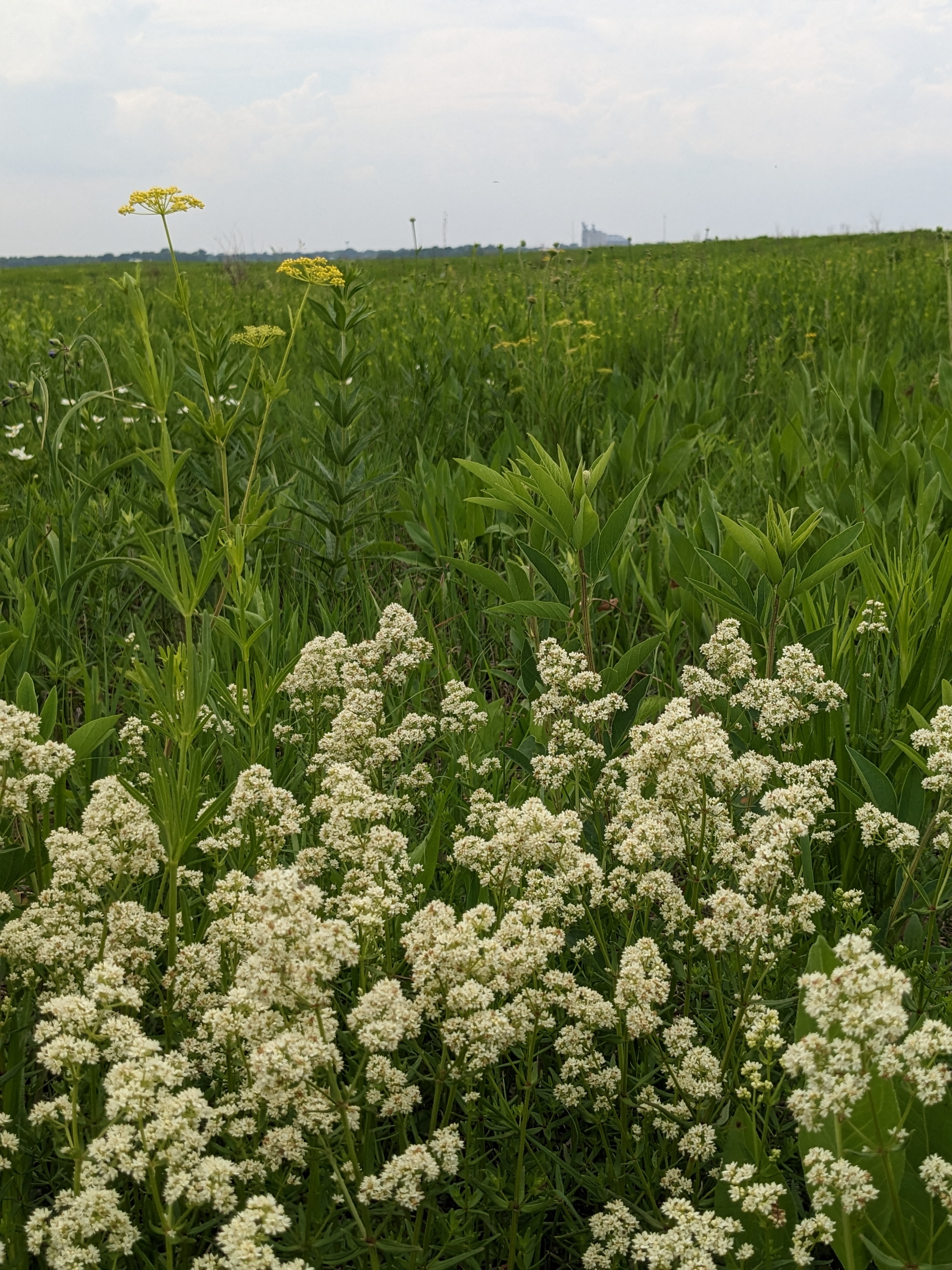
On the docket are visits to a number of prairie reconstructions, including both the best and the worst projects that I so far have been involved with. One is a diverse planting at the Lamberton Wildlife Management Area (WMA) that so far has a robust stand of prairie plants but is also part of a larger grassland/wetland landscape that hosts breeding wildlife as diverse as trumpeter swans, sandhill cranes, western meadowlarks, harriers, grasshopper sparrows, bobolinks, dicksissels, upland sandpipers, mallards, blue-winged teal, American badgers, and white-tailed jack rabbits. Monarch throng to the stands of blazingstar during fall migration, and a specialist bee normally restricted to remnants prairies has been recorded. The site has hosted professional and lay prairie enthusiasts, serves as an important seed harvest site, and has been the site of a wildlife research project.
On the other extreme is the most recent planting at the Vogel WMA, a mere 10 minutes to the east. A healthy population of leafy spurge, large swaths dominated by smooth brome, and seemingly never ending invasion of Siberian elm at first glance make it look like an ecological eyesore. The grasslands that adjoin it on both public and private land are similarly compromised.

Why the vast differences between the two outcomes? And why haven’t I given up on the poor Vogel planting and still have regrets about the Lamberton one? Both plantings were planted with similar seed mixes, at similar times of the year, on similar soils, with the same seeding method. The vastly different outcomes stand as a stark warning that many different factors come into play when determining how a planting develops over time. Both Lamberton and Vogel featured species adapted to dry mesic to dry soils (with the exception of a small pocket at Lamberton that received a wet mesic mix). Both were seeded during the dormant season, Lamberton in November and March and Vogel in March. Both were seeded with a Vicon broadcaster and left to the elements to work the seed into the soil. From that point however the background of the two plantings diverges radically.
The Lamberton site was a row crop agricultural field when it was acquired, and had been in crop production for many decades, and likely for over a century. It was planted to glyphosate tolerant soybeans the year prior to planting, and the stubble was lightly tilled after harvest to break up mats of soybean straw that remained. Seeding was begun in November of 2010 but was only about a third completed before earlier than usual heavy snowfalls suspended completion until after snowmelt in 2011. So far it was a typical planting. By late June annual weeds were beginning to reach a foot or so high and the site was ready to receive its first mowing. Then in stepped the unforeseen. A state government shutdown began July 1 and continued until late July, preventing the usual mowing. By the time our staff was back to work the weeds had reach two to three feet and produced enough biomass to smother the young prairie plants if the site was mowed and the material not removed. What’s more beneath the canopy of weeds an excellent stand of prairie plants was developing despite the weed canopy. Conventional wisdom said to mow the site, before those annuals choked out the fragile little prairie seedlings. The situation on the ground suggested that mowing at that stage would probably do more harm than good, and those “fragile” little prairie plants didn’t look like they needed much help. So I decided against mowing, and as they say the rest is history. An excellent planting developed and has subsequently been managed with haying and prescribed burning, producing what I consider to be excellent results.
The Vogel tract on the other hand was acquired as a long established CRP planting originally seeded to smooth brome grass and legumes, likely alfalfa and/or sweet clover, in the 1980s. We acquired the site circa 2015 by which time nearly 30 years of pocket gopher mounds made the site undriveable by any of our equipment. The slopes were steep and highly erodible, ruling out using the standard use of temporary cropping as a means of preparing the site. After much debate I decided to contract with an adjacent farmer to disk the site so that it was smooth enough for use to use our equipment to spray the brome and other vegetation with glyphosate and then follow with a no-till drill to get the seed in the ground. In late 2018 and early 2019 seed and glyphosate was purchased, a farmer was contracted, and all looked to be on track for seeding in fall of 2019. Then events intervened. Rain started early and returned often that summer, preventing the farmer from getting in to disk the site until September. And even after disking the site was still deemed too rough to use our spray equipment on, let alone drill. The seed, which was in refridgerated storage but approaching a year old, was in danger of having reduced germination if we stored it for another year. So my decision came down to a choice between seeding that fall and dealing with a live brome stand after seeding or waiting another year with the hope of getting better site preparation and having lost germination on expensive seed. I chose to deal with the live brome after planting and seeding was conducted with an atv mounted Vicon spreader in fall of 2019. And again, the rest is history.
But I’ve been around this game long enough to know that seedings are not endpoints in themselves but the beginning of a process. The nasty planting at Vogel has since had two intensive spring grazings and one prescribed burn to set back the brome, and native plants are beginning to thrive on growing acreages on the site. What’s more even in its present state it is still being used by grassland birds, badgers, and a large number of insects. The arrow is pointed in the right direction and while it will take regular, fairly intensive management there is a light at the end of the tunnel.
The Lamberton planting is now experiencing its own issues. While the planting itself was on soybean stubble, two side of it were bordered by smooth brome infested roadsides and fencelines. Smooth brome has been steadily advancing into the planting and now is 40 or so feet in the interior. This despite several burns over the past dozen years. Further an invasion of woody plants, mostly cottonwood and Siberian elm, is proving to be a persistent problem and threatens the integrity of the site for grassland obligate wildlife species. Even my poster child planting is going to be a long term work in progress.
Prairie reconstruction is an art, not a perfect science, and unforeseen events can wreck havoc on many best laid plans. Further, just because one piece of grassland can look excellent today and another poor, doesn’t mean that they will necessarily stay in that state nor does it mean one is better than the other in every aspect even in their present state. Grassland management is a journey, hopefully one that will be handed off some day to other managers so that they can chart its course long after we are gone.
These ideas will be core of the conversations we’ll be having on August 22st and 23nd in the vicinity of Windom, Minnesota. Registration will begin in early July and will be limited to the first 80 individuals signing up. The sites on tap promise numerous discussion opportunities on a wide range of establishment and management topics and the conversations among attendees should be worth the trip. Hope to see you there!


 grassland restoration network
Do you ever mow a grass dominate prairie planting to get more sun to the forbs below to have a fighting chance? I never thought to mow big blue?? More Wood Betony in the meantime.
Well timed grazing targeted at brome may disproportionately hit brome, but an important distinction to recognize between planted prairies and surrogate grasslands and old growth prairie sods and plantings intended to emulate them is that original and high quality remnant graminoid composition in uplands is much more comprised of mid-height and/or cool-season and/or caespitose grasses (Hesperostipa spartea, Sporobolus heterolepis, Koeleria macrantha, Schizachyrium scoparium, Dichanthelium leibergii, Bouteloua curtipendula…the main exception and most grazing tolerant of these) than Andropogon gerardii and Sorghastrum nutans in MN, IA, S. WI, N Ill., E. NE, E. ND, E. SD, and E. KS. There is actually very good research (some old, but we best remember it, Weaver and Clements describe these changes in their 1930s Ecology book and their research basis in their body of work) behind that (most grazing regimes, excessive thatch in the absence of fire, fire occurring outside the dormant season causing change to the tall, rhizomatous grasses) and increasing mechanistic understanding (not just photosynthetic pathway, but phenology, but bank size, where buds reside…near or above the surface in the bunchgrasses and more protected an inch or two below ground in big bluestem and Indiangrass). So all of this is to say it depends on what one is trying to do, but results will diverge strongly from old-growth-like characteristics no matter how diverse a planting is with under intense grazing disturbance, out of dormant season fire, and absence of fire. …and diversity is not the same thing as quality. Diversity is actually high at both the low and high ends of prairie community integrity and floristic quality. Much research done in the western tallgrass region on land managed historically as prairie pasture was initiated long after those prairies’ compositions were altered in fundamental ways by post-green-up spring burning and grazing practices (e.g., Konza).
I forgot to mention–Brome can be managed with fire-even if that fire is in the dormant season. It just has to be very frequent. I’ve seen that lead to the near miraculous expression of suppressed remnant mesic prairie in western Iowa, and brome is one of the best starting points for reconstructing prairies with remnant-like composition and physiognamy (this presentation is the essential “how to” for old brome CRPs and cool-season pastures: https://www.youtube.com/watch?v=hvMy–MMM2c)…wood lilies, wood betony, false toadflax, prairie violets, etc.). It essentially takes annual dormant season burning, which should be no surprise, because that was the stabilizing element that allowed ecologically complex and tight prairie sods to developed as floras expanded and/or contracted from the north, south, east, and west…also from expanding and contracting woodlands, which share much flora with open prairie. Historical accounts are nearly unanimous in that regard, but so little is managed that way that it is greatly underappreciated.
Thank you for sharing so much great information! If you can make it to Minnesota in August it sounds like you have a lot to add to the discussion!
Unfortunately I won’t. The Prairie Enthusiasts’ Annual Picnic is in St. Peter this weekend (July 16) and visiting some TPE member-landowners in that area (one has a nice remnant along the Minnesota River between New Ulm and Mankato), and I’ll be there.