
By: Julianne Mason, Restoration Program Coordinator, Forest Preserve District of Will County

We have been using rice hulls as a carrier for our native seedings and loving the results! I first got the idea to try rice hulls from this USDA technical note [link to https://www.nrcs.usda.gov/Internet/FSE_PLANTMATERIALS/publications/idpmctn11458.pdf] I’ve tried various carriers over the years, primarily cereal grains like annual oats and rye, but here’s why rice hulls seem to work well:
- Rice hulls are light and fly out of the broadcast spreader about as far as native seed. More aerodynamic carriers like annual oats fly farther and give the operator a false sense of how wide the native prairie seed is being spread;
- Rice hulls seem to keep very small seeds (like rushes, wool grass, etc.) from falling out of the seed mixture all at once, and make them more evenly distributed across the field. This is especially beneficial for wetland seed mixes, which tend to have a lot of small seeds;
- Since they are light, rice hulls are a much nicer carrier for hand broadcasting. Also, less weight in the broadcast spreader makes it less likely for pins to shear;
- For our minimally cleaned prairie seed, rice hulls help the fluffy, stick-filled mass of seed to flow better through the seeder, and they reduce bridging and clumping; and
- Rice hulls are cheaper than cereal grains, when you just need a carrier and not a cover crop.
Here in the Midwest, unbroken rice hulls are available in compressed 50 pound bales directly from Riceland or from various on-line distributors like A.M. Leonard. We’ve been using 10 pounds of rice hulls per acre as a carrier for initial seedings, and 5 pounds of rice hulls per acre for lighter overseedings. Also fabulous: mixing the seed and rice hulls in a concrete mixer, which works really well!
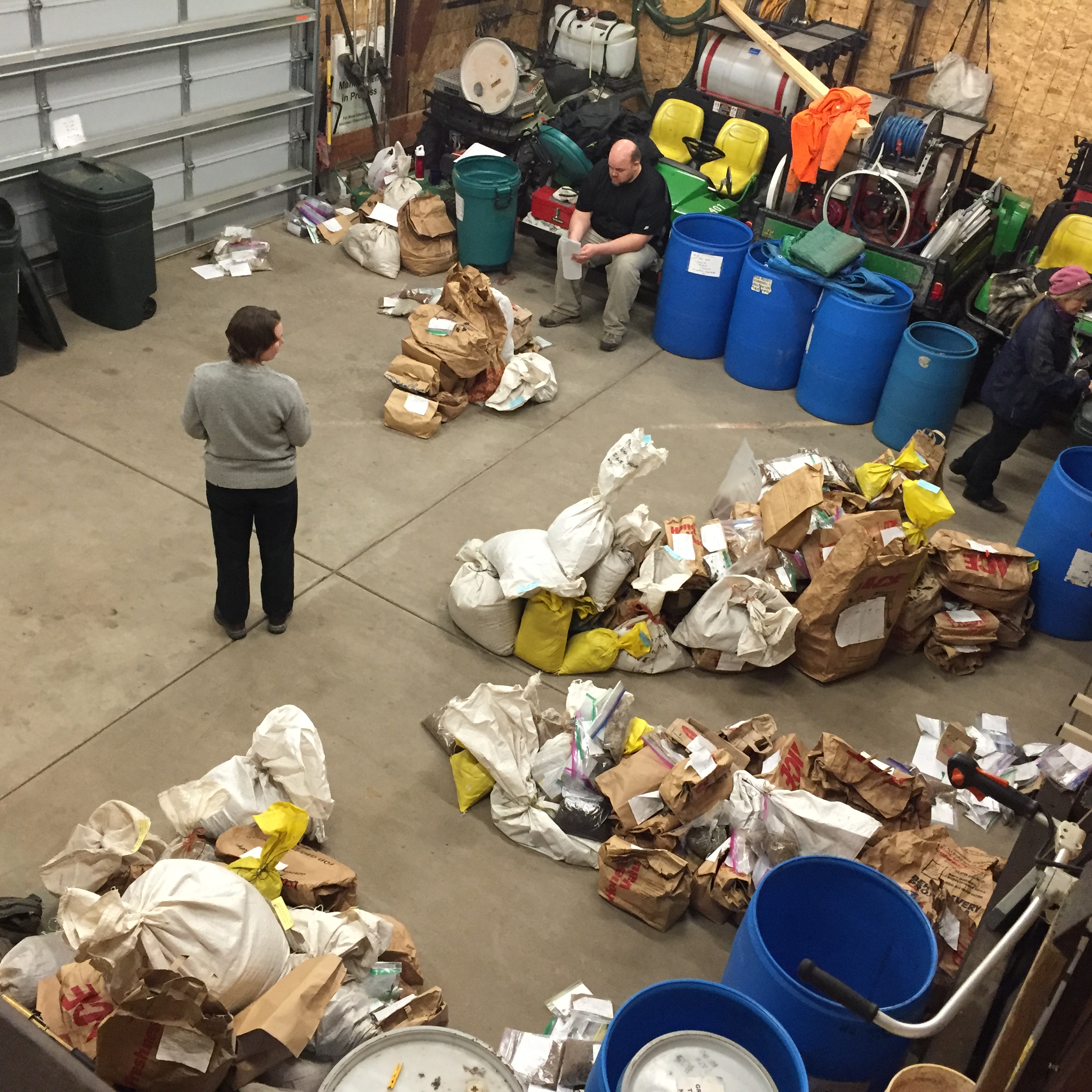
Caption: Sorting bags of seed for mixing.
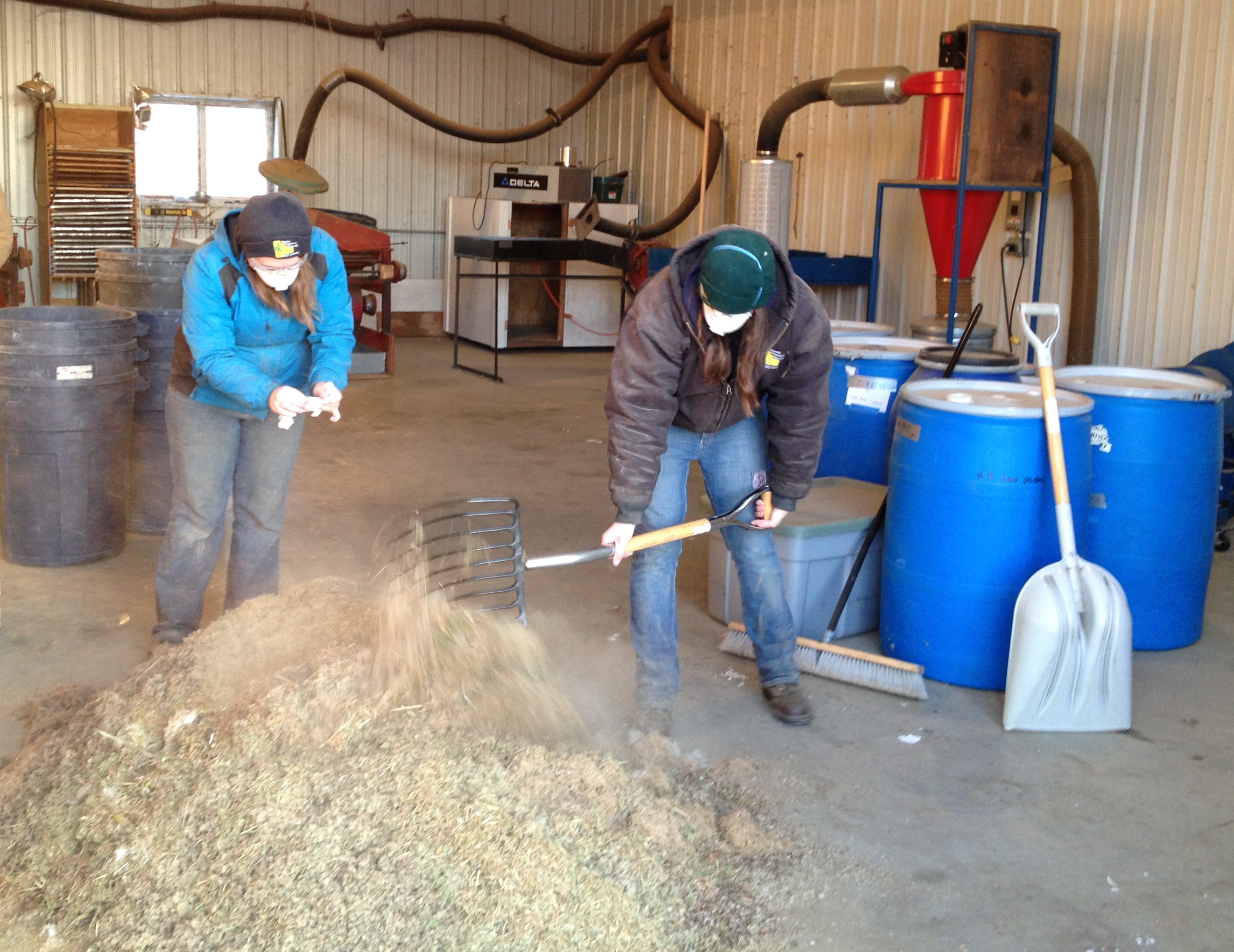
Caption: We used to mix seed by hand, mixing it with pitch forks and shovels on a concrete floor. A very dusty job!
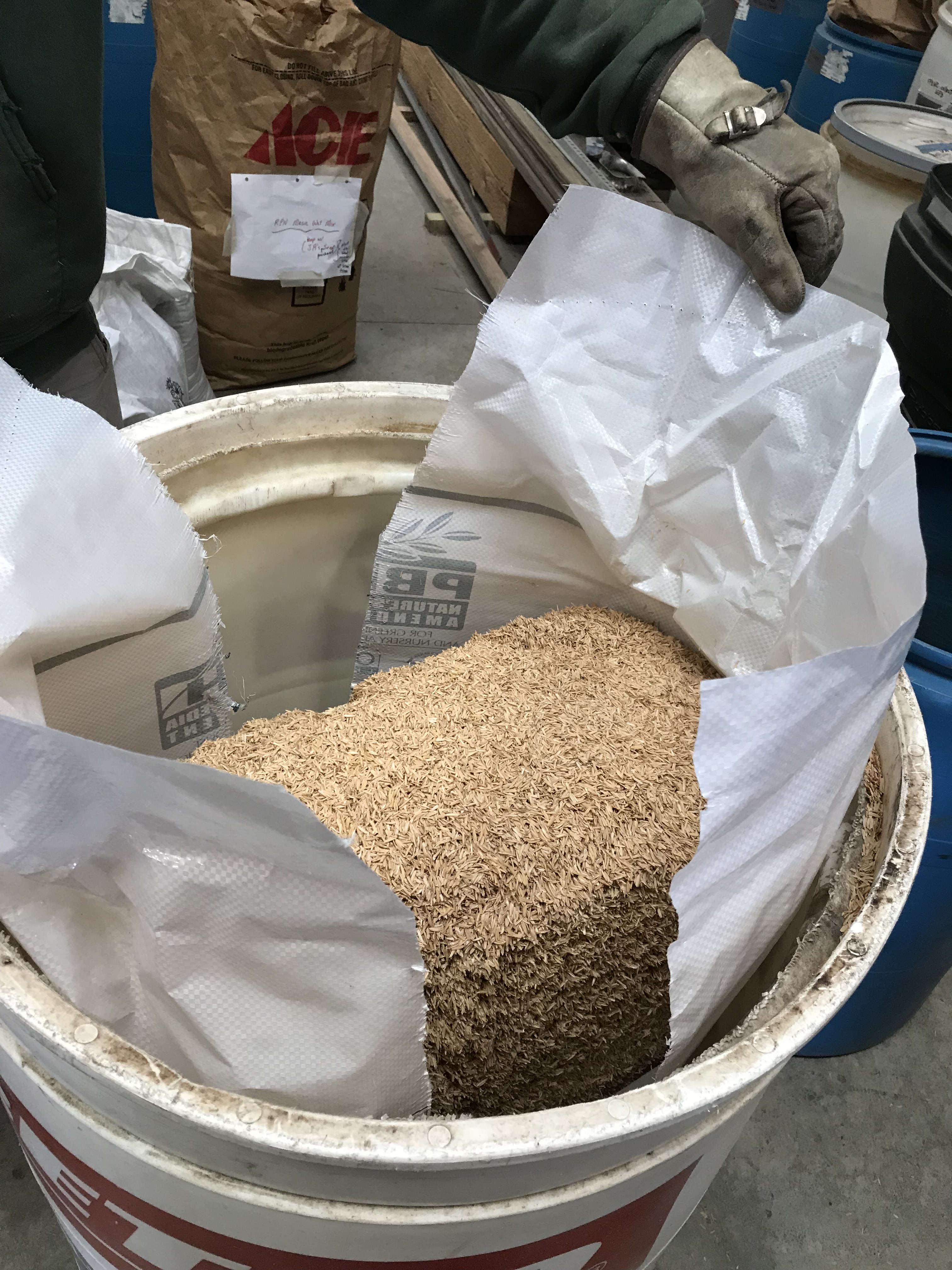
Caption: The rice hulls are compressed and expand when the bale is opened. I highly recommend putting the rice hull bale in a 55-gallon plastic drum before slashing the sides of the bale open with a knife.
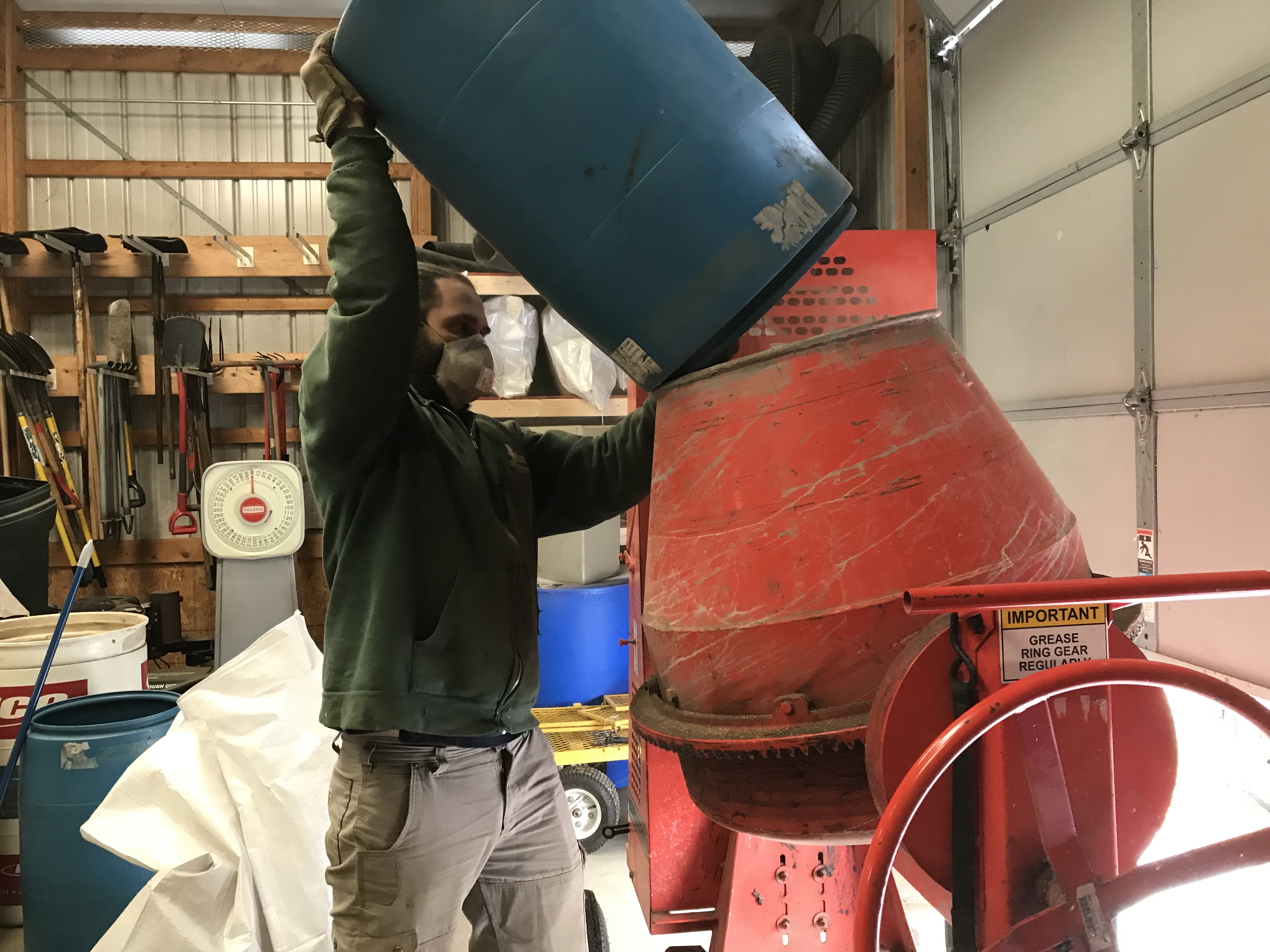
Caption: Photo of our restoration ecologist, Nick Budde, loading native seed and rice hulls in the concrete mixer.
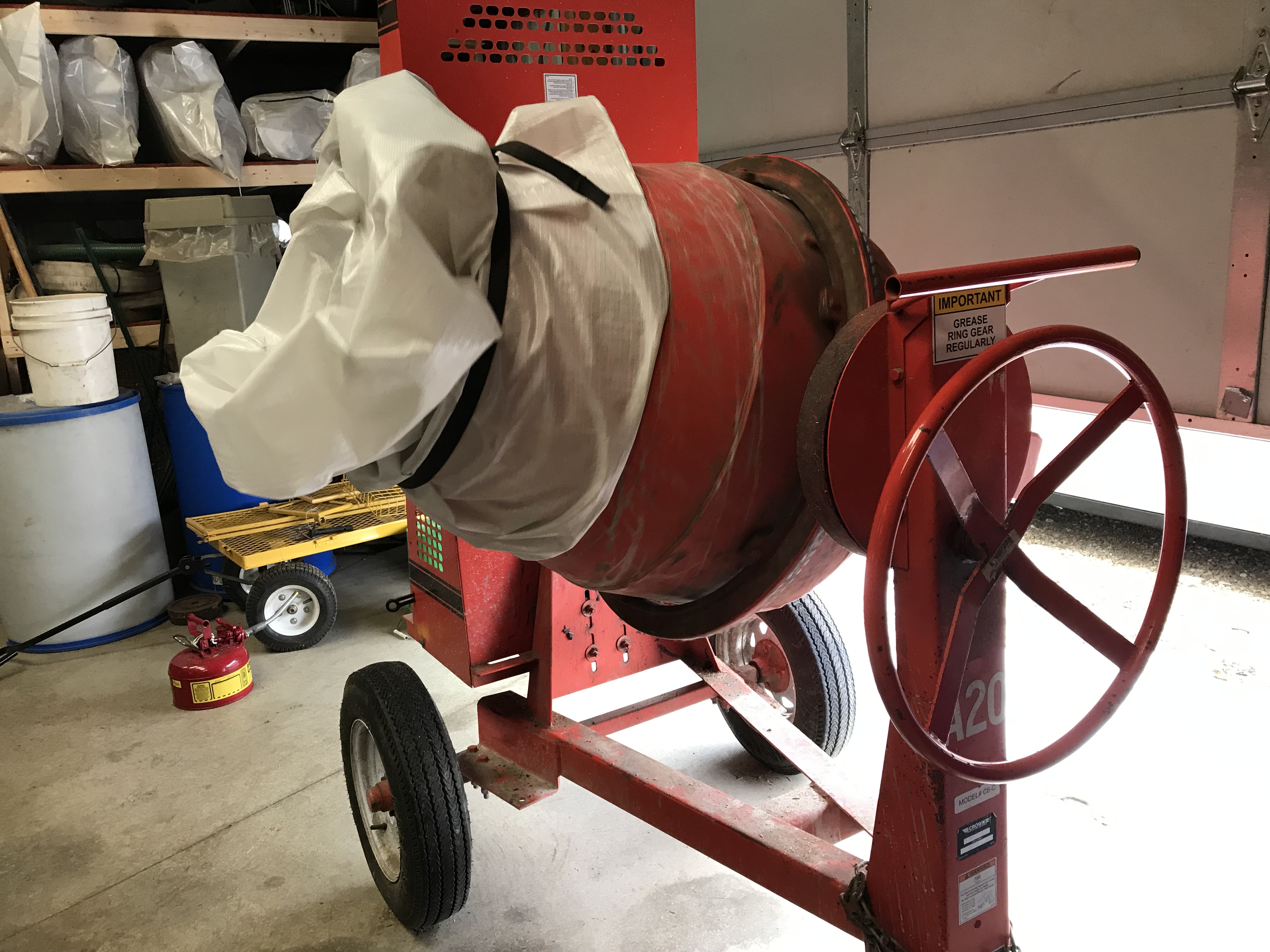
Caption: We keep a poly bag strapped over the mouth of the concrete mixer while the seed is mixing. It keeps seed and dust from flying out.

Caption: Once mixed, the seed and rice hulls are dumped out into the poly bag.
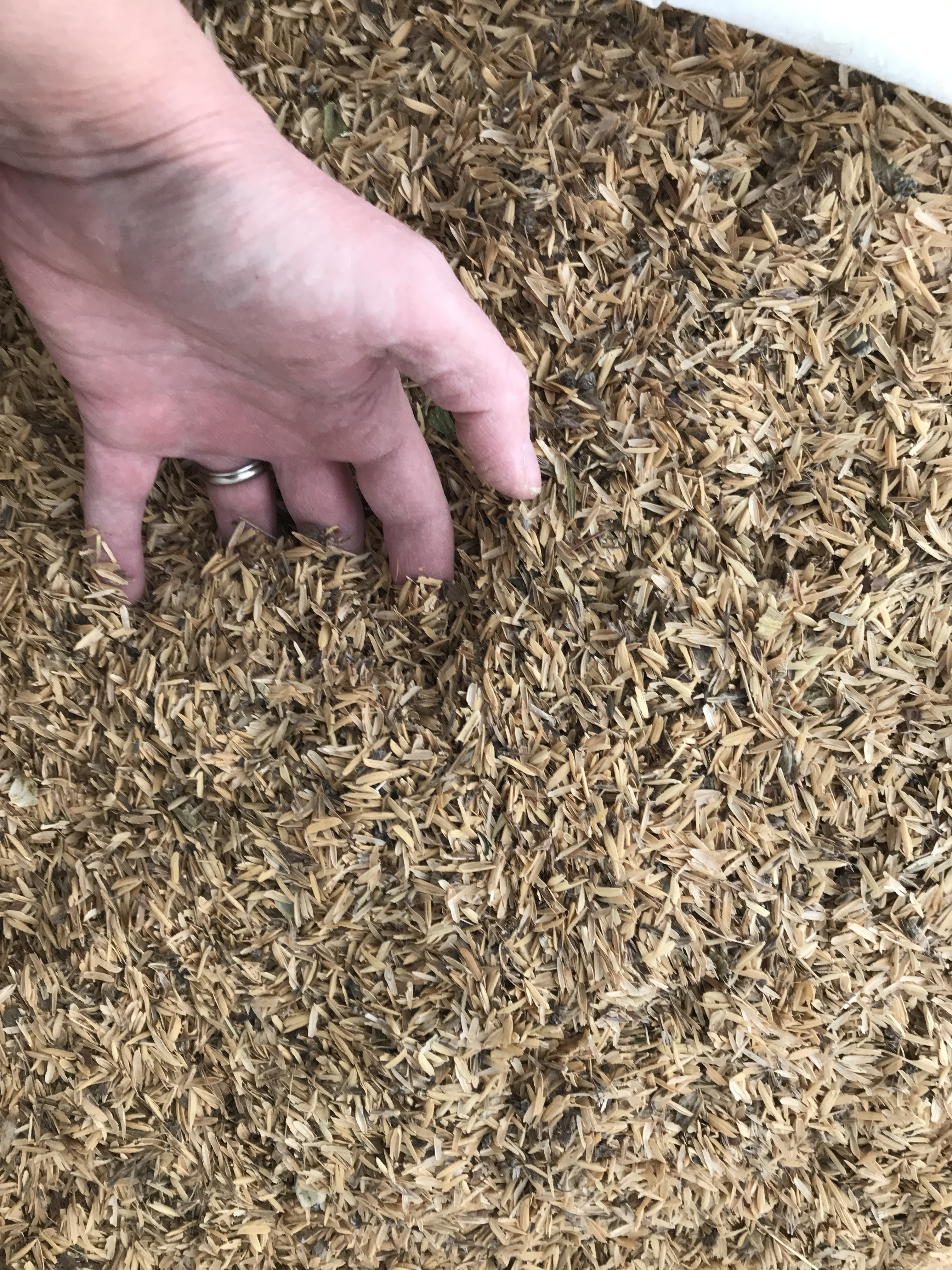
Caption: View of rice hulls mixed with very clean seed bought from a commercial nursery.

Caption: View of rice hulls mixed with our minimally processed native seed.

Caption: View of seed and rice hulls broadcast onto snow cover.


 grassland restoration network
Hi,
I’m not familiar with this work. It would be helpful if there was an introduction to the article explaining why you need any additional substance in with the seeds. What the advantages of it are. I’m also trying to understand the dynamics of using the two substances together, and I’m wondering has it been tested yet to the point where you know that the seeds do reach the ground and then sprout when they are broadcast using the hulls. Thanks
Suzanne
>
Hi Catherine,
You make a good point about the post needing more context. Carriers are often used to make sure the native seed flows properly through the seeder, and is distributed evenly across the field. In my experience, carriers are important when using broadcast seeders, but I don’t know how necessary when using drop seeders or other types of seeders. For broadcast seedlings, rice hulls (or other carriers) act as an even-sized chaff which makes the medley mix of sizes and shapes of native seeds flow more evenly. Seeds and carrier are all lightly distributed on the ground surface, and the native seeds germinate irrespective of the presence of the carrier. No formal science on that, just casual observations. Thanks for your comment!
– Juli Mason
What about using seed oats as the carrier when planting in mid-Spring (i.e. now, second week of May) in upper midwest. That way get a ground cover…, or will the seed oats choke out the natives in the CRP mix?
What about using seed oats as the carrier? Or will they choke out the native species in the CRP mix. This is for mid-Spring planting in the upper midwest. Thank you.
Great Job Julianne,
I have been using and selling the same product here in Ohio for the last five years, and they work well.
One important addition; You and I are using what is known as PBH or Par-Boiled Rice Hulls from Riceland Foods. They have indeed been cleaned and then boiled to kill of any weed seeds, so they are a very sterile product. If folks just ask for “Rice Hulls” they may get a product straight from the fields and full of “who knows what” weed seeds! Ask for “PBH”
I tried to buy rice hulls on-line, but the shipping cost was outrageous- three times as much as the product itself. Any advice on how to get this product for a lower cost? I live in Wisconsin.
Dean, you are correct that the shipping can seem outrageous. You need to buy at least a full pallet (16 bales) at a time to start to see some cost effectiveness. If you have large plant nurseries in your area, call them to see if they use “PBH”. Nurseries commonly use it to thin and loosen potting soils or to Topdress Mulch their container stock. The product also works great when tilled into your garden, really loosens up our hard Ohio clay. I typically sell a single bale for $16, and it can be shipped Via UPS. Still cheaper than wasting seed.
As far as cost of rice hulls and shipping I would recommend trying Pheasants Forever Seed store online for that. It’s very reasonable in regards to price and shippijng.
You are right about shipping costs. That said, Fedco Seeds parboiled rice hulls https://fedcoseeds.com/ogs/rice-hulls-8392 after shipping added are still 10 times less expensive than at a local nursery and 4 times less expensive than from Amazon.
Hi pileatedbill (great name, by the way), when we used to do more spring/growing season seedings, we often used seed oats as a carrier/ cover crop at 32 lbs/acre. It’s an option, especially if you need quick annual grass cover for erosion control. However, we have found that diverse native seedings (especially forbs and sedges) come in much better when dormant seeded, and we really like the results that we’ve gotten when dormant seeding using a broadcast spreader and rice hulls as the carrier.
Thank you for the advice. By dormant seeding, you mean seeding during winter with snow on the ground? I already purchased the CRP mix. Is there a best way to store it until winter? I’m thinking I’ll plant oaks for now and then dormant seed the CRP mix this coming winter. Any carrier needed for the oats? This is in wooded hillside, so I expect I’ll need to use a manual broadcast spreader. Any recommendations for a broadcast spreader that would work for both oats and CRP mix diluted with rice hulls. Thank you again for the voice of experience/great information.
Hi pileatedbill, Yes, by dormant seeding I mean in the winter and usually a light covering of snow is helpful to be able to see where you’ve put the seed. I have not found a hand-held mechanical seeder that works well for seeding native seed. The ones that I have used (think, organ grinder) work ok for oats and other cereal grains but not good for native seed mixes with lots of fluffy seed since they lack internal agitators. Anyone else have a mechanical seeder recommendation for pileatedbill?
Thank you again. Is there a best way to store the CRP mix until winter?
Hi pileatedbill, I would recommend storing it somewhere cool, not too damp/humid, and mouse-proof.
Have you tried the Pheasants Forever Seed store? I find they are very reasonable.
Thank you David. Those are some great prices. Was unaware that they had a seed store. Here in MN we have a seed store in Albert Lea https://alseed.com/?s=crp that sells CRP mix for very reasonable prices (about 5 times less than from nurseries and other vendors). Pheasants Forever is right at the same price point. Couldn’t tell what weight they were selling in each bag, since it wasn’t available.
I have read that restoration groups have been using rice hulls as a carrier. It still amazes me that different places can get so much seed that they need a carrier. I usually get only a few hundred seeds of each species I focus on collecting. The things I collect include yellow star grass, violet wood sorrel, Seneca snakeroot, prairie phlox, smooth phlox, fringed puccoon, and hoary puccoon. I also work on sedges that are conservative and/or produce little seed like Carex crawei, Carex meadii, Carex richardsonii, Carex tetanica, and Carex umbellata. However, I only have the time to collect a fraction of these species in any given year. When spreading the seed I just place one seed at a time in a favorable looking spot in between established restoration vegetation. I choose placement of each seed carefully hoping to improve the chances for success and guarantee even distribution. It is hard for me to fathom the scale at which Nachusa and other places work. I can see how the concrete mixer would be perfect for mixing large seed mixes. I enjoyed seeing the pictures of the work happening. Thank you for writing this post and sharing your experiences with all of us.
what is a good ratio of rice hull carrier to wildflower seed?
carrier : seed = ?
I see you’ve got the application rate in your article. 10lbs/acre. I’m all set thanks.
What is the best mechanical hand seeder for larger seeds such as big blue stem i.e. CP 25 in Iowa. The seeds do not want to come out of a rotary mechanical bag seeder that is available at local stores.
From Juli Mason: I have not used any mechanical hand seeders that work well for fluffy native seeds. The hand seeders that I have used (think, organ grinder style) work well for cereal grains like annual oats or rye, but not well for native mixes since they lack internal agitators. Has anyone used a mechanical hand seeder that they recommend for fluffy native seeds? – feel free to chime in! – Juli Mason
I have used the Earthway 2750 n which is a 25# organ grinder style bag seeder with rice hulls as a carrier for native seeds including a healthy amount of big and little bluestem and have had good results. You do have to have the opening set for wider than would be expected to get a good flow as well as jostle the unit a little as you go.
Truax did make one, although it was heavy to use. They also had one electrified for the back of a UTV. Both were limited by small hoppers. Check with them to see if they are still offered. http://www.Truaxcomp.com Personally, I would rather mix the seed with (Par-Boiled) Rice Hulls and broadcast by hand. BTW, April is probably too late in the season to expect a good stand by broadcast seeding.
I am happy to report that I found a mechanical seeder that works great from a company who drill planted 30 acres of CP-25 and 13 acres of pollinator for me last year. Hoskey Seed Co. in Iowa and they have been using a Truax mechanical seeder. My only problem now is spending $750 for one! See company link attached. https://seedsource.com/seed-slinger-hand-yellow/
Hi,
I’m not sure if this thread is still active but here’s my question. I’m getting ready to mix native wildflower seeds with rice hulls for broadcasting. I find a variety of recommended ratios of hulls to seed, but none of them indicate whether the ratio is by weight or volume. What ratio would you recommend and is that by weight or volume?
Thank you so much for this post. It was very informative.
Robin, I have mixed seed and rice hulls both ways, both by weight and volume. At the start, we were mixing 10 pounds of rice hulls per acre of native seed. This was simple and it was easy to calculate how many bales of rice hulls to buy if you know how many acres you’re seeding. However, this meant that each of our seed mixes (e.g., wet prairie vs mesic prairie) had a different finished volume, and therefore we needed to re-calibrate our seed spreader between each mix. To help standardize the calibration, we switched to doing the mixes by volume. We have official black sharpie lines on the inside of the blue barrels that we use for mixing seed. We put one acre worth of seed in the barrel and fill the remaining space up to the black line with rice hulls. Then, we mix it in our concrete mixer. This volume-based system has been working really well for us. Hope that helps! - Juli Mason
very interesting , I was not aware of all the usefulness of rice besides eating it.