By Bernie Buchholz, Volunteer at Nachusa Grasslands
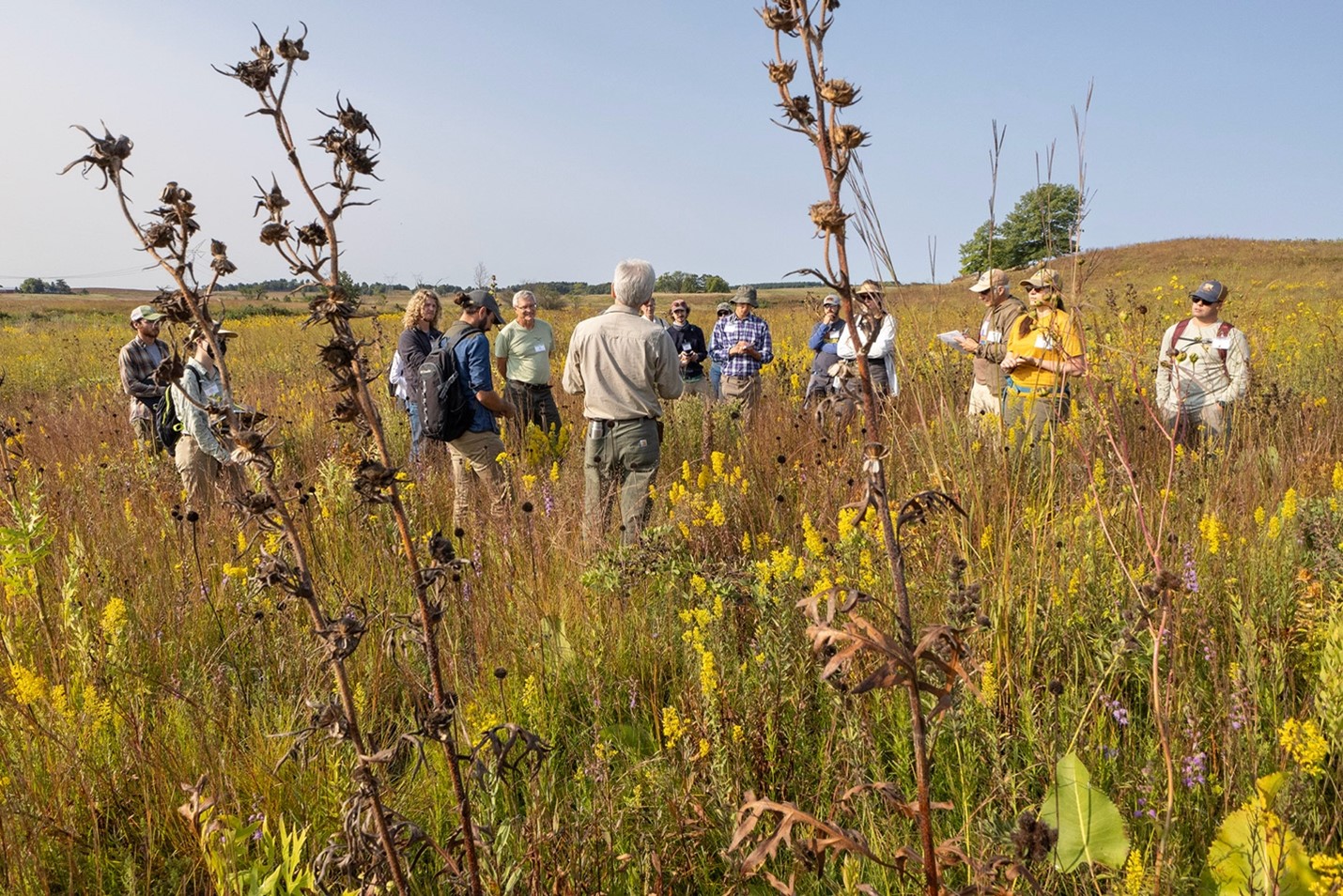
The recent GRN conference at Nachusa Grasslands included “Prairie Tours” of new plantings and remnant restorations. It was a very experienced group with about 90% of attendees having either planted a prairie in former crop fields or having restored degraded remnants. About 90% were also working professionals and the remainder were devoted volunteers. We were a knowledgeable group.
ORGANIZATION: Nachusa has had success with an “ownership” model where individual volunteers can “own” a unit of the grasslands where, after extensive informal mentoring, they make the decisions about what to plant, how much to plant, seed harvest, and weed management. Nachusa staff provides support with some tasks like chain sawing, mowing, prescribed fire, and heavy equipment, if needed. Volunteers become quite devoted to their units, with pride being an additional motivator.
OBJECTIVES: Many attendees use maximization of plant biodiversity as the goal, which is effectively a proxy for maximizing habitat resilience and function. The group discussed plant assisted migration, but there was support for the idea that maximizing diversity with existing species builds resilience while the concept of assisted migration is developed elsewhere.
Photo by Chris Helzer
SEEDS: Nachusa’s approach to is to plant every species desired in the plantings in the very first year. For example, we don’t start with extraordinary amount of adventive plants with plans to add conservative species later. Volunteers have noted that it takes 350 to 400 hours to collect 175 species for a five-acre planting. (For more see Plant High Diversity ) Use of plant plugs is limited due to the demands of planting and watering them. Many participants shared the species they had the most trouble growing, including Comandra umbellata and Lilium philadelphicum.
Nachusa does not clean its seed of chaff. Target weights are 45 pounds per acre of which maybe 30-50% may be seed. Grasses may be up to 20% of the gross weight with Indian grass and big blue stem used vary sparingly, or not at all, depending on soil moisture and other factors.
WEEDS: Former row crop land offers relatively “clean” soil for native plantings, but there are still occasional surprises, including large amounts of yellow and white sweet clover, for example, and birdsfoot trefoil has a decades long life in the seedbank. We had a lighthearted, but thoughtful conversation about managing non-invasive weeds like wild parsnip and Queen Annes lace which are addressed only after the true invasives are dealt with. There was strong support for the aesthetic and emotional value of eliminating highly visible but non-threatening weeds. It gets down to priorities.
FIRE: At Nachusa we burn plantings as soon as there is enough plant matter to carry a fire which is often the second year. A new planting is usually burned annually until it is well established, which could be 5 to ten years. It is important not to burn the entire preserve at the same time for fear of diminishing insects. However, we look at plantings as part of the whole, rather than trying to burn portions of individual units.
Photo by Chris Helzer
REMNANTS: It’s a very favorable and special situation when you can simultaneously do cropland plantings and restore an adjacent remnant. Look for a comparable remnant of similar soils and contours,but with higher plant diversity to use as a model. Eliminating non-invasive weeds like wild parsnip and Queen Anne’s lace completely can take six to seven years, while invasives like birdsfoot trefoil can persist for decades.
OVERSEEDING DEGRADED HABITAT: There was considerable discussion about the best technique for overseeding pastures. Seeding directly into existing vegetation, including dense non-native grasses, seems counterintuitive to first treating the area with herbicides. Our experience at Nachusa, however, indicates that heavy seeding into existing vegetation, when supported with frequent prescribed fire, can be very successful over a period of five to seven years. For more see Converting Pasture to Prairie
PASSION FOR BEAUTY: The opportunity to convert row crop land to thriving prairie is an intoxicating idea. The passion of a volunteer or professional land manager may provide the necessary dedication and hard work to make the most of a planting. There can also be ego (or hubris) compelling the volunteer to establish a great planting. Hopefully, the beauty of a diverse and functioning native grasslands is a result and reward for devotion.
By: Mike Saxton – Manager of Ecological Restoration and Land Stewardship at Shaw Nature Reserve – a division of the Missouri Botanical Garden – Gray Summit, MO
There are few acts more hopeful than planting prairie. We put so much effort and thought and love and care into the process and we hope for ecologically significant results. We want our efforts to translate into benefits for biodiversity and for the increased health of the land. And, perhaps a bit selfishly, we want to be proud of our good work, to show off our success, to reap the rewards of so much determination.
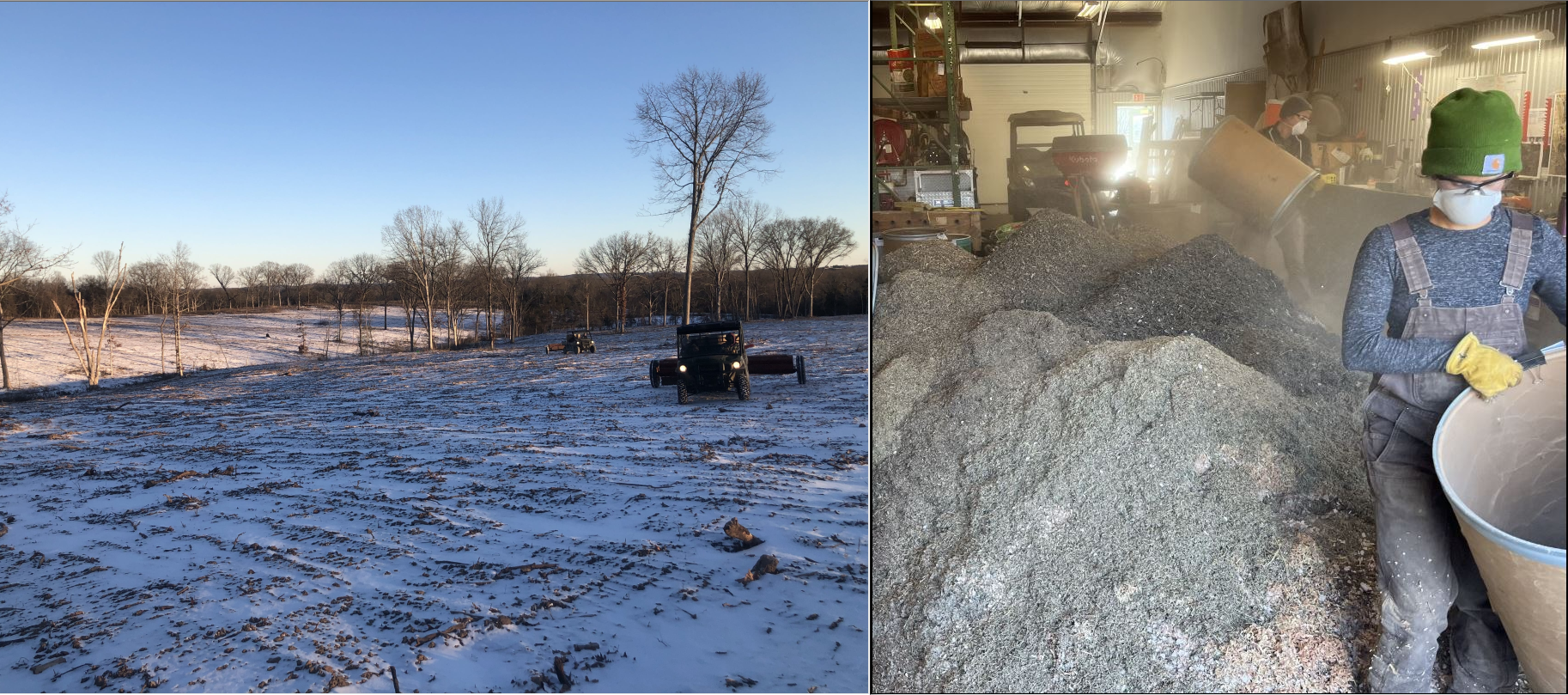
Left – frozen snowy ground for seed sowing of 40 acres on January 16th. Right – Restoration team mixing 1,000 pounds of hand collected, bulk milled seed.
Collecting seed, prepping the ground, sowing on a frosty winter morning…and then the hard part – the waiting. The agonizing wait. Once the seed is down, we want to chase off every bird we see feasting in the field. In the spring, we worry about getting enough rain. And sometimes about getting too much rain. Every day we’re out there expectantly watching for seedlings to emerge.
• 244 total species in the mix • All 40 acres received 1-pass of prairie seed • ~2 acres received a wet swale mix • ~8 acres received an open woods mix • ~30 acres received a 2nd pass of prairie mix • Roughly 25 pounds of bulk, milled, hand collected seed per acre • 146 pounds of PLS purchased seed • No big blue or Indian grass in the mix • We are not high-mowing at any time during the growing season • The 40-acres has been swept on foot for invasives by our crew. They report using a total of 1 gallon of herbicide per acre on Japanese stilt grass, Sericea lespedeza, and white sweet clover. More weeds than we’d like in a first year planting, of course. But extremely important to be on them from the beginning.
I walked the ground in the early summer hoping to spot seedlings. I didn’t like how much non-native brome I saw and I was impressed with the abundance of plain’s coreopsis (Coreopsis tinctoria) growing across the site (it was seeded but also was in the seed bank). I found many, many native plants but lots of the usual suspects too: fireweed (Erechtites hieraciifolius), mare’s tail (Erigeron canadensis), ragweed (Ambrosia artemisiifolia) and fox tail (Setaria pumila). We mostly do not worry about these distrubance driven annual Ag weeds.
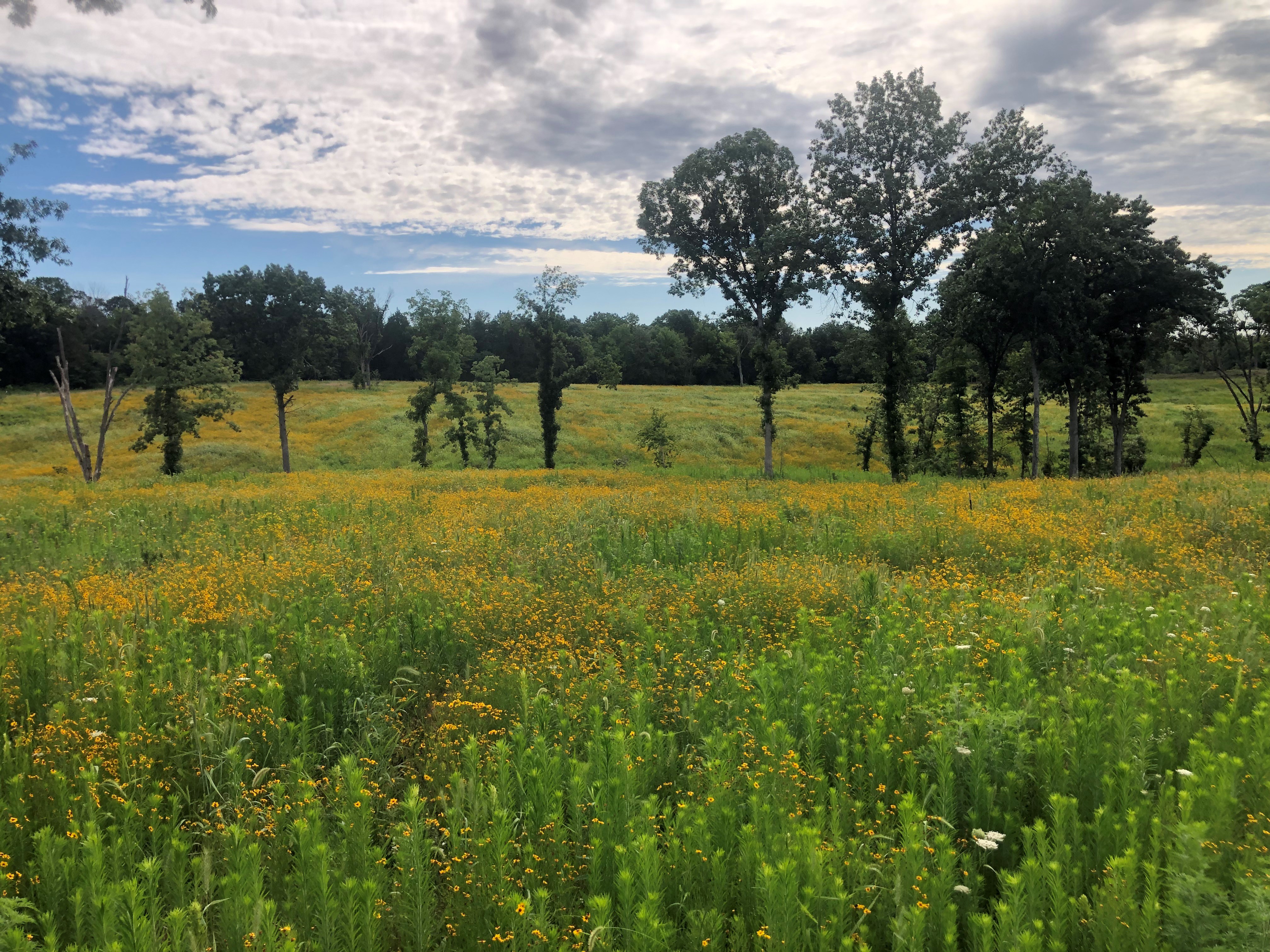
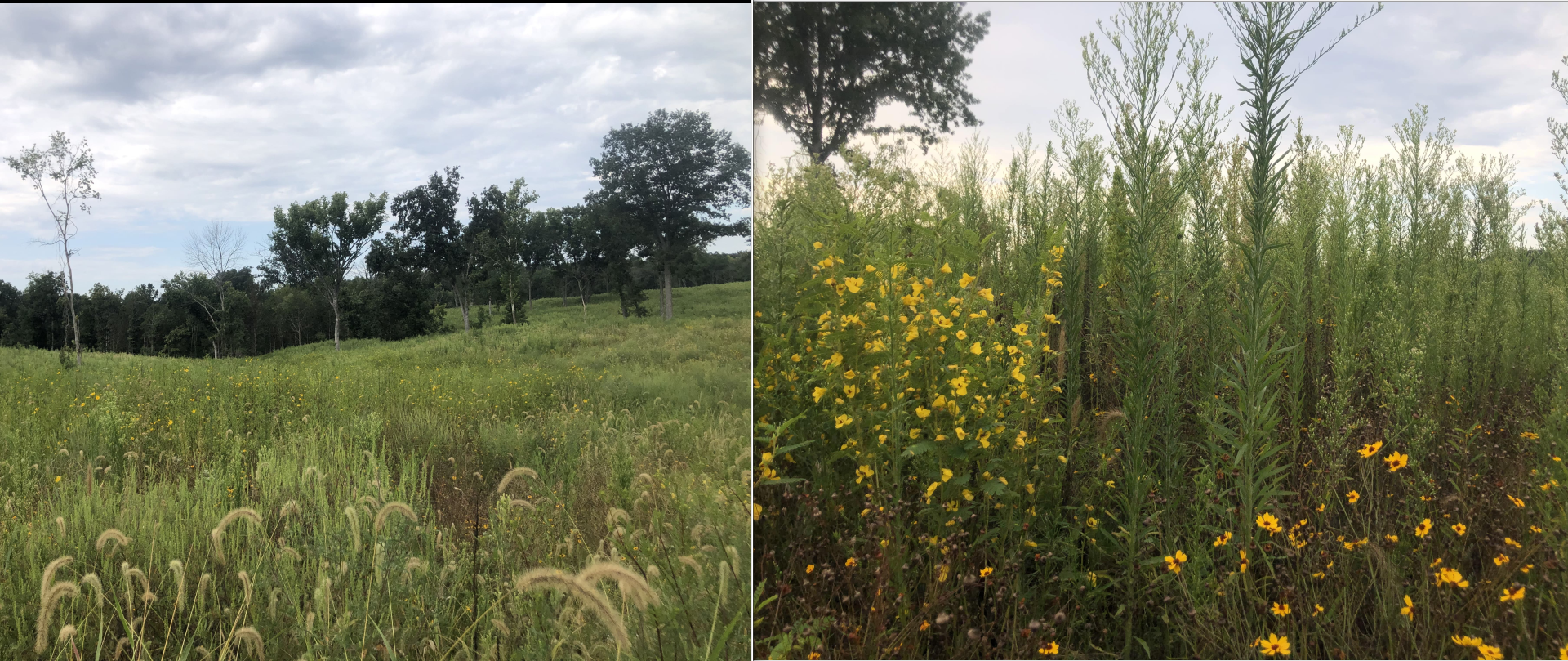
Left – Bidens aristosa in background (wetter swale) with sprinkling of fox tail in foreground. Right – Partridge pea, mare’s tail and plain’s coreopsis – pretty typical for a first year planting.
Yesterday I walked the planting with a hopeful optimism. Generally, I’m happy with what I saw. I found flowering Liatris pycnostachya (prairie blazing star), Salvia azurea (blue sage), Agalinis tenuifolia (slender false foxglover), Physostegia virginiana (obedient plant), and multiple other species. Vegetatively, I found lots of Silphiums (compass & rosin), Baptisias, and Partheniums (quinine).
The most important piece of context – this ground was once forested, it was then cleared and converted to row-crop agriculture. In 1925, the Missouri Botanical Garden purchased the land, describing parts of it as “wasted farm ground”. It was then mowed for decades to be kept open. Then they planted blue grass and ran cattle on it. When mowing/grazing ceased (ca. 1960) it went through old field succession. Then we cleared the trees and are now asking the land to become a diverse prairie restoration. We need to be patient with the land and to attempt to understand what it wants to be and what it can be.
The Agony
A few patches of what I think is Bromus japonicus (Japenese brome). This area had been old-field succesional closed-canopy cedars and mesophytic hardwoods for decades…so it took us by surprise. There are native seedlings in and around the Brome, but not as many as we’d like.
Not extensive but some patches of a Digitaria that might persist. Mostly thin enough that native plants co-occur.
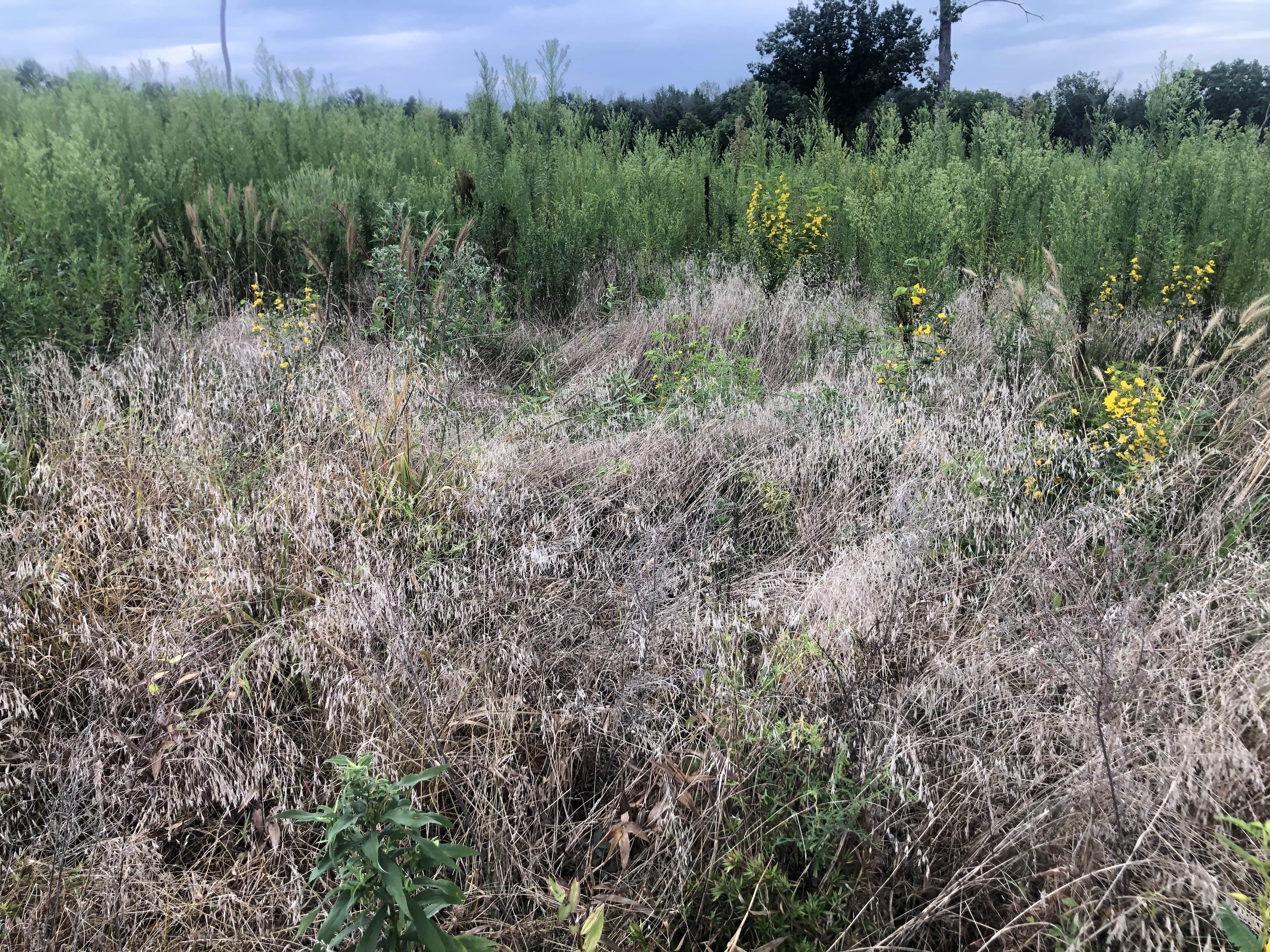
Large portions of the 40 acres have a spattering of fox tail. Some areas have nearly none while a few small areas have thickets.
The Ecstasy
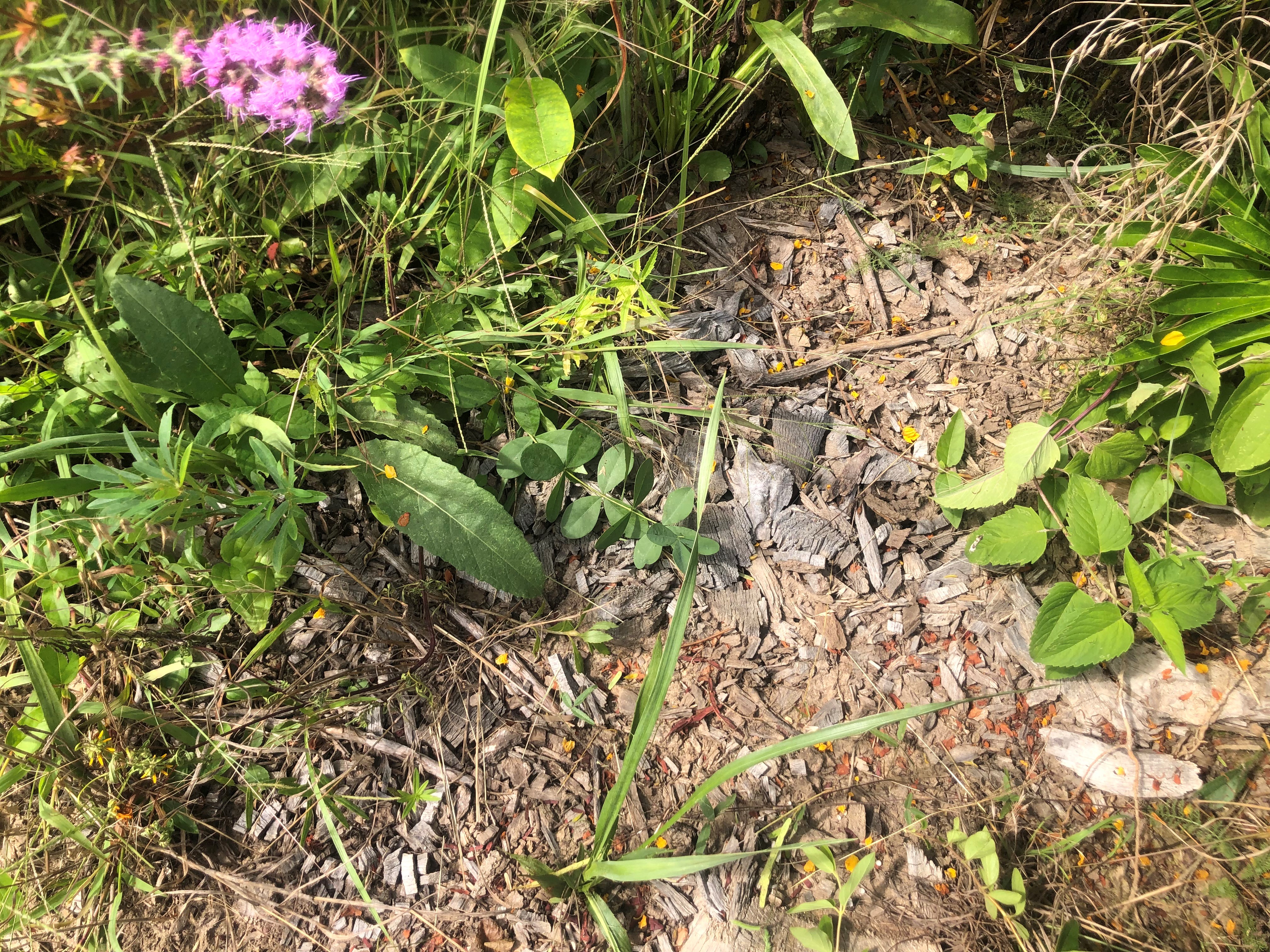
Eryngium yuccifolium (Rattlesnake master), Monarda fistulosa (bee balm), Baptisia,Aesclepias, Lespedeza capitata (Round headed bush clover), Parthenium (quinine). These plants are growing around the remnants of a stump from the land clearing.
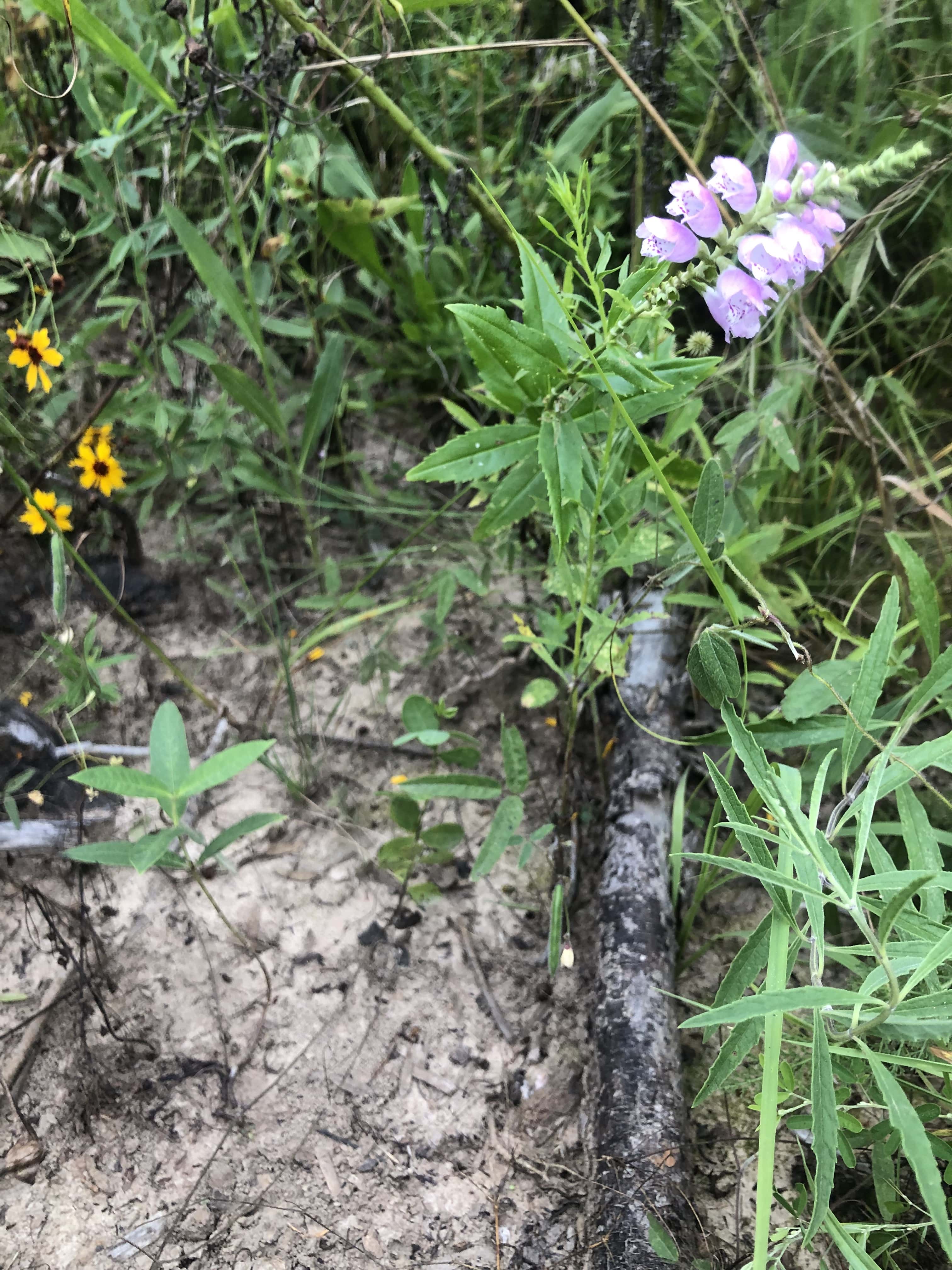
Obedient plant flowering with Baptisia, Salvia, Boltonia, Coreopsis and Aesclepias within 2ft.
Porcupine grass (hand-seeded in clusters across the unit – marked by pin flag), with yarrow, Liatris, and Parthenium.
We will be planting 40-acres of prairie over each of the following two winters. We will take the lessons learned from this first 40 and apply them to our subsequent efforts. This planting isn’t perfect but considering the context, we’re happy with these early results! And the planting will, hopefully, only get better with age and continued care.
By Bill Kleiman, Nachusa Grasslands Project Director, TNC
If you visit an invasive weed occurrence only once a year to treat it the weed may increase.
If you visit the occurrence twice you will break even and maybe gain.
If you visit three or more times you will make great progress.
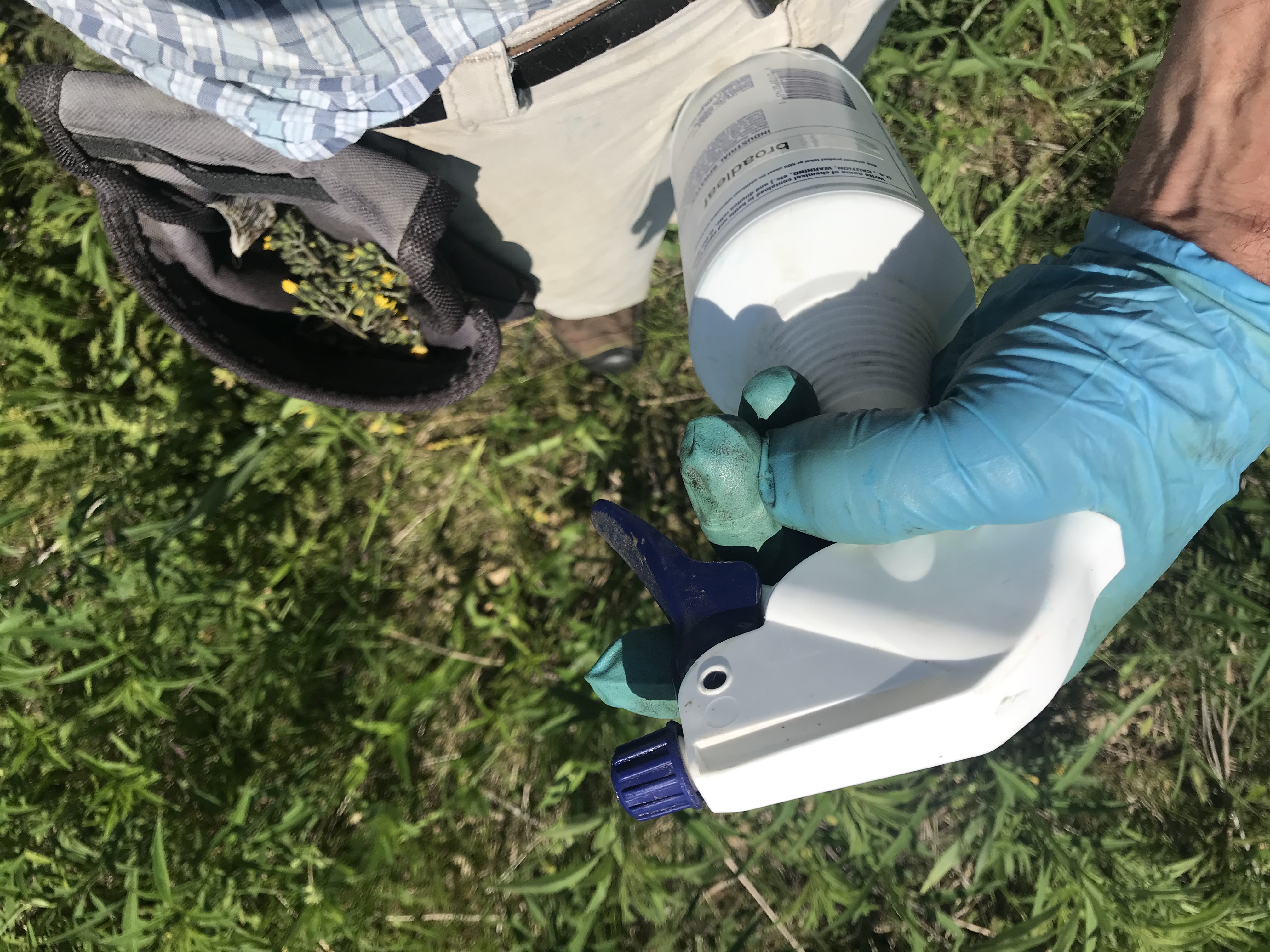
The photo below shows a nail pouch that clips to my belt. Those are king devil flower heads in there. I pluck the heads and spray the basal rosettes. This is easy and I call it fun.
Year round I have a quart sprayer of some herbicide in my vehicle sitting in a five gallon pail to keep it upright. In winter it is a basal bark herbicide solution since it won’t freeze. In summer I still have the basal bark spray bottle, but I also carry a bottle of water based broadleaf herbicide. Lately it has been a solution of 2% Garlon 3A with a bit of blue dye. It is very pleasant to hop out of the truck, grab a squirt bottle, and treat an autumn olive or a birdsfoot trefoil, without having to put my backpack on, or make a note to return to it.
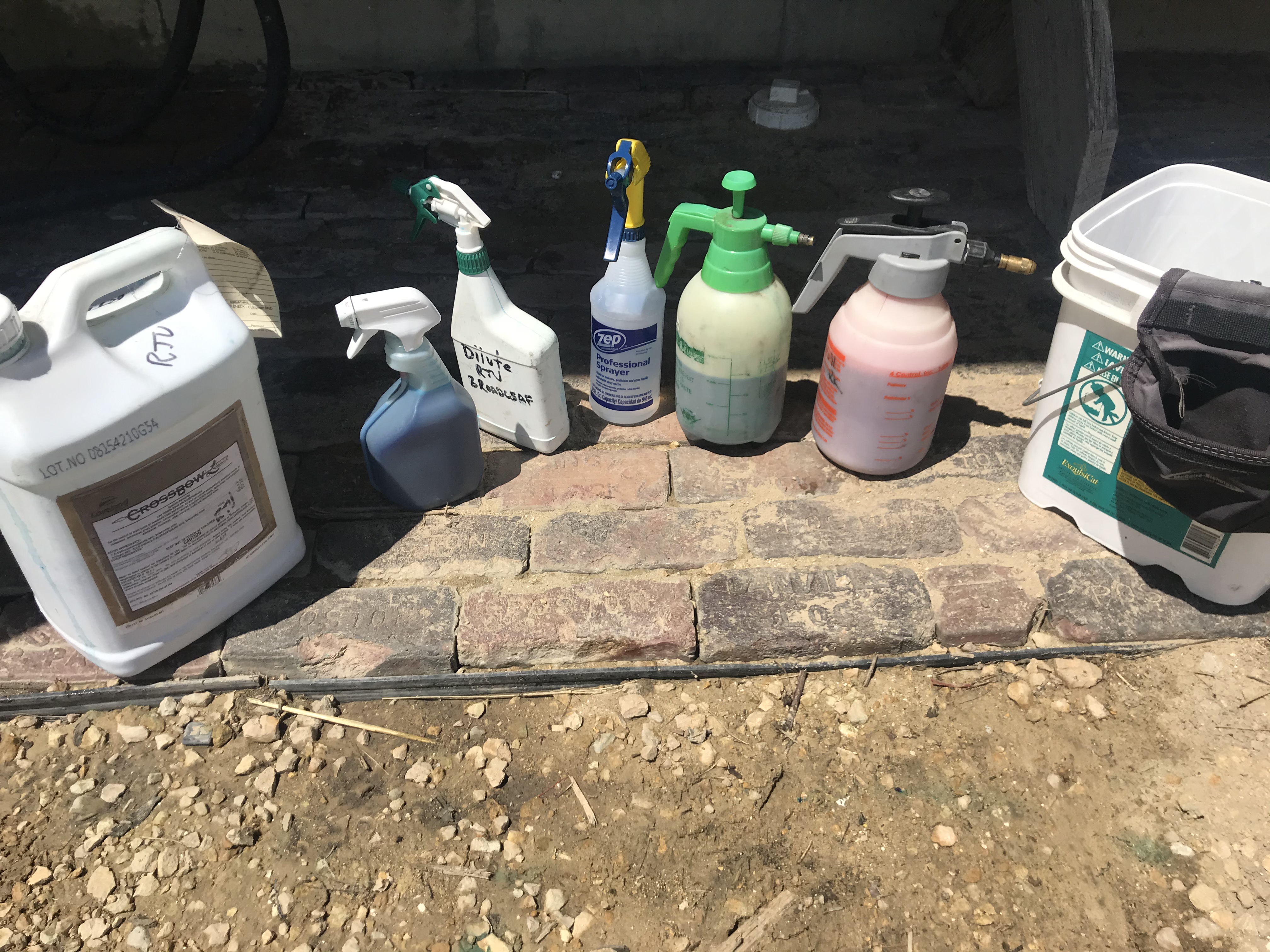
Below is a jug of broadleaf herbicide. It is marked RTU which stands for Ready To Use, meaning it is not concentrate but diluted, with a surfactant and colorant added. I carry about a gallon in the jug as it is easier to fill the bottles that way. I have a funnel with me. Or you can fill the squirt bottles from your backpack sprayer.
Below are five squirt bottle brands. I am not sold on any of them. Elsewhere in this blogsite I review squirt bottles. Some of these bottles cost very little. The Zep bottle purchased in hardware stores in the cleaning section are pretty reliable. We tend to keep the solution in these bottles for months so it is no surprise that they stop spraying sometimes.
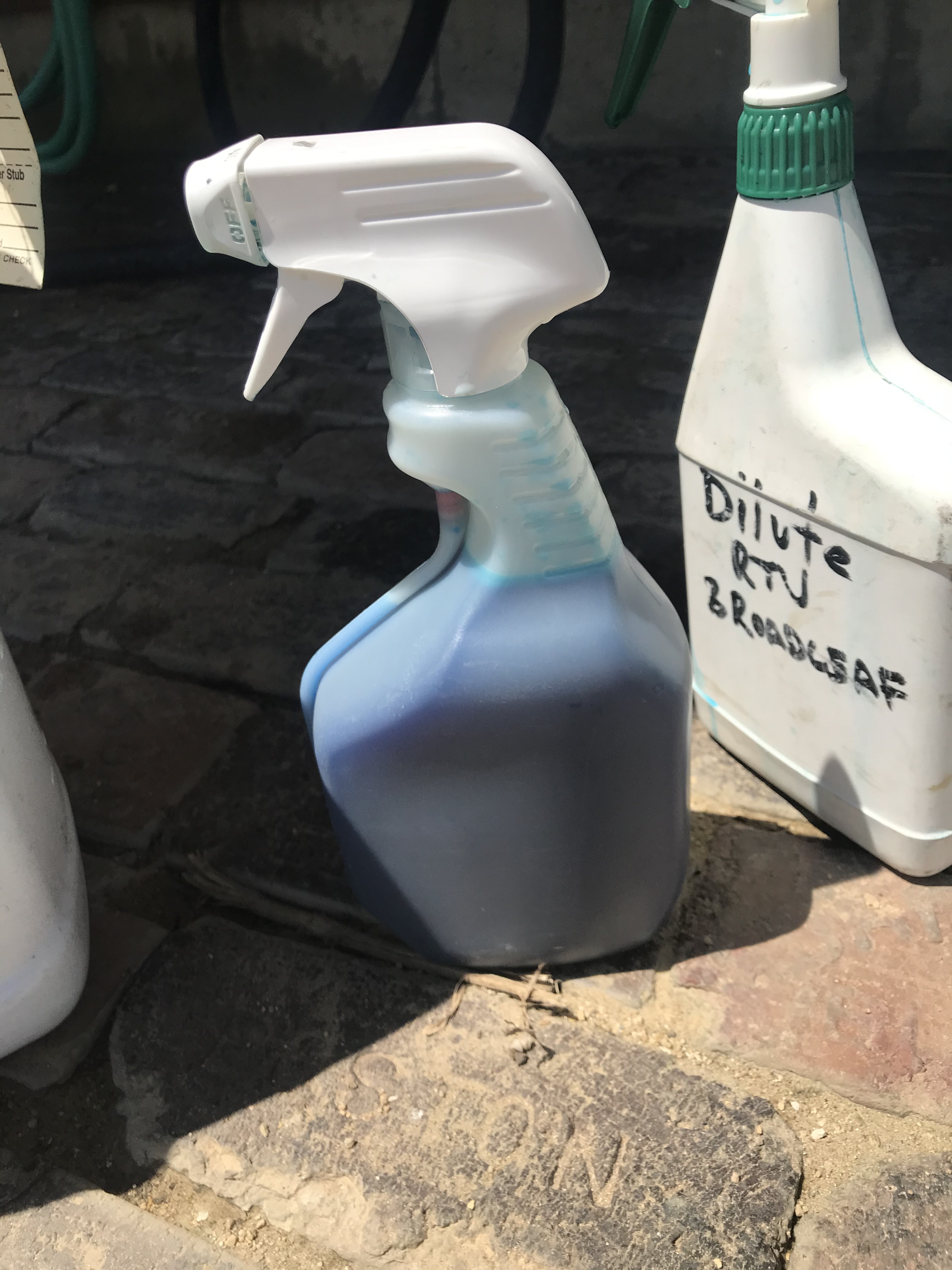
Below is a repurposed Chlorox cleaning solution bottle. On the other side I used a label maker to mark it as “Broadleaf herbicide”. This model will spray every drop as that pickup tube comes from the very bottom front, so you don’t pump air when the bottle is tilted down. I liked it but then it quit spraying after a few weeks.
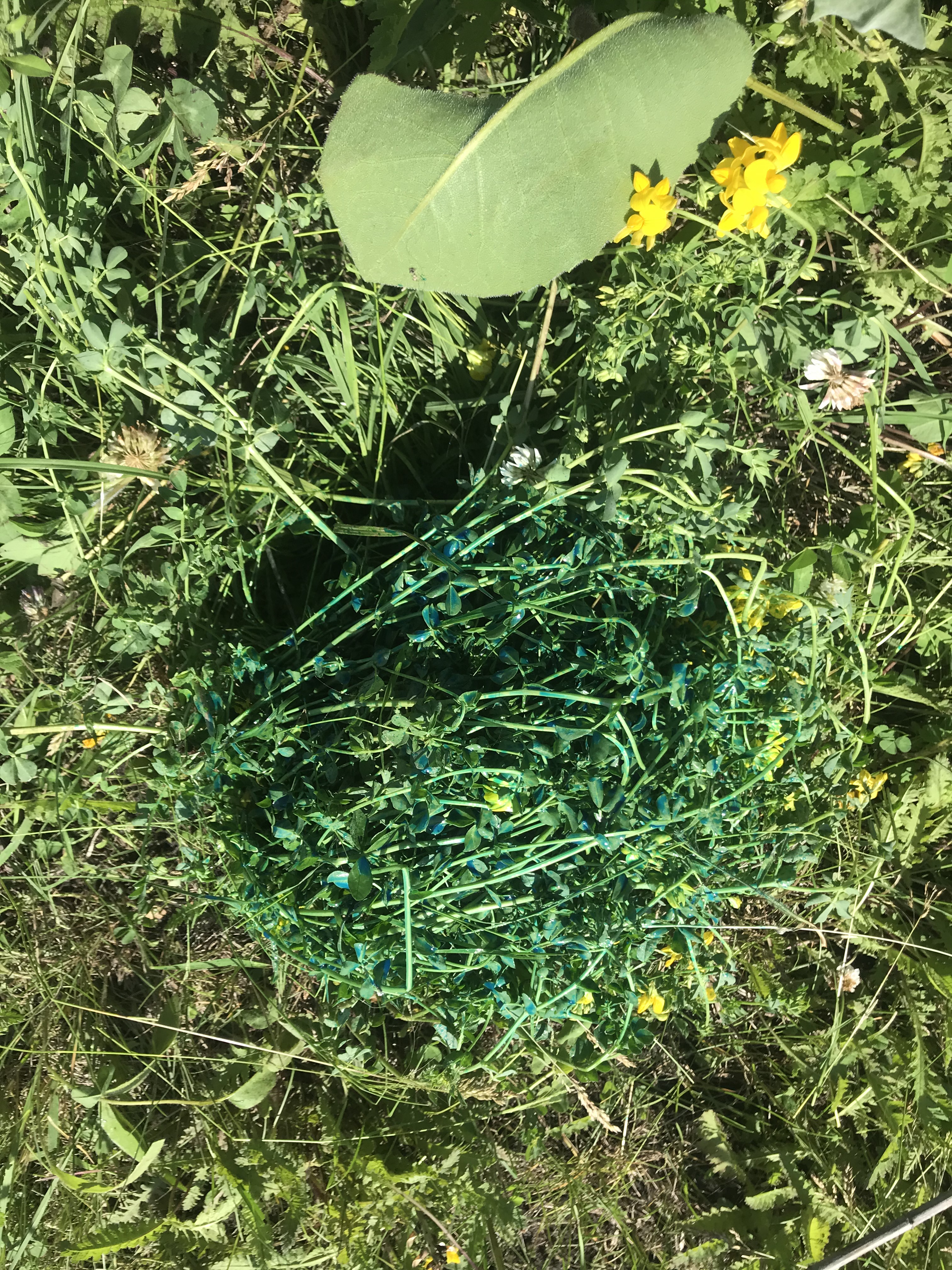
Below you are looking down at one big invasive birdsfoot trefoil with the yellow flowers. Carrying a hand sprayer means it is easy to bend down and gather up that sprawling plant as I did here and then squirt the middle of the “braid” with a dose. The prairie dock should survive.
I have found that if I use basal bark herbicide I can just spray a bit where the BFT plants emerge and the plant will die with very little off target impacts.
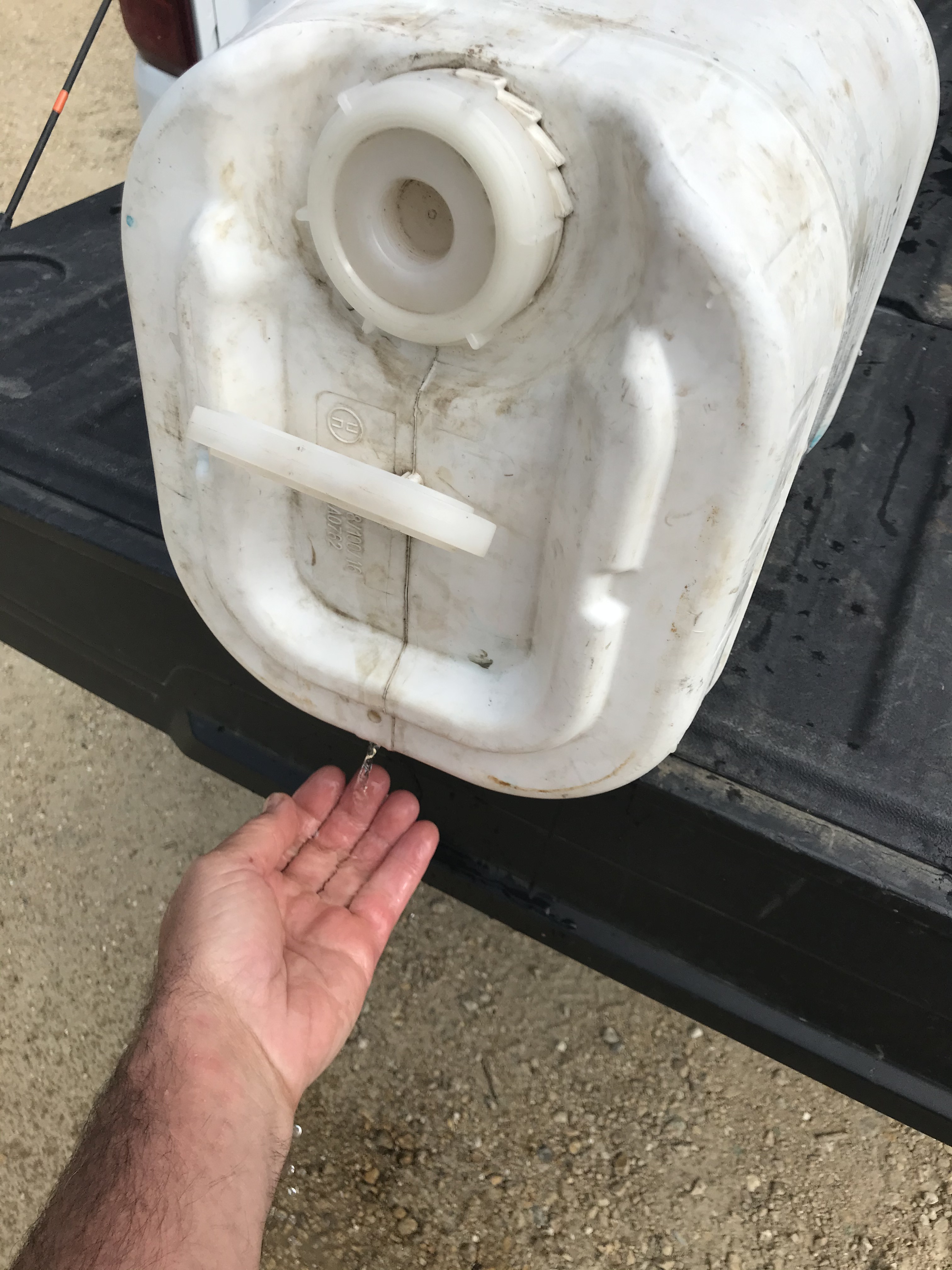
Below is a repurposed class A foam container to hold water for a simple hand washing station. I drilled a hole in the edge. Just lay it over and it trickles out water. Sometimes I carry soap but just the water is very nice to have around. Don’t fill it all the way, a gallon or two last a few days.
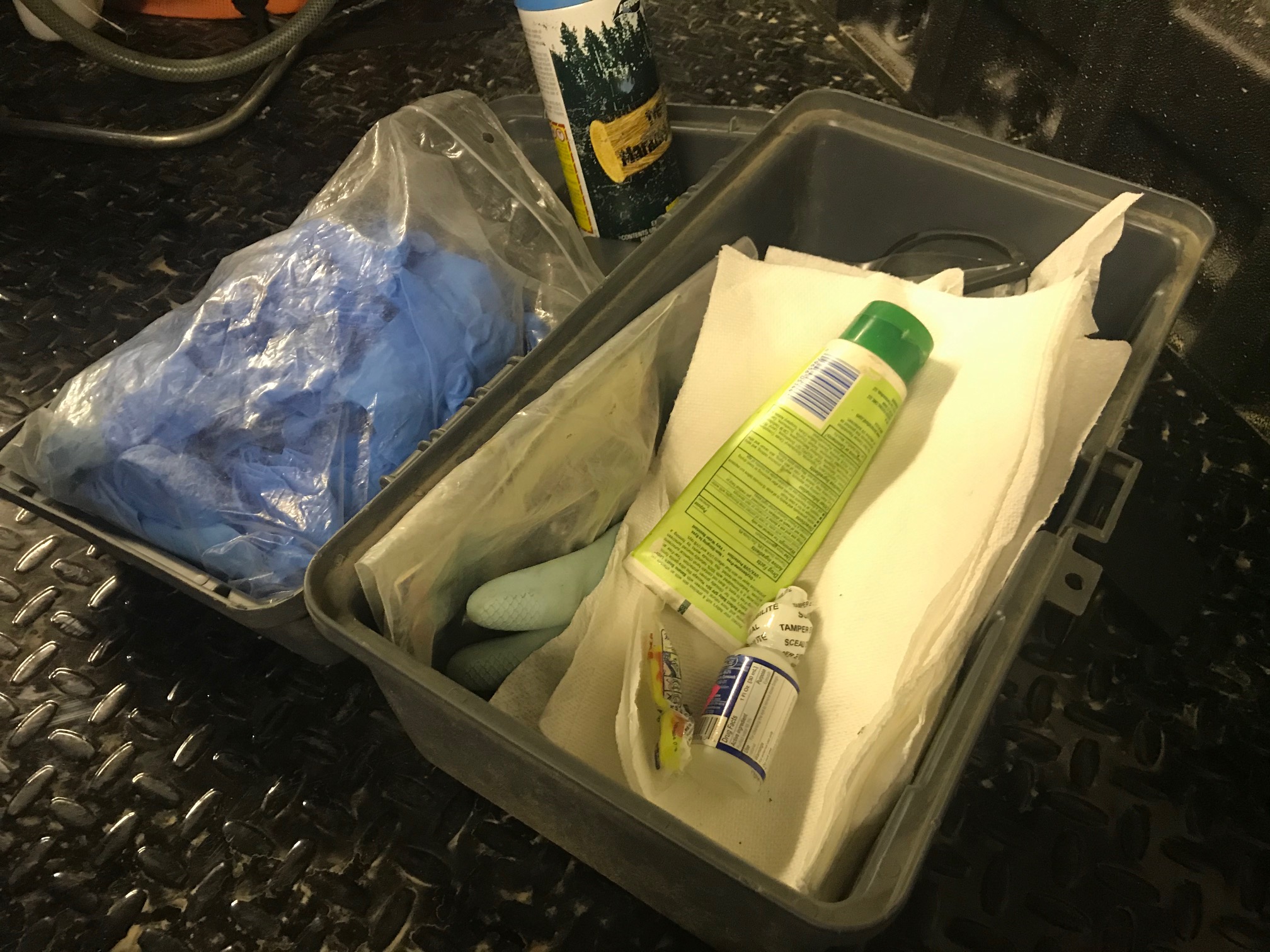
Below is a plastic hinged box to hold items useful in weed work. Disposable rubber gloves, blue tree marking paint, sun screen, ear plugs, paper towels, safety glasses, a little bottle of eye saline, MSDS sheets.
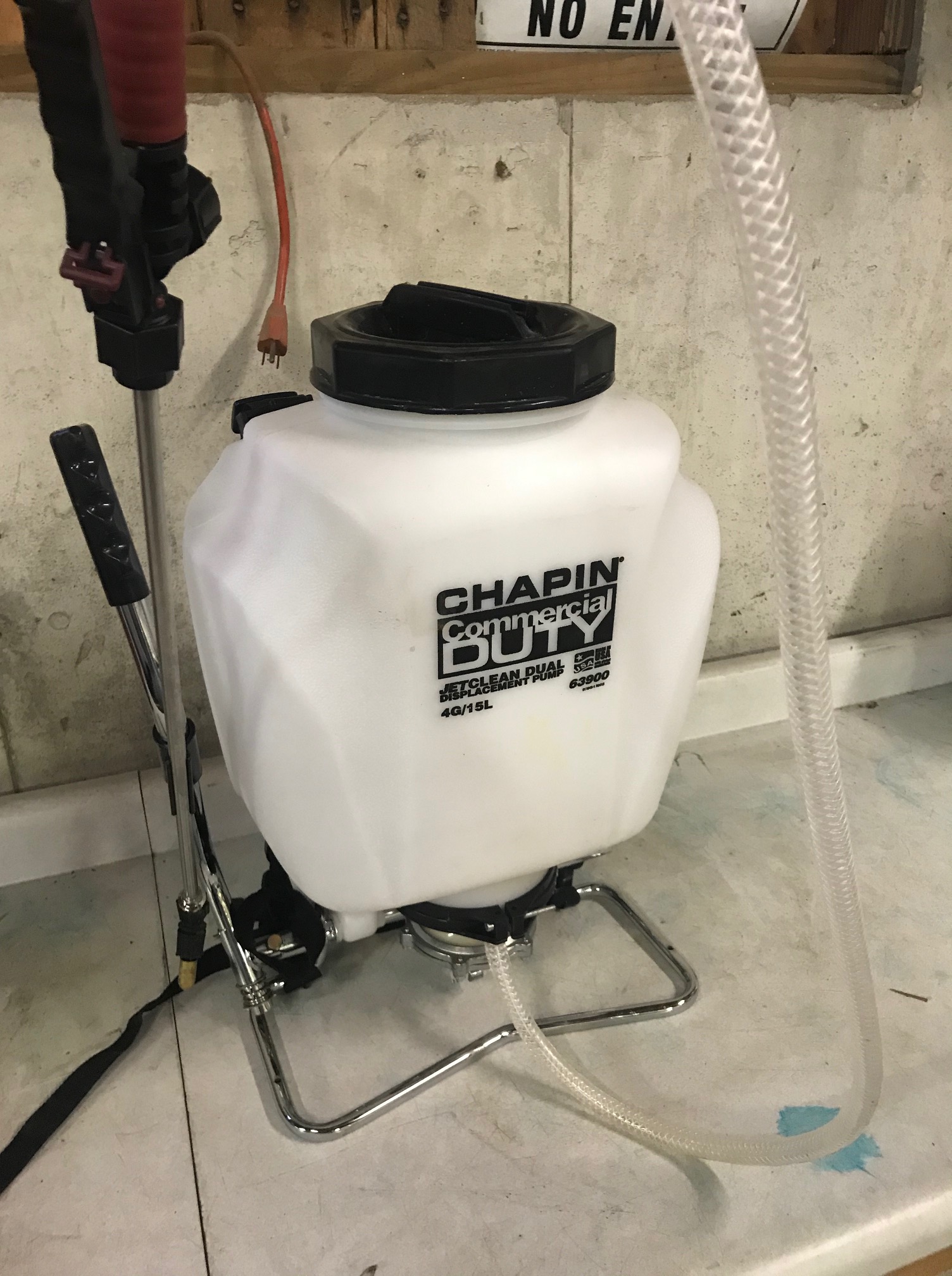
Of course a backpack is a common item to carry in my truck. The Chapin below we tried. I like its folding handle. The clip seems to hold the nozzle wand. The wand is metal. It has a padded shoulder straps and back pad. The fill lid is deep and wide which means less splashing on fill up. We had issues with the pressure being too low and the shut off of the spray was not crisp and so it dripped a bit. So we did not continue with these.
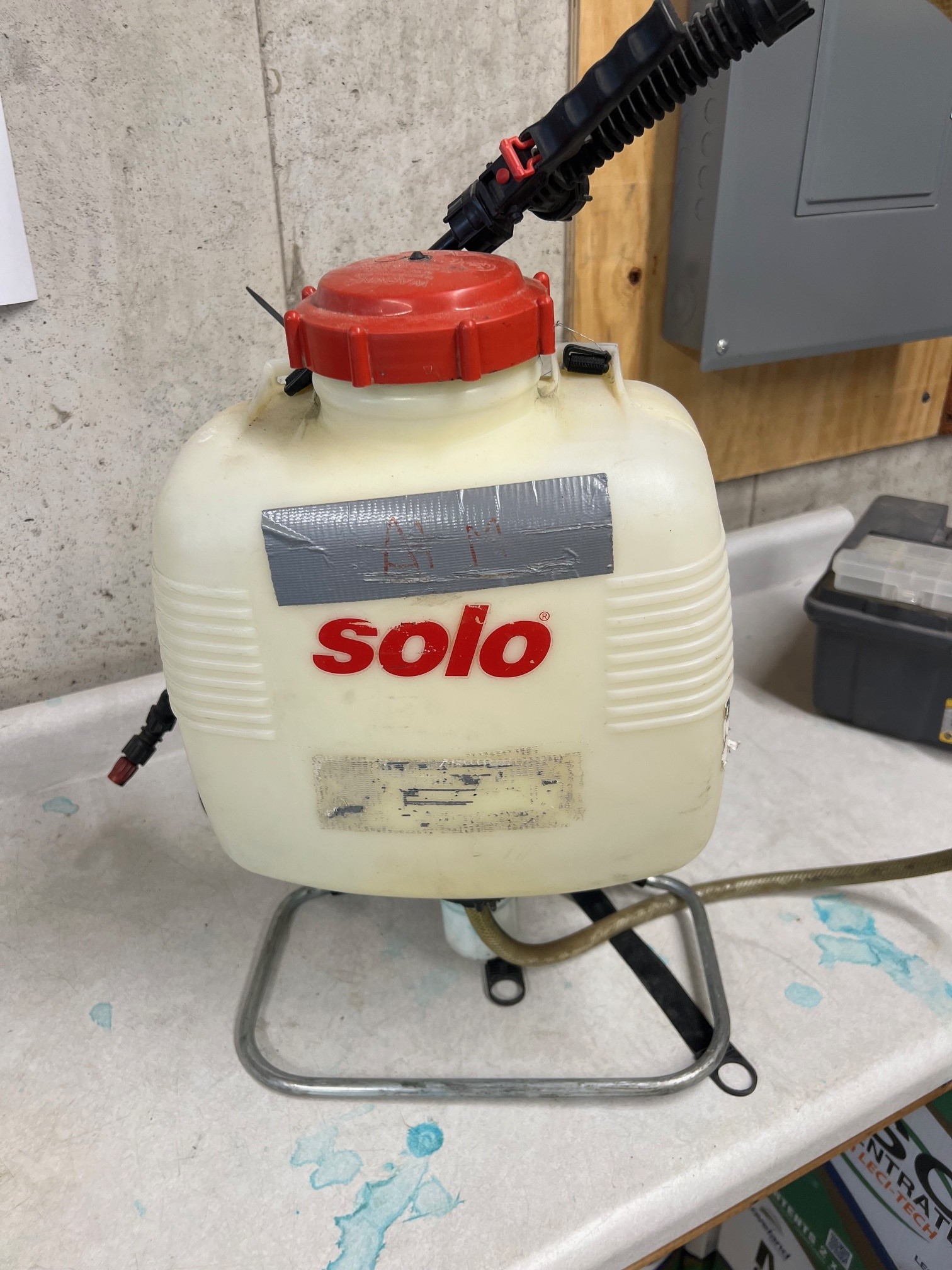
We have used the Solo brand for a long time and some of them go for years.
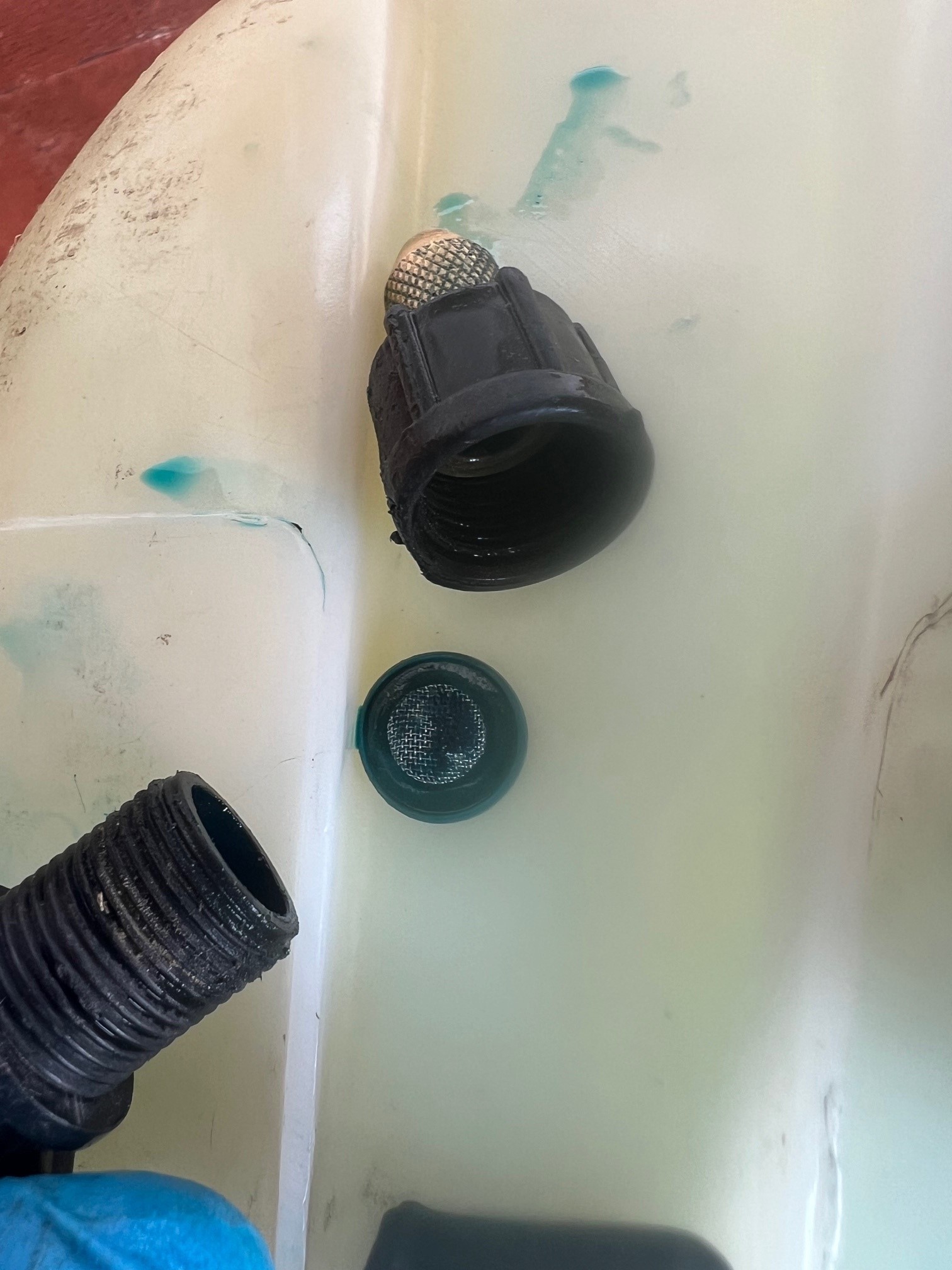
Below a partially clogged screen that Solo has in some of their tips. I find these clog frequently and usually I pitch the screen. It needs cleaning every day or two of use.
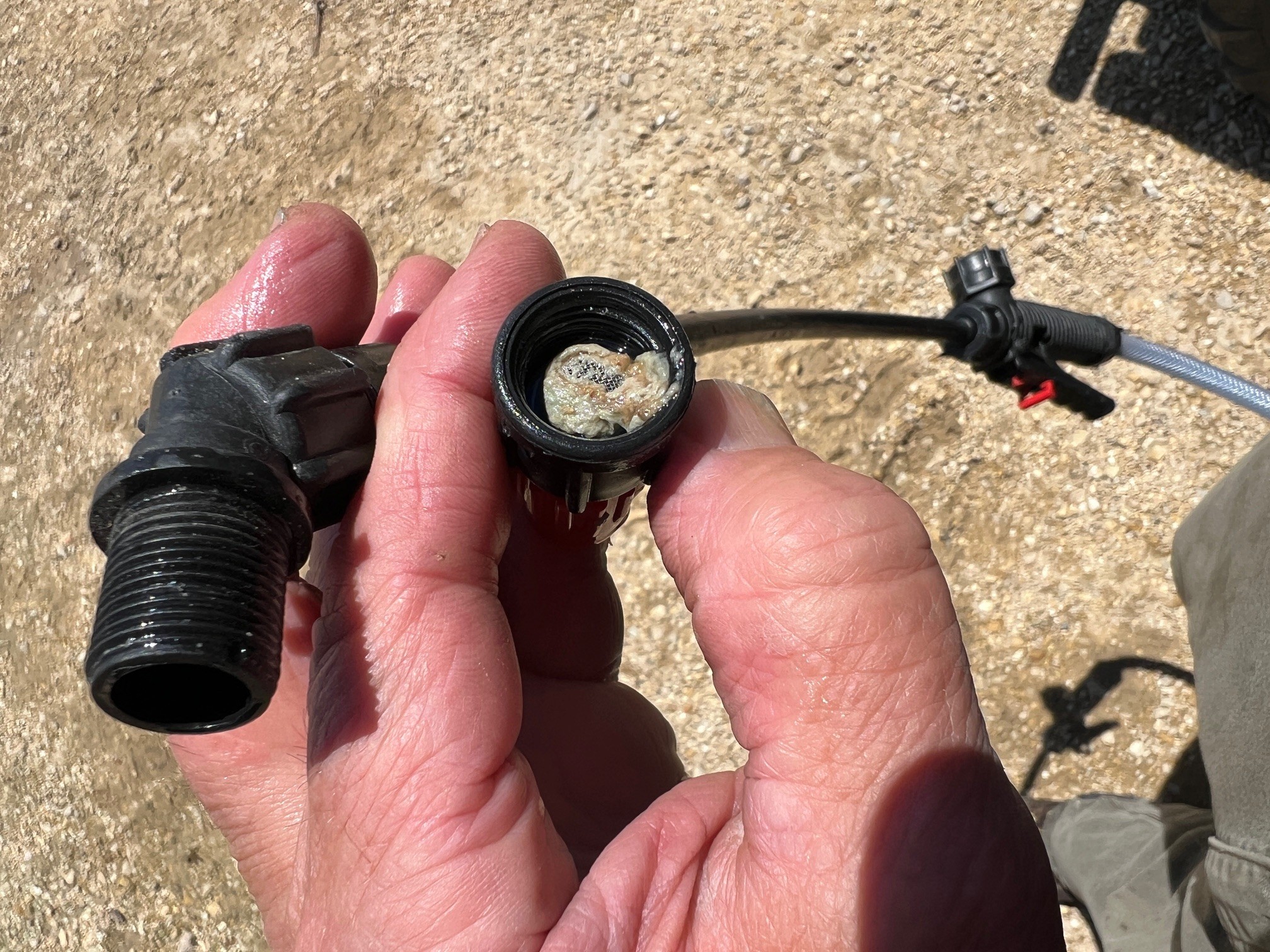
This pack came in with a tag stating it would not spray. I could feel the pressure in the pump was fine. The tip was very clogged. We reuse 2.5 gallon jugs and sometimes a paper from the cap falls into the jug, then into the pack, and this happens. It looks like shredded paper.
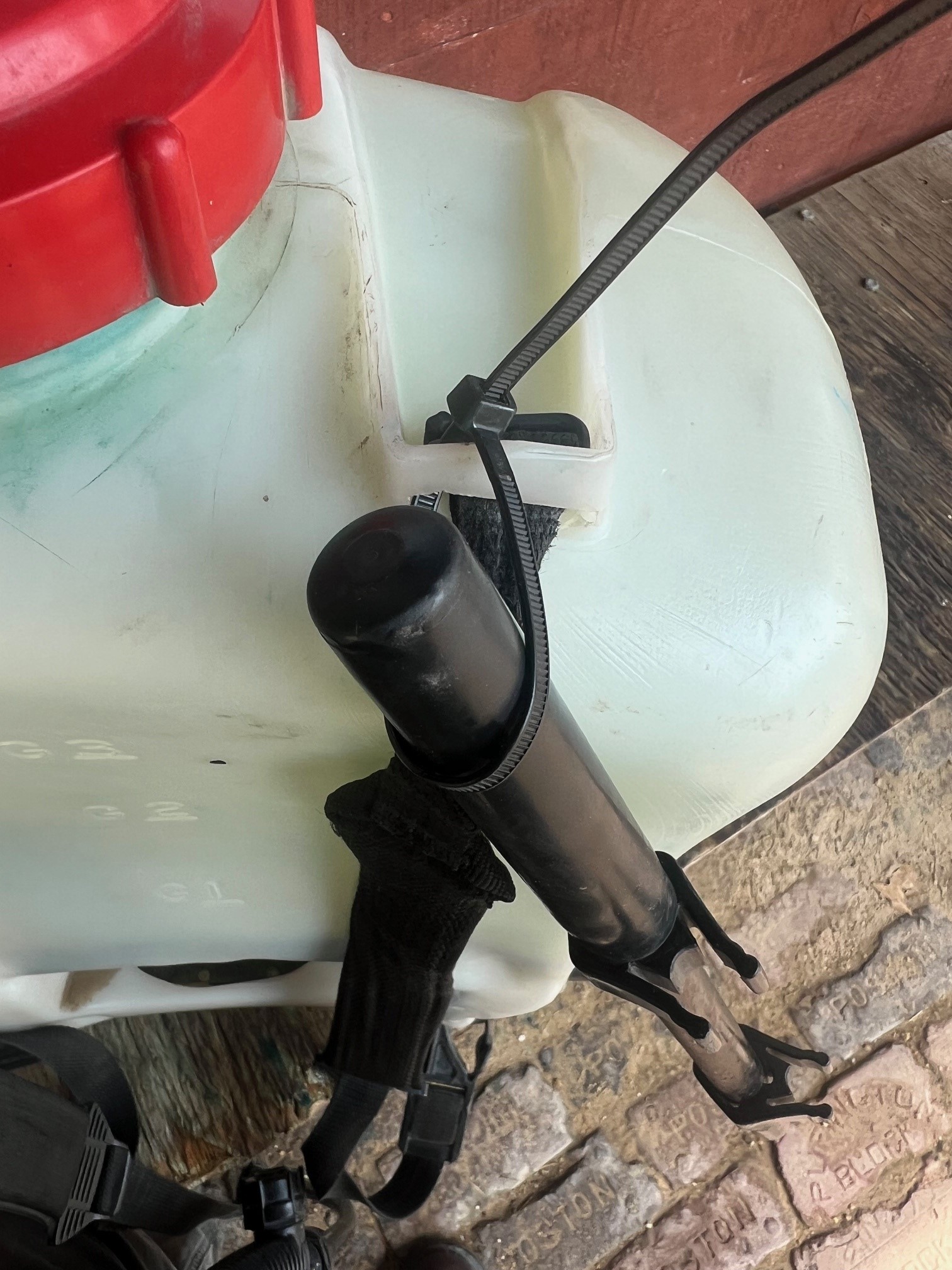
Below, a cable tie acts to hold up the folding pump handle of the Solo.
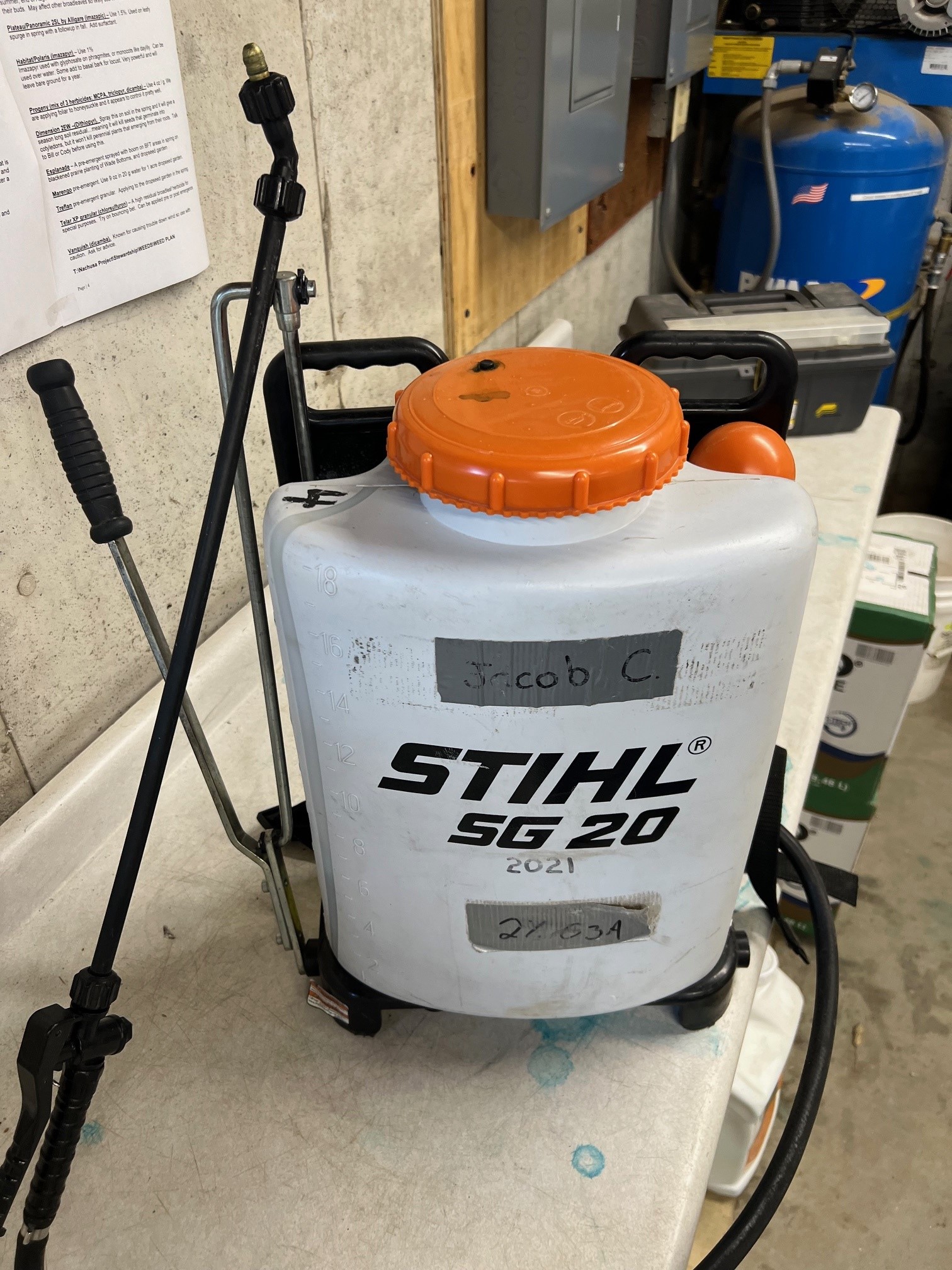
Below, the Stihl sprayers are nice. We have been buying these as they are easy to buy at our local Ace, they spray well, and so far are holding up to our abuses. Mike Saxton reports they work well too. You can see that we assign packs to individuals, with the duct tape noting the herbicide in the tank. The Stihl does not have a good system to hold the nozzle wand when in storage.
I encourage our crew to just put in 1.5 gallons of mix to keep the weight low. This pack full would feel like you were backpacking the A.T.. Hopefully we walk more than we spray. Carry a 2 gallon jug of RTU mix in the truck.
By: Mike Saxton – Manager of Ecological Restoration and Land Stewardship at Shaw Nature Reserve
Across the Midwest, many prairie restoration efforts seek to transform degraded pastures or row crop fields into robust and vibrant plant communities. In this post-agricultural context, restoration practitioners typically utilize standard ag equipment like harrows, discs, boom sprayers (PTO driven from tractors or electric sprayer rigs in the back of a UTV) for site preparation before planting.
Areas of former ag usage usually are hazard free (rocks, stumps) and can be readily and safely traversed by standard equipment. But what do you do with a 40 acre field of stumps that you want to restore to prairie? When conventional spray equipment cannot be used, new tools are needed. Enter drones.
Before and after image showing extensive cedar and mesophytic tree removal
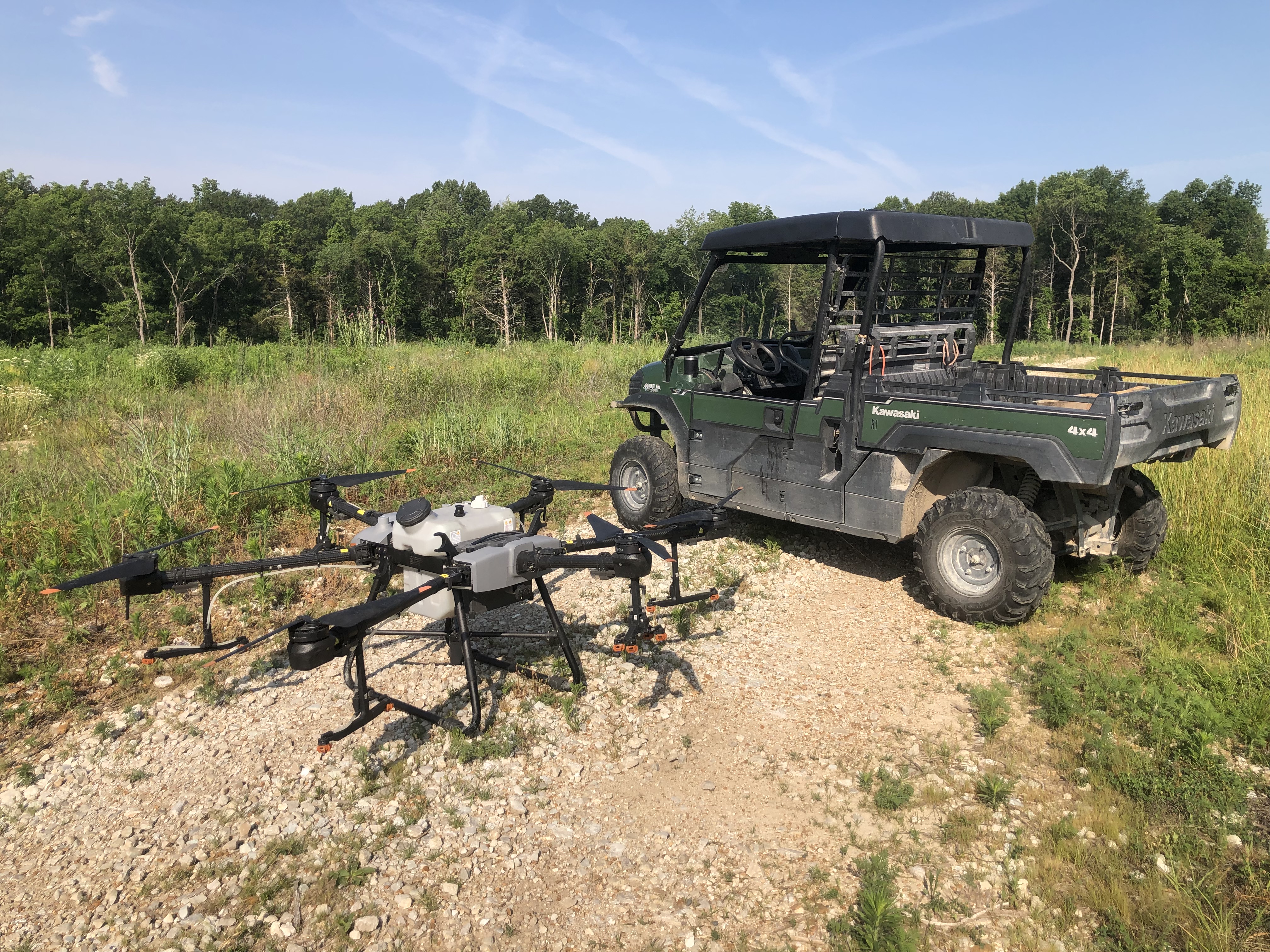
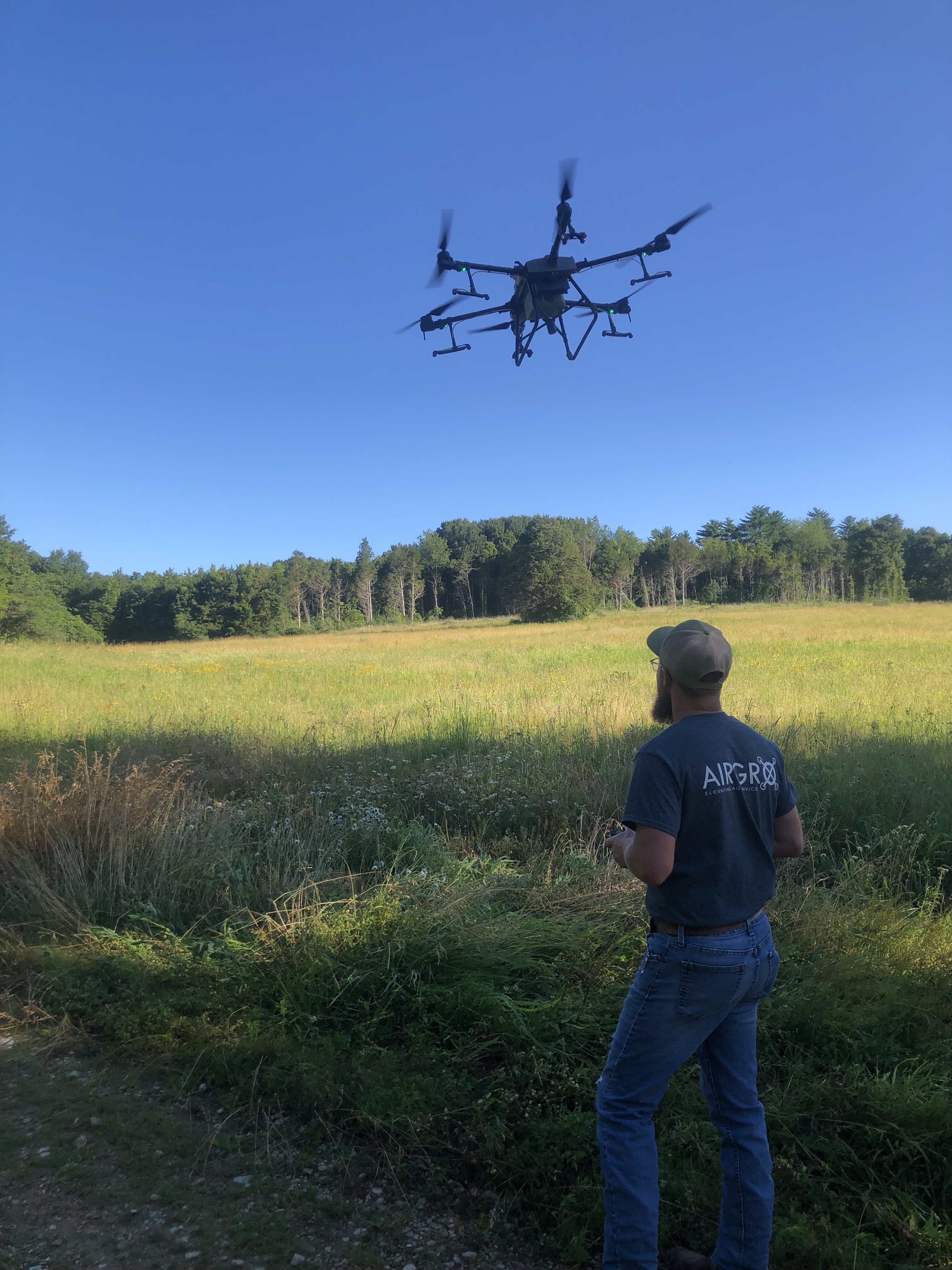
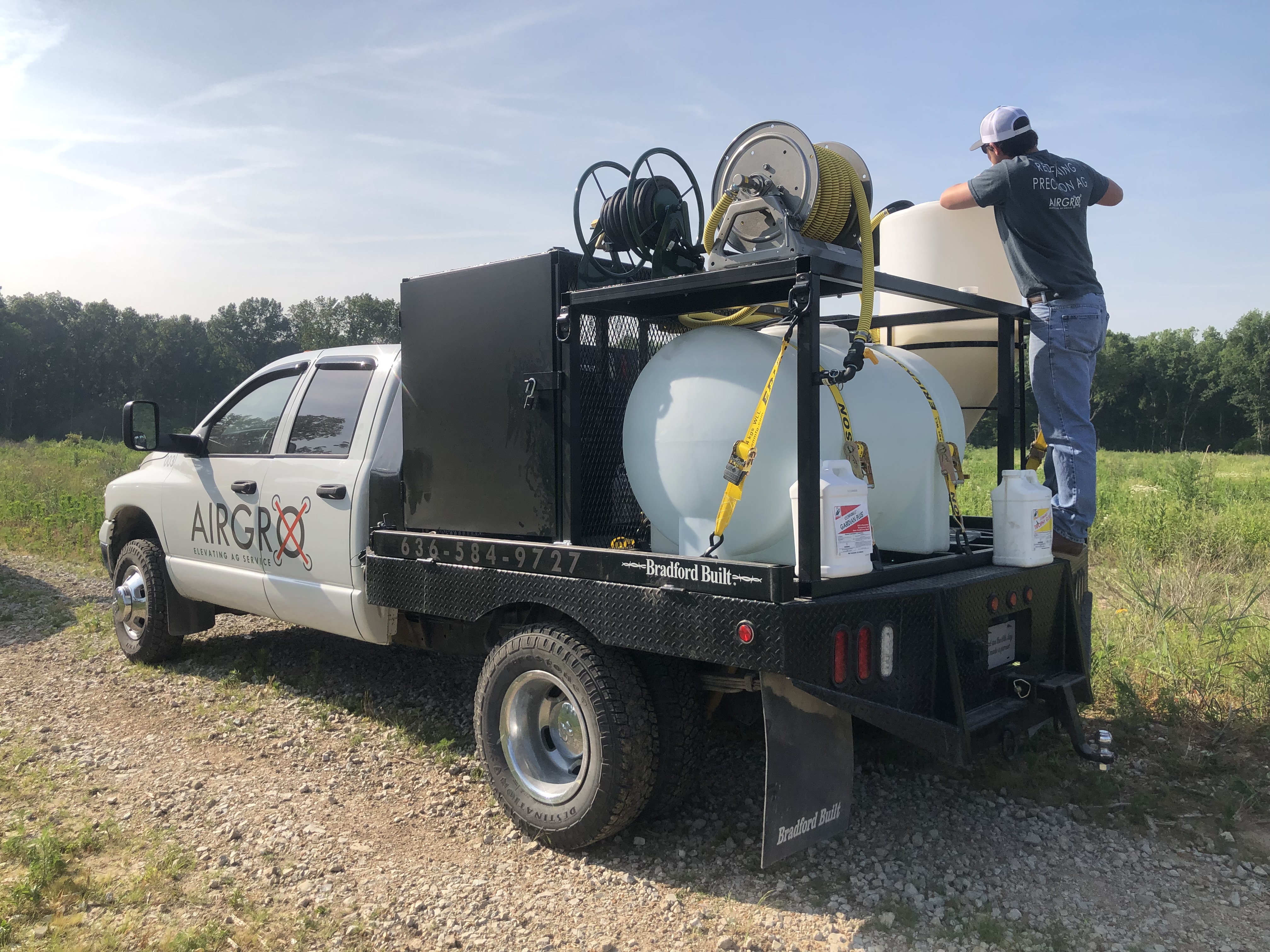
With the help of a contractor, drone herbicide application of invasive species and for general site preparation for native seed addition was completed in a stump-filled 40 acres that we will plant this winter.
Drone specs:
About 12ft wide from propeller tip to propeller tip
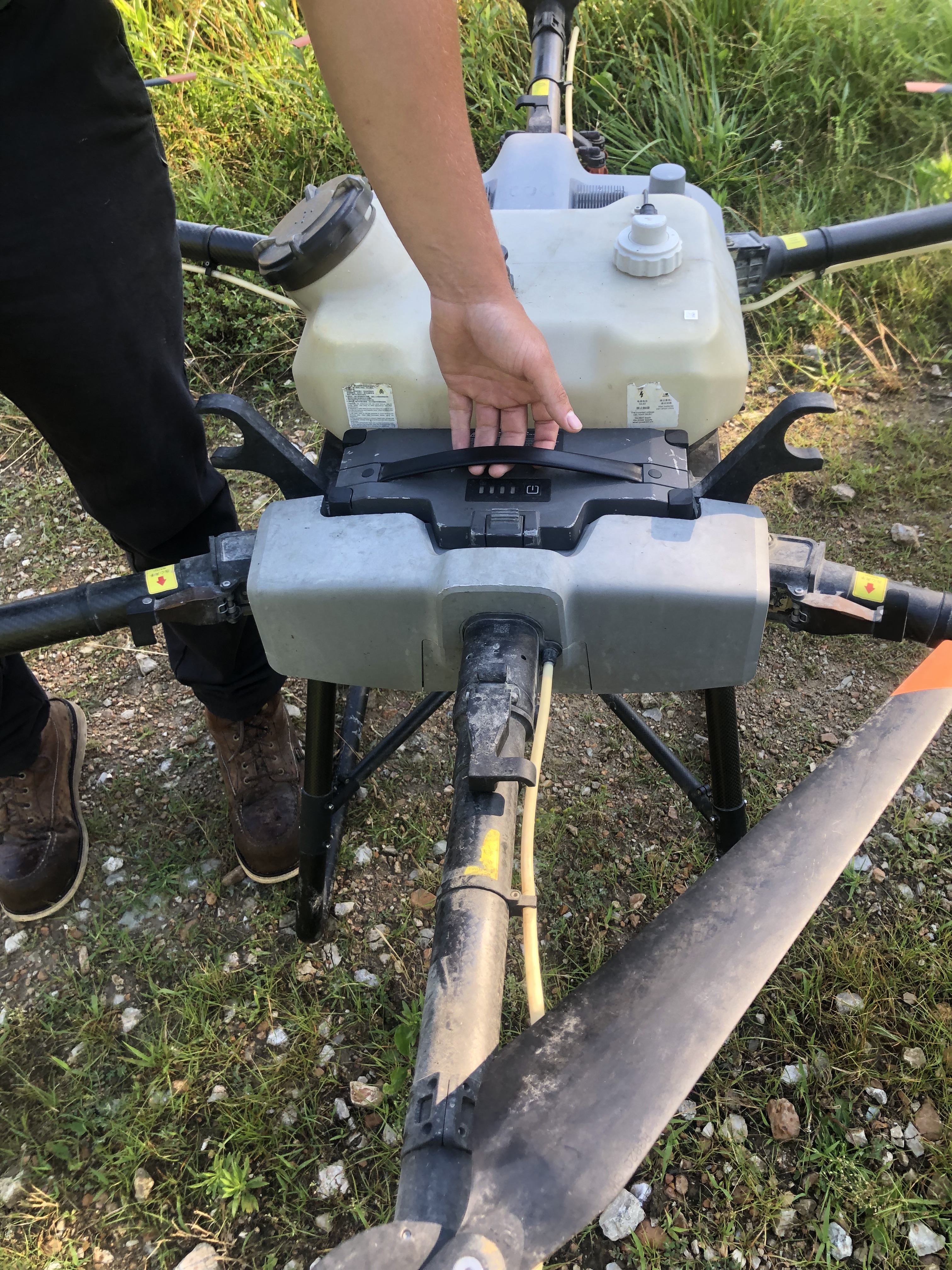
Carries 8 gallons of herbicide
Usually sprays 3 to 4 gallons per acre (mix is at a high concentration and within the label)
Drone has a 7.5 min flight time
One battery takes 6 minutes to charge
Drone can identify and avoid hazards
Drone flies a grid, knows when it runs out of herbicide, and automatically returns to fill up location where staff refills. The drone flies out and picks up where it left off.
Drone flies roughly 12ft over top the vegetation.
Treatment width per pass is roughly 25ft
Drone sprayer is roughly the size of a Kawasaki Mule Pro
Drones thrive where conventional equipment can struggle:
Fields with high tension power lines
Small, odd shaped fields in a forested landscape
Post-logging areas with high density of stumps
We provided the herbicide to the contractor and the rate for the drone to fly was somewhere around $36/acre.
Contractor hauls enough water for most large jobs and mixes everything on-site. Hand is on the battery. 8 gallon spray tank behind. Carbon propeller in foreground.
By Nathan Burmester, Coastal Plains Stewardship Manager, The Nature Conservancy, North Carolina
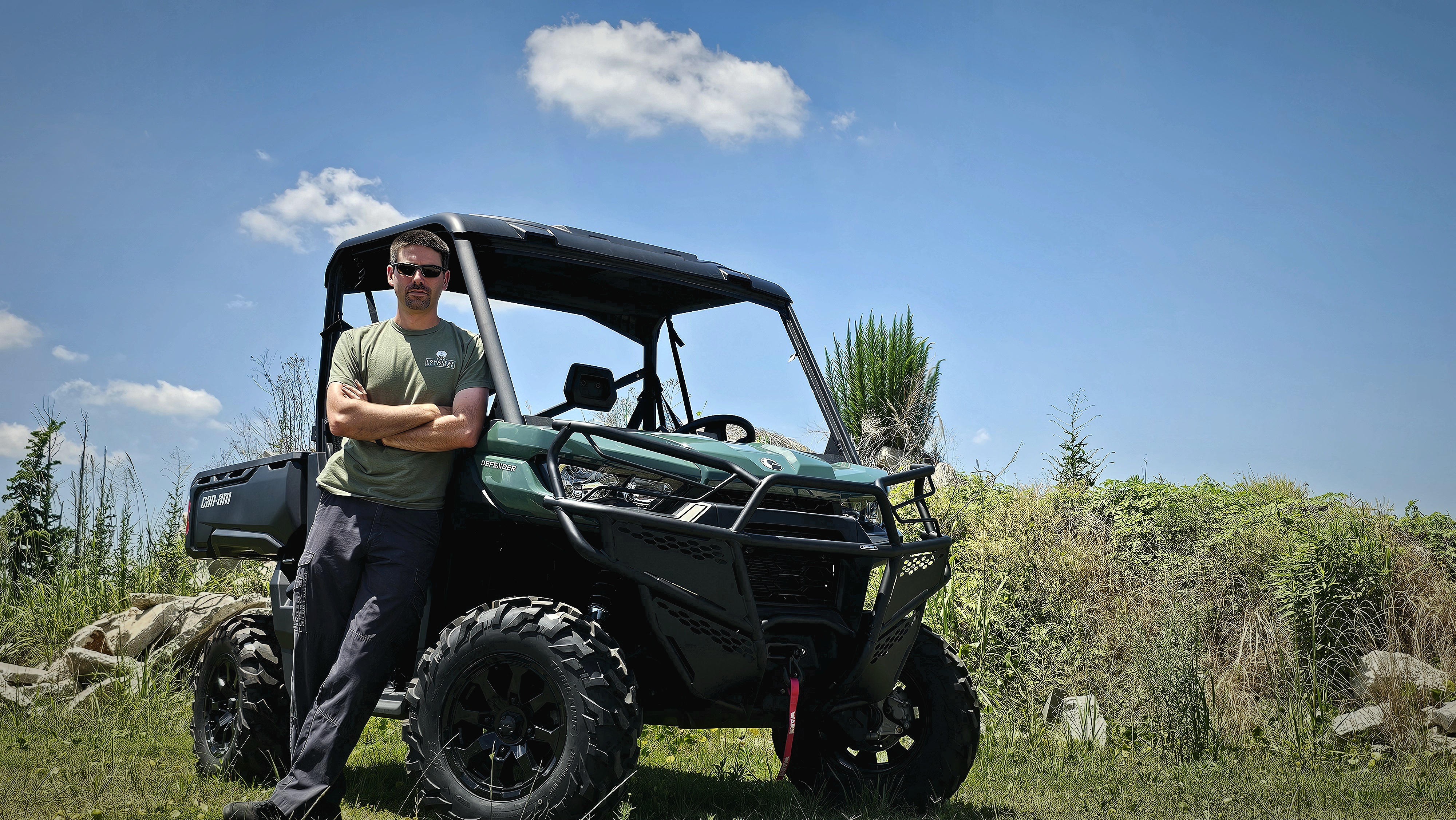
Nathan Burmester with their new Can-Am
Bill Kleiman here: Nathan Burmester was shopping for a UTV and he asked a bunch of TNC colleagues what they liked and the list was fun to peruse. So I asked Nathan if I could share it and he agreed. He is not endorsing any one machine. What UTV to buy depends on specific needs, and what dealerships are in your region.
South Dakota
I ditched Polaris and went with Cam AM about 8 years ago and I wish I I had done it way before that. Can AM’s are built for more commercial use and are tough as nails. Our Polaris machines were always in the shop and we haven’t had hardly ANY problems with Can AM. I have a UTV and 6×6 atv. No problems with either. I should do a commercial, because I am that much of a believer. You can adjust the suspension, they have all kinds of storage (depending on what you get) and they can handle more weight, especially if you get upgrades. I purchased the first one in 15/16 and its still going strong and they are the work horses of this program. Polaris was constant headaches and problems. I think nearly all the offices in our Chapter have walked away from Polaris and shifted to Kubota and Can AM.
I don’t think you will be disappointed.
Illinois
We went with Can-Am with our most recent UTV. Very sturdy, with lots of clearance. We opted for the 4-seater. The power steering is very handy.
Texas
Can am 6 wheeler. More power. Ground clearance weight capacity. Does take an “acre” to turn around. Uses more gas. Pretty expensive. We don’t have one yet but I was with a vfd that has two. Seats 3. Most of the time people overload things. Just because the sticker says it will haul something. It’s probably for 5% of it use. Figure 50-60% of recommended capacity to make it last longer. The Kubota is the only one that you can get close to capacity and it stay together but it is heavier.
Oklahoma
We have a kubota rtv-xg850 it’s their sporty version its been great so far
Indiana
Here in Northern Indiana we have started to use the Bobcat UV34. Prior to this we were using six wheel Polaris 800s. The bobcat utv have similar clearance, bed capacity, and durability. They seem to handle mud better than 4 wheel Polaris rangers and have better clearance. The bed capacity is better than the 4 wheels. Also, we were able to get a winch as part of the package when we bought the UTV. The shocks are adjustable which has helped to offset the weight of the slip-in. We didn’t need to do much adjustment for ours.
It is a Polaris with bobcat branding. The engine is Polaris but so far we haven’t had any big issues unlike the real Polaris rangers. There is a limit on speed which is reduced even more if you don’t have the seatbelt buckled in. The seats are gray which get really dirty but get less hot than the black ones.
So far, it is my recommended UTV when people are looking to purchase a new. I have used Polaris, Bobcat, Kubota, Gators, and mules. I also have used Can-am a couple times but not enough to have a great sense of what they are like all around as a machine.
Kansas
We purchased a 2020 Can-Am 6×6 and it has been rock solid. It sees dual use for fire and herbicide application. A couple quick notes, I am happy to chat more if you would like:
This UTV sees dual-use for fire and invasive treatments (different spray rigs).
Each spray rig has a 100 gal tank, machine carries the weight well with minimum squatting
This thing is a rockstar on Flint Hills terrain. Super stable, crawls up and down hills and through some pretty gnarly prairie streams no problem. Nice suspension system. High ground clearance, which is great for our rocky soils.
Several ranching neighbors have changed their tune about how useful UTVs can be on wildland fire because of our Can-Am. We’ve put out a lot of wildfire, getting places where no other rig could have.
Great power and top-speed for transport around a site.
4 years of hard use, so far nothing more than typical maintenance and a new set of tires.
The only downside is the long wheel base. We had to buy a new trailer to accommodate, and the turning radius is not as small as the Polaris 6x6s.
North Carolina
I would recommend the Honda Pioneer 1000. We now have 3 of them and everyone loves them compared to gators. They have a more traditional transmission with gears, and a sub transmission, which is a design Honda has been using since the 80’s when they were making 3 wheelers. They also have a payload of 1000 lbs (2 seater).
Any machine with a CVT (Polaris calls it PVT) transmission is not great for moving at slow speeds and constantly stopping and starting movement. The clutch belt drive system is dry and was designed to use the belt as the wearable item that can be easily replaced in the field . Unfortunately, for fireline work, the two clutches that the belt rides on also begin malfunctioning over time and they are not so easy to change in the field. The primary clutch uses centrifugal force to actuate weights which swing out and move one half of the clutch in and out on a shaft, pinching the belt. The weights wear out quickly from constantly engaging and disengaging and the clutches start to get stuck on the shaft and will not slide as they need to. That is the cause of the dreaded ratcheting sound when the transmission is in gear but the vehicle will not move with throttle applied. Moving at slow speed and slow rpm causes the weights to be partially engaged. The last time I replaced both clutches and a belt on a ranger XP it was about $1020 plus the special tool needed to remove the primary clutch from the shaft.
I also hate the polaris wheel bearings. The honda pioneers use similar 1 piece bearings but the Polaris bearings wore out so much faster. I have only replaced 1 honda wheel bearing so far and we are in season 3 with our first machine and season 2 with our 2nd machine.
I have looked at the design of the new Polaris with the metal belt design but I am skeptical of the new design, especially in the first year or two of production. I have not seen one in person yet, though, and it may turn out to be a great machine. If money is no object, CanAm makes a UTV with a tool body but it is very expensive, very long and also uses a CVT.
There is no way around needing good rear shocks for whatever UTV is decided on. Our UTV skid units weigh about 900 lbs loaded with water and 10 gal of torch fuel. The honda pioneer 1000 limited edition is no longer available but it came with Fox shocks that have enough adjustment to hold the rear of the machine at proper ride height. For the last pioneer we purchased, we added those same Fox shocks to the spec sheet for a standard model, as well as a roof, full skid plates, front bumper, winch, and rear bumper to protect the discharge plumbing on the skid unit. That has worked out fine and the dealer had no issues accommodating that.
Fox shocks and Elka shocks can also be ordered and built custom by the shock manufacturer for the weight the machine will be carrying. That is what we did with our Rangers and the prices were very reasonable ($800 a pair for the Elkas).
We have over 700 hours on our 2021 Pioneer and 206 hrs on our 2022 Pioneer. The only maintenance other than regular I have done to either machine is one wheel bearing and two rear axles.
Minnesota
Look into a Can Am Defender HD10. We put tracks on ours and it’s been great w/ and w/o tracks. Only had it for a year, but we use it for everything. We use Kubota’s a lot. Heavy duty, but w/o tracks clearance sucks.
Missouri
I’ll share for my experience this season using a new Honda Pioneer, I would not recommend it.
Great piece of equipment, not ideal for fire.
A big problem we’ve had is bed storage. It doesn’t seem to fit a slip in well and it’s hard to figure a way to attach one. We have yet to find a solution 6 months in.
Another big issue with it is that it is so powerful it just wants to go too fast. You can’t slow roll it along a line for patrol or holding without a jerky lurching sensation. It is also so powerful I think you could easily smack into someone in close quarters if you give a little too much gas.
It performed best for us here where it tackles the rough terrain, but shows up with a poorly fitted slip in and gear barely strapped to the sides. It performed worst in the grass lands where it is just way too sporty to drive slowly in a straight line holding.
North Dakota
We’ve used Polaris Ranger from 2010-20 and Kubota RTV from 2007-currently. Polaris are terrible, I refuse to buy one again. Terrible design and unreliable.
We have two- Kubota RTV 900’s that have been workhorses. One is the 2007 and another is 2014. Both are diesel and can handle the heavy loads, no problem. Our slip-on units are 80-90 gal tanks- no problems with terrain, doesn’t get tippy. You drop these in low gear and engage 4WD and they’ll scale a mountain. Clearance isn’t great- 8” I believe, but the standard metal skid-plate mitigates damaging underside. They are on the heavy side with the diesel engine and are slow- max speed of 25 mph. There is a gas version that hits 40 mph.
We also have 2020 Can-Am Defender HD8 that we run with 80 gal slip-on. So far seems to be holding up but the jury is still out on it. It has a 20-30 grease zerks that I’m not a fan of. Clearance is in 10-12” range. Very comparable to the Polaris ranger, slightly less tippy. We’re running the same slip-on unit that was originally in the Polaris Ranger 800. In the Polaris, the front wheels would commonly want to come off the ground when you were maxed out trying to navigate terrain. That doesn’t happen with the Can-Am.
I was extremely interested in Honda Pioneer when replacing the Polaris but I was needing a machine immediately and Honda was 3-5 months out.
Minnesota
If you want to eliminate transmission issues, consider Honda Pioneer. I have a 1000 model, and it’s shaft-driven, I love it.
We also have several Can-Am UTVs in our fleet in MN, but I don’t have any first-hand experience. Those that have them are not going back to Polaris from what I hear
Kansas
You’ll pay out the nose for it, but CanAm is the best machine I’ve worked with. After 7-8 seasons depending on the ranger 6×6 and all its maintenance, I think Canam is worth the investment. We use one here in Kansas and I’m continually impressed by that thing’s ability to climb and slosh around in the mud with a full slip-on in the back. It’s only a few years old, but I remember the Rangers needing a considerable amount of after-market work by that point. Radiator lifts, new CV boots, etc. That’s kind of prairie-specific stuff but it gives an idea. That said, I don’t have experience with those newer models of Polaris and Honda you mentioned.
North America program
I have worked with several machines, including Honda, Polaris, and Can-Am to name a few.
I highly recommend the Honda pioneer 1000. The shaft drive is superior to the belt drive of other manufacturers. If you need to do any aftermarket accessories to make it have a higher clearance, better tires, bed extension, etc are readily available.
Nathan adds this too: Don’t forget that these machines have a break in period of about 10hrs/30mi that you need to complete, then you need to have it serviced (change all the oils), and only then will it be ready to haul your slip-on and be used on the fireline.
And a few comments came in after Nathan published his list:
Steven Kloetzel: We have 2 units here in Western Montana. We rely on partners a lot, and they rely on us. We don’t have a lot of dough for fire equipment, so here’s what I’ve put together. These are very popular on our partner burns, with no breakdowns or issues:
2021 TNC-built 110gal slide-in, with hose-reel, that we put in a 2014 Tacoma. One person can load and install this slide-in in about 30min. Chris Gordon at the Cross Ranch (ND) & Evan at Niobrara Preserve (NE) helped advise on the slide-in build. We often use that setup like a UTV. And then the Tacoma doubles as a daily-driver pickup for our second forester, how sweet is that?
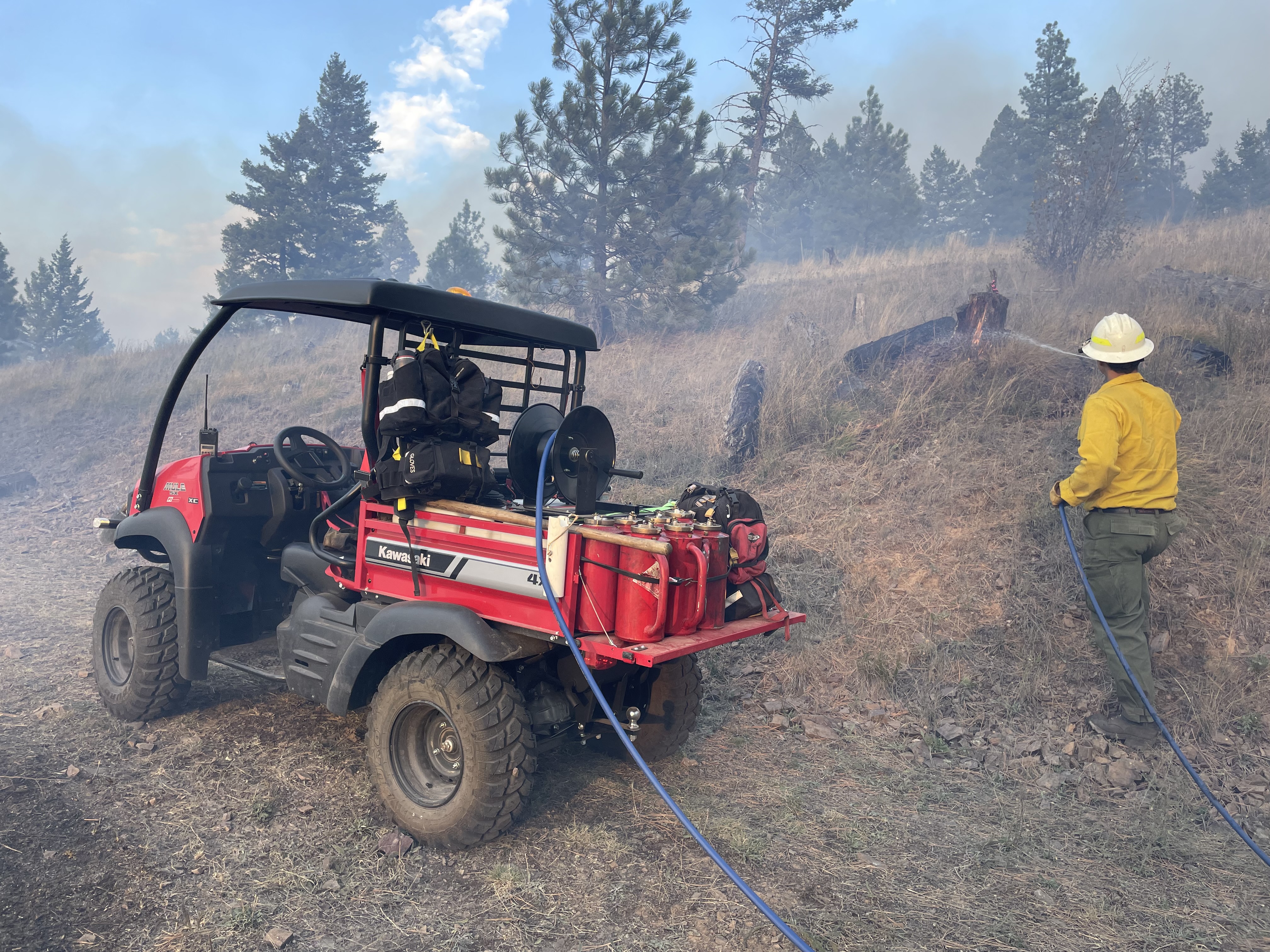
2023 Kawasaki Mule UTV with 50gal slide-in tank. Tops out at about 25mph – but it is small & mighty. Narrow as an ATV, so easy to weave thru trees. Has better clearance than most UTVs, and way less plastic body-parts. My weed management contractors swear by Mules. The lightweight slide-in is custom built by Warne Chemical of Rapid City, SD, with a hi-pressure electric pump (onboard backup replacement pump can be swapped in 5min.) I’m in the process of adding a front-rack to the UTV for gear/tools. The whole setup cost maybe $15000.
Steve Kloetzel’s Mule with slip on
David Printiss: Thanks Nathan. Whatever rig you buy, you must remember to not go over the listed cargo capacity when adding equipment, tools, etc.
Rob Littiken: We have a few of the Bobcat UTV U34. They are the Commercial line of Polaris and are more heavy duty than normal Polaris UTV’s. The cargo capacity is 1,250# as opposed to most of the other at 1000#. We have had good luck with them. TNC gets a pretty good discount if the dealer prices it out through the government discount system.
This blog site has other posts on UTV slip on units:
There are likely a lot of opinions about if and how sweet clover should be controlled, and I encourage you to share your experiences in the comments. What follows has been my experience over 30 years at Nachusa Grasslands.
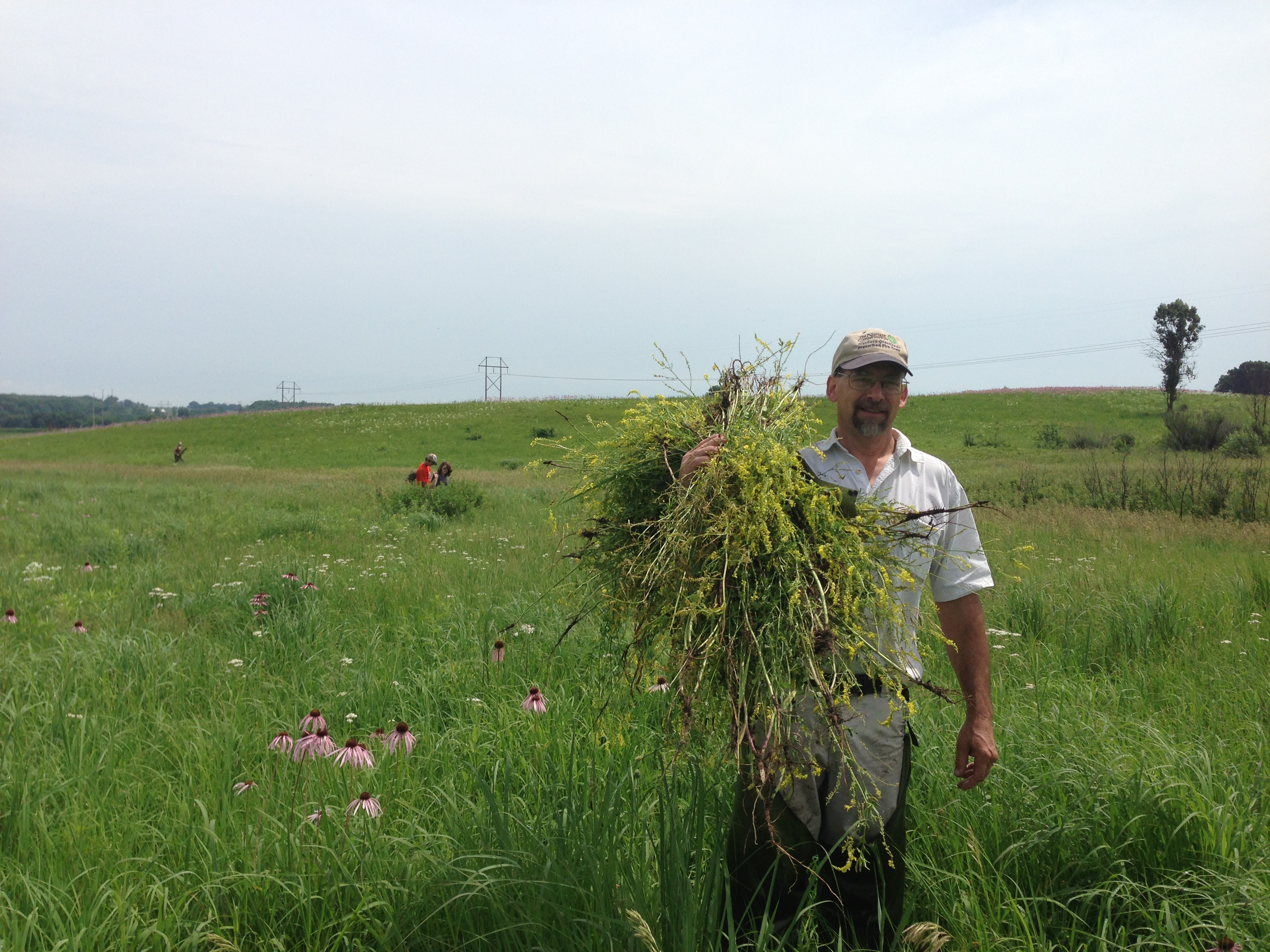
June 25, 2013: Bill hauling out yellow sweet cloverJuly 11, 1997 Upland prairie planting full of white sweet clover being mowed
When I first started in 1993 there were two prairie plantings that were several years old and had come up in a lot of white sweet clover. We decided to mow it as low as we could after the Fourth of July. The above photo shows one of these prairie plantings with a very thick cover of white sweet clover. If we had chosen to spray this there would be no prairie planting remaining. So we mowed it.
The rule of thumb is to mow below the lowest leaves of the sweet clover. The clover drops its leaves starting from the leaves closest to the ground. By the Fourth of July the lowest leaves of white sweet clover are several inches above the ground so the mower can cut them below those leaves. The plant is a biennial so by the second year it is quite tall, and if all the leaves are mowed off there is no signal from the plant to re-sprout. Therefore it dies and no seed sets. But don’t wait too long to mow such that seed is on the plant.
Did this work? Very much so. We did occasional patch mowing over the next several years but at this point 30 years later there is just a sprinkling of sweet clover to chase down. Now, some might say it would have gone away on its own, with episodic flushes now and then. Maybe. We left no patches to test this idea.
The mowing must be very close to the ground. An offset hay mower does the best with this because the tires then don’t crush the stems and make it hard to mow the plant. Twice we had an offset hay mower do the task. The other times we had a standard rotary mower with a sharp blade running as low to the ground as possible. We also will use a batwing mower. We have used long hand scythes too for small patches.
We also do a lot of spading of sweet clovers. We haul them out if in seed. And we spot spray them at times if the situation seems to call for that. Most any broadleaf herbicide will work.
Some areas we have are simply ruderal junk, and you might have a flush of sweet clover, essentially no native plants, and the ground is too rough to mow. In such a place we might broadleaf spray across the patch. This quiets the situation for the season, but at some point we will want to establish native habitat and will seed this spot and try to manage it. When to plant a formerly ruderal area is tricky. Is the soil full of invasive weed seed? Do we have the time to care for it if it comes up in invasive weeds? I am not as intimidated of sweet clover as I am of say birdsfoot trefoil or those invasive Lespedezas.
For yellow sweet clover, the timing of the mowing is important. If mowed too early, before late flower, the plant will re-sprout and bloom and we assume set seed as little bonsai yellow sweet clovers.
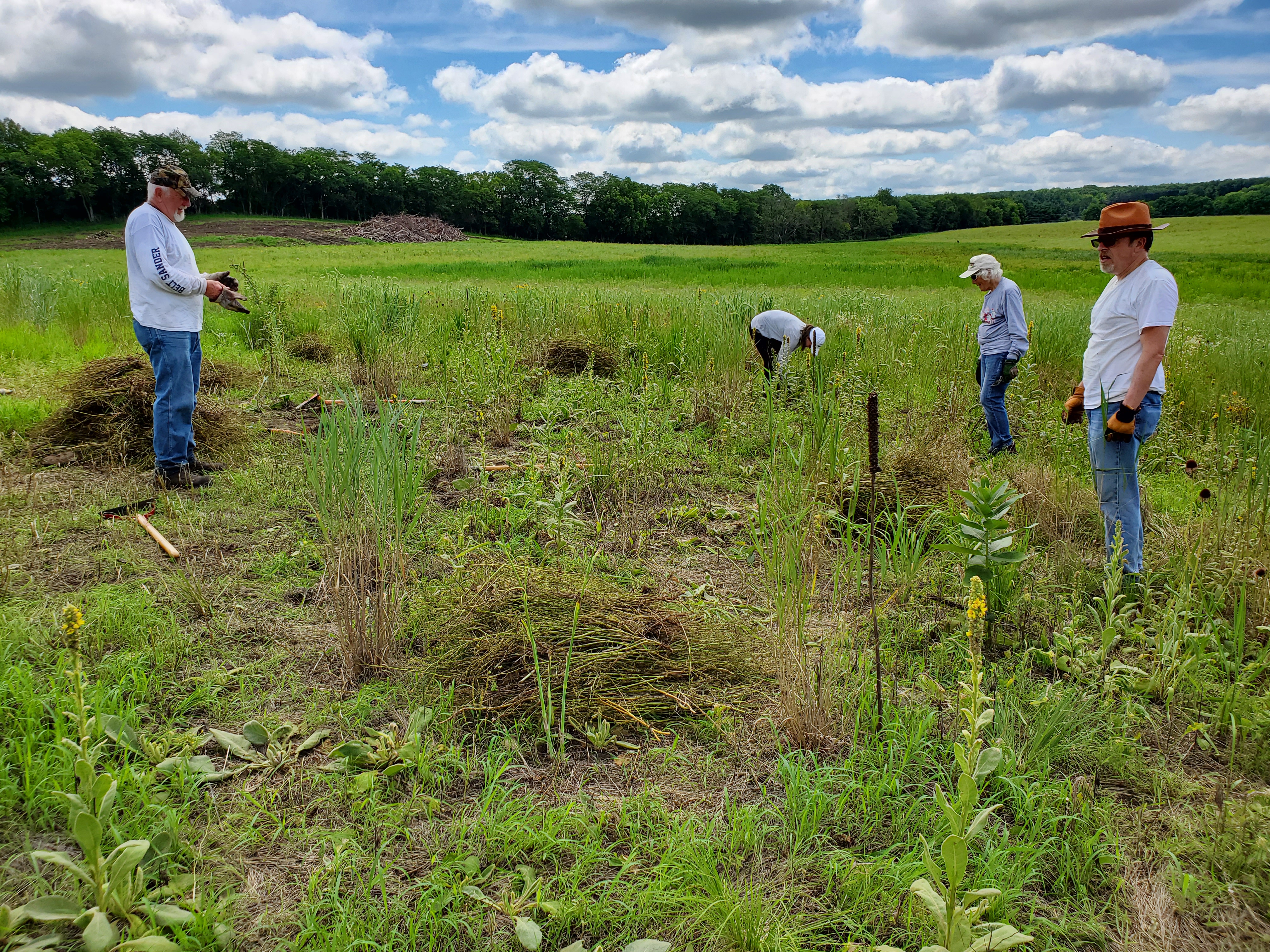
July 16, 2020 workday to remove mostly yellow sweet clover from a new planting at the Williams tract. A weed scythe is on the ground. The plants in bundles to be hauled off to burn.
Here is Kevin Scheiwiller on sweet clover:
I have a response that reflects my personal opinions that have been formed from working with multiple agencies who may or may not agree with my opinion.
Having a group of dedicated people who care about the ecological health of a site is the most important and effective way to treat sweet clover or any weed really. Continued hand pulling is incredibly labor intensive, but has produced great results in many instances. This can take one or multiple decades just to clear out a moderate sized (50-100ac) restoration. High-quality, smaller restorations are important, but will not achieve our goal of large scale biodiversity conservation.
Some groups choose to ignore sweet clover completely in order to go after other more aggressive, exclusionary weeds. Many land managers have an anecdotal story of mowing sweet clover and reducing it by X%. We know that Transline and Milestone work great on it, but Juli Mason’s most recent post has got me thinking that this approach could be creating more harm than good by leaving high levels of residual herbicide in the soil.
I’m starting to believe that the best approach is to spot mow the large patches while it is in full bloom and continue to overseed these areas with more prairie forbs. I don’t think this will necessarily get rid of the Sweet Clover but will continue to add competition and make it more palatable to spray or hand pull the stragglers.
More passionate stewards across more acres is the best solution.
Our target audience are a mix of staff with various experience levels who are involved in creating high diversity habitat for an agency or non-profit. We can be a bit wonkish on tools, techniques, and strategies. Attendees might be a seasonal crew member, or a new hire who would benefit from interacting with seasoned experts. They may be people who do the science of restoration. The mix of folks who attend these workshops has been enjoyable.
Agenda: We have several concurrent field trips planned, to keep the group size low enough for discussions to prosper. We will look at and discuss various prairie restorations, a savanna or two, equipment used, our seed room, on-going science work, brush work and its overlap with prescribed fire.
By Jason Johnson, Natural Resource Manager with Forest Preserve District of Kane County
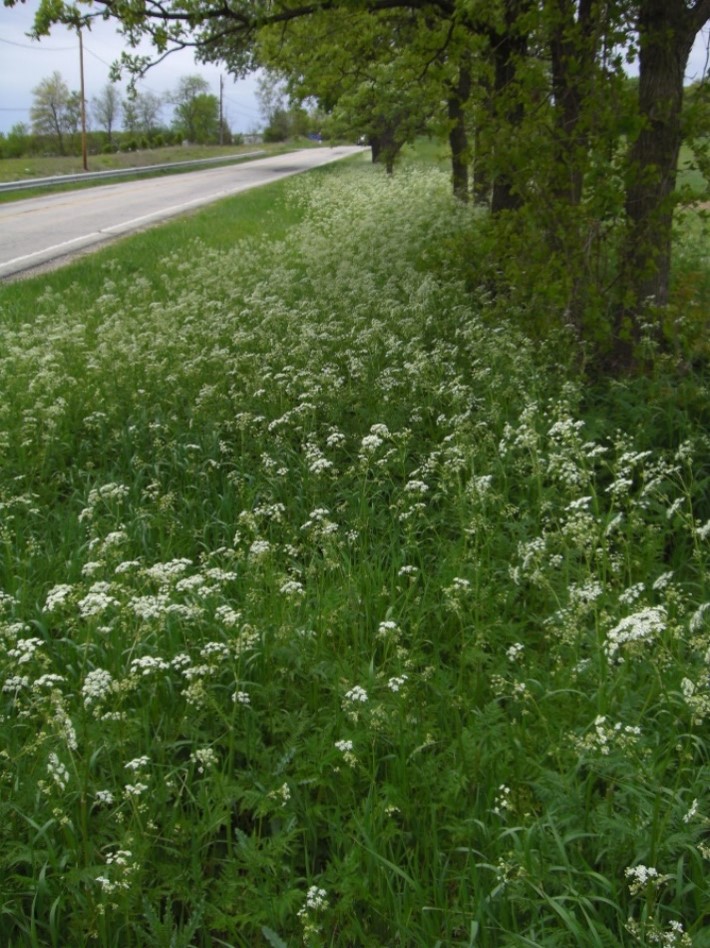
Invasive wild chervil
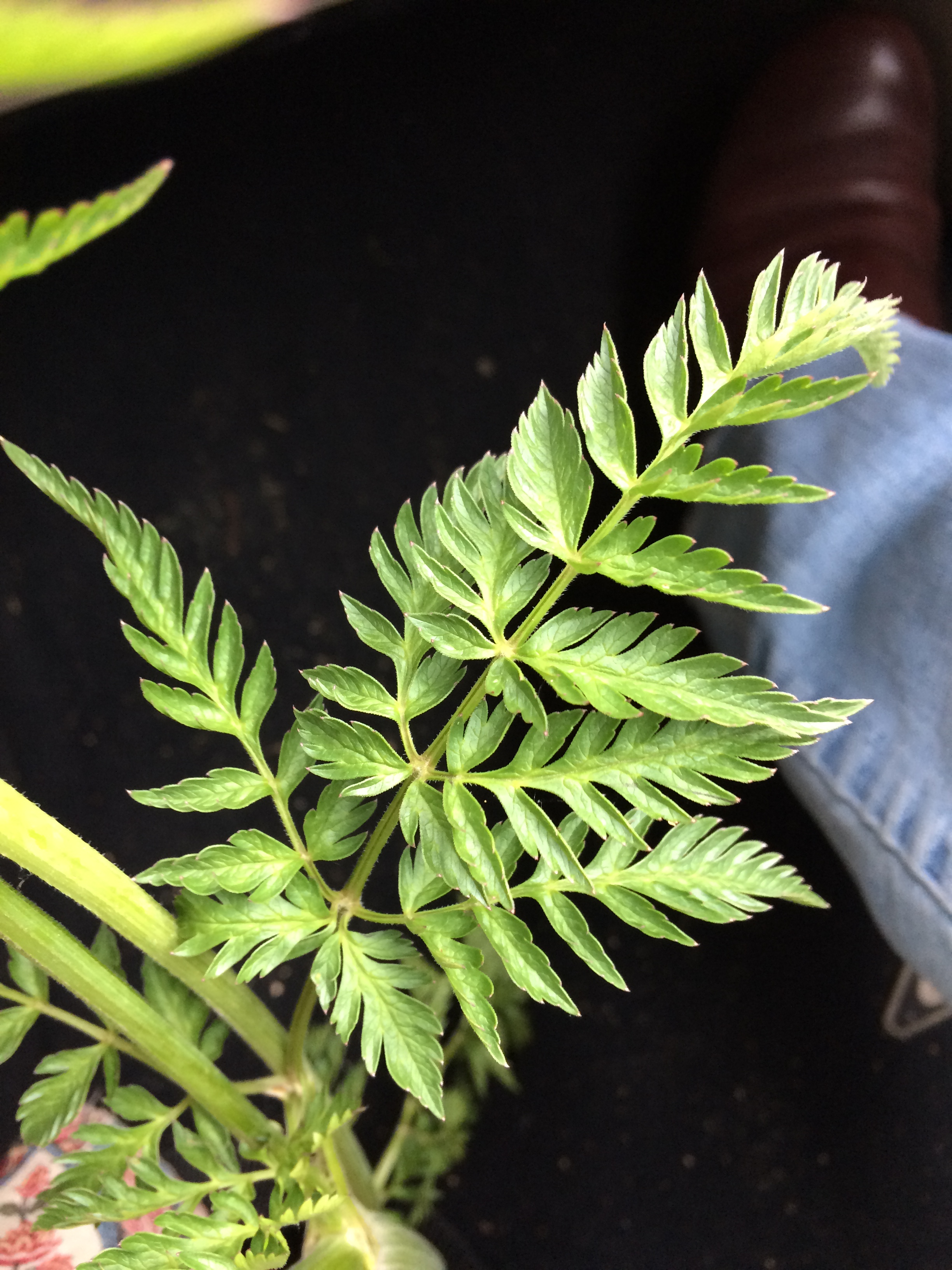
Wild Chervil (Anthriscus sylvestris) is an herbaceous biennial or short-lived perennial introduced to the US from Europe, is about 3 feet tall, and in the Apiaceae family. It has a hollow stem, white umbel flower, and tripinnate leaves. Chervil blooms before most of these other common look-alikes such as Queen Anne’s Lace (Daucus carota), Japanese Hedge Parsley (Torilis japonica), Sweet Cicely (Osmorhiza longistylis, O. claytoni), and Poison Hemlock (Conium maculatum). Chervil spreads rhizomatously as well as producing large quantities of viable seeds. It forms dense stands, displacing native species. Shaded lowlands, especially near creeks, seem to be a favorite habitat for this invasive species. Flowing water and human activities, especially mowing, are the most common means of dispersal. On the plus side, the seed bank is very short lived. Seeds only survive one or two winters.
Chervil was first observed in Kane County, IL in 1975, but was not widely distributed until the late 1990’s or early 2000’s. By 2007 it was exhibiting rapid spread throughout the county; particularly in roadside ditches and has since spread to many of the surrounding counties. By my observations, Kane County has seen the worst of it in northern Illinois for some reason.
Invasive chervil on a right of way
Forest Preserve District of Kane County staff began noticing large populations of Chervil in a few preserves in the mid-2000’s and began treating them. From about 2007-2012, Chervil populations were exploding across the county and they were spreading into more and more County Forest Preserves. Roadsides in some townships were full of it and it was spreading into preserves from those road ditches. Creek corridors in a few preserves also had large infestations with very low native plant diversity. Because the Forest Preserve District holds land in so many disjunct parcels, we have a significant amount of edge. All of those edges are incredibly vulnerable to invasion by weeds. As Chervil spread around the county, we decided that it was necessary to focus a large effort on controlling it as part of our overall mission to preserve and protect the public lands of Kane County. Over the years, our list of Chervil populations has grown, but fortunately the size and density of those populations has been reduced. It is difficult to eradicate weed populations when you have a constant influx of new seeds, but even the densest populations on neighboring property are being held at bay with annual follow-up visits to treat scattered individuals that are trying to reinvade the preserves.
Invasive chervil on a creekside
When the District first began treating Chervil around 2007, we used glyphosate. Glyphosate is effective, but is not ideal due to its non-selectivity. An attempt at mowing it was made, but quickly abandoned due to how highly labor intensive it was. Also, the large root system of the plants allowed them to re-flower rapidly; defeating the efforts of the mowing crew. District staff began looking for an effective broadleaf specific herbicide to use on Chervil. Ben Haberthur, Restoration Ecologist at the time; now Executive Director, ran a field study in 2012 testing several different herbicides and determined 0.5% Transline (Clopyralid) as the best option. We have since increased the concentration to 0.75%, or 1 oz/gal., which provides better results. Rodeo (Glyphosate) was tested at 2.5% and it did the job, but as previously mentioned, is non-selective. Escort (Metsulfuron methyl) and Milestone (Aminopyralid) were also tested but did not have as favorable results. In hindsight, I think that Milestone may in fact work, but it was tested at too high a concentration; which killed all vegetation.
After almost 15 years of consistent field use, 0.75% Transline has shown itself to be very effective at controlling Chervil. Today, District crews begin spraying Chervil populations as early as March. Chervil is one of the first plants to green up in the spring, so is easy to locate early. Once flowers form, crews clip the heads to prevent them from going to seed. Follow-up visits continue into May until seed set. Due to the short-lived seed bank, large infestations are relatively easy to bring under control, however, if there is an off-site seed source the area will need to be monitored annually.
It is possible to treat large, established Chervil populations late in the year. Chervil seems to green back up in the fall and existing populations may be sprayed with glyphosate as late as November or December if the weather is mild. Native species have gone dormant by this time and thus will be protected from the effects of the herbicide. This method does only provide partial control of Chervil, but is helpful in reducing the size of large populations that were not discovered or not able to be treated the preceding spring. The reduced population size makes follow-up treatments easier the next spring.
Bill Kleiman notes he tried spading chervil and found it difficult, but ok for a few plants.
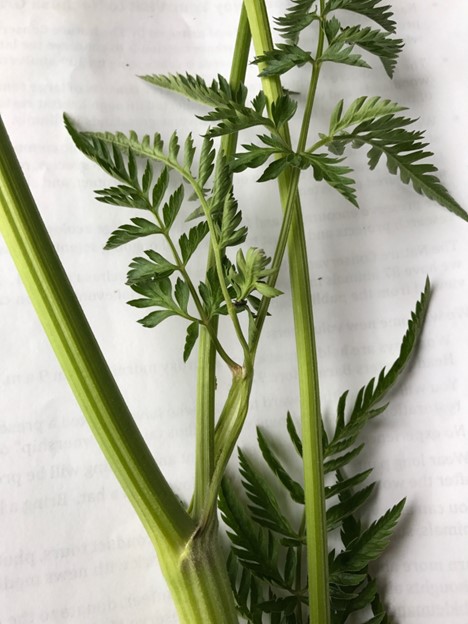
wild chervil leaves are tri-pinnate. Photo BKwild chervil flowers. Photo BKPhoto by BK. Wild chervil has this characteristic ridged stems with fringe of hair at leaf nodes. Hairy on the lower stems and smooth on the upper.
By: Julianne Mason, Restoration Program Coordinator, Forest Preserve District of Will County
Here are my top reasons for not spraying thistles. I’m specifically talking about Canada thistles (Cirsium arvense), but who knows, maybe this applies to other non-native thistles too.
1. It’s Unnecessary. When native forbs get established, Canada thistles fade away. Read about my experiences at Prairie Bluff below for an example. Note that Canada thistles seem to coexist happily and indefinitely with non-native, cool-season grasses. The fading phenomenon seemingly happens when native forbs get established and displace them.
2. It’s Counterproductive. Spraying thistles causes collateral damage to nearby forbs and can inhibit re-establishment of desirable forbs due to residual herbicide activity in the soil [See Part 2 of post] when herbicides like Transline or Milestone are used in excess. This results in less competition for the thistles and perpetuates their re-establishment.
3. Don’t We All Have Other Invasives to Combat? There are more invasives displacing native species than we collectively have resources to address. We should be focusing our efforts and herbicide on the ones that are displacing natives and reducing biodiversity (e.g., Phragmites, reed canary grass, etc., etc., etc.). Yes, thistles are long ingrained in our culture as noxious weeds because they are problems in ag fields and pastures. But, that doesn’t necessarily mean that they are serious problems in natural areas.
Let’s Distinguish Between Weeds that are Symptoms of Problems vs. Causing Problems. Thistles are usually symptoms of one of two problems. One is when not enough native forbs are present. This often happens in early restorations, when native communities are first planted in former row crop fields. Or, it can happen when previous herbicide applications cause dead zones or “holes” in the native cover. The second problem when thistles persist is the dominance of non-native, cool-season grasses. Thistles seem to happily coexist indefinitely with non-native, cool-season grasses. In this case, burning, overseeding natives, and addressing the C3 grass problem (we use post-burn application of clethodim herbicide) are the prescription, not spraying thistles. Once the C3 grasses are dealt with and the seeded natives can get established, the thistles fade.
Combat Thistles with Seed, Not Herbicide. If thistles are symptoms of a lack of native cover, then combat the issue by a dormant seeding of native species, especially native forbs.
Case Study: Prairie Bluff – The Tale of Two Restorations
Here is my perspective-changing experience on thistles from the prairie restorations at Prairie Bluff Preserve in Lockport, Illinois.
Prairie Bluff is a 600-acre former row crop farm. When it was in agricultural leases (prior to 2019), we restricted the use of chemicals that have groundwater advisories, which includes most broadleaf herbicides. As a result, the ag fields became very weedy and Canada thistles were persistent throughout the fields; they were chronically just being suppressed by row cropping. Funding for restoration of the preserve came from two different primary sources. The two different restoration projects, although happening simultaneously, took almost opposite approaches regarding thistle management.
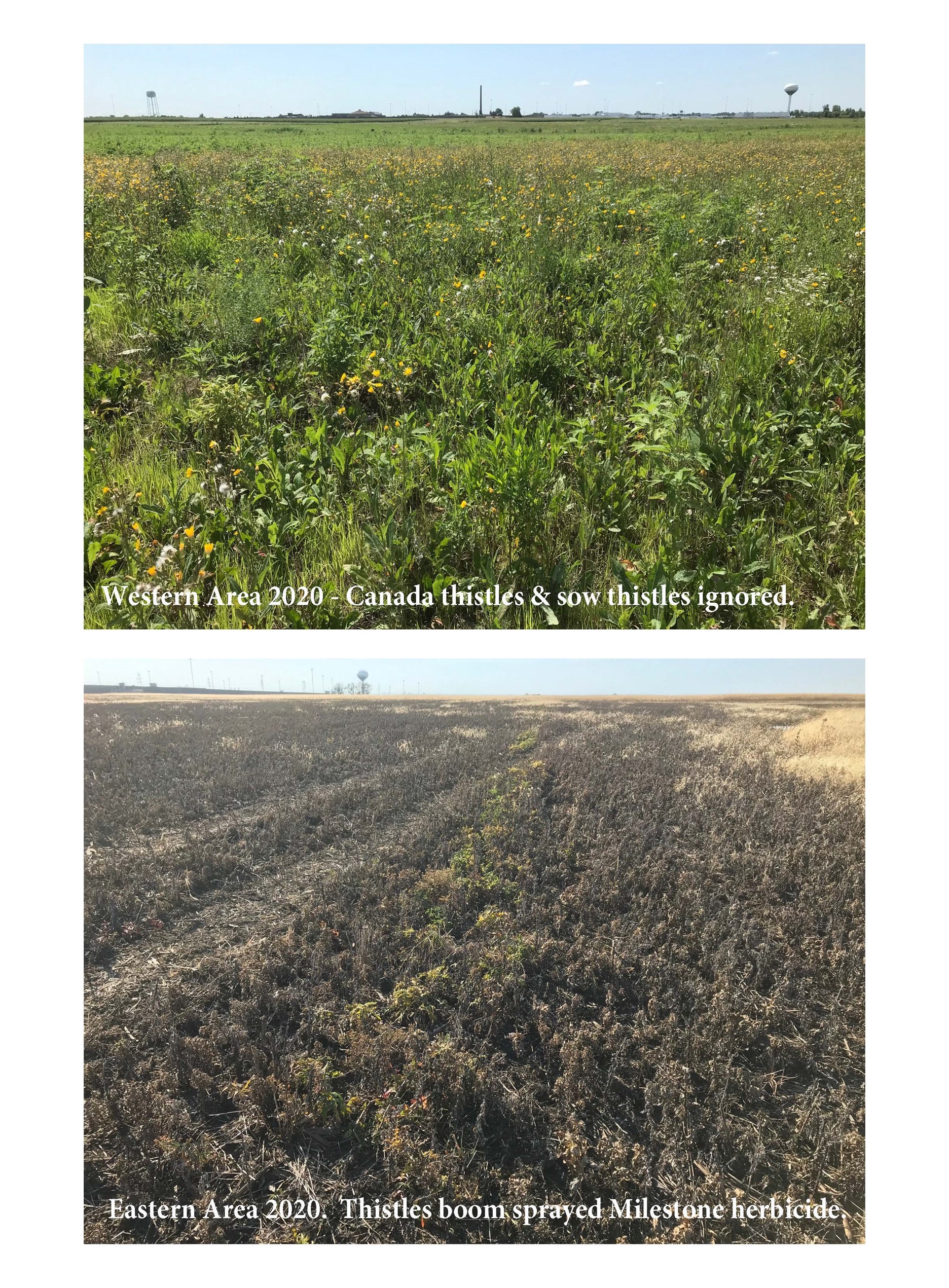
Western Project Approach: Do a good dormant seeding and don’t worry about the thistles.
Dormant seeded with full prairie and wetland mixes – Feb 2020
Mowed or spot mowed the weedy parts of the prairie- Summer 2020 & 2021 (I don’t know if this was helpful or necessary, but it made both them and the grant agency feel like they were doing something to help the prairie establish.)
Prescribed burn – March 2022
Eastern Project Approach: Seed a more limited native matrix and battle the thistles into submission before establishing a more diverse prairie.
Boom sprayed Milestone herbicide – Fall 2019
Seeded native grasses, graminoids, and limited forbs – Feb 2020
[Summer 2022 – I realized that the western restoration was looking immensely better and decided to change course on the thistle approach in this restoration.]
Summer 2022 – laid off herbicide and avoided spraying thistles
Tested herbicide residual in soil – August 2022 [see Part 2 of blog post]
Overseeded more diverse mixes – February 2023
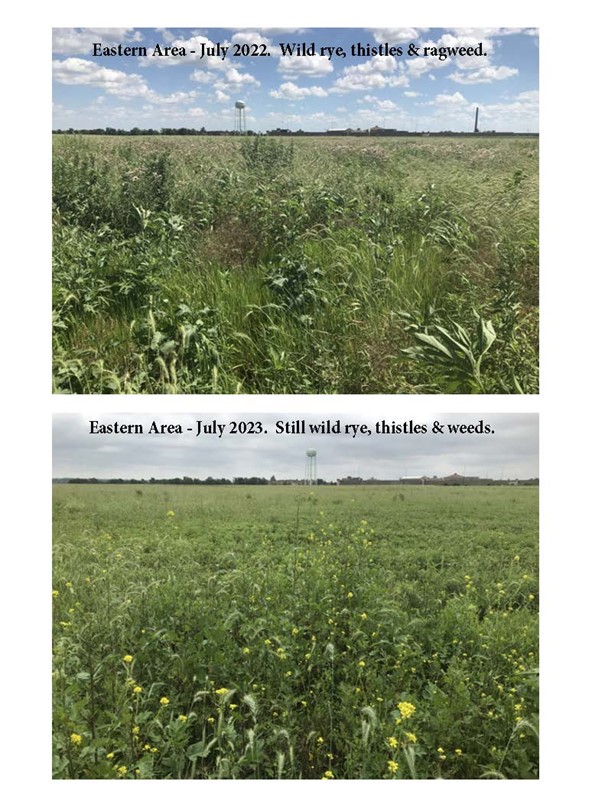
Western Area Results – Thistles Ignored, Thistles Faded: In the western project area, where the approach was to not herbicide the thistles, there are almost no thistles remaining in the restoration. It is a good-looking early restoration, dominated by Canada wild rye (Elymus canadensis), yellow coneflower (Ratibida pinnata), wild bergamot (Monarda fistulosa),golden Alexanders (Zizia aurea), foxglove beardstongue (Penstemon digitalis), rattlesnake master (Eryngium yuccifolium), field oval sedge (Carex molesta),and many other natives. The diversity of the prairie establishing reflects the original seed mix.
The only Canada thistles remaining in the western project area are present along the trail corridor. There, non-native, cool-season grasses that were planted to be mowed turf along the trail shoulders have expanded out into the prairie. The thistles are persisting in the non-native C3 grass zones, but not anywhere where natives have established.
Eastern Area Results – Thistles Battled with Herbicide, Prairie Restoration Suffers. In the eastern project area, there are still lots of thistles in the restoration. Lots of thistles. The seeded native grasses are becoming established, but besides that, the rest of the vegetation is weeds. Now the restoration has been overseeded with properly diverse mixes and we are avoiding widespread herbicide use to allow the seeding to establish. Hopefully, the recently seeded native forbs will be able to establish well and displace the Canada thistles and other weeds (sow thistles, annual/biennial weeds, etc). I’ll keep you posted on how the restorations are progressing in a few years.
Just for good measure, here’s one more photo comparison of the western project area at Prairie Bluff where the thistles were not treated with herbicide, compared with the eastern project area where the thistles were originally boom sprayed with herbicide. It’s only anecdotal data, but I think it’s time to stop spraying thistles. Restorations are a lot easier and more successful when you view thistles as symptoms of a problem (i.e, lack of native cover) and not the problem themselves.
By: Julianne Mason, Restoration Program Coordinator, Forest Preserve District of Will County
To preserve or restore native plant diversity and community integrity, it’s often necessary to apply herbicides to kill invasive plants. However, using herbicides can cause collateral damage to the native plant species that we’re trying to protect. In addition to direct collateral damage, I have begun to appreciate how the soil residual effect of herbicides can inhibit establishment of the native species that we’re trying to restore.
We spend a lot of money and crew-hours purchasing or collecting seeds of native plants to restore native plant diversity. However, I have seen many examples of where we have gotten almost no native plant establishment from these seedings. I started to consider the mechanism of how herbicide use to control invasive plants may be implicated in the lack of success of the seedings.
In a recent mesic prairie restoration project in northeastern Illinois, the PBP project area had been sprayed with Milestone herbicide (aminopyralid) to target Canada thistles (Cirsium arvense). Before I spent a hundred thousand dollars on native seed, I wanted to make sure that the residual herbicide level in the soil was low enough to allow the native seed to establish.
In another prairie restoration area in northeastern Illinois, we boom sprayed the MRP project area twice with Transline herbicide (clopyralid) to target teasel (Dipsacus laciniatus) and birdsfoot trefoil (Lotus corniculatus) before seeding a mesic prairie mix. I wanted to know why the seeding didn’t establish, and whether the residual herbicide level in the soil was low enough to try overseeding natives again.
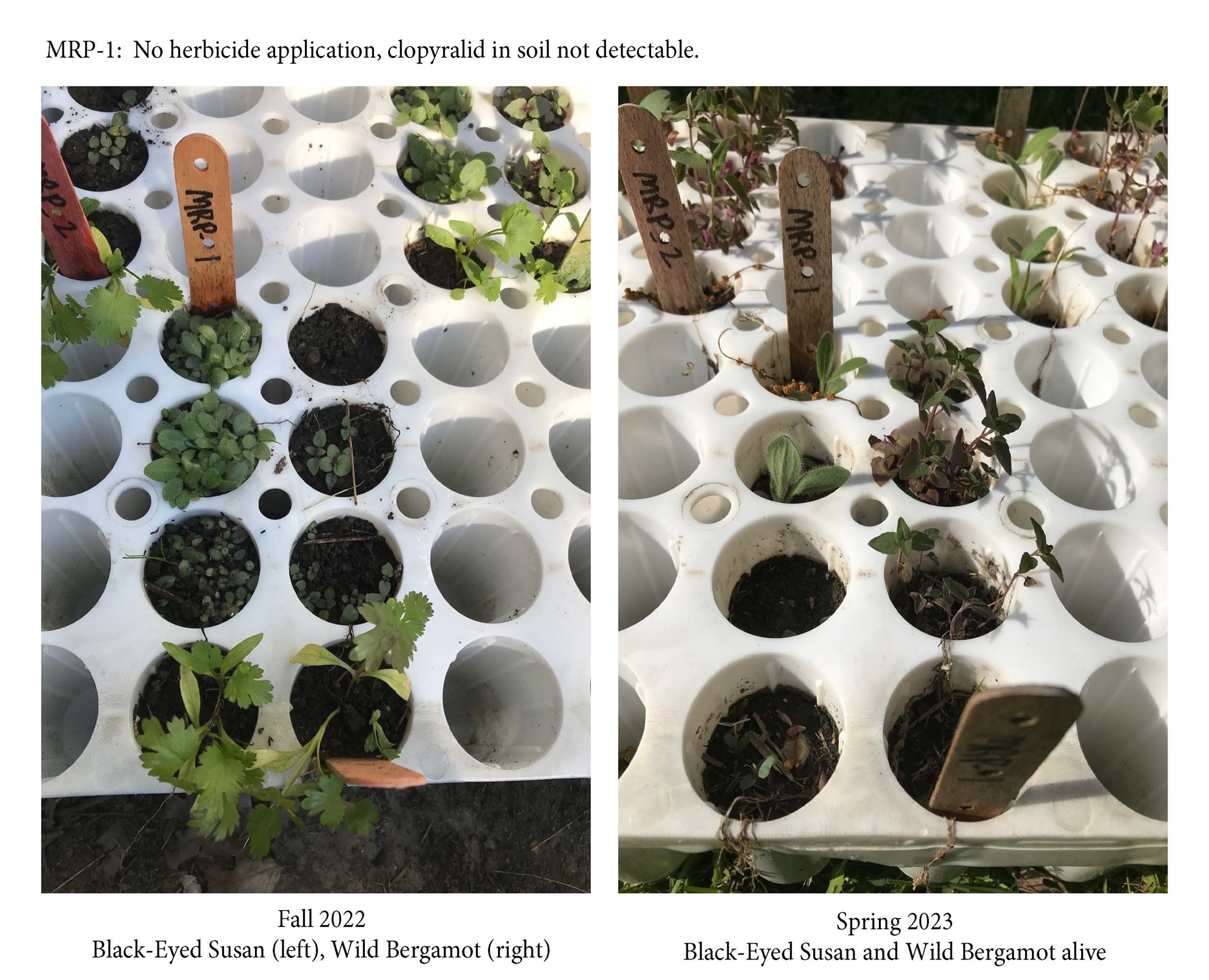
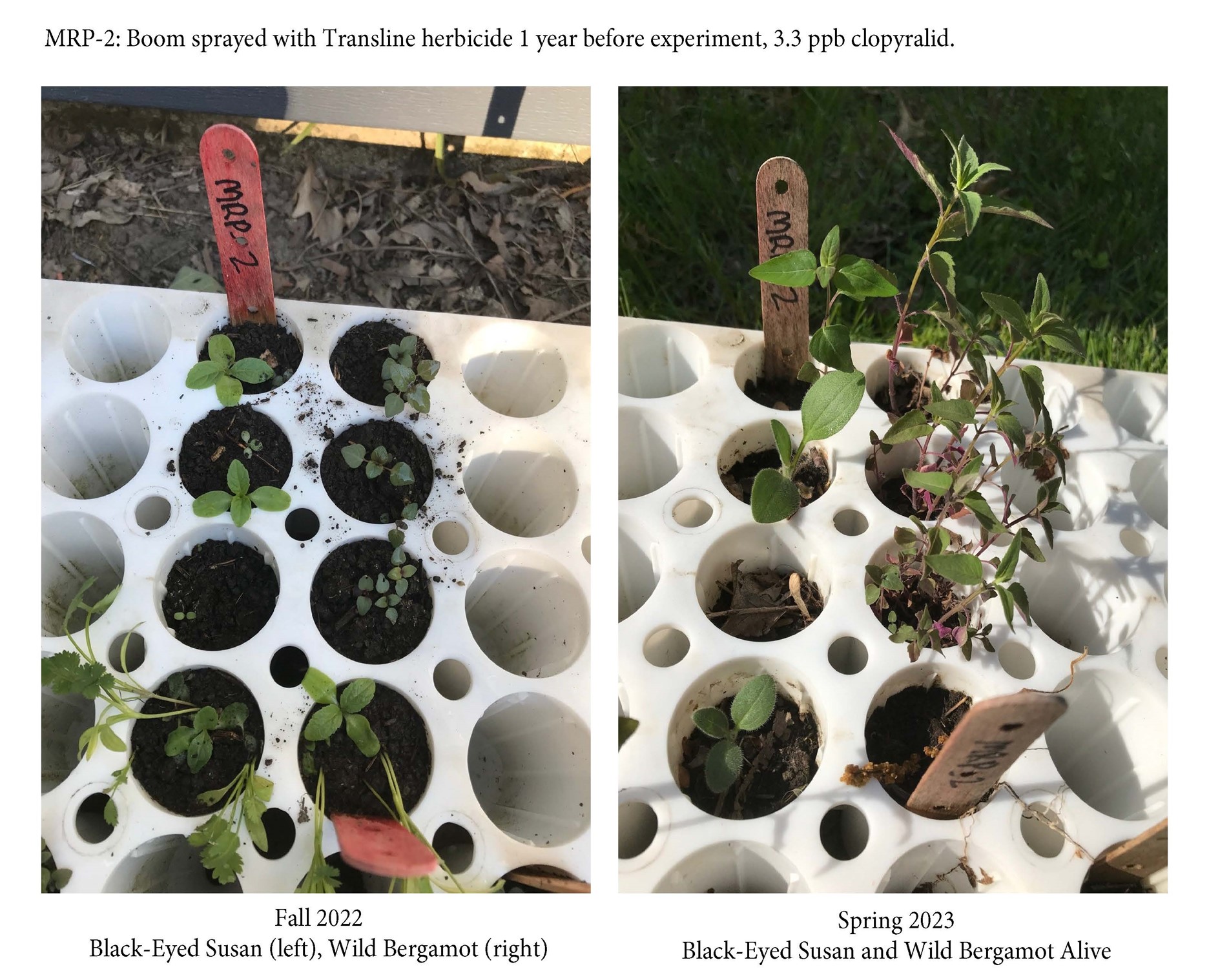
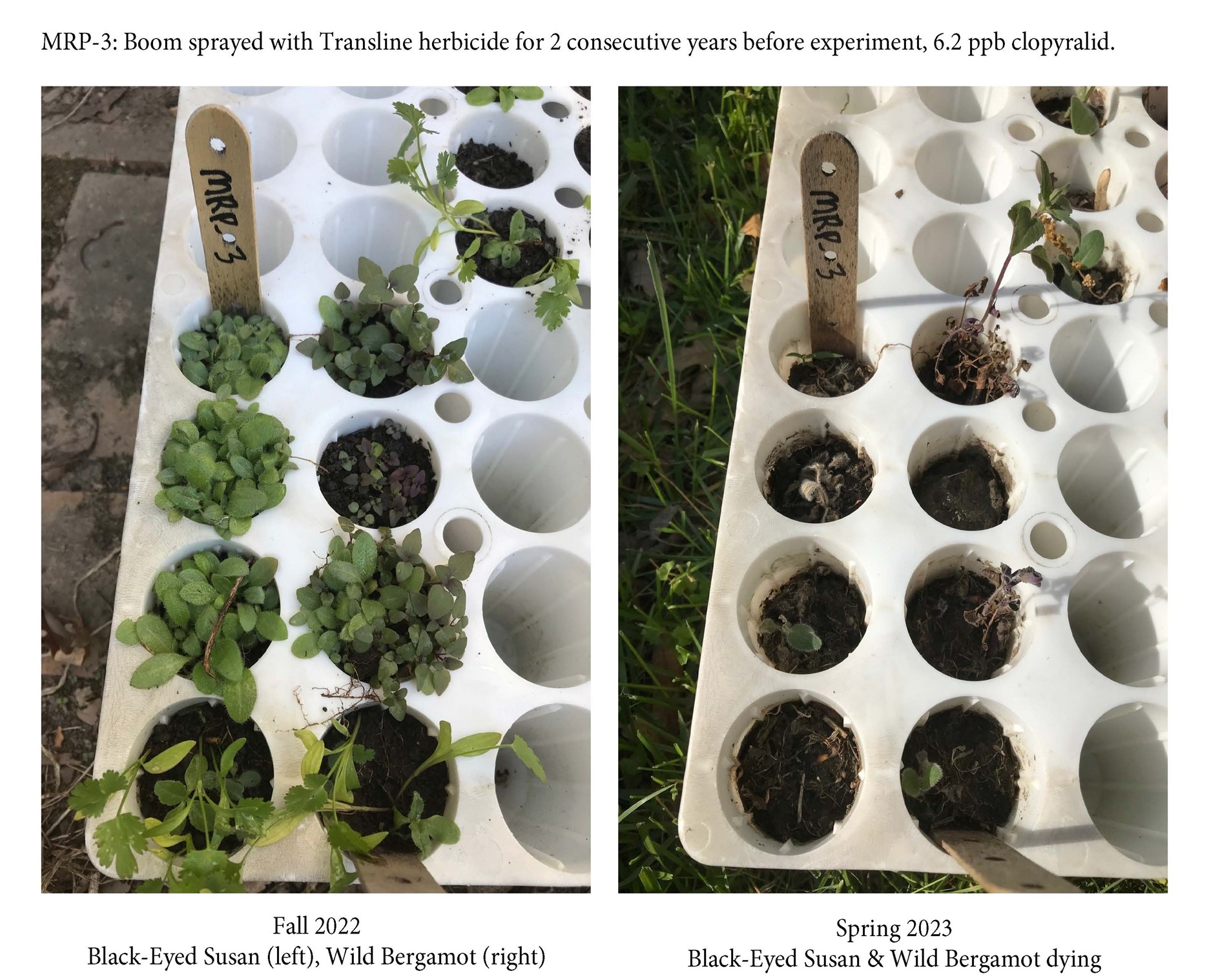
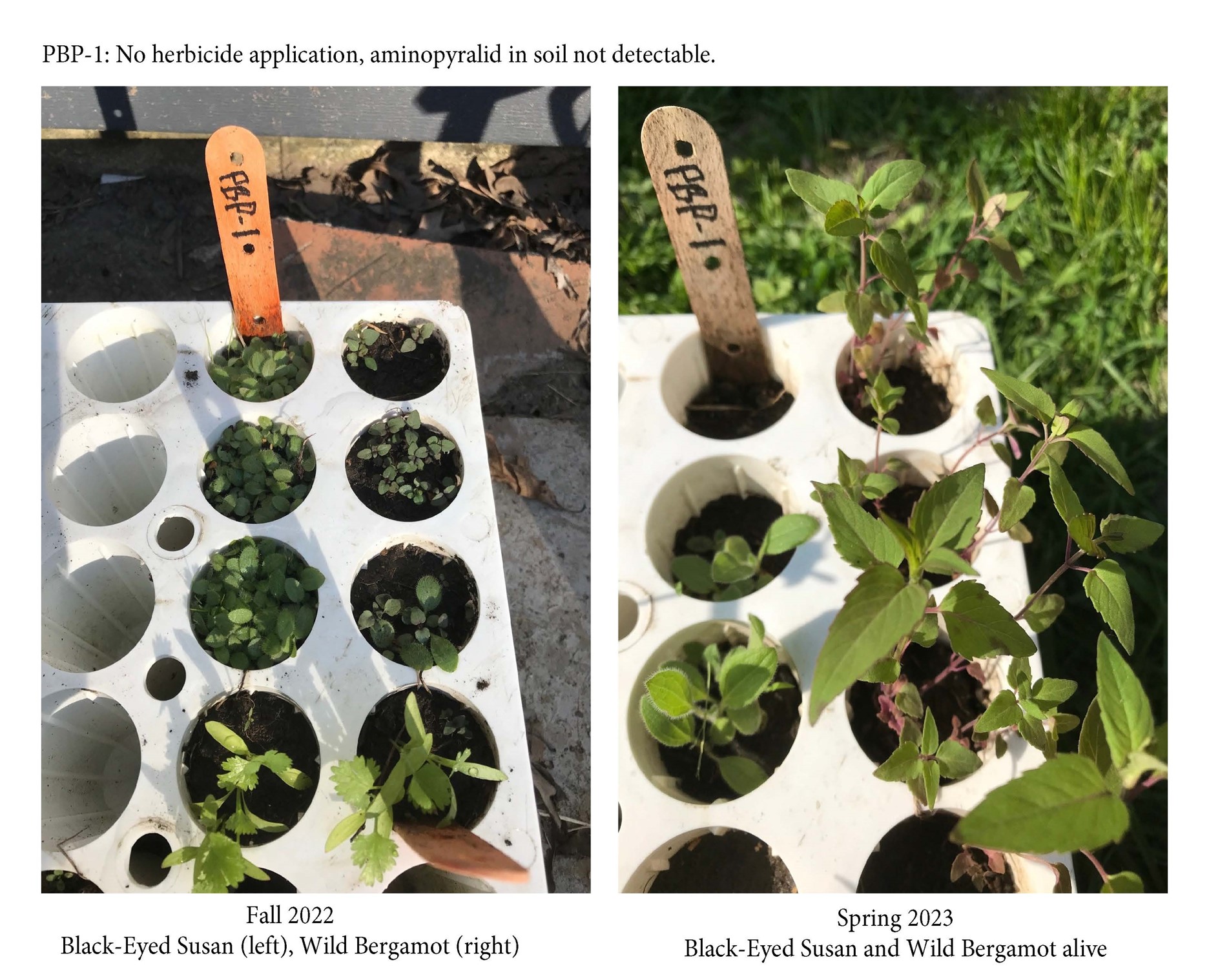
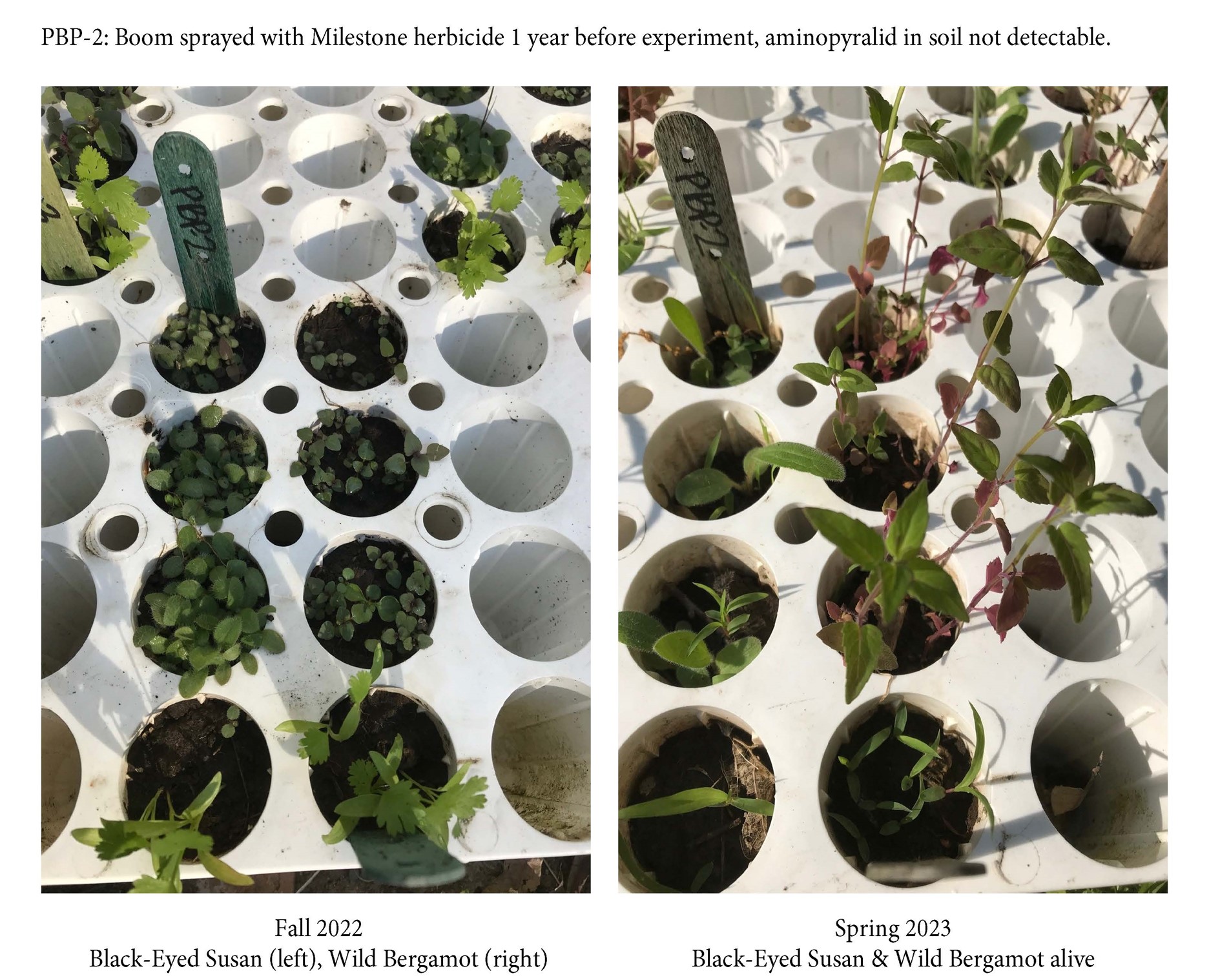
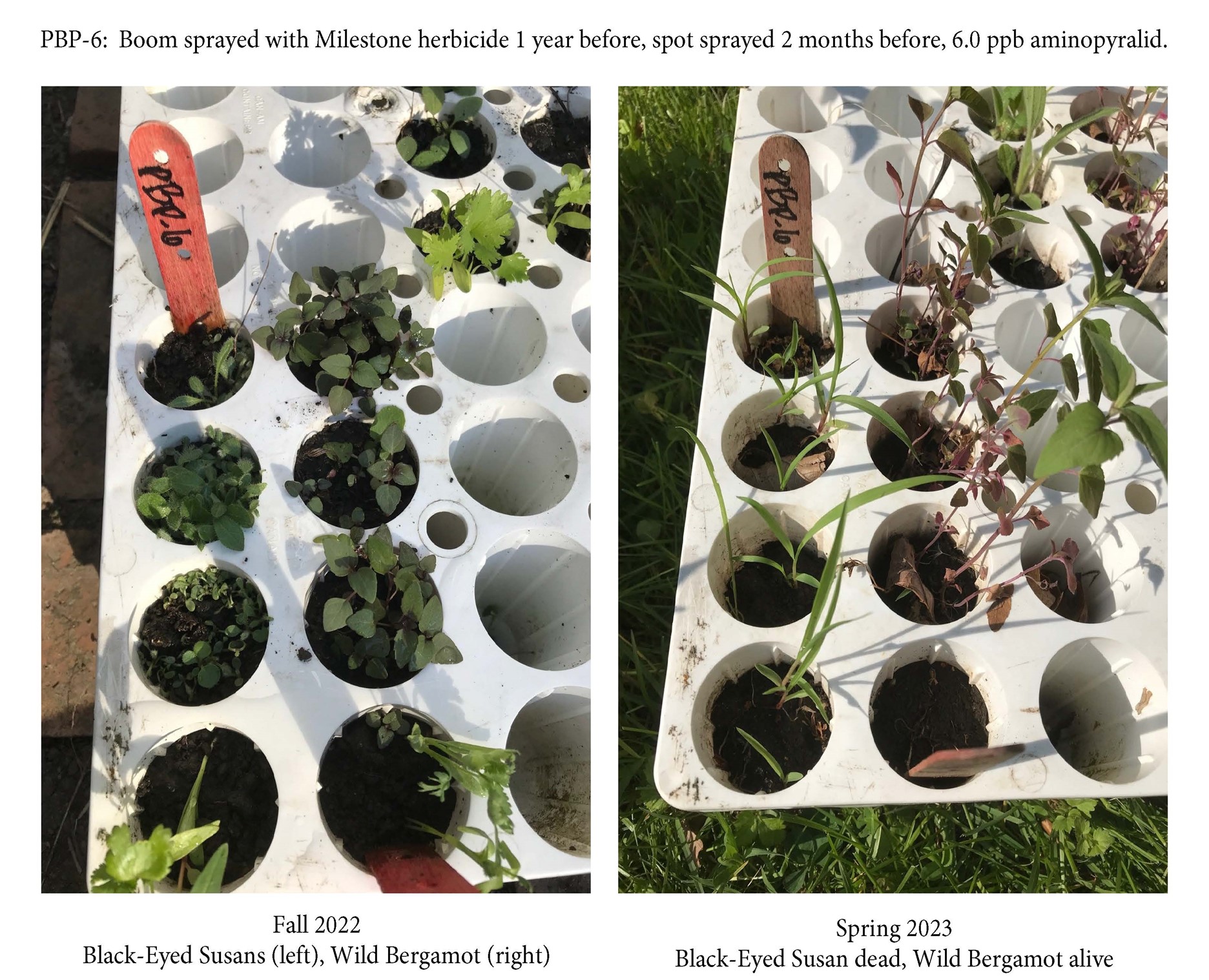
For both areas, I sent soil samples to the South Dakota Agricultural Laboratories for analysis during late August 2022. At the same time, I put soil samples from the two project areas in plug pots and seeded them with black-eyed Susan (Rudbeckia hirta; left plugs), wild bergamot (Monarda fistulosa; right plugs), and cilantro (front two plugs). Black-eyed Susan is susceptible to both herbicides, wild bergamot is relatively tolerant of both herbicides, and cilantro is an annual that germinates readily (and I had extra seed lying around). In the fall of 2022, most seed had germinated of all species, and there was not any difference between the soil samples.
By the spring of 2023, there was a notable difference between seedling survivorship in the soil samples with higher levels of residual herbicide and those without detectable herbicides. In MRP-3, which had the highest level of clopyralid (from Transline herbicide) in the soil at 6 ppb, both the black-eyed Susan and wild bergamot seedlings were dying. In PBP-6, which had the highest level of aminopyralid (from Milestone herbicide) in the soil at 6 ppb, the black-eyed Susan seedlings were dead, but the wild bergamot seedlings were still alive. In nearly all the soil samples where the herbicide levels in the soil were below the laboratory’s detection limit, both black-eyed Susan and wild bergamot seedlings were alive.
Take-Home Messages:
If you suspect that you might have too much herbicide residual in the soil, get it tested before spending a lot of time or money seeding natives!
Be mindful of uncalibrated spraying – both uncalibrated boom spraying, broadcast spraying with a gun, and backpack spot spraying. Our two examples with the highest soil herbicide levels had received an uncalibrated spray (via backpack spot spray or uncalibrated boom).
Be mindful of the accumulation based on consecutive years of spraying. Our two examples with the highest soil herbicide levels had also been sprayed two years in a row.
Here is a summary of the management history, the soil herbicide level, and the germination study results.
MRP-1: No recent herbicide activity.
Clopyralid level in soil: below detection limit.
Germination results: Establishment & survival of black-eyed Susans and wild bergamot.
MRP-2: Broadcast sprayed with Transline herbicide (0.5%; ave 12 fl oz/ac) 1 year before soil tests.
Clopyralid level in soil: 3 ppb
Germination result: Establishment & survival of black-eyed Susans and wild bergamot.
MRP-3: Broadcast sprayed with Transline herbicide (0.5%; 19 fl oz/ac) 2 years before soil tests.
Broadcast sprayed (uncalibrated) with Transline herbicide (0.5%; 40 fl oz/ac) 1 year before soil tests. *Note: this application exceeded the annual maximum application rate (24 fl oz/ac).
Clopyralid level in soil: 6 ppb
Germination result: Both black-eyed Susans and wild bergamot germinated but died the following spring.
PBP-1: No recent herbicide activity.
Aminopyralid level in soil: below detection limit.
Germination result: Establishment & survival of black-eyed Susans and wild bergamot.
PBP-2: Broadcast sprayed with Milestone herbicide (0.25%; ave 2.6 fl oz/ac) 1 year before soil tests.
Aminopyralid level in soil: below detection limit.
Germination result: Establishment & survival of black-eyed Susans and wild bergamot.
PBP-6: Broadcast sprayed with Milestone herbicide (0.25%; ave 2.6 fl oz/ac) 1 year before soil tests.
Then, spot sprayed teasel with Milestone herbicide (0.25%) 2 months before soil tests.
Aminopyralid level in soil: 6 ppb
Germination result: Black-eyed Susans germinated but died (only annual foxtail grass visible in 2023 photo). Wild bergamot established.
Conclusion: Remember, it’s not only Kill, Kill, Kill. In conjunction with killing invasive plant species, it’s equally as important to seed and promote establishment of a diverse native community. To allow native seed to establish, good practices are to avoid excessive spraying, be mindful of the soil residual effects of herbicides, and get the soil tested as necessary to know when it’s safe to apply the precious native seed. A finesse approach is much more effective than brute force in invasive plant management!
















 grassland restoration network