by Bill Kleiman
Back in 2014 the Kleiman family decided to test if basal bark herbicide killed invasive bush honeysuckle. Anecdotal comments in articles said it did not work well. I was seeing good control. My daughter Leah was 14 at the time. My wife, Susan, and I coaxed her to have fun in the woods with us to set up a controlled study. We mapped out three study areas. The honeysuckle we treated we painted with a spot of colored tree paint. We marked untreated control shrubs with another color. We did the treatments on May 22, 2014.
The honeysuckle would wilt over the summer. We waited until September of that year to collect our data. We found 100% mortality.
The method works, but it is important to find all the shrubs to treat, and return a few years in a row to treat the ones you missed. You can also mow down the live shrubs and just treat the re-sprouts.
We then decided to try to publish our findings. That proved to be a lot of work. Research, emailing researchers for clarifications, visits to the University Library. Leah was there on every step and did the writing. We worked at it for too long and Ecological Restoration took pity on us and published our finding in their “Restoration Notes” section. There is a paywall, but here is a link to the first page of three http://er.uwpress.org/content/36/4/267.extract Below I copy the same essential text.
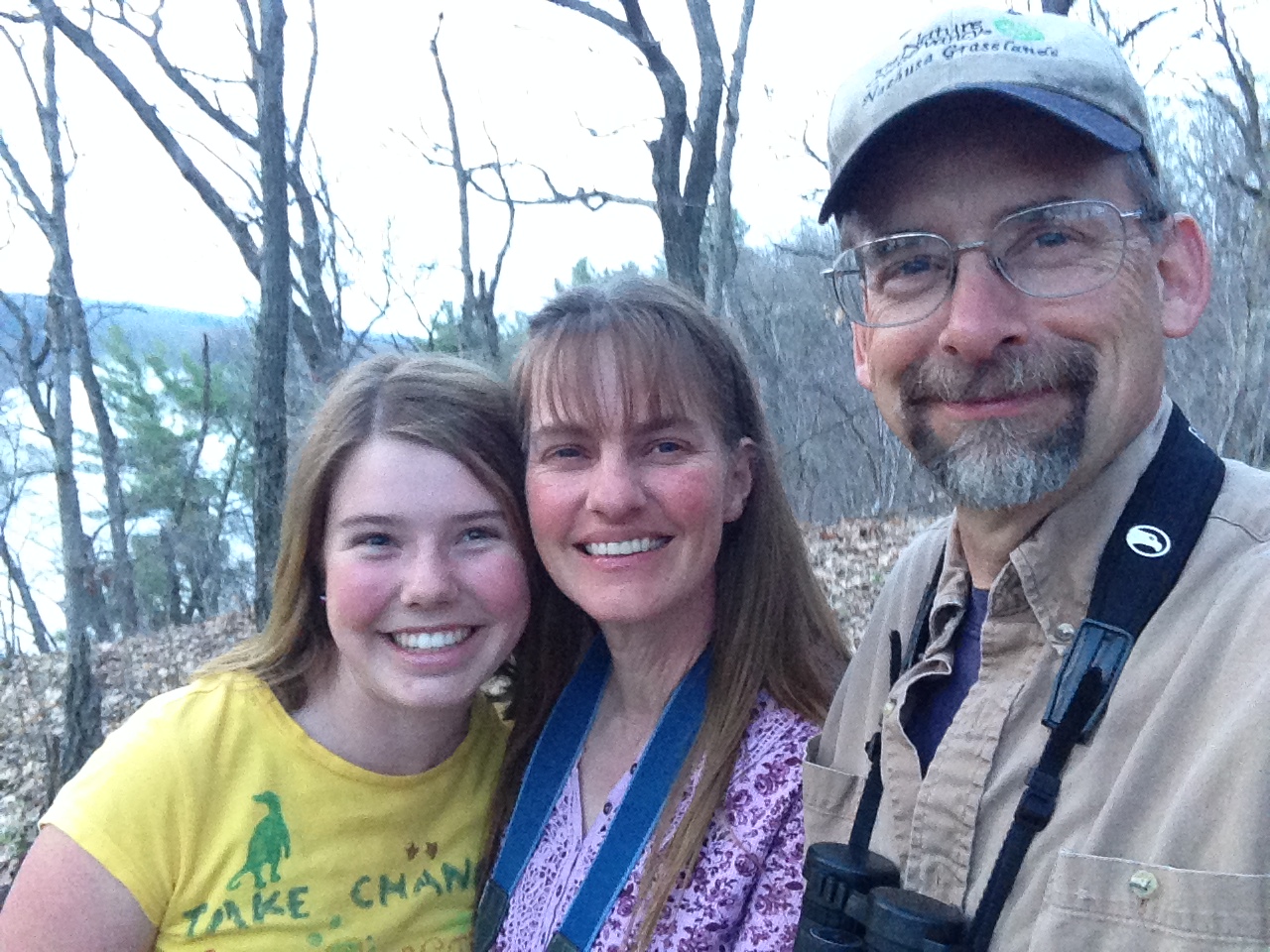
Above is us in 2014.
Leah is now a graduate student in forestry looking at the composition of the understory plants in oak woodlands. Bill and Susan still go out together on weekends treating shrubs. Romantic, huh.
Successful Control of Lonicera maackii (Amur Honeysuckle) with Basal Bark Herbicide Leah R. Kleiman, Bill P. Kleiman and Susan K. H. Kleiman
Lonicera maackii (family Caprifoliaceae), often referred to as Amur Honeysuckle, is a perennial shrub native to temperate Asia. In the Midwestern United States, L. maackii is an invasive shrub that was first made available as an ornamental plant and was later used for soil retention (Saxton 2012). The shrub now infests many savannas, woodlands, and grasslands in the region. Lonicera maackii has traits that make it a strong competitor. The shrub’s leaves emerge very early in spring and stay green long into fall. Lonicera maackii can dominate the shrub canopy, leaving ground layer plants with much reduced sunlight. The shrub also produces allelopathic chemicals that inhibits other species (Hartman and McCarthy 2004). Its seeds are highly viable, germinate easily, and recruit readily, especially in areas with a lot of sunlight (Schulz and Wright 2015). The shrub rarely shows signs of disease.
Lonicera maackii is difficult to eradicate. Spraying the foliage causes herbicide to land on large areas of the ground layer, likely damaging desirable plants. Pulling the shrub from the ground when plants are small is effective, but even modestly-sized plants are a physical challenge to pull and leave the soil disturbed. Cutting the plant and applying herbicide to the cut stem produces high mortality; however, cutting can be laborious (Love and Anderson 2009). Mowing shrubs and prescribed fire can top-kill the plants, which will re-sprout.
In this study, we examined the efficacy of basal bark application in the month of May. We chose to study a basal bark herbicide treatment in May because in the few weeks after prescribed fire season (March-April), Nachusa Grasslands’ herbaceous weed management season has not started, and it is obvious which shrubs have not been killed by prescribed fire or previously treated with herbicide. We conducted this 2014 work at The Nature Conservancy’s Nachusa Grasslands preserve, Ogle County, Illinois (latitude 41° 53’ 41.64” N, longitude 89° 22’ 11.28” W, elevation 247 m). The site was in the Stone Barn Savanna unit with an over-story of Quercus alba (white oak), Quercus velutina (black oak), Quercus macrocarpa (bur oak), Carya ovata (shagbark hickory), and Carya cordiformis (bitternut hickory). The tract was purchased in 1999 and had a dominant understory cover of L. maackii shrubs. The study area was within a prescribed burn unit that has had almost annual fire since 1999; however, some of this area has had little direct fire due to the dense shading from the shrubs providing little fuel to carry fire. No fire occurred in the treatment plots from the herbicide application on May 22, 2014 to the data collection on September 13 and 14, 2014.
We randomly chose three treatment plots from 0.45 ha of a ridgeline running East/West. The plots were relatively flat with a slight southern aspect with a slope of 0-3%. The three plots were each approximately 30 m in the East/West direction and 15 m in the North/South direction. All three treatments plots were dense with L. maackii, with a ground layer of exposed soil and a few typical herbaceous plants such as Geranium maculatum (wild geranium), Ageratina altissima (white snakeroot), Alliaria petiolata (garlic mustard), Circaea lutetiana (enchanter’s nightshade), and Pilea pumila (clearweed). One of the three treatment areas contained a retired, shallow, dolomite quarry.
The main treatment was basal bark herbicide applied to L. maackii. We also had a treatment of the mineral oil carrier without herbicide (to confirm the herbicide, not the carrier, was the lethal agent). We also had a control whereby no treatments were made to L. maackii. The shrubs varied in size with stem diameters ranging from 0.25-15 cm at ground level. Those that were multi-stemmed had re-sprouted from previous mowing or burning.
The treatments were performed from May 22-25, 2014.For the controls, live shrubs were chosen and marked with a 10-15 cm stripe of orange tree-marking paint (on upper stems) and left as is.; For the main test of basal bark herbicide, again live individual shrubs were chosen and marked with a 10-15 cm stripe of blue tree-marking paint and then basal bark herbicide with mineral oil carrier was applied to all stems of each shrub by spraying using a Birchmeier Flox backpack sprayer. The basal bark herbicide was Garlon 4 Ultra with active ingredient 60% triclopyr (Dow). This herbicide/mineral oil mix was made as follows: 10 L of Garlon 4 Ultra added to a 57 L drum containing 47 L Bark Oil Red LT (Loveland Products). So the total solution is 57 L in the drum which is a 17% solution. Shrubs were sprayed with approximately a 15 cm band close to the soil, and sprayed such that the circumference of all stems were covered. To test if the mineral oil carrier had any effect on mortality, live shrubs were chosen and marked with a 10-15 cm stripe of yellow tree-marking paint and then Bark Oil Red LT mineral oil was applied to all stems of each shrub with a Birchmeier Flox backpack herbicide sprayer.
We did all the applications during the same four days, choosing live shrubs at random, (first the control, then the herbicide, then the mineral oil). Each shrub was spray painted with tree marking paint with its particular color so that we were confident several months later which shrubs were treated and which were control. We assessed efficiency of the treatments in causing mortality on September 13 and 14, 2014. To confirm mortality we examined each treated shrub for browning of leaves, number of dead stems, number of living stems, and diameter of the largest stem.
Basal bark application with triclopyr in the growing season yielded 100% mortality on 261 plants of L. maackii. The herbicide was effective on all diameters of shrub encountered, from 0.25 cm to 15 cm. Applying mineral oil without herbicide yielded 4% mortality. There was 0% mortality in the control treatment.
The literature is sparse on the efficacy of basal bark application on L. maackii. We found only two relevant papers. One of these studies was performed in January 2003, in which the authors found inconsistent and poor control using basal bark applications, possibly due to the treatment being applied in the dormant winter months (Rathfon and Ruble 2007). In 2004 Rathfon (2006) repeated this original study with a similar experiment which found 95% mortality. In correspondence with us, Rathfon confirmed that basal bark application was effective. In Rathfon and Ruble (2007), the study area had very dense undergrowth and individual shrubs were not marked after being sprayed with herbicide, so some smaller shrubs were likely missed during the treatment work. There was also an inch of snow on the ground with very cold temperatures. Rathfon noted the herbicide label cautions against applying with snow on the ground or when bark is moist or frozen. In the second study, Rathfon (2006) found very effective control of L. maackii applying basal bark triclopyr herbicide in various months. Our experiment is consistent with Rathfon (2006).
A May 2012 study by Nachusa volunteer Mike Carr resulted in 100% mortality of 208 basal bark treated plants of all sizes with no control. This experiment and our current experiment show basal bark to be highly effective in the growing season (May). Other control methods such as cut-and-treat, and foliar applications have been found to be effective; however, basal bark application offers advantages such as: 1)Basal bark application kills a smaller area of surrounding desirable plants than foliar spraying due to the wide spray pattern needed for foliar herbicide on tall shrubs; 2)Basal bark application is quiet, safe, and efficient. Cut-and-treat takes more time, is physically demanding, and is hazardous due to the use of cutting tools; and 3)Basal bark application has no soil disturbance, whereas manual or machine pulling of the plant root does.
Future Research
- Does basal bark application work in the dormant season? The total mortality of our early May application is clear, and Rathfon (2006) supports good dormant season control. However, further studies of applications throughout a year are needed to increase confidence in this method.
- If basal bark herbicide is applied to shrubs in fall, winter, or spring does a follow-up fire that top kills the shrub stems still allow the chemical to kill the roots?
- What is the extent of damage to nearby plants from applying basal bark herbicide? Natural areas managers have occasionally noted such damage and browning of vegetation adjacent to basal barked stems. Is this due to overspray, runoff, applying on wet stems, or applying on hot days? Future experiments could be done on how this off-target damage compares to foliar spraying.
- What basal bark mixture is most effective? This study used 17% triclopyr whereas others are using 20% triclopyr and some are adding a second herbicide to increase potency of the herbicide mix.
Management Recommendations for Controlling L. maackii, and Other Invasive Shrubs
- Map out occurrences in your area of interest. Take a few photos from fixed points and retake photos later to see progress.
- Implement prescribed fire when feasible and keep a short return interval as this will top kill many shrubs and keep them from setting seed.
- Use basal bark techniques when the brush is not too dense to traverse on foot. Use a brush mower on thickets and then basal bark herbicide the individual re-sprouting shrubs after they emerge in late spring.
- For areas that have had L. maackii invasion for years it will take more than one year of treatment. The reintroduction of native understory herbaceous species may be needed to restore such an area to quality native habitat (Hopfensprenger et al 2017).
Here we demonstrated the efficacy of basal bark herbicide application to invasive L. maackii shrubs in May with the shrubs in full leaf. All treated shrubs died. All sizes of shrubs were effected equally. Applying an oil-based herbicide to the bark (basal bark application) is efficient because: 1) the mortality is very high; 2) the work is physically easier than cutting the shrubs one by one; and 3) the damage to nearby desirable plants is limited to several inches surrounding the shrub. The herbicide mix is expensive, but time and safety gains makes the treatment cost competitive.
Acknowledgements
Mike Carr assisted us on several L. maackii control studies that enlightened our design of this study. We also thank Ronald Rathfon for his help in discussing his studies.
References
Hartman, K.M. and B.C. McCarthy. 2004. Restoration of a Forest Understory After the Removal of an Invasive Shrub, Amur Honeysuckle (Lonicera maackii). Restoration Ecology 12:154-165.
Hopfensperger, K.N., R.L. Boyce and D. Schenk. 2017. Removing Invasive Lonicera maackii and Seeding Native Plants Alters Riparian Ecosystem Function. Ecological Restoration 35:320-327.
Love, J.P. and J.T. Anderson. 2009. Seasonal Effects of Four Control Methods on the Invasive Morrow’s Honeysuckle (Lonicera morrowii) and Initial Responses of Understory Plants in a Southwestern Pennsylvania Old Field. Restoration Ecology 17:549-559.
Rathfon, R.A. 2006. Application timing of 20 basal bark herbicide and oil diluent combinations applied to two sizes of Amur honeysuckle. In Hartzler, Robert G; Alice N. Hartzler, eds. North Central Weed Science Society Abstracts 61. [CD-ROM Computer File]. North Central Weed Sci. Soc., Champaign, IL. (Dec. 2006). 61:189k
Rathfon, R.A. and K. Ruble. 2007. Herbicide treatments for controlling invasive bush honeysuckle in a mature hardwood forest in west-central Indiana. In: Buckley, David S.; Clatterbuck, Wayne K.; [Editors] 2007. Proceedings, 15th central hardwood forest conference. E-Gen. Tech. Rep. SRS-101. U.S. Department of Agriculture, Forest Service, Southern Research Station. Pp. 187-197. [CD-ROM].
And if you still need more information, here is a link to some other honeysuckle info we collected: https://www.nachusagrasslands.org/uploads/5/8/4/6/58466593/kleiman_summary_of_honeysuckle_management_2016.pdf

















 grassland restoration network