By Bill Kleiman
This is an update on an earlier post.
It is good to do simple monitoring or testing to see if a weed treatment you are using works. I will describe the simple way I tested a herbicide treatment. I retreated this patch and found it did work. Read on.
On May 30, 2024 I sprayed eight distinct mature patches of reed canary grass (Phalaris arundinacea) with clethodim herbicide. Each patch of reed canary was about six feet in diameter, the plants 3 to 4 foot tall, and in flower. So their big growth spurt was done for the season.
As I have read, it is recommended to apply clethodim when the plants have emerged several inches and are actively growing. I have tested this and it works. I was hoping for a longer application window by spraying more mature plants. Would that work?
The herbicide mix was 1.5% Intensity (clethodim), ammonium sulfate crystals (three cups added to a 50 gallon mix), and a half ounce per gallon of methylated seed oil. Maybe I needed more AMS and MSO.
In each of the eight patches I drove in a four foot tall fiberglass rod. The rod could withstand a fire and be noticeable a year later.
I sprayed the patches so the milky herbicide mix was starting to drip off.
I recorded this information into Field Maps.
I made a calendar reminder for a year later to look at the results.
Yesterday I looked, May 28 2025, and all eight patches looked very healthy. The clethodim did not control reed canary grass that was applied when the plants were mature.

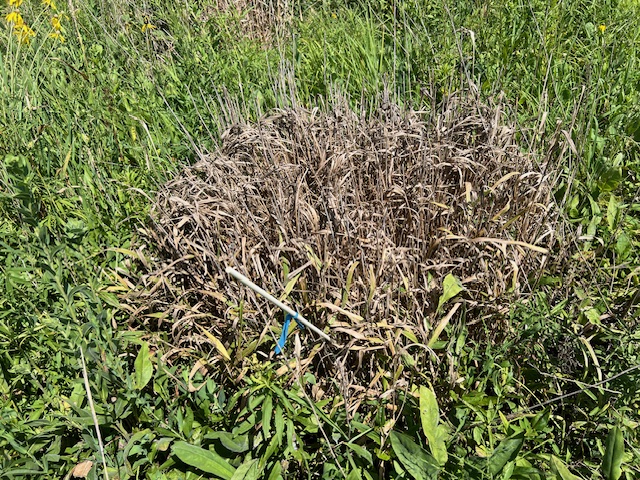
But then again. I try a second application. The next day, May 29, 2025, I did make a new clethodim mix and re-sprayed the same 8 patches of reed canary to see what happens. Below are two photos of those patches about six weeks later on July 19, 2025. They are clearly top killed. I was surprised. Top killed but are the roots dead? I will leave the fiberglass rods in them and check back in May of 2026 and report back.

I encourage managers to test out their treatments. It was not hard. It was also not rigorous enough to publish a scientific paper or get a degree.


 grassland restoration network
Bill, did you happen to check on these clumps last spring after the initial spraying? I would be interested to know if they looked top killed last year after the first spraying as well.
I don’t remember checking on them after my spring spraying in 2024. I should have but forgot.
Clethodim is a weak acid herbicide. Same as Poast, Glyphosate, 2, 4-D, and various others. One implication of this is that if you have hard water…the minerals in the water can bind to the herbicide and render it less potent, less effective. AMS (ammonium sulfate) should counteract the effects of hard water.
Mixing order/procedure is really important. Water, AMS, then herbicide/dye/surfactant. Our crew has sometimes forgotten this and adds AMS at the end of the process…by which point the hard water and weak acid herbicides have already interacted.
I agree you want AMS in the water, and it is the first thing to add. It could be I made an error. In the post I state that AMS was added, but I wrote the post a year after the treatment which makes me consider that maybe I made a mistake in my mix. I will report back next spring.