By Bill Kleiman
This is an update on an earlier post.
It is good to do simple monitoring or testing to see if a weed treatment you are using works. I will describe the simple way I tested a herbicide treatment. I retreated this patch and found it did work. Read on.
On May 30, 2024 I sprayed eight distinct mature patches of reed canary grass (Phalaris arundinacea) with clethodim herbicide. Each patch of reed canary was about six feet in diameter, the plants 3 to 4 foot tall, and in flower. So their big growth spurt was done for the season.
As I have read, it is recommended to apply clethodim when the plants have emerged several inches and are actively growing. I have tested this and it works. I was hoping for a longer application window by spraying more mature plants. Would that work?
The herbicide mix was 1.5% Intensity (clethodim), ammonium sulfate crystals (three cups added to a 50 gallon mix), and a half ounce per gallon of methylated seed oil. Maybe I needed more AMS and MSO.
In each of the eight patches I drove in a four foot tall fiberglass rod. The rod could withstand a fire and be noticeable a year later.
I sprayed the patches so the milky herbicide mix was starting to drip off.
I recorded this information into Field Maps.
I made a calendar reminder for a year later to look at the results.
Yesterday I looked, May 28 2025, and all eight patches looked very healthy. The clethodim did not control reed canary grass that was applied when the plants were mature.

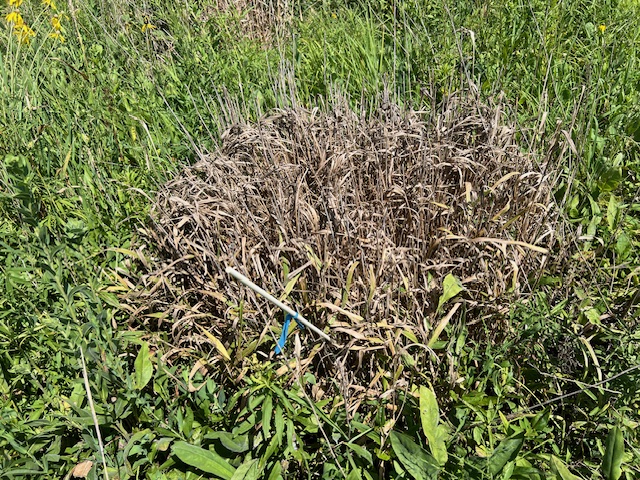
But then again. I try a second application. The next day, May 29, 2025, I did make a new clethodim mix and re-sprayed the same 8 patches of reed canary to see what happens. Below are two photos of those patches about six weeks later on July 19, 2025. They are clearly top killed. I was surprised. Top killed but are the roots dead? I will leave the fiberglass rods in them and check back in May of 2026 and report back.

I encourage managers to test out their treatments. It was not hard. It was also not rigorous enough to publish a scientific paper or get a degree.


 grassland restoration network
Out of curiosity, was it burned the same Spring that Clethodim was applied later?
The unit was burned spring of 2024, so I was treating RCG in a unit that was blackened a few months previously.
Interesting! That management seems to follow the sedge meadow restoration that was successful in combating RCG. Cited here: https://tallgrassprairiecenter.org/sites/default/files/inline-files/IRVM%20PDFs/Tom%20Rosburg%20Sedge%20Meadow%20Renovation%202019-2023.pdf
Have you tried cutting/trimming RCG at this time of year, allow a little regrowth, and then clethodim application?
Geoff Mouming
Project Manager
ISA Certified Arborist #IW-0026A
Eocene Environmental Group
315 West Cherry Street Suite 4, North Liberty, Iowa 52317
MOBILE 319.288.8224 OFFICE 515-473.6256
EMAIL gmouming@eocene.com
eocene.comhttp://eocene.com/
I have not tested that but I encourage others to test it and report out. Or if you have repeated experience with that method report that out to us.
I gave up on Clethodim about 7 years ago for two reasons. 1. I called the manufacturer and got confirmation from them that it only kills RCG down to the point of the growth. Then it re-sprouts and comes back. Clethodim was designed for getting Corn out of the Soybeans is my understanding. Clethodim seemed to keep RCG from going to seed however but does not kill it. Annen’s papers about 10 years ago refers to a dormant lateral bud that re sprouts even if you kill the main one. This means spraying at least twice. Clethodim is probably best for high quality areas to knock it back and try to have the quality species crowd it out in non wet areas. Once I learned it did not kill it I did not want to keep spraying it again and again and Clethodim is expensive. The herbicide companies would do the world a favor by creating a grass killer that can be used in water!
2. Clethodim can only be used in dry areas. Most RCG is in wetter areas so that was a deal breaker right away especially with wetlands and standing water. Big patches can be sprayed after Oct 15th when the carb cycle is going down as it kills it more effectively in fall while the majority of other plants are dormant as RCG stays green late into the season. Spray Rodeo when everything else is dormant! Once big areas are hit then the real work starts with a backpack sprayer and cutting off the seed heads. You will need to hit it at least twice even with Rodeo.
I have had good success with over 50 acres but still go after flare ups every year. It’s like fighting crime as you won’t get all of it but can get it to acceptable levels. So far I have not found a magic wand for this formidable opponent. I would be happy to show anyone my results. It won’t happen in just two years! You have to stay after it like a dog with a bone. John Ayres 312-968-1052
Interesting results! My best control (western Washington) over the past two years of treatment (on very established and extensive patches) has come in mid-spring, right before flowering of the RCG, with 1% clethodim and 1% crop oil. I treated any resprouts at a similar growth stage in the fall. I have been very pleased with how the native sedges and bulrushes are now dominating this time of year, where in the past, this time of year pre-treatment they were in the understory of flowering RCG. My fall treatments have not shown any success unfortunately.
Because my experience with clethodim has resulted in a fairly small time window for treatment success (that can be messed up by spring rains), I’m going to only focus on a few high quality wetland areas for clethodim, and treat the remaining RCG acres with aquaneat, hoping to encourage the native sedges and rushes to recolonize areas treated with a non-selective herbicide.
Formidable foe indeed!