By Bill Kleiman
SHRUBS:
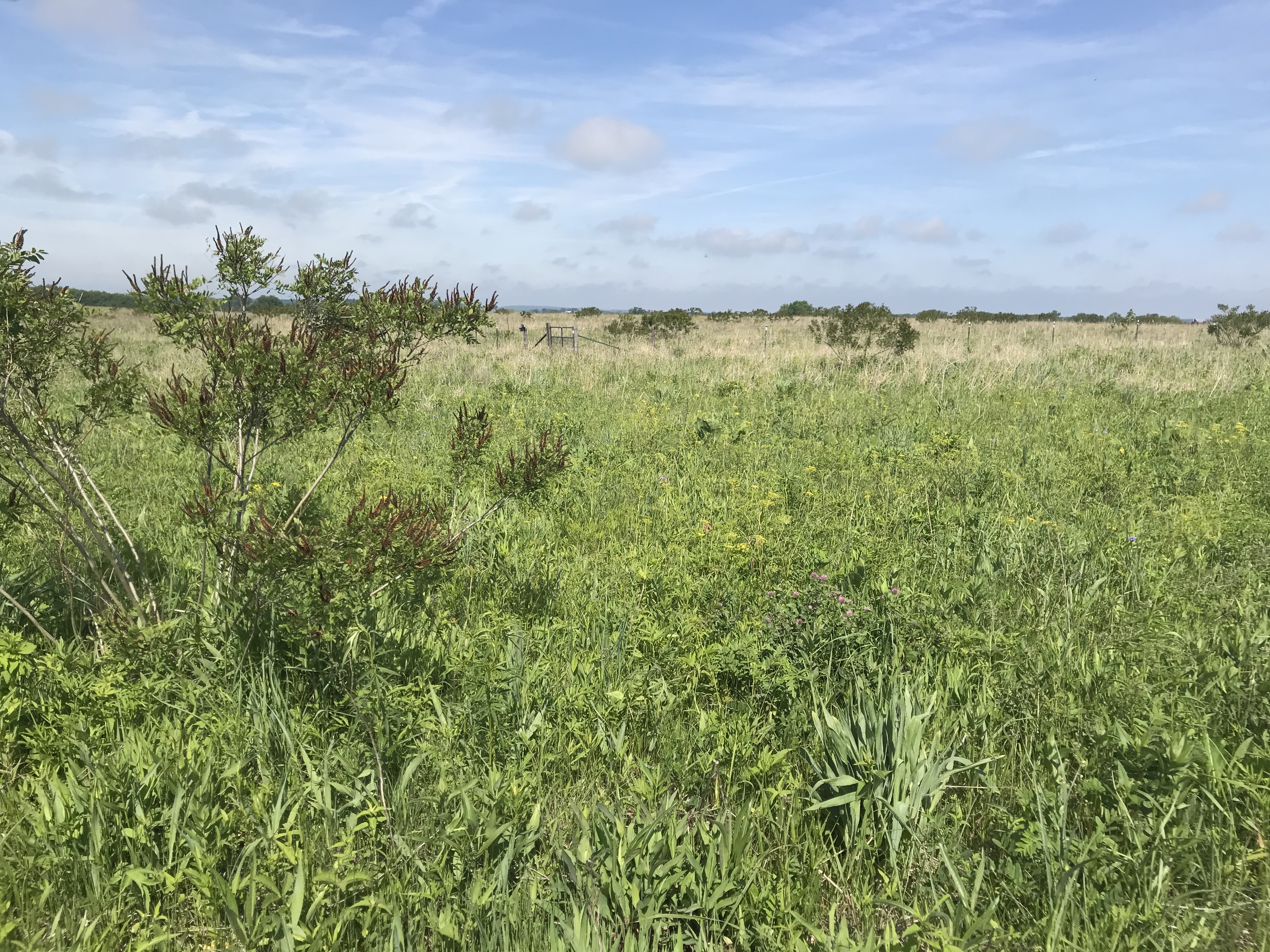
We want some of our prairies free of shrubs for various birds and other wildlife that want prairie without shrubs everywhere. We will end up with lots of shrublands in the future as there is a lot of seed source of shrubs around in our modern landscape. For now, we can push back some shrubs to have open grasslands in places at Nachusa Grasslands. For example, Amorpha bush, Amorpha fruticosa has been shown to be aggressive here. For now, we don’t add it to our mixes. This shrub took over a chunk of the Thelma Carpenter Prairie SW planting #59. Crazy thick. That is not a prairie but a shrubland on top of the some of the highest ground in Ogle County! This shrub is “supposed” to grow along creeks. I know we want some shrubs here and there. Generally, we would love to see more hazelnut thickets, some American plum groves. But some shrubs can take over. Like smooth sumac and wafer ash, which we don’t plant as they are abundant with no help from us.
SEED MIX PROPORTIONS:
As volunteer steward master planter Jay Stacy says, getting the proportions right in the seed mixes is a challenge. I have not been as finicky as Jay but I agree that some species can be overdone. We tend to want to plant a lot of seed and a lot of diversity per acre, which is generally good. But several species can come on abundantly.
Examples:
Big bluestem and Sorghastrum nutans. Good to have a bit, but not too much. We do need graminoids in the seed mixes. Some of our plantings look like flower gardens with few grasses. But we now add a lot more northern dropseed thanks to our one acre dropseed garden. We add lots of little bluestem, side oats grama, Kalm’s brome, the little Panicums and other less common grasses.
Black eyed susan can be too abundant: Don’t throw in a ton of a species to get the weights up. For instance, see MRCP Hill Planting #134. On its second year it looks like black eyed susan is all we planted. They planted 37 pounds of Rudbeckia hirta on 18 acres, so about 2 pounds per acre. Looks like a quarter of that would have been enough. I would like to think the thick cover of this one species will not inhibit the other native seeds, but who knows?
Yellow coneflower, Rattibida pinnata: It seems that every seed planted of yellow coneflower will establish, so go light on this one. I remember the planting along Stonebarn Road of HLP, on the west third. The yellow coneflower was crazy thick for at least several years. Then it tamed down and now seems normal. Have a look.
Bee balm, Monarda fistulosa: Similar to yellow coneflower.
Showy tick trefoil, Desmodium canadense: This becomes very abundant and all those seeds stick to your clothing making you avoid the area and likely avoid caring for the area. I would not add this to your mixes. I don’t find Illinois tick trefoil becoming abundant.
Canada milkvetch, Astragalus canadensis: This was not on the property before a nursery purchase long ago at Nachusa. I hesitate to add a species that was not here. But we have done it with this and that, and have been burned a few times with invasive plants sold to us instead of what we ordered. https://grasslandrestorationnetwork.org/2021/09/09/beware-what-seed-you-buy/
I think prairie dock was not here on our remnants. Back then, in an early planting they rationalized adding dock as almost all of our mesic soils were plowed up long ago. This makes sense to me, but beware as seeds are powerful.
EQUIPMENT:
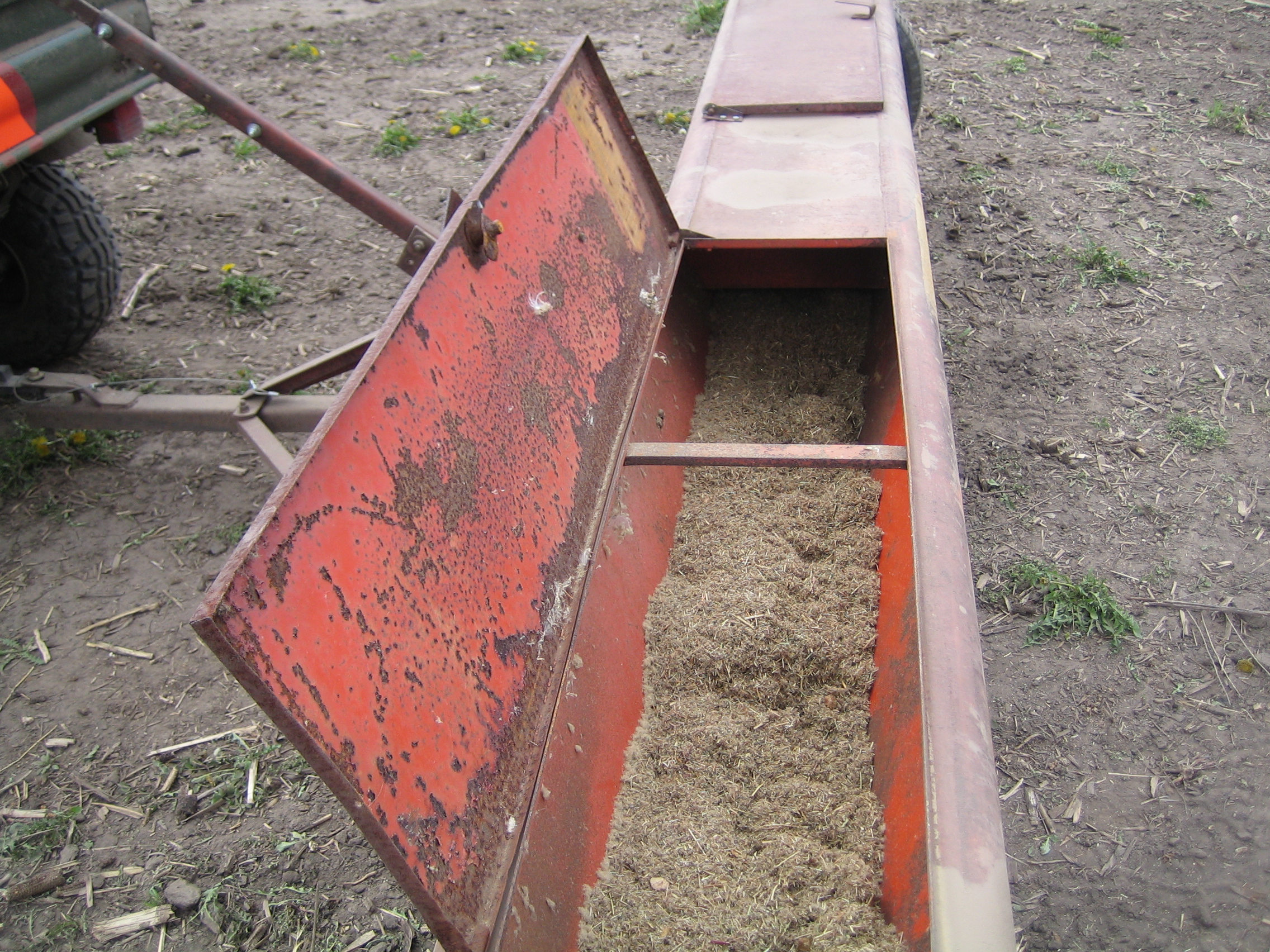
Add more seed when the pull behind seed hoppers is about half full. Due to chaff and stems. We have planting 135 where I see several “empty” lines in this planting, which is on its second year. A crew member may have been pulling a seeder behind their truck that was not planting much seed. The seed mixes have lots of chaff and chopped stems. If you open the seed hopper and see a quarter full hopper, you may think you have a quarter of the seed left. Nope, that is just stems and chaff rotating about in there. The seed fell out already.
Or perhaps the empty strips were the crew being too casual on their driving paths and simply missed sections. We often use an orange cone or two to help mark the driving path. We move the cones on each pass to see where we left off. We sometimes have a person on foot who moves the orange cones to help keep the seeders going in straight lines.
Don’t run out of seed. We tend to seed a field twice. First time we go say east west. Second seeding done right after this in north south. This helps eliminate missed spots. If a field needs say 10 barrels of seed, save about half of those barrels for the second round of seeding. We have seen people put all their seed in hoppers and run out before they got half of the first seeding done.
Seeder openings. Similar to above, don’t run the seeder openings on the bottom of a seeder at full open. You may plant the seed too fast and run out early. Start with modest openings and watch and adjust. Spray label glue on a piece of 8 by 11 inch paper and place the sticky paper sheet in front of where you are seeding and then look at the sheet. You will see the seeds on the paper that are impossible to see on the soil. Seeding the snow is nice because you can see the seed on the snow.
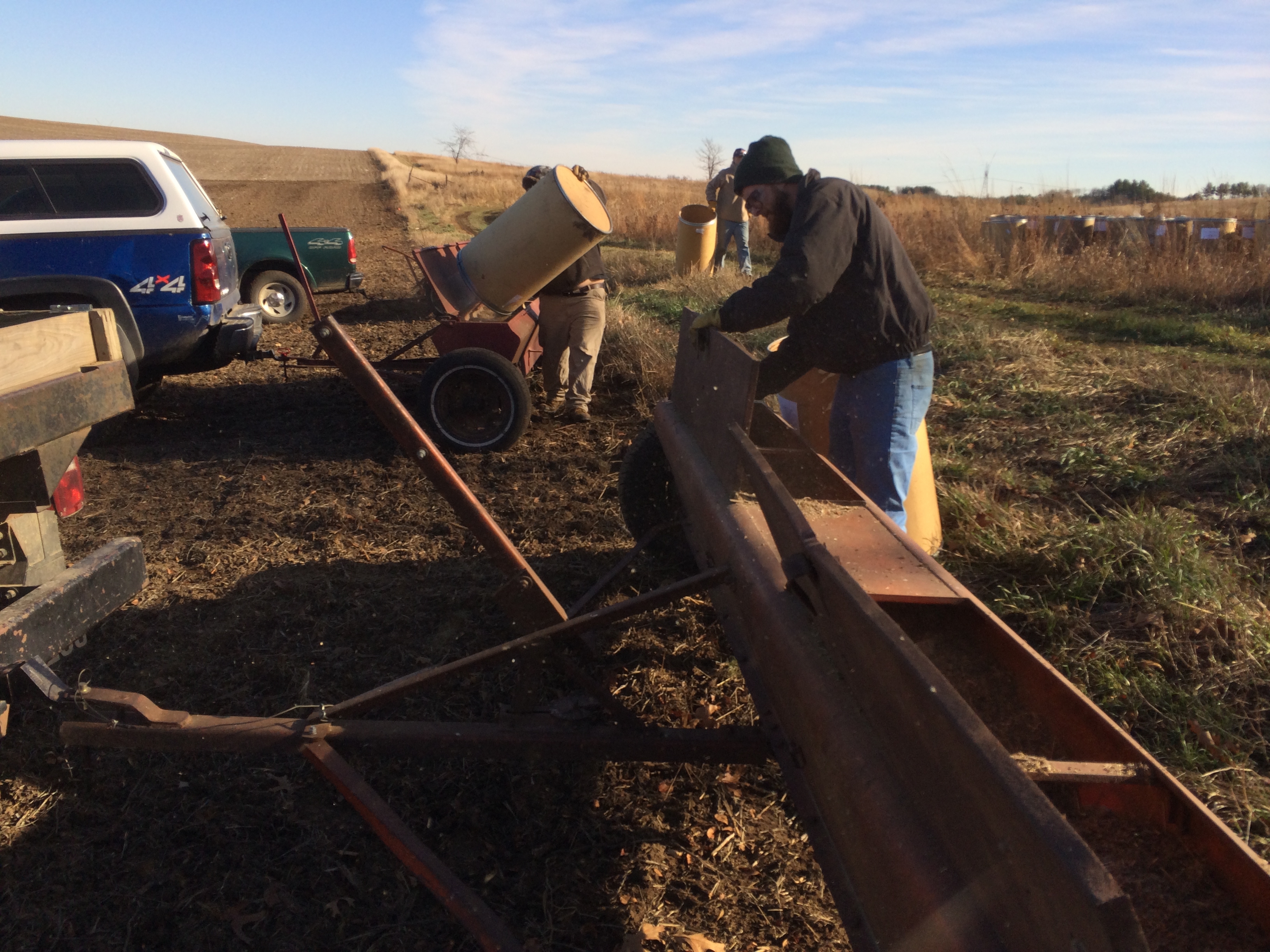
Don’t reverse with pull behind seeders. They jack-knife very easily and will dent the vehicle you are using. Get a spotter. Or take it off the hitch and turn it manually.
Grease seeders every day.
Keep hopper lids secure and not bouncing open as you bounce over the field. The hinges will break.
Don’t be too fussy about where one mix starts and another ends, say the dry mix vs the dry mesic mix. Those boundaries are hard to define. Ponder your soils, put some flags out and go for it.
Bring a portable air tank with you as tires can go flat.
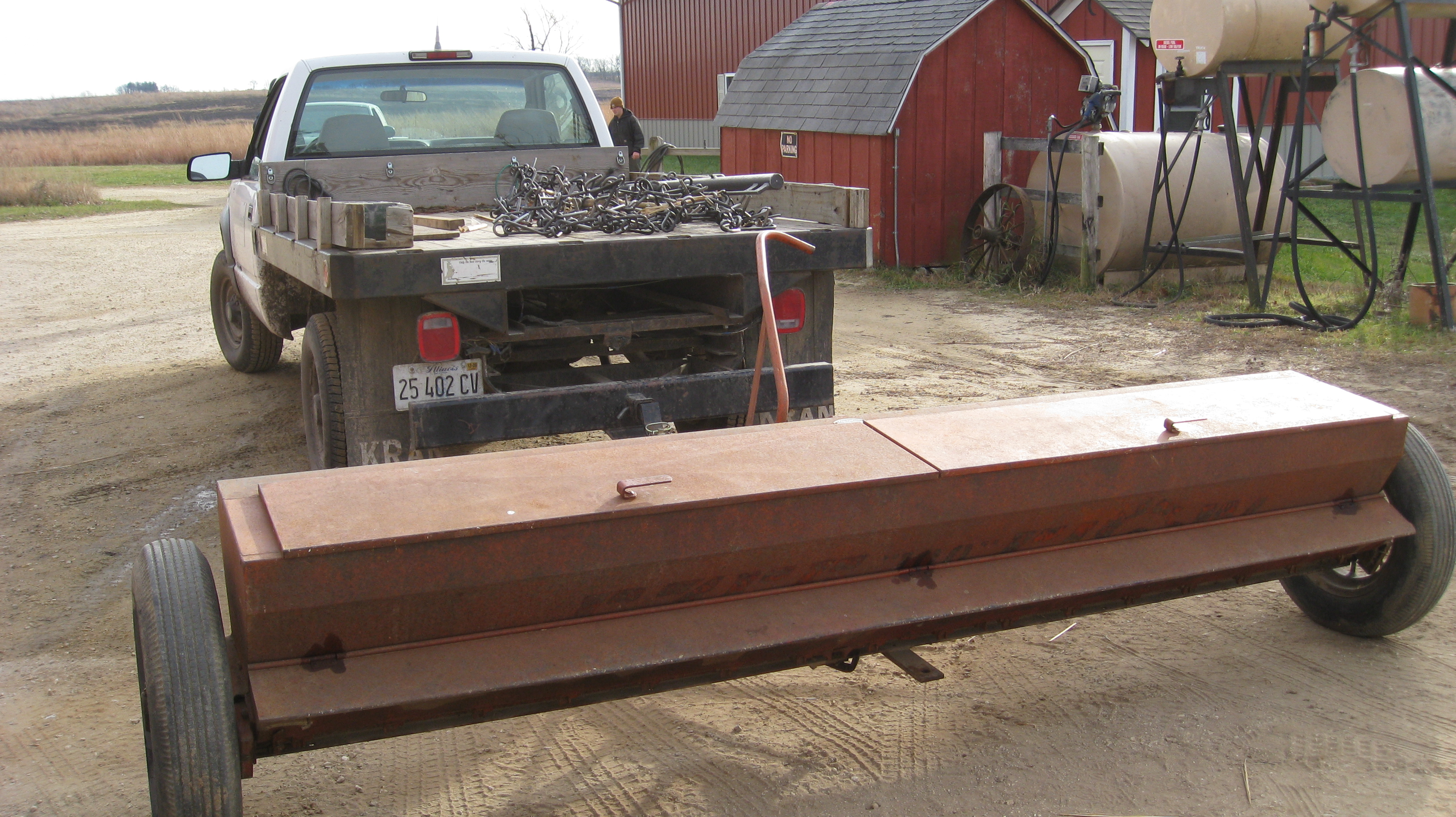
Seeders: Don’t drive fast, like on a road, with the mixer paddles engaged to the wheels. You may damage seeder. Go slow. Go easy. Or trailer it to the site.
We use an enclosed livestock trailer to haul big loads of seed to keep them dry and not seeding the roadsides.
Rye buffer or no: I like to seed right up to the right of way. Sometimes we seed ten yards of Canada rye buffer with the mix. The rye perhaps keep the right-of-way grass from moving in quickly. I don’t know if this works but likely it does not hurt, but put the diverse seed mix to the ROW edge.

For a few years we used contracted “air seeders” that blew seed onto the ground. We concluded that we like to keep our seed on our site. The contractors wanted the seed mix delivered to their shop, and their conveyor to fill the seeder was dropping our precious seed on their shop floor into a kind of pit. It is too hard to get that seed to see any wasted. When seeding with this machine we had a clog a few times from our stems and chaff and it was hard to know where it missed seeding the field.
FIELD PREP
We tend to mow corn stubble to make driving over it easy. We used to burn the corn stubble but we seem to get good establishment without burning. Maybe the corn stubble helps retain moisture in dry summer days for those seedlings. Maybe the stubble helps keep rain from washing our seeds to the bottom of the hill.
We tend to glyphosate waterways at least once to help our seed establish in the waterways.
We tend to disable field drainage tiles and bulldoze weird fencerows or overly sculped waterways before planting.
End


 grassland restoration network
Interesting comment on the early successional species like Gray headed coneflower, bergamot, and Black eyed susan. I would encourage prairie reconstructions to include those species because they are early successional species-yes they germinate and establish well. They are place holders for some of the more conservative species that come later in a reconstructions life. I know that people see a reconstruction at year 3-4 and its all yellow with these species, but if a proper mix of other species are added in, then in the end a good diverse prairie will be in place.
These seeds are in the mix but the amounts of each should be considered
Some of the better start from scratch plantings I’ve seen included these, but also mowed them in years 2 and 3 to prevent them from shade-smothering seedlings/small plants of more conservative species. The seeds of most conservative species have only transient viability once broadcast (transient seed banks, there are some exceptions), so they are mostly there as vegetative plants early–just taking longer to become conspicuous. Those faster species all establish well from small amounts of seed.
In WI the top three grasses from Curtis on a meter square frequency basis on mesic prairie were 1) porcupine grass, 2) Leiberg’s panic grass, 3) Prairie dropseed…and little bluestem was still 3/4 as frequent as big bluestem on wet-mesic prairie (big bluestem was present on most prairies of most types, but atop the hierarchy only on wet-mesic, and only nominally). Early work/descriptions of composition on prairie in Iowa by Hayden and NE OK to the E Dakotas, W MN south to W Missouri from Weaver are similar. The growth form (where growing points are, sizes of reservoirs of belowground buds, rhizome lengths, and height) and phenology (in part due to physiology, but prairie dropseed is an early warm season grass) of the “true prairie” grasses is profoundly different from big bluestem and Indiangrass, with profound impacts for how prairies develop, respond to management (fire intensity, seasonality, thatch accumulation), and function. Big bluestem/Indiangrass dominated prairie outside of alluvial bottomlands, ravines, and old glacial lakebeds is in many instances something new.
Thank you so much, all the time, for sharing your knowledge. This time I need some clarity:
“We tend to glyphosate waterways at least once to help our seed establish in the waterways.”
Are the “waterways” the manipulated earth that served in irrigation? Or are they the result of erosion from past irrigation systems? Or are they the riparian-ish areas along natural drainage, within the acreage, that leads to larger streams? Or are the waterways something completely different here?
I appreciate you helping me understand. I learn so much from following you. LOVE!! ~ Laura
By Waterways I mean the sculpted with a dozer and all exotic vegetation in ag fields. The glyphosate knocks this sod back. A few roundups does it better.
That tip about spraying label glue on paper to calibrate the sprayer is really great! We’ve used tarps, barrel lids, and other things but the seed is prone to blow or move around, making it harder to estimate how many seeds/foot we’re putting down. Thanks!
You can take photos of the paper too and then gawk at them in your leisure. Exciting photography